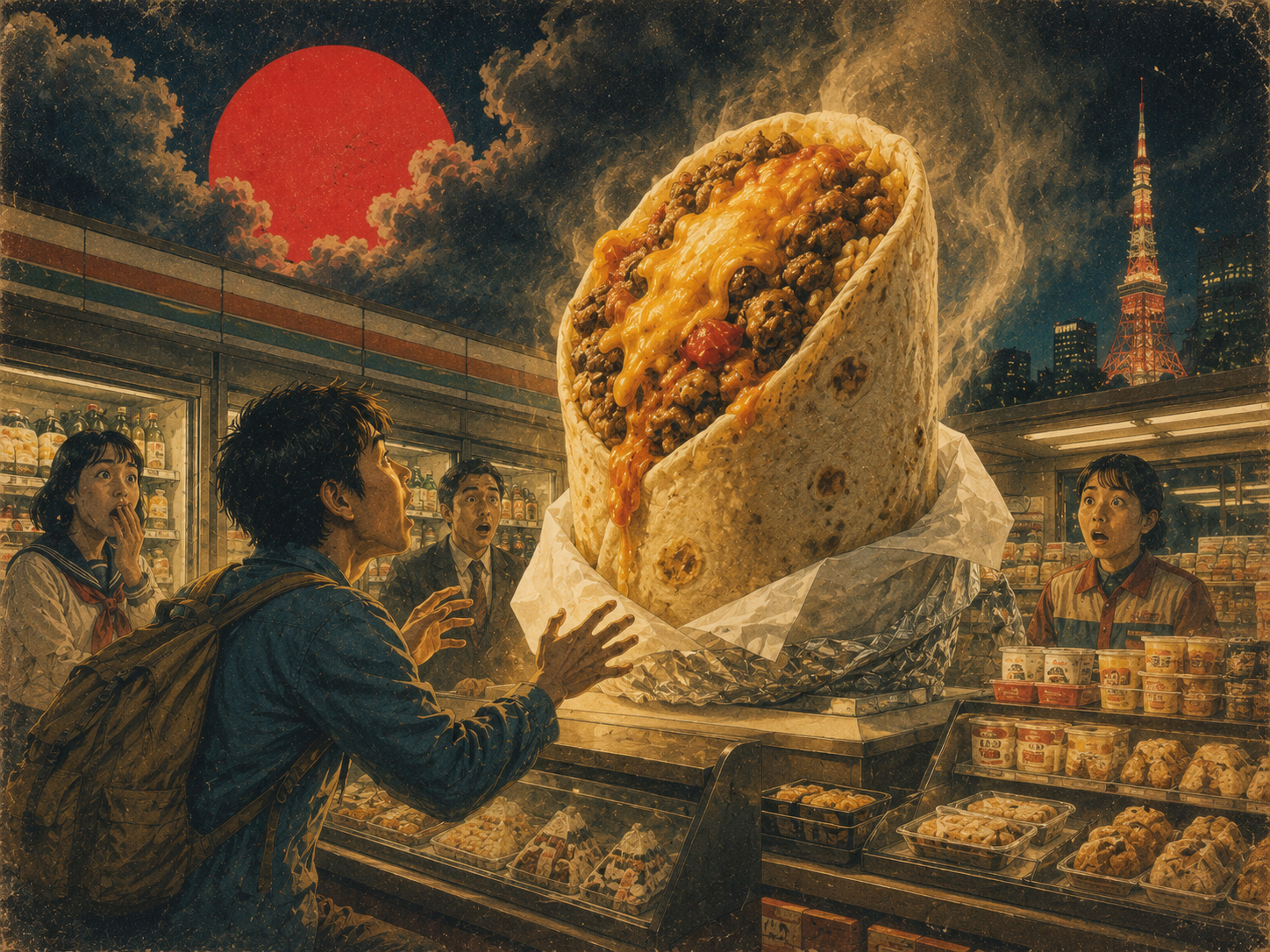
One minute later, the cheese melts inside the package
Cold from the refrigerator, the burrito is a flat rectangle. Open one edge of the wrapper and microwave it for about one minute at 500 watts. The paper holder protects the hand as the tortilla softens and the salsa, meat and cheese heat together.
On June 10, 2026, Seven-Eleven Japan launched the Taco Meat Salsa Cheese Burrito alongside a Double Sausage Smoky BBQ Burrito. The taco version costs ¥288 before tax, or ¥311.04 including tax.
Reviews from Pouch and SoraNews24 highlighted its spice, melted cheese and easy handling. Seven-Eleven has not published sales proving a national craze, so “cult hit” should not be confused with a measured mass phenomenon. The cult quality lies in repeated recommendations: a modest refrigerated rectangle that reviewers tell travelers and regular customers not to overlook.
The “new discovery” is 43 years old
The 2026 flavor is new; the category is not. Seven-Eleven Japan has sold burritos since 1983.
Its official anniversary archive lists three originals: Ham & Cheese, Sloppy Joe and Beef & Bean. The company described the burrito as “born in Mexico, raised in America,” then converted it into a Japanese one-hand food.
The Ham & Cheese version omitted chile sauce to suit customers unfamiliar with heat. Demand exceeded expectations, with some stores selling 100 per day. A once-unfamiliar foreign food name entered ordinary convenience-store vocabulary.
Is the burrito really Mexican?
The answer changes by region. Northern Mexico has a long wheat-tortilla tradition and burritos filled with meat or beans. In central and southern Mexico, corn tortillas remain more dominant, and the giant rice-bean-cheese burrito associated with the United States is less representative.
In the 20th-century American Southwest and California, the burrito became larger and more elaborate, absorbing rice, beans, cheese, sour cream and salsa as a Mexican-American or Tex-Mex meal.
Japan therefore imported a food that had already crossed and changed at a border. The convenience-store version became a third form: smaller, refrigerated, microwave-ready and designed as a snack.
A taco and a burrito are not the same thing
A taco usually places filling on a smaller tortilla that is folded rather than fully sealed. A burrito encloses filling inside a larger wheat tortilla.
“Taco meat” in the 2026 product describes flavor rather than structure: seasoned ground meat and salsa associated with tacos placed inside a burrito form.
Japanese product development often uses cuisine names as flavor signals—“Napolitan flavor,” “yakisoba flavor,” “taco flavor”—rather than strict definitions of dish shape.
| Element | Northern Mexican burrito | American burrito | Seven-Eleven burrito |
|---|---|---|---|
| Tortilla | Wheat, often simple | Large wheat tortilla | Small, soft and microwave-engineered |
| Filling | Meat, beans or a limited combination | Rice, beans, meat, cheese, salsa and more | Ham, cheese, mentaiko, taco meat and rotating flavors |
| Size | Varies by region | Often a complete large meal | Snack or light meal |
| Setting | Home, street stall or restaurant | Restaurant and fast food | Convenience store, office, car or home |
| Core value | Regional daily food | Fullness, customization, takeaway | Consistency, one-hand eating, fast heating |
Why it worked in 1983 Japan
In the early 1980s, Japanese convenience stores were evolving from late-night mini-markets into product-development companies. Tuna-mayonnaise rice balls also appeared in 1983, inserting a new filling into a familiar structure.
The burrito fit the moment. It needed no chopsticks or plate. It could be eaten in a car, at work or during a short break. Its sealed tortilla contained filling more securely than many sandwiches.
The spread of microwave ovens was equally important. Store heating transformed a refrigerated item into hot melted cheese within seconds. The checkout counter became a miniature kitchen.
One-hand food is an urban technology
Handheld food is not merely a simplified meal. It is food engineered around commuting, overtime, driving and short breaks.
Rice balls, steamed buns, sandwiches, fried chicken and burritos come from different cultures but solve the same convenience-store problem: quick purchase, safe heating, clean handling and minimal waste.
The tortilla is an edible container. It holds steam and filling, then disappears with the meal.
A corporate product shaped the Japanese name
In Japan, the spelling buritō became closely associated with the Seven-Eleven product. Ito Ham participated in manufacturing and trademark activity from the 1983 launch.
Burīto can be closer to Spanish pronunciation, but buritō became the widely recognized Japanese form. A corporate product helped standardize the name of a foreign dish.
Food crosses borders with pronunciation packaged beside it.
Ham and cheese became the Japanese baseline
Ham & Cheese became the enduring entry point. Instead of beginning with beans or chile, Seven-Eleven used familiar processed meat, dairy and wheat.
This can be criticized as dilution. It can also be understood as sequencing: first teach consumers the tortilla format through familiar flavor, then expand the range.
Customers who learned the texture through Ham & Cheese later accepted taco meat, cheese dakgalbi, mentaiko potato, carbonara and other hybrids.
The burrito became Japanese more than once
Over the decades Seven-Eleven released Bacon & Corn Potage Cheese, Mentaiko Potato Cheese, Cheese Dakgalbi, Extra Meat Taco, Double Ham & Cheese and many other versions.
Korean food, Japanese fish roe, Western sauces and American barbecue all entered the same wrap. The burrito became a delivery architecture rather than a fixed recipe.
Like Japanese curry, ramen or Napolitan spaghetti, an imported form developed a domestic genealogy.
Why the 2026 flavor is marketed for summer
Seven-Eleven positioned the taco-meat version as a hot and spicy summer item. Chile heat, tomato acidity, meat and cheese create a forceful flavor when appetite declines in hot weather.
The package uses bright colors, folk-pattern suggestions and sombrero-like imagery to communicate “Mexican” instantly.
Such symbols can reduce a complex culture to hats, cactus and chile. Greater popularity creates a stronger responsibility to explain the food beyond shorthand.
The hardest problem is texture, not authenticity
A refrigerated burrito is manufactured, transported, displayed and reheated. It is not eaten moments after assembly.
The tortilla must not dry, split or become gummy. Filling cannot leak when heated. Cheese must melt without separating into oil.
Convenience-store flavor is food engineering across time, not merely a recipe.
The paper holder is part of the meal
A heated burrito can burn the hand. Seven-Eleven’s paper tray allows the customer to hold it while partially opening the wrapper.
Packaging controls where to grip, how much to expose and whether sauce escapes.
Cult affection often comes from this complete frictionless experience: one person can buy, heat and eat it without making a mess.
- Identify the region and migrant culture behind the original dish.
- Notice how heat, sweetness, smell and portion size were changed.
- Examine how refrigeration and microwaving affect texture.
- Ask whether names and packaging represent the culture accurately.
- Consider what convenience removes and what new food form it creates.
- Avoid treating one version of the “original” as frozen and universal.
Why Mexican food remained less mainstream in Japan
Chinese, Italian, French, Indian curry and Korean food built broad restaurant networks in Japan. Mexican food remained more concentrated in major cities and areas near U.S. bases.
Migration, supply chains and chain investment matter. Specialized corn, dried chile, herbs, beans and cheeses were once harder to source consistently.
Japan also already associated “spicy foreign food” with Korean, Sichuan, Thai and Indian cuisines. Convenience-store burritos spread the name nationally before Mexican restaurants became common.
Okinawa’s taco rice chose the opposite translation
Taco rice emerged near U.S. military bases in Okinawa during the 1980s, placing taco-seasoned meat, cheese, lettuce and tomato over rice.
Replacing the tortilla with rice made the meal inexpensive, substantial and immediately legible in Japan. It is now a modern Okinawan regional food.
Taco rice kept the filling and changed the vessel. Seven-Eleven’s burrito kept the vessel and repeatedly changed the filling.
The convenience store is a translator of world cuisine
Japanese convenience stores sell Napolitan, doria, bibimbap, gapao, butter chicken curry, pho and lu rou fan. Few are complete reproductions of restaurant originals.
Each is redesigned for one-person portions, microwave heating, refrigerated shelves, national factories, price targets and disposable utensils.
This gives consumers an entrance to other cuisines, but also creates a narrow first impression. Convenience chains have cultural influence as well as commercial reach.
Seven-Eleven itself traveled from America to Japan and back
7-Eleven began in the United States, entered Japan through licensing, and was transformed through Japanese logistics and prepared-food development. The Japanese parent later took control of the American company.
The burrito followed a similar loop: northern Mexico to the United States, the United States to Japan, and then back into English-language travel culture as something people are told to try at a Japanese 7-Eleven.
This is circulation, not one-way importation.
Why travelers obsess over Japanese convenience food
Japanese convenience stores offer low prices, cleanliness, visual packaging, consistent quality and late-night access. They are easy to use without fluent Japanese.
After egg sandwiches, rice balls, fried chicken and desserts, the burrito offers a second layer of novelty: eating a foreign-derived food through a highly Japanese retail system.
The familiar 7-Eleven logo also sharpens the contrast with food expectations in other countries.
A cult hit is not only a sales statistic
A cult product may not be the chain’s largest seller. It is something informed fans recommend strongly, seek out, compare and worry will disappear.
Burritos sit quietly in the refrigerated case and stock varies by store. Discovery requires a small search.
Limited flavors disappear quickly. Scarcity turns satisfied customers into unpaid campaigners.
Where cultural respect belongs
Dismissing a Japanese burrito as “inauthentic” ignores the long history of food changing through migration. Using Mexican imagery without acknowledging origin is also insufficient.
A product can explain northern Mexico’s wheat-tortilla culture, U.S. development and the difference between tacos and burritos in a few lines.
Respect does not require freezing a recipe. It requires honesty about what was received, where it came from and how it changed.
A 43-year history heated in one minute
The 2026 Taco Meat Salsa Cheese version appears more Mexican than the mild 1983 Ham & Cheese original.
What connects them is the convenience-store system: one hand, one minute, reliable heat and consistent texture.
The Japanese burrito is not a substitute for a burrito elsewhere. It is a distinct convenience food produced by movement among Mexico, the United States and Japan.
Open the wrapper, wait one minute and hold the paper tray. The object inside is more than a spicy snack. It is 43 years of culinary translation rolled into a warm rectangle.
Sources and further reading
- Seven-Eleven Japan, June 10, 2026: two new burritos, release date, price and ingredients.
- Seven-Eleven 50th Anniversary Archive: the three 1983 flavors, stores selling 100 daily and Japanese flavor adaptation.
- Seven-Eleven Japan, 2014: 30th-anniversary history.
- Seven-Eleven Japan, 2018: 35th anniversary and expanding flavor range.
- Pouch, June 30, 2026: tasting review, microwave instructions, heat and texture.
- SoraNews24, July 2, 2026: English-language review and traveler attention.
- UNESCO, Traditional Mexican Cuisine: maize, beans, chile and community food systems.
- Seven-Eleven Japan, innovation history: convenience-food development and the 1983 burrito.