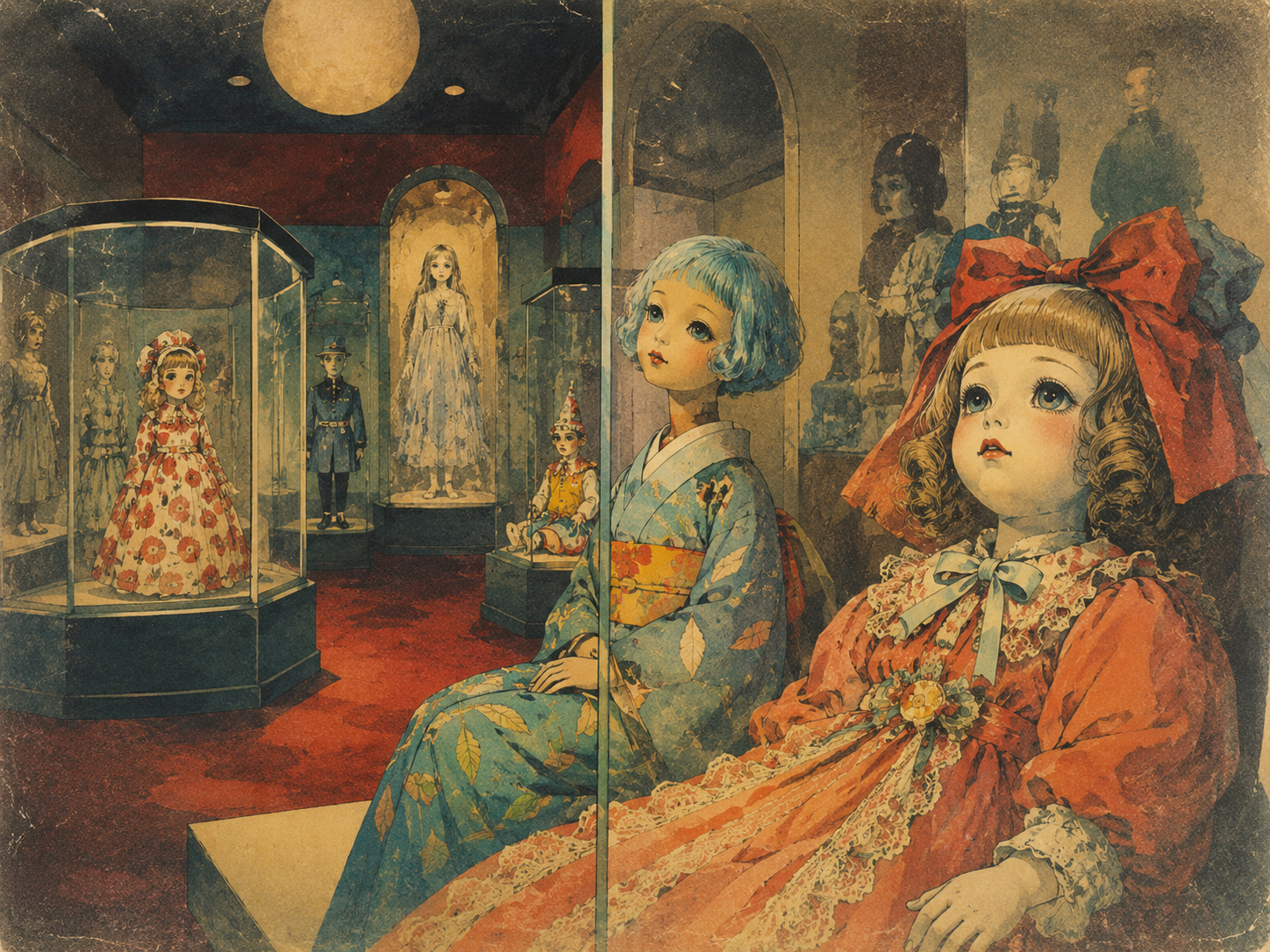
A summer museum filled with doll power
Behind one glass case stands a human form tied from straw. Another contains a red cow whose head nods softly. White cloth guardian figures lie in stillness, dog-shaped boxes wait in pairs, and masks hover between smile and threat. They are dolls, but few were created only for play.
Iwatsuki Ningyo Museum’s exhibition “Magical Doll World: Slightly Strange, Funny and Mysterious Dolls” runs from July 18 through September 6, 2026. Standard hours are 9:00 a.m. to 5:00 p.m. The museum closes Mondays, except July 20, and remains open until 8:00 p.m. for night-museum events on August 22 and 23.
Major exhibits include straw dolls, Aizu papier-mâché akabeko, amagatsu and hōko guardian dolls, Saga masks, dog-shaped inubako boxes and Utagawa Kuniyoshi’s print “I Want Fine Weather.” Children can make masks, join festival activities and use a worksheet for free elementary-school admission.
What does “magical” mean here?
The magic is not stage illusion or fantasy spellcasting. It is the power people entrusted to objects: keeping disease away, protecting a child, absorbing misfortune, guarding marriage and childbirth, or requesting rain and sunshine.
The modern Japanese word ningyō means doll, but older human-shaped ritual objects are often called hitogata. Such figures could receive pollution, guilt, illness or danger in place of a person.
That function prevents the doll from becoming merely cute. An object able to protect must also touch danger. An object that receives wishes can seem to know secrets.
Straw figures were not made only for curses
Modern horror associates straw dolls with nails and curse rituals. Yet tying straw into human form belongs to a much wider folklore.
Rice straw was abundant and used for roofs, rope, sandals, bags, livestock feed and ritual objects. It could be shaped quickly, burned, floated away or returned to soil—ideal for a temporary substitute carrying misfortune.
Large straw figures guarded village boundaries from epidemic disease. Others protected fields or were burned after festivals. Protective and hostile figures share the same basic mechanism: force is transferred into a substitute body.
Amagatsu and hōko: the baby’s second body
Amagatsu dolls use crossed sticks, a small head and hanging clothes. Hōko are soft white-cloth figures with crawling human form.
Families prepared them around childbirth and placed them near a baby’s bed. They functioned like substitutes or twins intended to draw disease and malign influence away from the child.
In an era of high infant mortality and limited medicine, parents had few ways to control danger. The doll turned helpless prayer into a guardian that could remain beside the sleeping child.
Inubako: dog-shaped boundaries for marriage and birth
Inubako are paired lidded containers shaped like dogs. Male and female formed a married couple and served as wedding objects and guardians of childbirth.
Dogs symbolized fertility and relatively safe delivery. The containers could hold cosmetics or incense, but a pair with faces and bodies became more than furniture.
Marriage meant entering a new household; pregnancy and childbirth were dangerous transitions. The inubako acted as small domestic guardian animals.
Akabeko: the red cow that carries illness
Akabeko from Fukushima’s Aizu region is a red papier-mâché cow with a gently bobbing head. Legends connect it with a red ox that helped transport temple timber or protected children during epidemic disease.
Red was widely treated as a color repelling illness, particularly smallpox. Black spots are sometimes interpreted as disease marks transferred onto the toy.
Today akabeko appears as an adorable souvenir. Beneath that cuteness lies fear of infection and childhood death.
Saga masks and yōkai: what happens when a face can be exchanged?
Saga masks from Kyoto depict demons, monkeys, gods and animals. Made from paper, clay or wood, they are hung in homes or used in ritual settings.
A mask can replace a living person’s face directly. The wearer’s identity disappears and another being appears. In festivals that being may be divine, demonic or protective.
Yōkai dolls perform a similar transformation. By shrinking, naming and displaying frightening beings, people make fear observable and manageable.
| Object | Primary function | Source of strangeness |
|---|---|---|
| Straw figure | Misfortune, epidemic, crop protection, curse or boundary defense | Power placed in a fragile body that can be burned or discarded |
| Amagatsu / hōko | Infant substitute, disease protection, bedside guardian | A second child-body placed beside the living one |
| Inubako | Wedding, childbirth, fertility and household protection | Dog, married pair and storage box combined in one object |
| Akabeko | Epidemic protection, health and Aizu regional identity | Cheerful movement carrying memory of disease |
| Saga mask | Protection, festival and embodiment of deity, demon or animal | A face capable of replacing the wearer’s own |
| Hina dolls | Purification, child growth, family rank and seasonal ritual | A motionless court society reconstructed inside the home |
Hina dolls emerged when play met purification
Hina Matsuri did not exist unchanged from antiquity. Purification rites that transferred pollution onto paper or grass figures merged with children’s doll play, producing the Edo-period festival recognizable today.
A hina display creates a reduced court: imperial couple, attendants, musicians, guards, furniture and architecture. It places an idealized social order inside the home.
Although meant to protect growth, folk rules also appeared—such as the claim that leaving dolls out too long delays marriage. A blessing object became a behavioral clock for the household.
Warrior dolls create an image of the strong child
For the Boys’ Festival in May, households displayed warrior dolls, armor, helmets, Kintarō and the demon-repelling Zhong Kui.
Zhong Kui’s fierce eyes, black beard and sword may appear frightening in a child’s room, but the face must be frightening enough to repel worse forces.
Festival dolls do not simply resemble children. They materialize the qualities families hope children will acquire.
Gosho dolls: white, round and overflowing with life
Gosho dolls have polished white skin, large heads and plump limbs. The museum explains that they represented the ideal healthy child.
Before modern medicine, a well-fed child with shining skin signified survival. These dolls circulated among court, aristocratic, daimyo and warrior households as gifts of auspiciousness and fertility.
To modern eyes, the oversized head, fixed smile and extreme whiteness can seem uncanny. Historically, they celebrated life rather than death.
Dolls are difficult to throw away
Many people resist placing an old doll in ordinary trash. It has a face and appears to have watched the family for years.
Temples and shrines conduct doll memorials, allowing owners to offer thanks before ritual disposal. Not every form of doll memorial is an unbroken ancient custom; many expanded in modern times. But they answer a durable emotional need.
The ritual does not prove a literal soul. It provides a social procedure for ending a relationship with an object without abrupt rejection.
Why dolls look frightening at night
In daylight, visitors examine pigment, textiles and craftsmanship. In reduced light, a doll’s gaze becomes more forceful.
The human brain detects faces rapidly. Painted eyes may seem to follow a viewer because their direction never changes. Skin resembles human skin but lacks warmth; posture resembles life but contains no breath.
Japanese roboticist Masahiro Mori proposed the “uncanny valley” in 1970: affinity increases as an artificial figure becomes more humanlike, then sharply collapses when resemblance is very close but imperfect. Dolls can occupy this perceptual border.
The uncanny valley cannot explain everything
Response depends on context. A grandmother’s familiar hina dolls may comfort; the same figures in an abandoned storehouse may frighten.
Horror films train audiences to expect the doll’s head to turn or body to move. That expectation attaches motion to stillness.
For households that live with seasonal dolls and folk toys, the figures measure family time and continuity. Eeriness is not universal.
- Material: how straw, wood, paper, cloth, tōso and gofun became a body.
- Use: play, prayer, substitution, wedding, festival, souvenir or art.
- Body: where eyes, mouth, hair, limbs and posture resemble or depart from humans.
- Time: how fading, cracks and damage changed the figure from its new condition.
- Owner: who made a wish, protected the object and passed it onward.
Was Iwatsuki always Japan’s giant doll center?
A popular story claims craftsmen building Nikkō Tōshōgū settled in Iwatsuki and founded the trade. Museum research presents a more complicated history.
As Hina Matsuri grew in Edo, production developed in Musashi villages such as Kōnosu and Koshigaya. Iwatsuki has evidence of Edo-period doll commerce, but full industrial growth came mainly after the Taishō era.
Craftsmen and wholesalers moved from Tokyo after the Great Kantō Earthquake. Transport, nearby paulownia woodworking, seasonal labor and proximity to the capital combined. During the high-growth era nearly 300 workshops and wholesalers operated in the district.
A face emerges from paulownia sawdust
Iwatsuki’s woodworking produced plentiful paulownia powder. Mixed with wheat-starch paste and molded, this tōso material became important for doll heads and limbs.
After drying, craftsmen applied and polished repeated layers of gofun, a white pigment made from shell. Features were painted and hair inserted.
Many dolls are collective products. Specialists make heads, hands, bodies, costumes, hair and accessories before wholesalers assemble the final figure. One body contains the labor of an entire town.
The museum opened in 2020 for the industry’s future
Iwatsuki Ningyo Museum opened February 22, 2020 as a public specialist museum in one of Japan’s leading production centers.
It preserves craft knowledge while researching the wider history of Japanese dolls. Despite pandemic closure soon after opening, it continued exhibitions on hina, gosho figures, animals, conservation, miniatures and Iwatsuki history.
Low birth rates, smaller homes, simplified festivals and aging craftspeople have reduced the traditional market. The museum expands dolls from products people purchase into cultural objects people study.
Cute and frightening grow from the same features
Large eyes can appear cute until they become too large. White skin can suggest purity until lighting makes it corpse-like. A smile comforts until it never changes.
Dollmaking is the art of adjusting the amount of humanness. Too little becomes symbol or toy; too much becomes portrait. In between, affection and anxiety can coexist.
“Magical Doll World” reveals not only slightly frightening dolls, but the part of the viewer that becomes frightened by them.
Dolls do not move—and that is why wishes can remain with them
People change. Children grow, become ill, leave home and die. The doll stays in one form.
Families bring out the same hina figures each year, rock the same akabeko and pass old inubako onward. Motionless objects wait through human change.
A doll appears to do nothing. Yet it receives illness, waits for growth, watches marriage and announces the season. If the exhibition creates unease, that unease is an entrance into its history. The doll remains between object and person, facing us because that is where generations placed their wishes.
Sources and further reading
- Saitama City, July 6, 2026: dates, works, admission, night museum and related events.
- Iwatsuki Ningyo Museum, “About the Museum”: Iwatsuki’s production history and institutional mission.
- Saitama City historical feature: tōso, gofun and the growth of the industry from late Edo through the Taishō and high-growth eras.
- Iwatsuki Ningyo Museum, “How Dolls Are Made”: division of labor among head, limb, body, costume and accessory specialists.
- Iwatsuki Ningyo Museum, “Gosho Dolls”: healthy children, auspiciousness and fertility symbolism.
- Iwatsuki Ningyo Museum, Hina Festival exhibition: purification rites, doll play and Edo-period formation of the festival.
- Masahiro Mori, “The Uncanny Valley”: the 1970 concept of sharply increased unease when artificial humans become nearly lifelike.
- Shoto Museum of Art, “The Infinite World of Japanese Dolls”: dolls crossing religion, curse, festival, mannequin and contemporary-art categories.