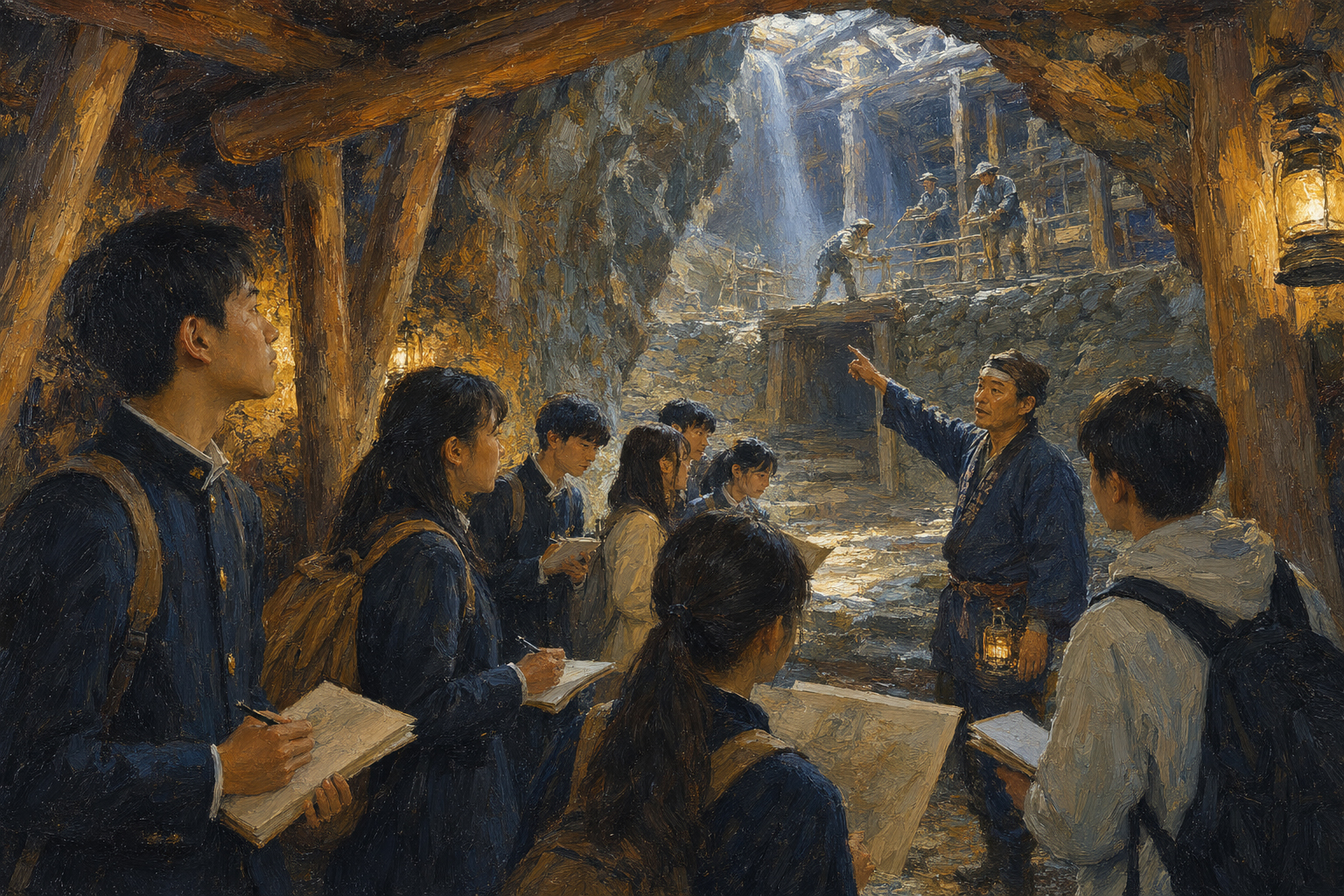
Students Invited to Help Design the Future of Sado’s Gold Mines
Niigata’s three-day field program asks young people to look beyond gold and tourism. Their real assignment is harder: learn what the World Heritage designation protects, face the island’s living problems and propose ways to pass a complicated place to the next generation.
What has been announced
Niigata Prefecture is recruiting 20 students for the second “Come, Become a Sado Supporter!” inquiry project devoted to the Sado Island Gold Mines. The program is open to high-school and upper-secondary students living in Niigata Prefecture, and to university and vocational-school students from inside or outside the prefecture. Applications, including a short report, are due July 27.
The field program runs August 18–20. Participants gather at the Sado Kisen Niigata Port terminal, travel to Sado and study at sites including Kirarium Sado, the Historic Site Sado Gold Mine, Aikawa’s Kyomachi streets, Sasagawa village and the Kaneko Kanzaburo house. They will try traditional river gold panning at Nishimikawa, work in groups with the nonprofit Mirais Works, present on the final day at Ryotsu District Community Center and receive certificates.
The estimated fee is about ¥34,000, covering round-trip ferry travel, lodging and meals; a different amount applies to Sado residents. The organizers are the Sado Island Gold Mines Preservation and Utilization Executive Committee, a coalition including Niigata Prefecture, Sado City, tourism and archaeology bodies, and a heritage-support association.
What “help design” means
Students will learn, interview, workshop and make proposals. The announcement does not give them statutory authority over conservation, land use or UNESCO reporting, and it does not promise that every proposal will be implemented. The useful test is whether the program creates a continuing pathway from a three-day idea to research, local review, a pilot, funding and measurement.
A mine is a system, not a hole in the ground
UNESCO inscribed the Sado Island Gold Mines in July 2024 under criterion (iv), which recognizes an outstanding example of a type of technological ensemble or landscape. The listed serial property joins two mining areas: the Nishimikawa Placer Gold Mine and the Aikawa–Tsurushi Gold and Silver Mine. It is not simply the tourist tunnel at Aikawa, and the celebrated split peak called Doyu-no-Warito is only one visible clue.
Nishimikawa teaches placer mining. Workers redirected water, cut channels and washed earth to separate dense grains of gold. Aikawa and Tsurushi teach underground hard-rock mining: locating veins, cutting galleries, draining water, moving ore, crushing it, concentrating it and smelting metal. Settlements, roads, administrative sites and water systems reveal how the Tokugawa shogunate organized labor and production around different geology.
How to read the landscape
Ask five connected questions: Where is the ore? How was water controlled? Where did workers live? Who governed production? What physical evidence survives? A World Heritage landscape becomes intelligible when technology, environment and social organization are read together.
The outstanding value recognized by UNESCO is deliberately time-bounded. Sado demonstrates the continuity and refinement of unmechanized mining and processing during the Edo period, from 1603 to 1868, at a time when mechanization was spreading elsewhere. Japan’s Agency for Cultural Affairs describes Sado as the world’s largest gold-producing center in the 17th century. That claim concerns the nominated historical system; it does not mean every later industrial ruin on Sado is inside the inscribed property.
Four centuries in one view
Ancient to medieval Sado
Placer gold was known before the great Aikawa development. Nishimikawa’s landscape preserves the logic of washing alluvial deposits.
1601–1603
Rich veins were discovered at Aikawa around the opening of the 17th century. The Tokugawa shogunate soon brought Sado under direct control and established a magistracy.
17th century
Mining, ore dressing, smelting, administration and an urban settlement expanded together. Sado gold and silver fed the shogunate’s monetary order and wider trade.
1868 onward
The Meiji state introduced Western machinery and industrial management. Mitsubishi later operated the mine; modern facilities reshaped the landscape.
1989
Commercial mining ended after nearly four centuries of operation.
2010–2024
Japan placed the property on its tentative list, refined the nomination and won inscription at the World Heritage Committee’s New Delhi session in July 2024.
2025–2026
The practical era begins: interpretation, monitoring, visitor management and transmission to a shrinking community.
This chronology matters because “Sado gold mine” can refer to overlapping things: the Edo-period value recognized by UNESCO, the later industrial mine, a modern visitor attraction, several living communities and a symbol in Japan–Korea memory politics. Good interpretation labels the layer being discussed rather than blending four centuries into a golden success story.
The history that cannot be polished away
World Heritage status does not certify moral purity. UNESCO asked Japan for an interpretation and presentation strategy that comprehensively addresses the whole history of mining at the site. At inscription, Japan stated that this would include workers from the Korean Peninsula and promised to remember all workers. Koreans were mobilized to the mines during Japan’s colonial rule and wartime labor system; South Korean officials and families have pressed for explicit acknowledgment of coercion and suffering.
The first memorial ceremony in November 2024 exposed the continuing dispute. South Korea boycotted the Japanese-organized event, then held a separate ceremony. Japanese speakers honored “all workers,” but the absence of an explicit apology or agreed description of forced labor drew criticism. This disagreement is not a sidebar to heritage education. It is a case study in how institutions choose words, evidence, speakers and silences.
Heritage is not only what a community is proud to inherit. It is also the obligation to preserve evidence and make room for people whose experience unsettles the preferred story.
Students should distinguish three levels of statement: what surviving records establish; how governments officially describe those facts; and how victims, descendants and scholars interpret responsibility. Honest inquiry neither turns the entire site into one wartime episode nor restricts the story to the Edo achievement for which UNESCO inscribed it.
Why the five student challenges are well chosen
The 2026 teams select from five problems: making people want to remain involved with Sado; designing new learning through World Heritage; responding to population loss in culture and community; carrying forward the everyday life that supports the mines; and making heritage or regional work an attractive career.
These prompts move from promotion to stewardship. Sado City reported 46,039 residents on June 30, 2026. Its health and welfare plan recorded an aging rate of 42.5% in September 2023 and projected 44.9% in fiscal 2025. A preserved tunnel still needs guides, conservators, researchers, bus drivers, innkeepers, craftspeople and residents. If their knowledge and livelihoods disappear, a technically protected site can become socially hollow.
1. From visitor to continuing participant
A repeat relationship may be more valuable than a one-time crowd. Students could design alumni research teams, remote translation, oral-history transcription, seasonal volunteer work or university credit partnerships. The measure is not social-media reach alone, but how many people return and perform useful work with local consent.
2. From entertainment to inquiry
Gold panning is memorable, but learning should connect the activity to geology, water engineering, labor and environmental change. A strong lesson asks students to compare Nishimikawa with Aikawa and explain why the mining methods differ.
3. From “revitalization” to resident benefit
More visitors can also mean congestion, waste, rising costs and pressure on fragile places. Proposals should name who benefits, who bears the work and what capacity limit protects both residents and remains.
4. From glamorous ideas to maintenance
Heritage survives through unglamorous routines: drainage, vegetation control, structural inspection, recording, guide training and archival care. A useful student design may be a maintenance dashboard or volunteer protocol—not another logo.
5. From inspiration to a job ladder
“Heritage career” includes archaeology, conservation science, architecture, museums, interpretation, tourism, transport, digital mapping and local enterprise. Students need to see qualifications, wages, mentors and routes into paid work, not merely be asked to volunteer indefinitely.
A practical proposal test
Turn an idea into a responsible pilot
Problem: define one observed need and whose need it is. Evidence: interview residents and check visitor, demographic or conservation data. Heritage constraint: identify what must not be damaged or simplified. Prototype: test the smallest version. Owner: name the local organization able to continue it. Budget: include staff time and maintenance. Measure: choose learning, conservation and resident-benefit indicators. Review: invite criticism, especially from people missing from the first discussion.
For example, “make an app” is not yet a proposal. Which visitor misunderstanding does it correct? Does it work with weak connectivity? Who verifies translations and historical claims? Does it direct people away from vulnerable areas? Who updates it in year three? The same discipline applies to tours, festivals, school materials and volunteer schemes.
What the three-day design can teach—and where it is thin
The program’s sequence is educationally sound: prior video study supplies vocabulary; field observation replaces abstraction; encounters with local people complicate assumptions; group work forces choices; public presentation creates accountability. The 2025 first edition involved 26 students, according to the preservation committee’s newsletter, and participants reported greater understanding and interest in further involvement.
But three days favor confidence and presentation speed. They do not automatically provide archival depth, Korean-language perspectives, conservation engineering, long-term resident consultation or implementation capacity. Organizers can strengthen the model by publishing proposals, recording local responses, selecting a few pilots, giving each a mentor and reporting after six and twelve months. Students should be told when an idea is rejected and why; that is part of civic learning.
The larger lesson: designation begins the work
UNESCO inscription creates visibility and duties, not preservation by magic. The World Heritage Committee requested boundary maps and a report on implementation of recommendations, including interpretation, risk preparedness, visitor management and protection. Physical remains face water, vegetation, earthquakes, weather and visitor pressure. Historical meaning faces a different erosion: reducing a complex system to a photogenic ravine and a bar of gold.
Sado’s strongest future is therefore not a choice between conservation and community. Conservation needs a functioning community, and community development needs boundaries that prevent the heritage from being consumed. Young people can help most when they are treated neither as decorative “voices” nor as instant experts, but as apprentices in evidence, listening, design and public responsibility.
The gold is the invitation. The real subject is inheritance: who receives knowledge, who has authority to interpret it, who is remembered, who performs the care and whether an island with 46,039 residents can turn global recognition into durable local capability.
Sources and Further Reading
- Niigata Prefecture Tourism Association / PR Times, July 13, 2026 — full program announcement.
- Niigata Prefecture — official 2026 recruitment requirements and application material.
- Niigata Prefecture — project purpose and first-edition archive.
- Sado Island Gold Mines Preservation and Utilization Executive Committee — 2026 newsletter and 2025 participation report.
- UNESCO World Heritage Centre — property description and Outstanding Universal Value.
- UNESCO World Heritage Committee Decision 46 COM 8B.18 — inscription and follow-up requests.
- ICOMOS Advisory Body Evaluation — authenticity, integrity, management and interpretation analysis.
- Japan Agency for Cultural Affairs — Japan’s World Heritage overview and Sado statement.
- Niigata Prefecture — English introduction to the mining areas and techniques.
- Ministry of Foreign Affairs of Japan, July 27, 2024 — inscription statement and commitment on Korean workers.
- Associated Press, November 24, 2024 — memorial ceremony and South Korean boycott.
- Associated Press, November 25, 2024 — separate South Korean memorial.
- Sado City — official population dashboard, June 30, 2026.
- Sado City — Elderly Health and Welfare Plan, demographic and aging projections.
- Sado City — Second SDGs Future City Plan, 2026–2030.