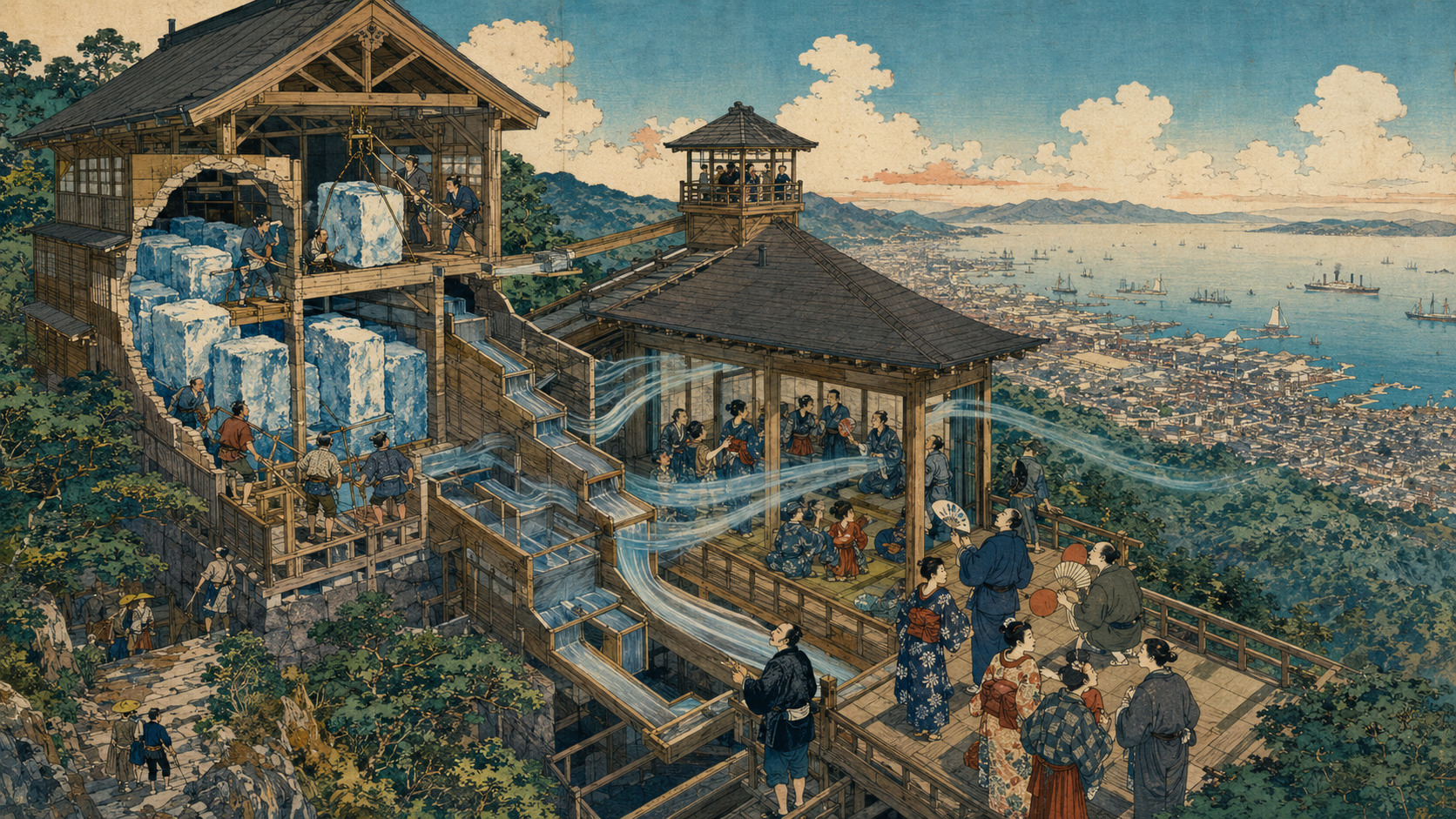
At 9 a.m. on July 13, 2026—the observatory's opening anniversary—operator Rokko Mountain Tourism held its annual himuro-biraki, or ice-chamber opening. Five groups were admitted to the normally closed interior. Once the doors open, wind crosses the stored ice and enters the “wind room” through outlets built into chair armrests.
Read the numbers precisely
The operator reported about ten metric tons of ice remaining on July 6 and a wind room roughly 10°C cooler than Kobe's urban area. That does not mean the room is always 10°C, or always ten degrees below a conventional air-conditioned room. Reference location, time, humidity and wind alter the comparison. The official site warns that weather can prevent the experience in some years.
| Claim | What it says | What it does not say |
|---|---|---|
| About 10 tons | Ice remaining on July 6 | Total harvested, or a guarantee through summer |
| About 10°C cooler | Difference from downtown Kobe | A fixed difference in every condition |
| No electricity | No mechanical cooling for the cold-air experience | A zero-energy, zero-carbon life cycle |
How much heat can ten tons absorb?
Melting one kilogram of ice at 0°C requires about 334 kilojoules of latent heat. For 10,000 kilograms, that is 3.34 gigajoules—about 928 kilowatt-hours of absorbed heat. Meltwater can then absorb more heat as its temperature rises.
But 928 kWh of heat is not 928 kWh of saved electricity. Modern heat pumps move several units of heat per unit of electrical input; the ice chamber cools a small, open experiential space. A fair comparison would measure temperature, humidity, airflow, ice loss, visitor-hours and the counterfactual mechanical load.
An ice house was a seasonal battery
Societies around the world once stored winter snow and ice in insulated pits and buildings. Japanese himuro appear in ancient records, later supporting court systems and rituals such as the Kaga domain's presentation of ice to the shogunate. Earth, straw, timber and shade slowed melting.
Before household refrigeration, ice formed on Mount Rokko ponds was stored and carried to Kobe and Osaka for sale. The route survives as a hiking trail called the Ice Road. Rokko Shidare does not quote this history merely as decoration; it restores the functional idea of transferring winter cold into summer.
The mountain is already doing part of the cooling
The observatory stands around 880 meters above sea level, reaching 888 meters. A broad rule of thumb is that air temperature falls about 0.6°C per 100 meters of elevation, though weather, sun, humidity and wind complicate that relationship. The mountain–city difference is therefore not produced by ice alone.
The design's intelligence lies in using that existing gradient instead of erasing it with a larger machine. Ice absorbs heat from incoming air; cooled, denser air is guided into the wind room. The goal is not a sealed box with uniform thermostat control. Visitors encounter local coolness at an armrest, cypress fragrance and visible meltwater.
Architecture conceived as one tree
Designed by Hiroshi Sambuichi and opened on July 13, 2010, Rokko Shidare is conceived as a single large tree on the summit. Short cypress members and stainless-steel pipes form a woven dome of “branches and leaves.” Changing density moderates light, wind and rime without separating the interior from the mountain.
Sambuichi treats water, air and sunlight as moving materials. Ice rooms, a basin receiving rain and meltwater, a sun-warmed winter room, and places that reveal droplets and icicles form one seasonal system. Environmental technology is not hidden in a plant room; it becomes something visitors can feel and learn.
Moving winter cold into summer
- Water freezes on the ice shelf east of the observatory.
- Around Daikan, the coldest seasonal marker, blocks are cut and moved into deep chambers.
- Insulation and mountain temperatures slow spring melting.
- On July 13, doors open and summit wind crosses the ice.
- Cool air enters the wind room; meltwater appears in a basin.
This is a small example of seasonal thermal storage. Modern buildings also make ice at night to shift daytime cooling loads. Rokko Shidare replaces electrically made nighttime ice with outdoor winter cold and bridges not hours, but months.
Warm winters disturb the premise
Dependence on nature is both strength and weakness. From 2024, warm conditions prevented reliable freezing on the ice shelf, so snow from nearby Rokko Snow Park was stored instead. Local reporting says the ice melted in 2025 and the cold-air experience was canceled for the first time. In 2026, sufficient shelf ice allowed a return to the original method.
This variability belongs at the center of the lesson. Natural cooling is not independent of climate. Winter minimums, freeze days, snow and summer heat determine each year's capacity. It cannot guarantee commercial comfort like conventional HVAC, but it can act as a bodily instrument for understanding climate change.
Can cities borrow the idea?
Placing ten-ton ice rooms in every urban building is impractical. They demand land, structural capacity, waterproofing, condensation control, hygiene and drainage; warm cities may not produce natural ice. The transferable principles are night ventilation, solar shading, cross-flow, ground coupling, thermal storage and personal cooling close to occupants.
The sequence matters: reduce heat gain, store whatever coolness the climate offers, then use efficient machinery for the remaining load. During dangerous heat, mechanical cooling protects health. Passive design should not become a moral argument against air conditioning; it should reduce the size and hours of equipment required.
Architecture that makes coolness visible
Ordinary air conditioning conceals where cooling comes from. At Rokko Shidare, people watch ice being harvested, doors opening, wind moving and meltwater collecting. Energy crosses seasons in a form the body can understand.
The most important fact about ten tons is that it is finite. Each moment of comfort transfers heat into ice and turns it back to water. All cooling needs somewhere for heat to go. The chamber places that basic, often forgotten question inside the landscape: where do we send our heat?
Reporting and sources
- Rokko Mountain Tourism: 2026 ice-chamber opening
- Rokko Shidare official site: cooling, elevation and architect
- Hiroshi Sambuichi's Rokko Shidare: structure and environmental system
- The Mainichi: the 2019 ice harvest
- Kobe Journal: the 2025 cancellation and 2026 return
Latent-heat calculation: 10,000 kg × 334 kJ/kg. The resulting 928 kWh is absorbed heat, not a measured electricity saving. Ice mass and temperature difference are operator-reported figures.