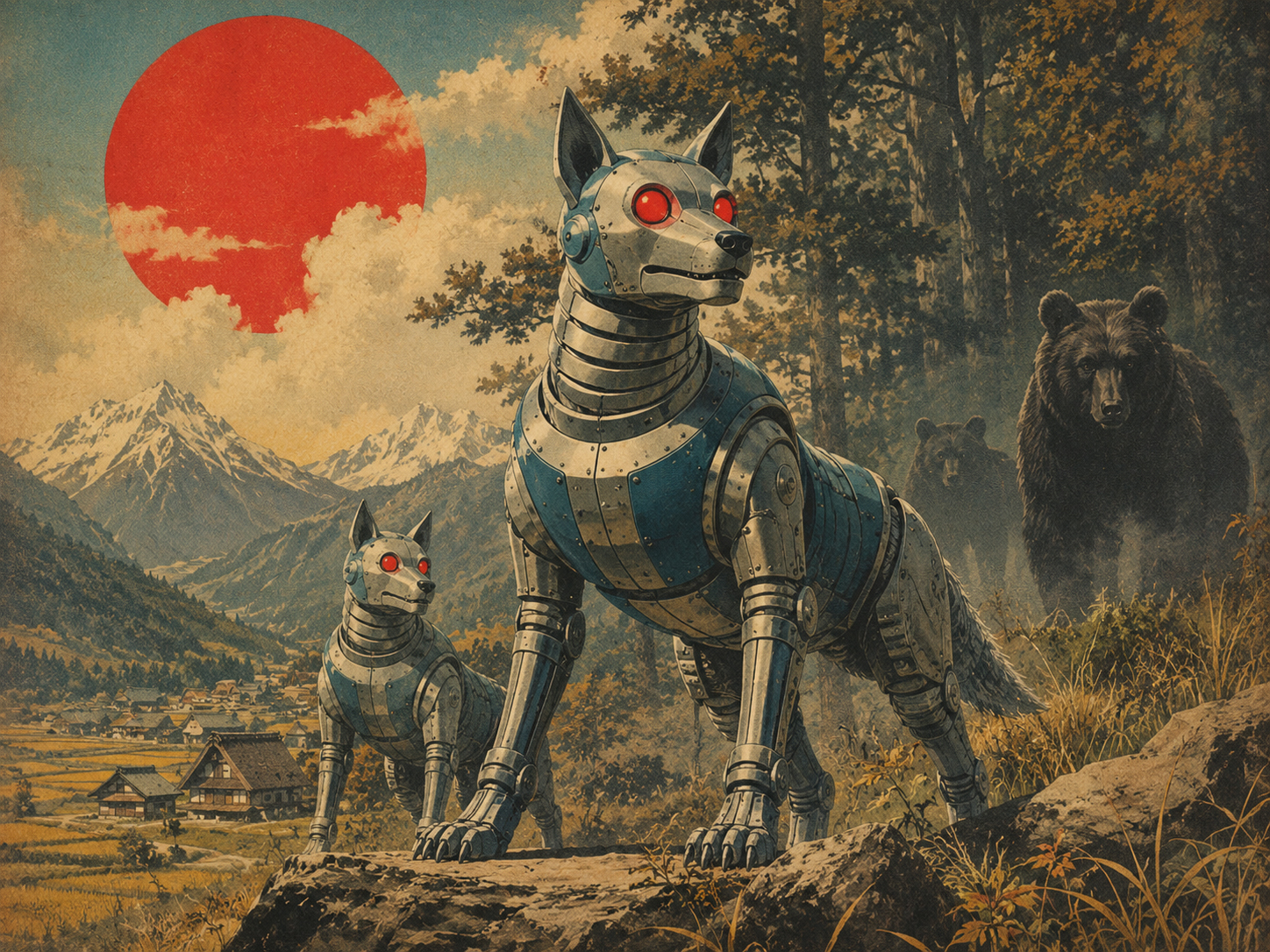
A nightmare guard dog at the edge of the field
From a distance it resembles a wolf. Up close, the pipe-frame skeleton, artificial fur, fixed jaws and glowing red eyes reveal something else. When an infrared sensor detects movement, the neck turns and the machine releases howls, growls, electronic noise, human voices and gunshot-like sounds.
It is called Monster Wolf, a wildlife deterrent developed by Ohta Seiki in Naie, Hokkaido. The machine emerged around 2016 as a way to repel deer, wild boar, monkeys and birds from crops. After Japan’s record bear year in 2025, its public role changed.
By May 2026 the company had received about 50 orders, more than its normal annual output. Because each machine is assembled by hand, customers were reportedly waiting two to three months. Company president Yuji Ohta said production could not keep up.
Why does it look so terrifying?
Monster Wolf is not a naturalistic museum model. Its teeth are oversized, its eyes glow red and its expression is permanent rage. It is theater engineered for alarm.
A deterrent must be noticeable at field and forest edges. A large head, vivid eyes, sudden movement and loud sound create a combined danger signal. Accurate wolf anatomy matters less than communicating that something unpredictable occupies the boundary.
LED eyes increase nighttime visibility. A rotating neck distinguishes the device from a static scarecrow. Randomized sounds are intended to delay the moment when wildlife learns the object is harmless.
Inside the machine
Product descriptions and reporting indicate infrared motion sensing, a powered neck, flashing LEDs and speakers playing multiple sound sequences. Power comes from a 12-volt battery, with optional solar charging.
Fixed versions stand at farms, orchards, golf courses, construction sites and settlement edges. Development has expanded toward wheeled patrol units, camera and AI identification, and small portable models for hikers, fishers and schoolchildren.
Reports claim sound can carry as far as one kilometer, though terrain, wind, forest density and buildings will change the real result. What frightens wildlife may also become noise for residents.
What changed in Japan’s bear conflict?
Hokkaido supports brown bears, while Honshu and Shikoku support Asiatic black bears. Their size and ecology differ, but encounters near settlements have increased across broad regions.
Reporting on 2025 described more than 50,000 bear sighting reports, 13 fatalities and over 200 injuries. The Ministry of the Environment continued monthly updates in July 2026 for appearances, injuries and authorized captures.
No single cause is enough. Poor crops of beech nuts and acorns, extreme heat, snow, expanding populations, rural depopulation, abandoned farmland, unharvested persimmons and chestnuts, unmanaged brush, garbage and dispersing young bears all interact.
The mountain did not simply invade the town—the boundary disappeared
Until the high-growth era, people regularly cut fuelwood, gathered leaf litter and maintained fields at the satoyama edge. Open ground and human activity formed a visible buffer between forest and house.
As villages age and shrink, fields become brush, fruit falls uncollected and empty houses multiply. Rivers, rail lines and overgrown lots become wildlife corridors.
Robot wolves imitate the human presence that once maintained those edges.
Japan once had real wolves
The Japanese wolf lived across Honshu, Shikoku and Kyushu. The larger Hokkaido wolf lived in the north. The Japanese form was small and adapted to mountainous terrain.
Environment Ministry materials place the Hokkaido wolf’s extinction around 1896 and the Japanese wolf’s last confirmed record in 1905, when a young male was captured in Higashiyoshino, Nara.
Drivers included bounty campaigns, poison used to protect livestock, rabies and other canine diseases, habitat change and declining prey. Hokkaido’s colonial development used strychnine and rewards to eliminate wolves threatening imported livestock.
| Period | Human relationship with wolves | Meaning for wildlife management |
|---|---|---|
| Ancient to early modern | Wolves feared and revered as mountain messengers that suppressed deer and boar | Predator understood as both danger and agricultural guardian |
| Late Edo | Rabies and attacks increased fear | The useful animal was increasingly recast as pest |
| Meiji era | Poison, bounties and livestock protection campaigns | Modern policy sought elimination of large predators |
| 1890s–1905 | Hokkaido and Japanese wolves disappeared | Ecological and cultural vacancy followed |
| From 2016 | Mechanical wolves placed at farms and villages | Predator signals reintroduced without a living predator |
| 2025–2026 | Bear crisis transforms a crop device into national safety technology | Nonlethal hope expands alongside questions about limits |
The wolf was an ōkami—a great deity
Japanese wolf traditions survive in mountain regions such as Chichibu and Okutama. Shrines including Mitsumine and Musashi Mitake treated wolves as divine messengers or “honorable dogs,” protecting against fire, theft and crop-raiding animals.
For farmers, wolves could threaten livestock while also keeping deer, boar and monkeys away. A howl represented danger and evidence that a guardian occupied the mountain boundary.
The robot standing in a modern field unintentionally reenacts that older role: a sensor-powered omamori with batteries instead of a shrine talisman.
Are bears naturally afraid of wolves?
Wild bears and wolves do not fit a simple predator-prey hierarchy. Large adult bears can dominate wolves at carcasses. Wolf packs may threaten cubs or weaker animals, but bears do not uniformly flee wolves.
Monster Wolf therefore probably works through a combination of novelty, movement, light, human voices and loud unpredictable noise—not solely through ancestral recognition of a wolf.
The appealing idea that Japanese bears genetically remember a predator extinct for 120 years should be treated cautiously. Animals may respond to general predator shapes and alarm stimuli, but that is not proof of species-specific cultural memory.
How strong is the evidence that it works?
Municipalities and farm groups have reported fewer visits after installation, and camera footage shows animals stopping or turning away. A strong initial startle response is plausible.
Long-term, large-scale controlled evidence remains limited. Animals habituate when no real consequence follows. Moving devices, changing sound patterns and removing food attractants may be necessary.
Sales numbers are not the same as measured reductions in human injury. Rigorous evaluation would compare treated and untreated sites, identify individual animals and measure displacement into neighboring areas.
- Can: create sudden light, noise and movement at a defined field or village boundary.
- Can: provide a nonlethal first line intended to prevent contact before a bear must be killed.
- Cannot: manage bear populations, crop failure, abandoned fruit, garbage or dense brush.
- Cannot: protect an entire mountain range or trail network from one location.
- Risks: habituation, noise, hardware failure and merely pushing animals elsewhere.
- Requires: electric fencing, mowing, attractant removal, monitoring, education and professional capture capacity.
The value of a nonlethal boundary
Once a bear repeatedly enters a settlement, it is more likely to be captured and killed. Deterrence before habituation can protect both people and bears.
Compared with firearms, dogs, fireworks, drones or patrols, Monster Wolf can remain on site and operate without a person constantly present. That is attractive where licensed hunters are scarce.
Nonlethal does not mean impact-free. Loud sound can affect residents, livestock and birds. If a device simply pushes a bear toward another village, regional coordination is essential.
Aging hunters and work transferred to machines
Reuters reported that Japan’s bear response depends heavily on aging recreational hunters, many over 60. The job is dangerous, poorly compensated and emotionally difficult, with strict firearms rules and public criticism.
Shooting in residential areas requires coordination between police, municipal officials and hunters. Delays can be dangerous.
Robot wolves will not replace skilled hunters. They may buy time, reduce routine patrol burden and lower the number of encounters escalating to emergency lethal action.
Why bears reach downtown streets
Bears learn. An animal rewarded with persimmons, garbage, pet food or livestock feed may return even if it normally avoids humans.
Young males travel long distances seeking territory. Mothers with cubs seek food while avoiding dominant animals. Poor wild food and abnormal heat can make lowland risk worthwhile.
News footage says a bear “entered town,” but in many places the forest edge, riverbank, railway, vacant lot and neighborhood form one continuous corridor.
Reintroducing a symbol, not a predator
Japan has periodically debated reintroducing wolves to control deer and boar. Obstacles include livestock loss, safety, social acceptance, ecosystem uncertainty and the absence of an identical living population.
Monster Wolf does not hunt, breed, form packs or change prey populations. It places only a predator’s face and voice at the edge.
It is a distinctly modern compromise: when a lost ecological function cannot be restored, imitate a fragment with sensors, LEDs and speakers.
Can a pocket wolf protect a person?
Ohta Seiki has discussed a small portable model and AI-linked detection for hikers, fishers and children.
No portable sound device should be treated as a guarantee. Wind, distance, bear motivation, cubs and food defense all change behavior.
Such a device may help announce human presence before an encounter. After detection, official guidance remains primary: do not run, increase distance and carry bear spray where appropriate.
The most important solutions are less photogenic
A red-eyed robot makes international news. Effective bear prevention still depends on harvesting fruit, securing garbage, managing feed, cutting brush, maintaining sightlines, installing electric fences and sharing sighting information.
Governments also need trained younger personnel, clear shooting authority, support for victims and regional population management.
The condition for Monster Wolf’s success is refusing to believe the machine solves the whole problem.
The meaning of an extinct wolf returning as a machine
Meiji Japan eliminated living wolves to protect livestock and settlement. Reiwa Japan manufactures artificial wolves to protect shrinking villages and farms.
The irony is powerful but not simple. Real wolves would not have solved every bear conflict, and wolf extinction is not the sole cause of today’s crisis. Yet after eliminating predators and reducing satoyama labor, humans inherited the work of maintaining every boundary.
The red-eyed machine is a warning light aimed in two directions. It frightens bears, and it reminds society that forest-town boundaries cannot be purchased once and forgotten.
Still, there is symbolic force in its howl. The animal once worshipped as a mountain guardian and then exterminated has returned between people and wildlife—this time wearing wiring, artificial fur and LED eyes.
Sources and further reading
- CBS News / AFP, May 13, 2026: order surge, design and 2025 bear casualties.
- People, May 2026: pricing, 50 orders, two-to-three-month waits and planned portable/AI models.
- Robotatta, “Monster Wolf”: infrared sensor, moving neck, LED eyes and multiple warning sounds.
- Japan Ministry of the Environment, bear information: July 2026 updates for appearances, injuries and captures.
- Reuters, December 3, 2024: population expansion, rural decline, aging hunters and long-term management.
- Japan Ministry of the Environment, “Lost Life Does Not Return”: 1905 extinction of the Japanese wolf and causes.
- Japan Ministry of the Environment, mammal history lecture: Hokkaido and Japanese wolf extinction, wolf worship and wildlife expansion.
- The Japan Times, “In Search of Japan’s Lost Wolves”: specimens, taxonomy and cultural memory.