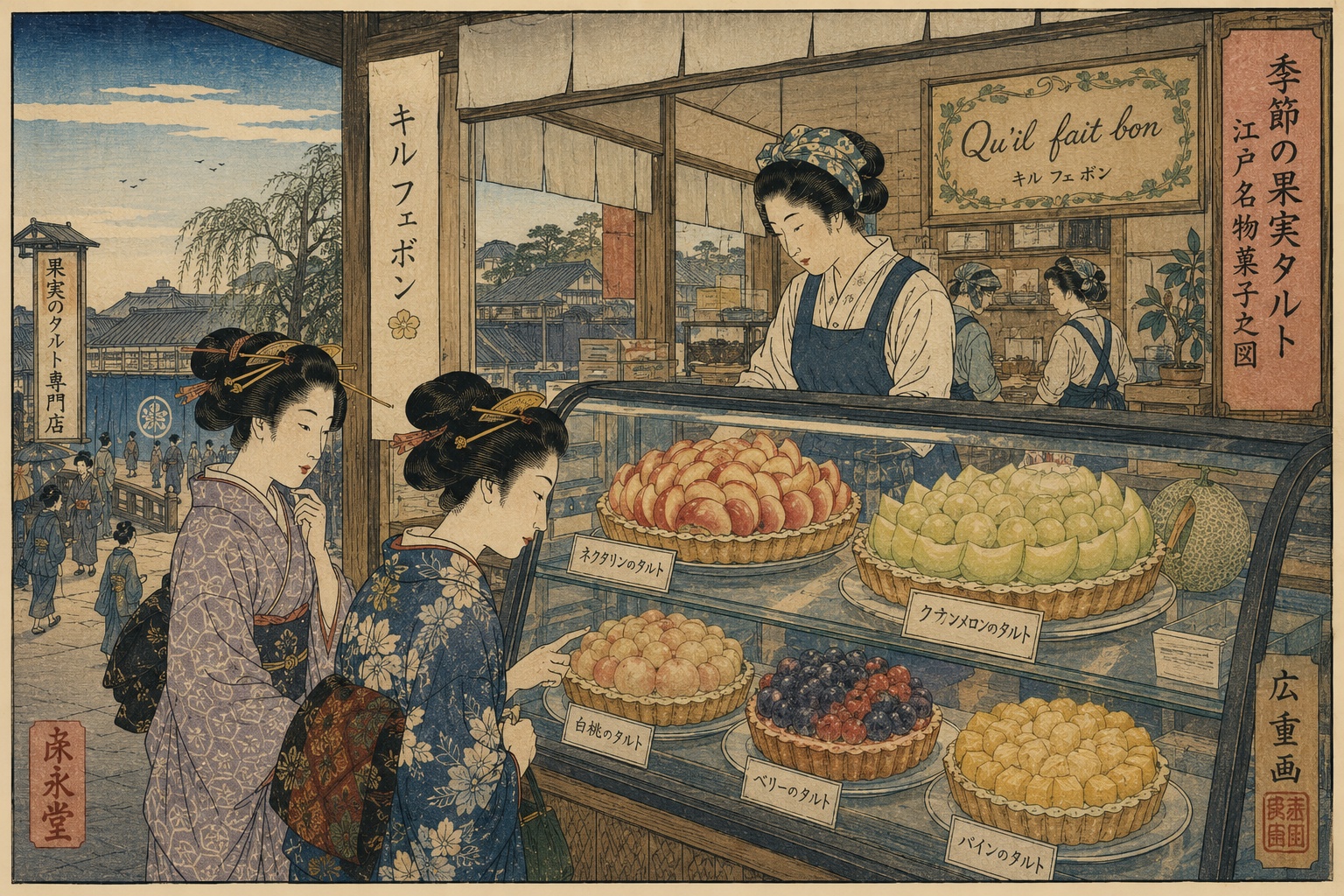
Qu’il Fait Bon began the third wave of its 2026 summer menu at all 12 stores on August 1. The company describes 27 items in total, including store-exclusive and continuing products, and highlights nectarine, Crown Melon from Fukuroi in Shizuoka, Shimane’s Shinku grape, Okayama’s Hareoh Shine Muscat, Fukuoka’s Toyomitsuhime fig, peaches and Okinawan Keitt mango. All sales periods are planned and may change with supply or store conditions. Listed prices include Japan’s 8% reduced tax rate for takeout; the tax rate differs for café dining. This article uses official announcements, public records and producer materials available by 6:00 a.m. Japan time on August 1, 2026. It does not invent the nectarine’s unnamed origin or cultivar, the Crown Melon grade, sales totals or customer response.
Late summer arrives inside the showcase
August appears behind glass as a circle of color. Yellow nectarine overlaps in skin-edged slices. Green Crown Melon forms the outline of a coronet. Red Shinku grapes, pale Shine Muscat, violet fig, peach, plum and mango occupy their own arcs. Season is no longer a date on the calendar. It becomes a sequence of cuts, surfaces and color.
Qu’il Fait Bon’s defining move is to refuse to hide fruit inside the cake. Whole tarts are placed in a central case visible from every side. Before reading a label, the customer encounters pattern, gloss, height and abundance. The shop behaves partly like a gallery, but its exhibition is perishable and changes with harvest.
The August collection occupies the border between high summer and late summer. Peach remains while fig and grape deepen; Keitt mango is scheduled to arrive later. The menu does not switch to “autumn” in one synchronized motion. Farms, regions and cultivars move at different speeds. That misalignment is what seasonality actually looks like.
Reading the announced August menu precisely
| Product | Price and planned period | Stores and verification |
|---|---|---|
| Nectarine Tart with Orange | Slice ¥1,260 25cm ¥12,600 Aug. 1–31 | 10 stores; not Ginza or Fukuoka. Skin-on slices, tart cream and orange aroma. |
| Fukuroi Crown Melon and Le Gall Rare-Cheese Tart | Slice ¥2,530 25cm ¥25,300 Aug. 1–31 | All 12 stores. Mango sauce, silver stars and a flower-shaped crown design. Melon grade not disclosed. |
| Shimane T’s fam Shinku Grape Tart | Slice ¥2,040 25cm ¥20,400 Early to late Aug. | All 12 stores; limited quantity. Paired with pastry, custard and whipped cream. |
| Okayama Hareoh Shine Muscat Tart | Slice ¥1,650 25cm ¥16,500 Aug. 1–31 | 11 stores; not Fukuoka. Announcement cites demanding criteria including sweetness, berry size and bunch appearance. |
| Fukuoka Toyomitsuhime Fig Tart | Slice ¥1,190 25cm ¥11,900 Aug. 1–Sep. 30 | All 12 stores. Custard is accented with jam made from the same cultivar. |
| Peach and Summer-Fruit Tart | Slice ¥1,410 25cm ¥14,100 17cm ¥7,620 Aug. 1–31 | All 12 stores. Peach, plum and raspberry are among the fruits named. |
| Okinawan Keitt Mango Tart | Slice ¥1,620 25cm ¥16,200 Late Aug.–early Sep. | All 12 stores; Ginza and Fukuoka planned from Sep. 1. Coconut-flavored custard. |
| Candle Night Cake — Fig Version | Slice ¥1,620 25cm ¥16,200 Aug. 20 only | All 12 stores. Red-wine fig, walnut and lemon-scented chocolate pudding filling. |
| Golden Pineapple and Cream-Cheese Tart | Slice ¥1,350 27cm ¥13,500 Aug. 1–31 | Hamamatsu only. Pineapple, anise liqueur, cream cheese and sour cream. |
| Mango and Banana Tart | Slice ¥1,198 25cm ¥14,385 17cm ¥6,598 Aug. 1–19 | Sendai only. Pastry, cheese cream, two rounded creams, mango and banana. |
The phrase “27 items” does not mean that every store carries an identical set of 27. It includes representative products, store exclusives and items continuing from earlier phases. Ginza lacks the nectarine tart; Fukuoka lacks Hareoh; Hamamatsu has its pineapple; Sendai has mango and banana. A national brand retains differences rather than pursuing perfect uniformity.
The dates are also described as planned. Seasonal fruit is not an industrial component. Rain, sunlight, maturity, harvest, grading and transport alter quantity and quality. The word “planned” leaves agricultural uncertainty visible on the menu rather than pretending it has been eliminated.
Nectarine is peach speaking in another register
Nectarine can appear foreign, but it is closely related to peach and is distinguished by its smooth skin. Japan’s agriculture ministry describes it as originating in Central Asia, identifies Nagano as the country’s principal producing region, and notes that it can be eaten skin-on and has sweet-tart flesh. Beside the soft perfume of a white peach, nectarine’s acidity and firmer bite can feel like the same melody played on another instrument.
Peach itself has a very long Japanese history. Seeds have been found at Yayoi-period sites, and the fruit appears in early chronicles and myth. Yet the broad spread of modern eating peaches began after the Meiji Restoration, when breeding and distribution transformed an ornamental and symbolic fruit into a major commercial crop. Nectarine belongs to that long, branching history of selection.
Nagano continues to breed nectarines. Its Sweet Crystal, harvested in late July, is one example of current research reorganizing flavor, appearance and harvest timing. But Qu’il Fait Bon has not named the cultivar or origin used in this tart. It would be inaccurate to label it Nagano-grown or Sweet Crystal merely because those are prominent examples.
The design decision to leave the skin on
The crucial phrase in the announcement is that the fruit is arranged “one slice at a time” with the skin intact. Skin creates an edge. Without it, yellow flesh can visually dissolve into the cream; with a red-toned border, each arc remains legible and gives the tart movement. An edible surface becomes both ornament and texture.
Thinly arranging fruit is not mechanical work. Different thickness changes the bite. Different ripeness changes whether a slice holds its shape. Too much juice softens the base; too little makes the fruit look dry. Time between cutting and service affects color and aroma. The visual regularity depends on a worker’s ability to read irregular fruit.
Tart cream and orange aroma are not there simply to add sweetness. They extend the nectarine’s acidity and scent in another direction. Making fruit the protagonist does not mean silencing every supporting ingredient. It means setting their volume so the main voice remains clear.
Crown Melon is a one-vine-one-fruit production system
Crown Melon cannot be explained by a luxurious name alone. Growers centered on Fukuroi and extending into Iwata, Kakegawa, Hamamatsu and Mori have built a year-round greenhouse and collective-shipping system in western Shizuoka. The Crown Melon branch traces local greenhouse cultivation to around 1921; its predecessor organization formed in 1964, when the crown-mark sticker also began to appear.
The emblem is the T-shaped stem. The producer organization describes it as proof that only one fruit was allowed to mature on a vine. Nutrition that could have been divided among several fruits is concentrated in one, while growers manage greenhouse temperature, water, roots, leaves, pollination, netting and maturity. Crown Melon is natural fruit, but it is also the output of highly organized agricultural technique.
In 2024 Shizuoka ranked first in Japan for all three reported measures of Earl’s-type greenhouse melon: 203 hectares planted, 5,030 tonnes harvested and 4,960 tonnes shipped. Those figures represented 35.7% of national area, 33.8% of harvest and 34.7% of shipments. Luxury-fruit stories focus on one perfect specimen, but a whole system of cultivation, grading and logistics stands behind it.
Qu’il Fait Bon arranges the melon in a flower-shaped tart with rare cheese, mango sauce and silver stars, translating the regional crown metaphor into pastry. Yet the release does not disclose the melon’s individual grade or exact volume. A regional brand name and a fruit’s specific market grade are not interchangeable facts.
What does a ¥2,530 slice actually price?
The Crown Melon tart costs ¥2,530 per takeout slice and ¥25,300 for a 25-centimeter whole. At the displayed rate of ¥157.57 to the dollar, those are approximately $16.06 and $160.56. Currency conversion, however, cannot explain how the price feels to a Japanese customer or how much returns to the grower.
The price includes more than fruit: greenhouse infrastructure and energy, cultivation labor, grading, transport, ripeness management, slicing, cheese, crust, store labor and the risk of unsold perishable inventory. One-vine-one-fruit agriculture is not easily reconciled with the industrial logic of increasing volume to reduce unit cost. Some scarcity is constructed by marketing; some is a real production limit.
High price still does not guarantee fair distribution. The harder questions are how much reaches the orchard, whether off-grade fruit can be used in sauce or other products, and whether purchasing relationships continue across seasons. A beautiful tart supports agriculture only when the place name on the menu becomes more than decoration.
A small Shizuoka shop, 1991
Qu’il Fait Bon began in 1991 as a small cake shop in Shizuoka. It now operates 12 stores, but its headquarters and origin remain there. Placing Fukuroi Crown Melon in cases across Japan is not simply importing a distant prestige ingredient. It is also exporting the fruit culture of the company’s home prefecture.
The company translates “Qu’il fait bon” as “What fine weather.” The name is French and the form is a tart, but the operating calendar is Japanese: seasonal fruit, gift occasions and regional names. Rather than reproducing a European pastry unchanged, the brand turned the imported structure into a vessel for the archipelago’s harvest calendar.
Nearly 35 years of continuity has not meant freezing one product in place. Strawberry, peach, citrus, grape, fig and chestnut have rotated; stores and buying habits have changed. What remained was an editorial principle: show the fruit in whole tarts and make the act of choosing part of the product.
The 360-degree showcase is an editorial desk
Most pastry cases run along a wall and offer one frontal viewpoint. Qu’il Fait Bon places its case in the center and makes it visible in the round. The customer circles rather than standing before a single line, and each step changes color, pattern, cross-section and diameter.
The company says about 20 whole tarts are displayed at any given time. Showing the complete circle matters. A whole tart suggests a group before it is cut: birthday, family, workplace or visit. Even a customer buying one slice first sees the shared object from which it came.
The case also amplifies agricultural value through visual arrangement. Too many bright products together create noise; too many pale fruits recede. Red, green, yellow, purple and cream have to be paced through height, negative space, plates and light. Daily merchandising becomes page design made from crops and pastry.
That is why 27 is more than an inventory count. It is an editorial vocabulary. The products placed beside nectarine can make it look sharp and refreshing; the neighbors of Crown Melon can make it feel calm or opulent. Taste begins to be narrated by placement before food reaches the mouth.
Seventy crust recipes: invisible structural engineering
Fruit takes the attention, but tart failure begins at the base. Qu’il Fait Bon says it holds more than 70 crust recipes, grouped broadly as brisée, sucrée, sablé and foncée. Flaky brisée, biscuit-like sucrée, richer cookie-like sablé and light foncée respond differently to water, weight and cream.
Fruit releases moisture over time. Thin nectarine, soft fig, juicy melon and taut grape impose different loads. The right thickness, bake, fat structure and cream barrier change with the topping. If a whole tart is to remain crisp and coherent for hours, migration of water has to be controlled where the customer cannot see it.
The long-selling Seasonal Fruit Tart uses a lightly salty brisée with house-made custard. Salt does more than intensify sweetness; it provides a reference line that helps ten fruits belong to one composition. Custard is adhesive, cushion and moisture buffer as much as flavor.
Seventy recipes can sound excessive if a tart is understood only as “cake with lots of fruit.” The more completely fruit occupies the foreground, however, the more work the base must do. Like a successful building foundation, a successful tart crust supports the season without asking to be looked at.
A French name governed by a Japanese seasonal calendar
The tart is European in form and the name is French, but Qu’il Fait Bon’s sense of time resembles the Japanese seasonal almanac. It does not stop at four large boxes called spring, summer, autumn and winter. It reads early summer, high summer, late summer, first arrival, peak and lingering end.
The 2026 sequence moved through the June Seasonal Fruit Tart and a July peach fair before reaching the August third wave. Fruit does not change at once: peach remains while fig and grape advance, and Keitt mango joins late. The menu behaves more like agriculture than a fashion calendar.
“Fine weather” is not simple praise for sunshine. Good weather differs by crop; excessive heat can alter grape color and cause sunburn, while rain changes sweetness and disease pressure. The beautiful season visible in the case is an edited result of farmers adapting to weather, not weather operating perfectly.
Twelve stores do not experience the same summer
The nectarine tart is absent from Ginza and Fukuoka, while Hareoh is absent from Fukuoka. Yet the Fukuoka store marks its 20th anniversary in 2026 with separate products using Fukuoka Shine Muscat and Toyomitsuhime. An absent national item may therefore reflect another local edit rather than a simple gap.
Hamamatsu’s Golden Pineapple adds anise liqueur and cream cheese. Sendai’s mango-and-banana tart uses rounded creams and layered pastry. Store exclusives allow each kitchen to act as a small laboratory, testing technique and demand at lower volume than a nationwide launch.
“Limited” is not automatically meaningful. It matters when connected to local fruit, store history, customer habit or a technical reason. Scarcity by itself is a marketing mechanism; a true regional product can explain why it belongs in that place.
Shinku: a red grape with the aroma of tea
Shimane’s Shinku was bred from Shine Muscat and Beni Balard after research beginning in 2007. Its official organization describes a seedless, skin-on grape with at least 20 degrees Brix, vivid red color, thick crisp flesh and an aroma reminiscent of black tea. Its name was selected from 1,472 entries submitted from 34 prefectures.
Only fruit meeting standards for sugar and color may use the name, and cultivation is confined to Shimane. A cultivar name becomes more than description: it links prefectural intellectual property, farmer recruitment, employment and tourism. The red berry is a joint project of researchers, growers, government and sellers.
The 2026 tart uses grapes delivered directly from T’s fam and is limited in quantity. Pastry, custard and whipped cream provide a quiet background for skin tension and aroma. In a premium market dominated visually by green grapes, red color and tea-like perfume create a different memory.
Hareoh: adding regional standards to a national cultivar
Shine Muscat is grown across Japan. Okayama’s Hareoh adds a regional and grading narrative to the cultivar. The August release says the tart uses fruit that has passed demanding selection for high sugar, large berries and attractive bunch form among Hareoh shipped by Okayama JA organizations.
Okayama has roughly 140 years of grape cultivation and uses the differences among its warm southern plains, intermediate uplands and cooler north to stagger shipments. A single brand therefore emerges from non-identical landscapes. Long availability is built from geographic variation.
In a tart the bunch is dismantled and berries are arranged around a circle. The prized visual harmony of the gift bunch becomes another visual harmony. Size and gloss survive the translation; bunch structure becomes tart structure.
Toyomitsuhime: from prefectural breeding to summer ritual
Fukuoka’s Toyomitsuhime was developed by the prefectural agricultural research system and registered in August 2006, making 2026 its 20th anniversary. The prefecture identifies strong sweetness, abundant juice and a smooth texture. Qu’il Fait Bon covers the tart with the fresh fruit and uses jam made from the same cultivar as an acidic accent.
Fig is exceptionally fragile. The closer it comes to full ripeness, the more difficult transport and display become. A design that has both intact fruit and jam creates separate destinations for different shapes and stages of maturity.
In 2025 Fukuoka described the Qu’il Fait Bon tart as entering its tenth consecutive year. Its continuation in 2026 suggests that the limited product has become a repeated relationship rather than a one-time advertisement. A regional cultivar succeeds not only when it attracts attention at launch, but when consumers wait for its familiar annual form.
Keitt mango marks the exit from summer
The August menu is not complete on August 1. Okinawan Keitt Mango is planned for late August into early September, with Ginza and Fukuoka scheduled from September 1. JA Zen-Noh describes Keitt as a scarce mango reaching season in August and September. It is a late fruit arriving after the first crest of summer.
Dense sweetness and smooth flesh are paired with coconut custard. Because maturity is not always obvious from external color, timing can determine value. The store must manage not only delivery date but the ripening window required for service.
As Keitt arrives, nectarine and peach approach the ends of their planned runs. A showcase creates season not merely by adding products but by allowing others to leave. Seasonality is not availability without limit; it is the presence of an ending.
One day of darkness on August 20
The Candle Night Cake is sold only on August 20. Cocoa tart holds red-wine fig and walnut under lemon-scented chocolate pudding, then fig, strawberry and raspberry. It inserts a deliberately dark object into a case otherwise built from luminous fruit.
One-day production is inefficient by ordinary measures. Preparation, communication, inventory and customer visits have to be concentrated. Yet brevity produces memory. A product that remains too long becomes background; a one-day cake can cause a customer to reorganize time around it.
The whole tart as a modern gift object
A slice satisfies an individual appetite; a whole tart constructs a scene of sharing. The 25-centimeter nectarine costs ¥12,600 and the Crown Melon ¥25,300. Their prices differ, but both sell the uncut circle before anyone knows how it will be divided.
In July 2026 Qu’il Fait Bon launched eGift tickets that can be sent by LINE or email: three slice-oriented values of ¥1,200, ¥1,500 and ¥2,000, plus ¥10,000 and ¥15,000 whole-cake values. Rather than shipping fragile fruit pastry immediately, the service sends the right to choose a tart and the time to visit.
Short shelf life is a weakness for delivery. Digital gifting converts it into an experience in which the recipient selects the date and product. Japanese gifting moves from box and courier to URL, message and store visit. Perishable freshness and digital immediacy turn out to fit one another.
Heat, waste and the honesty of the word “planned”
A 2026 fruit menu cannot be read apart from climate and cost. Greenhouse melon requires environmental control; heat can affect grape coloring and fruit sunburn; fig is vulnerable to rain and transport. The final perfect slice can conceal variability already absorbed by growers.
Place names are therefore not enough. What happens when supply changes? How are sellouts communicated? Can trim and off-grade fruit become sauce, jam or baked goods? A brand that displays fruit in abundance carries particular responsibility for the waste that is not visible.
The release’s use of “planned,” and its clear tax and store distinctions, matters. It refuses to fix a natural product completely. Journalism should do the same. Filling an unnamed cultivar with a famous name or treating a regional brand as proof of the highest grade makes a glamorous story less factual.
The best seasonal menu is not the one that remains identical every day. It is the one capable of reading fruit, ending an item when necessary and moving respectfully to another harvest. Change is not necessarily failure. It can be evidence that a restaurant knows how to handle season.
Five ways to read the showcase
- Separate origin, brand and grade: Fukuroi is a place; Crown Melon is a regional brand; an individual grade is another fact.
- Read the availability language: “Planned,” “limited” and “subject to supply” reveal agricultural uncertainty.
- Look below the fruit: Brisée, sucrée, sablé, foncée and cream perform structural work.
- Enjoy store differences: The missing and exclusive products in Ginza, Fukuoka, Hamamatsu and Sendai are part of the national brand’s local character.
- Do not let price end the story: Consider cultivation, grading, transport, waste, labor and the producer’s return.
To cut fruit is to edit a season
A slice of nectarine carries peach history and modern breeding. Crown Melon carries one-vine-one-fruit greenhouse technique and the cooperative system of Fukuroi. Shinku carries prefectural research and a new producing community; Hareoh carries selection layered onto cultivar; Toyomitsuhime carries two decades of breeding and a repeated relationship with food service.
Arranging them in a circle is not the same as showing nature untouched. The pastry team cuts, supports, balances acid and sweetness, and decides when an item begins and ends. The showcase is not an orchard. It can, however, become a place where orchard time is translated for an urban customer.
Qu’il Fait Bon began as a small Shizuoka shop in 1991, with a French name that grew into an instrument for reading Japanese harvests. What it shows in August 2026 is not one static picture called summer. It is the moment when high summer retreats, late summer enters and the first edge of autumn overlaps the frame. When the tart is divided, season itself is shared.
Sources and verification
Japan.co.jp reviewed company announcements, official brand materials, agriculture-ministry information and prefectural or producer sources available by 6:00 a.m. Japan time on August 1, 2026. Product figures are official takeout prices including Japan’s 8% reduced tax rate; café tax differs. Periods, products, inventory and operations can change. The displayed exchange rate is the provided value of ¥157.57 per U.S. dollar, timestamped July 31 at 9:00 p.m. UTC / August 1 at 6:00 a.m. JST. Conversions are illustrative, not price judgments.
- Qu’il Fait Bon: 2026 third summer-menu wave, 27-item announcement and product details
- Qu’il Fait Bon official: 1991 origin, 12 stores, circular showcase and roughly 70 dough recipes
- Qu’il Fait Bon: the 30-year Seasonal Fruit Tart and four broad crust types
- Shizuoka Crown Melon: Fukuroi production region and branch history
- Shizuoka Crown Melon: one-vine-one-fruit cultivation and the T-shaped stem
- Shizuoka Prefecture: 2024 greenhouse-melon area, harvest and shipments
- Ministry of Agriculture: peach history and nectarine origin, production and characteristics
- Nagano agricultural experiment stations: Sweet Crystal nectarine
- Official Shinku organization: breeding history, standards, aroma and sugar
- Fukuoka Prefecture: Toyomitsuhime’s 20th registration anniversary and characteristics
- JA Hare no Kuni Okayama: Okayama grape regions and cultivation history
- JA Zen-Noh: season and characteristics of Okinawan Keitt mango
- Qu’il Fait Bon: eGift launch in July 2026
- Qu’il Fait Bon: Fukuoka store’s 20th anniversary and local tarts
