Park Hyatt Tokyo has announced that its first-floor Delicatessen will expand its hours and begin full operation on August 3, 2026. This article is based on hotel announcements, operating information, architectural records, and brewery history available by 6:00 a.m. Japan Standard Time on August 1. Hours, menus, and prices may change.
The hotel everyone remembers by looking up is opening outward at ground level
To speak about Park Hyatt Tokyo is usually to look upward. There are the three peaked crowns of Shinjuku Park Tower, the guestrooms suspended from floors 39 to 52, the windows from which Tokyo seems to loosen into the horizon, and the jazz drifting through New York Bar above the city lights. For more than three decades, the hotel’s identity has been tied to altitude.
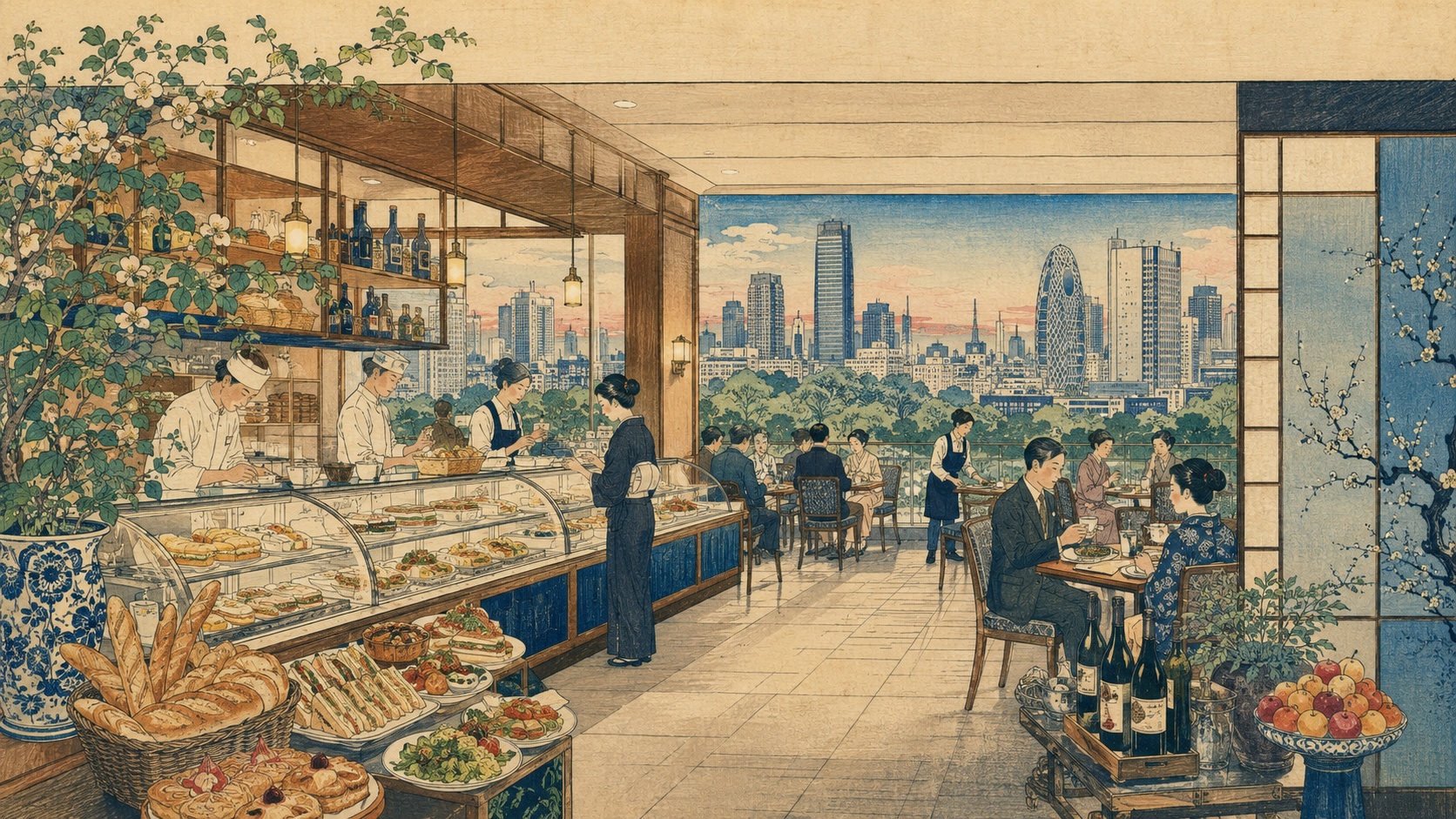
Its next chapter, however, begins on the first floor. On August 3, the Delicatessen expands beyond a lunch-centered schedule and becomes a true all-day café: a place for lunch, coffee, takeaway food, an afternoon pause, a light meal after work, or an aperitif before evening. If the hotel’s most famous experience is the sensation of observing Tokyo from above, the Delicatessen offers the opposite pleasure—the chance to join the city’s daily movement.
This is more than a longer timetable. It is an attempt by a hotel celebrated as a quiet residence in the sky to welcome office workers, neighbors, park visitors, families, and travelers at the same threshold. It reframes luxury from the ground up. The future of one of Tokyo’s best-known hotels may be visible not in its highest suite, but in the openness of its street-level door.
1994: a private residence in the sky appears over West Shinjuku
Shinjuku Park Tower was completed on April 25, 1994. Designed by Kenzo Tange Associates, the approximately 235-meter complex rises 52 stories above ground and descends five levels below it, combining offices, design showrooms, a hall, shops, restaurants, and a hotel into a vertical city. Its three connected towers step downward toward Shinjuku Central Park, giving the vast building a recognizable skyline and a deliberate relationship with the green space to the north.
Park Hyatt Tokyo opened that July on floors 39 through 52. It was the first Park Hyatt in Asia and became an early emblem of a model now common in major cities: the luxury hotel placed at the summit of a mixed-use office tower. Arrival was designed as a vertical journey. Guests rose out of the noise of the street and entered a slower world of glass, stone, wood, water, controlled light, and distant views.
Original interior designer John Morford did not imagine the property as a monumental palace lobby. He conceived a refined private residence above the city. Materials, space, natural light, and framed views carried more importance than obvious display. The hotel sold not merely opulence, but protection from the scale and velocity of Tokyo. In 1994, that quieter vocabulary felt radical. It helped redefine what urban luxury in Japan could be.
Cinema turned the hotel’s silence into a global image
In 2003, Sofia Coppola’s Lost in Translation transformed that atmosphere into a shared cultural memory. Its characters drift through the hotel unable to sleep above a city that never appears to stop. Windows, corridors, the pool, and New York Bar do more than establish location. They become instruments for expressing dislocation, loneliness, intimacy, and the strange calm that can occur inside a foreign metropolis.
The film turned Park Hyatt Tokyo from a distinguished address into a place of cinematic pilgrimage. For years, visitors have arrived seeking the bar, the view, and the suspended feeling they remember from the screen. Yet the hotel has generally resisted turning itself into a theme park. During the 2025 restoration, the black-and-chrome energy of New York Grill & Bar, its live music, and its theater of skyline views were carefully retained. The newer L.I.T. cocktail acknowledges the film, but the hotel’s deeper achievement lies in preserving the quality of time that made the film possible.
There is a revealing coincidence: the Delicatessen also opened in 2003. In the same year the world learned to look up at the hotel’s 52nd-floor melancholy, Park Hyatt Tokyo created an everyday doorway on the first floor. One space offered night, solitude, and a view across the metropolis. The other offered prepared food, coffee, and a route back into the street. The hotel’s two identities came into focus at the same moment.
Born in 2003 as an entry point to the hotel’s food culture
The Delicatessen opened in June 2003 as part of Park Hyatt Tokyo’s tenth-anniversary project. Its name evokes European and North American specialty-food shops, but its role in Tokyo was broader. It functioned as an “entry shop” to the hotel’s culinary world—a place where customers could encounter hotel-made food without committing to a formal restaurant meal or an overnight stay.
Japan already possessed an unusually sophisticated culture of prepared food through department-store food halls, station retail, specialty shops, bento, and seasonal gifting. Customers expect takeaway food to succeed on several levels at once: flavor, appearance, portability, packaging, seasonality, and the moment in which it will be eaten. A hotel delicatessen connects that everyday expectation with the technical discipline of a large professional kitchen.
Its first-floor location matters. A visitor does not need to ascend to the 41st-floor lobby to enter the hotel’s world. Food can be taken toward Shinjuku Central Park, carried back to an office, or eaten in a sunlit room just inside the tower. The Delicatessen is less an accessory to the guestrooms than a shared living room for Shinjuku Park Tower’s vertical city.
A nineteen-month restoration in which memory mattered more than novelty
Park Hyatt Tokyo closed in May 2024 and reopened on December 9, 2025, after four years of planning and nineteen months of work—the most comprehensive restoration in its thirty-year history. Guestrooms were reorganized from 177 to 171, while bathrooms, lighting, systems, circulation, dining areas, and social spaces were updated for contemporary use.
The difficult task was not simply to improve the building. It was to avoid destroying the atmosphere accumulated through three decades of personal memory and global recognition. Paris-based Jouin Manku approached John Morford’s original design as a living inheritance. Rather than erase the hotel’s identity, the studio softened what had become heavy, modernized what had become impractical, and protected what guests would immediately miss.
The Delicatessen followed the same logic. Furniture and layout were renewed, additional table seating was introduced, and the food program was rebuilt, while the venue’s established character and art remained. Large windows bring in daylight. Whimsical sculptures by Mieko Yuki keep the room from becoming overly solemn. A terrace admits breeze, sound, and the movement of the city. The upper hotel creates distance through height; the first floor gains vitality by allowing the outside world to enter.
Technique travels from the 52nd floor to first-floor comfort food
Chef de Cuisine Tsuyoshi Kuwazawa joined Park Hyatt Tokyo in 2002 and spent eighteen years in the New York Grill & Bar kitchen, becoming sous chef in 2005. He took charge of the Delicatessen in 2020. His career therefore forms a direct culinary bridge between the hotel’s most iconic restaurant and its most accessible dining room.
The menu is built around recognizable comfort: Roman-style pinsa with seasonal toppings, bright salads, lasagna, curry gratin, freshly brewed coffee, soft-serve ice cream, sweets, and other chef-made dishes for eating in or taking away. The vocabulary is casual, but comfort food is not careless food. Texture, temperature, sauce consistency, seasoning, and the condition of a dish after it leaves the counter all require control.
The strength of a hotel kitchen is not only access to expensive ingredients. It is the organizational ability to reproduce quality, maintain standards under different service speeds, respond to dietary needs, and design food for multiple occasions. The Delicatessen transfers that precision from linen-covered tables to trays, boxes, and paper bags. The form becomes lighter; the discipline remains.
Why all-day operation changes the role of the hotel
Beginning August 3, the Delicatessen is scheduled to operate daily from 11 a.m. to 8 p.m. Lunch has a 2:30 p.m. last order, but café service continues through the afternoon, and the evening can include a light meal or drinks. From an operating spreadsheet, that may appear to be a modest extension. From the guest’s perspective, it changes the nature of the place.
A lunch outlet exists only inside the narrow timetable of lunch. An all-day café can absorb meetings, pauses, waiting, solitary work, conversation after the office, and an unplanned weekend detour. General Manager Fredrik Harfors has said the hotel wants the Delicatessen to remain a gathering place for neighbors, hotel guests, and anyone seeking a moment of relief in central Tokyo. The word “neighbors” is crucial. A global hotel is not only trying to attract affluent travelers from afar; it is trying to become useful to the people who pass its doors every day.
Luxury is gradually moving from the creation of places most people cannot enter toward the creation of places people trust when they choose to enter. Park Hyatt Tokyo still has clear price and service boundaries, and the Delicatessen is not a bargain counter. Yet casual dress, no reservations, takeaway service, and the ability to stop for coffee lower the psychological threshold. If luxury can mean removing friction and bringing order to a person’s time, an all-day café is not peripheral to the hotel’s philosophy. It may express it in its most practical form.
Park Brewery, and two stories that began in 1994
The full reopening also brings back the seasonal Park Brewery. The two-hour free-flow plan includes Park Brewery Ale and Hazy IPA developed with Sankt Gallen, as well as sparkling, white, and red wine. Guests select one appetizer from the day’s pinsa, assorted cheese, charcuterie, spicy fried chicken, or smoked salmon with avocado cream. The plan runs from August 3 through October 30 and costs ¥5,000 including tax and service charge.
The collaboration carries a historical resonance beyond promotion. Park Hyatt Tokyo opened in 1994, the same year Japan relaxed the production threshold for beer licenses and opened the era commonly remembered as the beginning of the country’s local or craft-beer movement. Sankt Gallen traces its brewing origins to the United States before that deregulation and became one of the symbolic pioneers of Japanese craft beer.
Park Hyatt Tokyo also represented a move away from the logic of scale. Rather than demonstrate prestige primarily through enormous lobbies and mass banqueting, it emphasized individuality, quiet rooms, personal service, and the feeling of a private residence. Craft beer and Park Hyatt Tokyo emerged in the same year from different industries, but both reflected a turn from volume toward character. In the summer of 2026, those two 1994 stories meet at a first-floor table.
The Delicatessen completes Shinjuku Park Tower’s idea of a vertical city
Shinjuku Park Tower was planned as a three-dimensional city combining business, commerce, culture, design, dining, and hospitality. Office workers, shoppers, event audiences, design professionals, restaurant guests, and hotel residents use the same building at different hours. Seen from that perspective, the Delicatessen’s full-day operation is not merely a hotel initiative. It strengthens the public life of the entire complex.
West Shinjuku is built at a monumental scale. The towers are impressive, but distances can feel long, and the line between interior and exterior can be abrupt. A room that accepts a customer without a reservation and allows a stay over one coffee can function as an urban seam. It can be a destination or a pause on the way to the park, an office, a meeting, or the hotel above.
The best city rooms do not dictate a single use. A customer buying lunch may stand beside a traveler checking a map. An afternoon guest may drink coffee while an evening group arrives for beer. The brand may be consistent, but the human stories are not. Allowing that variety is part of what makes a hotel genuinely open to its city.
From 1994 to 2026: one hotel at two altitudes
| Year | Event | Why it matters |
|---|---|---|
| April 1994 | Shinjuku Park Tower is completed | A 235-meter vertical city brings offices, commerce, culture, design, and a hotel into one complex. |
| July 1994 | Park Hyatt Tokyo opens | Asia’s first Park Hyatt introduces the idea of a quiet private residence in the sky. |
| June 2003 | The Delicatessen opens | The tenth-anniversary project creates a first-floor entry point to the hotel’s culinary identity. |
| 2003 | Lost in Translation is released | The upper floors, skyline, and silence become part of global cinematic memory. |
| May 2024 | The hotel closes for restoration | The property begins the difficult work of updating function without erasing identity. |
| December 9, 2025 | Park Hyatt Tokyo reopens | After nineteen months, the 171-room hotel begins its next generation under Jouin Manku’s restoration. |
| August 3, 2026 | The Delicatessen begins full operation | A lunch-centered outlet becomes an all-day café connecting hotel life with the neighborhood. |
Visitor guide from August 3
| Item | Published details |
|---|---|
| Location | First floor, Shinjuku Park Tower, 3-7-1-2 Nishi-Shinjuku, Shinjuku, Tokyo |
| Regular hours | August 3–October 30, 2026: daily, 11 a.m.–8 p.m. Lunch last order at 2:30 p.m. Café service remains available through operating hours. |
| Food and drink | Pinsa, salads, lasagna, curry gratin, coffee, soft-serve ice cream, sweets, and other chef-made comfort food for dine-in or takeaway. |
| Park Brewery | Weekdays 5–8 p.m.; weekends 3–8 p.m.; last seating 6 p.m.; two-hour experience; through October 30. |
| Price | ¥5,000 per person, including two original craft beers, sparkling/white/red wine, and one selected food item. Tax and service charge included. |
| Reservations and dress | No seat reservations. Casual dress code. |
| Contact | Delicatessen: +81 (0)3 5323 3635 |
The future of the hotel is visible at its entrance
Park Hyatt Tokyo became famous for allowing guests to look across Tokyo. But a hotel’s relationship with a city cannot be completed by observation alone. People must be able to enter, pause, carry food back into the streets, return, and form habits. Through that circulation, a landmark becomes part of ordinary life.
The full opening of the Delicatessen may not appear as dramatic as the return of New York Grill. It is not the room where visitors recreate a film scene, nor a suite that claims Mount Fuji through its windows. Yet it may reveal the relationship the hotel most needs for its next thirty years: preserving memory while expanding use, retaining standards while lowering the threshold, and allowing global fame to coexist with a neighbor’s cup of coffee.
On August 3, the hotel in the sky does not surrender its height. It gains a second point of view. One Park Hyatt Tokyo looks down across the metropolis. The other sits inside the city and lets people meet. Only with both altitudes does the hotel become fully open again.
Sources and verification
Japan.co.jp reviewed official hotel announcements, current operating information, architectural records, and brewery history available by 6:00 a.m. JST on August 1, 2026. The displayed exchange rate is 1 U.S. dollar = 157.57 Japanese yen. The supplied timestamp, July 31 at 9:00 p.m. UTC, converts to August 1 at 6:00 a.m. in Japan. Guests should reconfirm hours, menu details, and prices with the official venue before visiting.
- Park Hyatt Tokyo: announcement of the Delicatessen’s August 3 full opening
- Park Hyatt Tokyo: official Delicatessen page, menu, hours, and chef biography
- Park Hyatt Tokyo: official Park Brewery details
- Hyatt Newsroom: the nineteen-month restoration and December 2025 reopening
- Shinjuku Park Tower: mixed-use planning and relationship to the city
- Shinjuku Park Tower: architectural outline, completion date, height, and functions
- TANGE Associates: Shinjuku Park Tower project record
- Sankt Gallen: brewery history and Japan’s 1994 craft-beer opening
