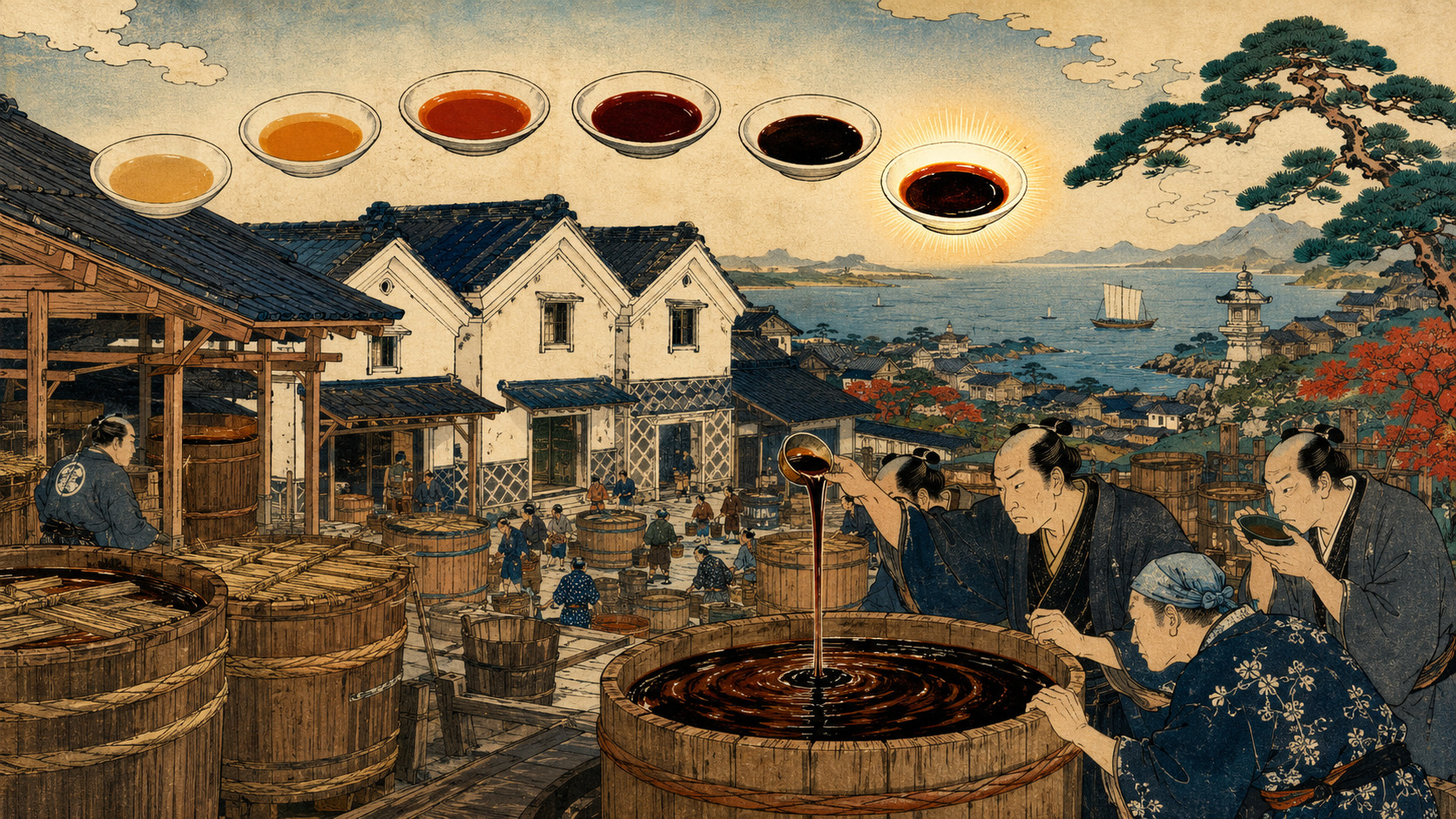
In July 2026, the Murasaki-kai youth section of the Ishikawa Ono Soy Sauce Cooperative began a 12-month publicity series for Ono Murasaki GF6, made in a dedicated gluten-free plant. “GF” means gluten free; “6” means the category after Japan's established five. Its four ingredients are organic whole soybeans, organic brown rice, Seto Inland Sea salt and underground water from Mount Hakusan. No wheat is used, and the sauce ages for one year.
What are the official five?
The Japanese Agricultural Standards divide soy sauce by ingredients, method and characteristics into koikuchi, usukuchi, tamari, saishikomi and shiro. Koikuchi, the nationwide default, generally combines soy and wheat. Pale usukuchi preserves the color of ingredients but, despite its name, is usually saltier. Tamari is soybean-heavy and concentrated. Saishikomi is brewed with raw soy sauce instead of brine for a second, richer fermentation. Wheat-heavy shiro is pale, amber and sweet.
| JAS type | Basic character | Typical uses |
|---|---|---|
| Koikuchi | About 84% of shipments; balanced aroma and umami | Simmering, grilling, dipping |
| Usukuchi | Pale aroma and color; generally more salt | Soups and pale simmered dishes |
| Tamari | Soybean-rich, dark and intense | Sashimi, teriyaki, processing |
| Saishikomi | “Twice brewed” in soy sauce | Sushi, sashimi, tofu |
| Shiro | Wheat-rich, very pale and sweet | Clear soup, custard, crackers |
Because GF6 contains no wheat, it falls within tamari. Yet the cooperative says it is unlike the thick, strongly flavored tamari associated with central Japan: it is fluid, clean and intended to work like an everyday all-purpose sauce. “Sixth” is therefore brand language for a sensory and market proposition that the formal shelf does not fully communicate—not an amendment to Japanese law.
Why replace wheat with brown rice?
In ordinary koikuchi production, koji mold grows over steamed soybeans and roasted, crushed wheat. Its enzymes split soybean proteins into amino acids and grain starch into sugars. In salty moromi mash, lactic-acid bacteria and yeasts add acids, alcohols and aroma compounds. Glutamate is one major source of umami.
GF6 gives part of wheat's role to hot-air-roasted, crushed organic brown rice. Rice starch supplies fermentable carbohydrate and a restrained sweetness. This is more than subtracting an allergen. Brewers must redesign how a replacement grain changes enzyme access, fermentation, aroma and balance.
A dedicated plant matters because an ingredient list is only one part of allergen control. Wheat handled in the same koji room or conveying line can create cross-contact. The cooperative says no wheat enters its koji-production space. People with celiac disease or severe wheat allergy should nevertheless check the current label, certification and producer guidance against their own medical threshold. “Gluten free” is not a universal promise that eliminates every individual risk.
Four centuries in the port of Ono
Japan's agriculture ministry dates Ono soy sauce to the Genna era, 1615–1624. At the instruction of Kaga domain's third lord, Maeda Toshitsune, an Ono merchant named Naoeya Ihei is said to have learned brewing in Yuasa, Kishu, and spread the method at home. Mount Hakusan's water, a damp Sea of Japan climate, Ono Port's access to salt and grain, and the large castle town of Kanazawa created an unusually complete brewing economy.
At its height the district had more than 60 makers and was counted among five major production centers with Noda, Choshi, Tatsuno and Shodoshima. That “five” is unrelated to the five JAS product types: one is a historical list of places, the other a technical classification.
Ono sauce became known for a moderately sweet, mellow umakuchi profile and a color a little lighter than ordinary dark soy sauce. It served as the quiet foundation for Kaga cuisine, Sea of Japan sashimi and simmered fish. The cooperative cites late-Edo records of rice and sugar use to connect GF6's brown rice with local knowledge. That is a lineage of an idea, not proof that today's formula is identical to an Edo recipe.
Cooperation is not the opposite of tradition
In the 1960s, small family breweries faced national mass-market brands and a widening range of seasonings. The Ono cooperative production organization was established in 1969 so makers could share equipment, improve quality and rationalize production of raw soy sauce. In 1980 it jointly developed seed-koji equipment with the Food Industry Center; in 1999 it installed automated koji machinery.
Romantic accounts of fermentation dwell on wooden vats and intuition. Reliable fermentation also requires sanitation, temperature, time and control of unwanted microbes. Shared factories, patented equipment and automation became social technologies that let small labels maintain common quality. A dedicated GF plant extends that cooperative logic into allergen management.
What regional recovery can—and cannot—mean
The 2024 Noto Peninsula earthquake left prolonged damage across Ishikawa's communities, tourism and food economy. Ono is in Kanazawa, not on the Noto Peninsula, but suppliers, workers, tourism and the prefectural brand form an interconnected system. Buying a regional product can support demand. Calling one bottle a “symbol of recovery,” however, cannot substitute for rebuilding equipment, logistics, housing and employment.
GF6 matters if recovery becomes capability: controlled production, long aging, jobs and durable orders. The project advertises 18-liter containers and larger bulk supply while seeking food manufacturers, exporters and distributors. That is more substantial than selling sympathy one retail bottle at a time.
Abroad, specifications arrive before romance
Gluten-free demand includes preference, but also people with celiac disease, wheat allergy and medically required diets. A restaurant or packaged-food company needs more than a good origin story: allergen controls, testing, certification, lot traceability, dependable volumes and labels compliant with each destination.
GF6 competes with Japanese wheat-free tamari, overseas gluten-free soy sauces and alternatives such as coconut aminos. “No wheat” alone is not a durable distinction. The brewers must translate Ono's mellow sweetness, organic soy and brown rice, one-year maturation and everyday versatility into repeatable specifications chefs and manufacturers can trust. “Sixth” opens the conversation; documentation and supply close the contract.
How to understand it at the table
The cooperative recommends sushi, grilled fish, meat, seafood rice bowls and mapo tofu. Because the sauce is described as light and fluid, it makes more sense to test it as an everyday koikuchi substitute than as a replica of heavy tamari. Taste a few drops first for aroma and finish, then try a simmered dish to judge sweetness and salt balance. A one-for-one recipe substitution may still change the result, so adjust gradually.
Gluten-free soy sauce remains a salty condiment. Do not confuse the absence of wheat with low sodium or automatic healthfulness. Follow the bottle's storage instructions after opening to protect aroma and color.
When does a proposed sixth become meaningful?
The five JAS types provide a shared language for quality and trade. GF6 does not deny them; its own announcement states that the product is legally tamari while arguing that its taste and purpose exceed the familiar image. That distinction marks the boundary of honest branding: teach the consumer both the standard and the declaration.
Four centuries ago, Ono learned a method from Yuasa and adapted it to a port and castle town. In 1969, brewers answered competitive crisis through cooperation. Brown-rice koji and a dedicated GF plant are not exceptions to this history. Tradition is not a frozen recipe. It is the work of translating accumulated local knowledge into the next constraint.
Whether a sixth type ever enters the official standard is not today's test. The test is whether GF6 gives excluded diners a useful option, creates durable work for a brewing district and explains its difference accurately abroad. Its most consequential fermentation is occurring not only in the tank, but among standards, science, memory and markets.
Reporting and sources
- Ishikawa Ono Soy Sauce Cooperative: What is Ono Murasaki GF6?, July 2026
- Ono Soy Sauce Brewers Cooperative: GF6 ingredients and process
- Ministry of Agriculture: Ono soy sauce history and food culture
- Soy Sauce Information Center: Japan's five JAS types
- Ono cooperative: organization history and equipment
- Japan Patent Office: regional collective trademark for Ono Soy Sauce
“Sixth soy sauce” is the cooperative's brand declaration, not a new JAS category as of July 2026. Product-specific statements about ingredients, maturation, facilities and historical records are attributed to the cooperative and distinguished from government sources.