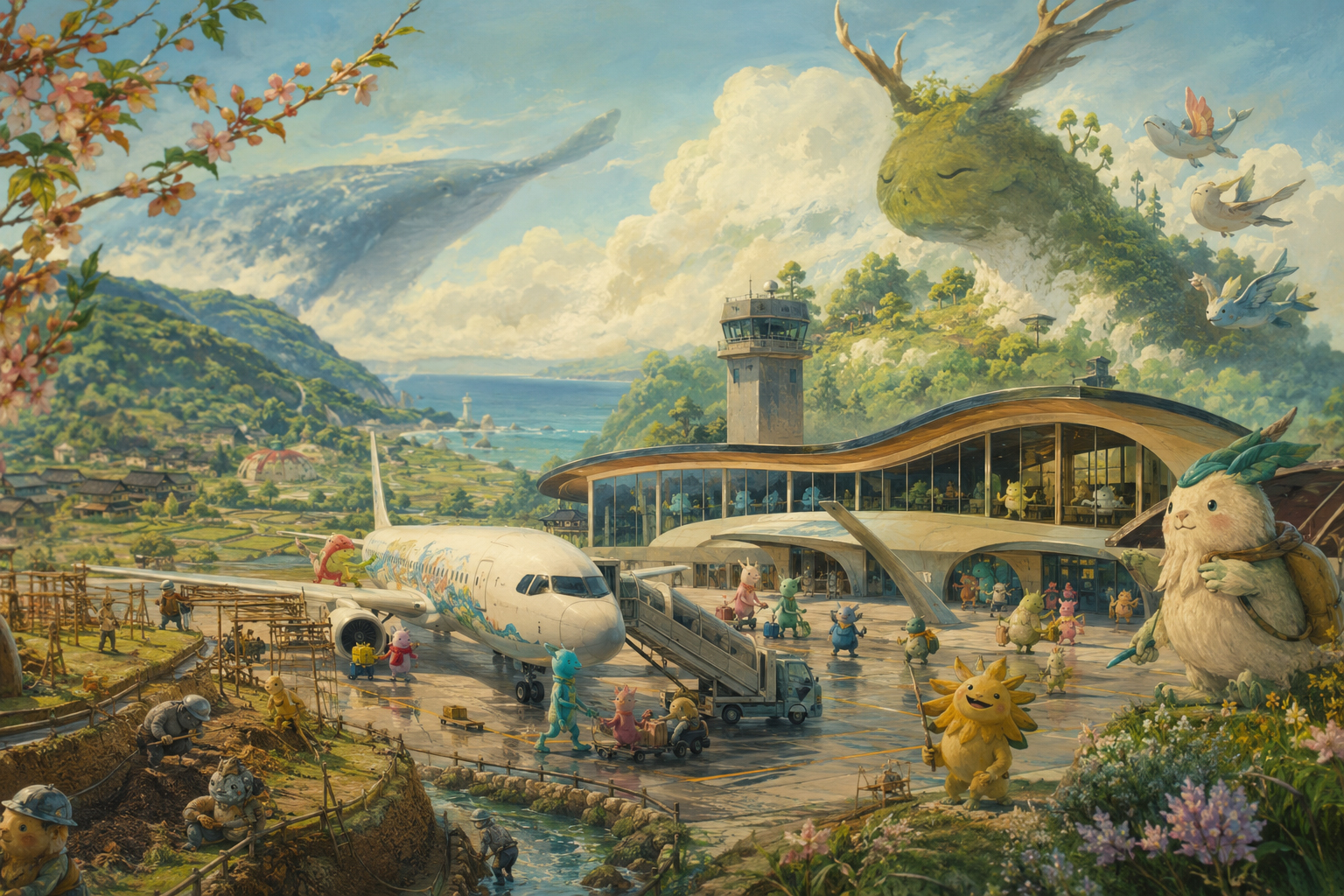
Pikachu is landing at Noto’s front door. On July 7, 2026, Noto Satoyama Airport in Wajima, Ishikawa Prefecture, is scheduled to reopen for a limited run as “Noto Satoyama Pokémon With You Airport.” It will be the first airport in the world to carry the Pokémon name. In the terminal’s airy second-floor atrium, a giant Pikachu and an airplane balloon will float above travelers, while the airport grounds are set to feature decorations of all 111 flying-type Pokémon known as of May 2026.
This is not just a cute makeover. It is pop culture pressed into the service of recovery. The Noto Peninsula was devastated by the January 1, 2024 earthquake. Homes, roads, fishing communities, inns, shops, and the emotional confidence of the region were shaken. Ishikawa Prefecture and the Pokémon With You Foundation are using the airport renewal to cheer children, rebuild tourism demand, increase the number of people with a relationship to Noto, and bring bustle back to a peninsula that has had more than its share of silence.
The phrase “with You” sounds gentle, but it carries history. After the 2011 Great East Japan Earthquake, Pokémon became part of recovery support in Tohoku, bringing activities, trains, and community projects to children and families. A character cannot rebuild a road. A balloon cannot restore a water system. But a smile can restart movement. A family trip can become local spending. A photo can become a reason for someone else to visit.
First: it is fun. That matters.
The official plans are wonderfully over the top in the best possible way. The second-floor atrium becomes a sky scene. A large Pikachu and an airplane balloon hover overhead. Pokémon appear to fly through the terminal. On the first floor, visitors are welcomed by a large version of the recovery-support artwork “Akarui Mirai,” or “Bright Future.” Pikachu, Plusle, and Minun from the artwork become three-dimensional monuments.
The project reaches beyond posters. Exterior signage, entrance columns, boarding bridges, restaurants, shops, original art, special menus, and exclusive goods all become part of the story. The idea is simple: the trip should begin the moment the traveler lands. For a regional airport, that is powerful. A small airport is not only a transport node; it is the first handshake between a place and the outside world.
The renewal also gives people a reason to go. A family might visit because a child wants to see the airport. A fan might fly in to collect photos, stamps, and goods. A traveler who might have stopped at Kanazawa might decide to keep moving north. That is what recovery tourism needs: not pity, but momentum.
The earthquake behind the cuteness
On January 1, 2024, a magnitude 7.6 earthquake struck the Noto Peninsula. The quake reached Japan’s maximum seismic intensity of 7 and triggered tsunami warnings, ground uplift, liquefaction, landslides, fires, and long-term infrastructure disruption. Wajima, Suzu, Noto, and Anamizu became familiar names not through travel pages but through disaster coverage.
Noto’s recovery is hard because the region’s geography is hard. The peninsula is mountainous, coastal, rural, aging, and thinly connected. Roads matter more there because there are fewer alternatives. Tourism matters because it supports inns, restaurants, shops, guides, farmers, fishers, and craftspeople. Then, in September 2024, record rain hit the quake-stricken region, adding another layer of damage to communities already trying to recover.
That is why the Pokémon airport is more serious than it looks. It will not solve the reconstruction backlog. It will not erase grief. But it can create a cheerful doorway into a region that needs visitors, spending, confidence, and attention. Sometimes recovery begins with a practical question: “How do we get people to come here again?” Sometimes the answer is a giant yellow electric mouse floating in an airport atrium.
The peninsula of satoyama and satoumi
The airport’s original name, Noto Satoyama Airport, already tells a story. Noto is famous for its satoyama and satoumi culture: the meeting of human settlement, forest, farms, rice fields, fishing villages, salt-making, lacquerware, festivals, markets, and coastal life. It is a place where landscape and livelihood have shaped each other over centuries.
Noto’s appeal is not a single postcard. It is a sequence: Shiroyone Senmaida’s rice terraces, the memory of Wajima Morning Market, Wakura Onsen, Suzu’s salt, the Kiri-ko festival culture, coastal roads, seafood, farm stays, lacquer, and quiet villages where the sea is never very far away. Recovery tourism cannot be built around one terminal or one monument. It needs routes.
That is why the broader “Oideyo! Pokémon Noto Meguri” campaign matters. The airport is the beginning, but the peninsula is the adventure. Digital photo spots, a stamp rally, photo campaigns, wrapped buses, footbaths, monuments, roadside stations, and local attractions are designed to move visitors through the region rather than leave them in one place.
The Pokémon bus as tiny expedition
Starting July 18, 2026, Pokémon-wrapped buses are scheduled to help visitors move through Noto. One route will connect Kanazawa Station, Noto Satoyama Pokémon With You Airport, and Wajima. Another, the Pokémon Noto Meguri bus, is planned as a loop linking Wakura Onsen, the airport, Yanagida Botanical Park, Mitsukejima, Anamizu Station, and other stops.
This is very Japanese in the best way. Japan has long understood that travel is not only about destinations. It is also about trains, station lunches, stamps, local mascots, limited goods, observation decks, and the joy of the route itself. For children, a wrapped bus is not transport; it is an event. For adults, it lowers the stress of navigating a recovering rural peninsula. For local businesses, it becomes a path that carries visitors from airport to hot spring, from photo spot to restaurant, from bus stop to shop.
Think of Pokémon here not as decoration but as connective tissue. It links the sky to the road, the airport to Wajima, the hot spring to the coast, the child’s excitement to the parent’s itinerary, the fan’s photo to the local rice cracker, seafood bowl, inn, or souvenir.
The Pokémon With You lineage
Pokémon’s disaster-recovery role did not begin in Noto. After the 2011 Great East Japan Earthquake, Pokémon supported children in Tohoku, and those efforts evolved into longer-term regional revitalization. The Pokémon With You train on the JR Ofunato Line became one of the most visible examples: a train of color, play, and comfort moving through a region rebuilding after trauma.
Using characters in disaster recovery can raise fair questions. Is it too commercial? Does it make disaster cute? Does it turn pain into tourism? Those questions deserve respect. But there is another truth: children need safe joy. Parents need reasons to make normal memories again. Communities need visitors who come not as spectators of tragedy but as guests of a living place.
Pokémon works because it crosses generations and borders. Parents played it. Children know it. Overseas travelers recognize it. Grandparents may not know every species, but they know Pikachu. Few cultural assets are that broadly legible. For a rural region trying to reintroduce itself to the world, that matters.
An airport is a promise
Airports are more than runways. They are promises. They tell arriving travelers what kind of place they have entered. A major international airport promises efficiency, scale, and speed. A regional airport has a different job: it must make the traveler feel that the place is distinct, close, and worth entering slowly.
Noto Satoyama Pokémon With You Airport can do that. The moment a traveler arrives, the region says: this place has been hurt, but it is not only hurt. It has humor. It has children. It has sea roads and rice terraces. It has buses and footbaths and food and local crafts. It has a giant Pikachu in the sky, and that is allowed to be wonderful.
For Noto, the airport becomes a gateway and a stage. For travelers, it becomes a memory before the trip has properly started. For Japan, it becomes a case study in how national pop culture can support a local recovery without burying the local identity underneath the brand.
Fun recovery is not disrespectful
After a disaster, two kinds of time run side by side. One remembers loss. The other tries to let ordinary life return. A region cannot live only in mourning. It also cannot pretend nothing happened. Good recovery tourism must hold both truths.
The Pokémon airport does not erase the earthquake. It gives people a cheerful, careful reason to visit a place still recovering from it. Visitors should check road, lodging, restaurant, and facility status before traveling. They should avoid intrusive photography around damaged areas and respect local guidance. But they should also feel welcome to enjoy themselves. Buying lunch, staying overnight, taking a bus, sharing a photo, and bringing a child to smile in the terminal are all small acts of economic and emotional support.
That is the charm of this story. It is not grand policy language. It is not a reconstruction white paper. It is a travel invitation with wings.
Japan.co.jp view
Japan.co.jp sees Noto Satoyama Pokémon With You Airport as one of the most interesting regional-recovery ideas of 2026. It joins Japan’s character power, rural tourism, transport infrastructure, and disaster recovery in a single, visible project. If it works, it will not be because Pokémon alone saved Noto. It will be because Pokémon helped people notice Noto, reach Noto, move through Noto, and spend time in Noto.
Japan has world-class characters, world-class food, world-class landscapes, and world-class regional stories. Too often, they remain separate. This project tries to connect them: airport, bus, photo spot, hot spring, food, goods, stamps, roads, coastline, children, fans, and local businesses.
Noto’s recovery will be long. Pikachu cannot finish it. But if Pikachu makes one child laugh, if that laugh brings a family north, if that family buys dinner in Wajima or a souvenir in Anamizu or takes a bus through a peninsula they had never considered, then something real has happened.
The plane lands. The door opens. A child looks up. Pikachu is flying. For a moment, Noto’s recovery has wings.
Reader guide
| Item | What to know |
|---|---|
| What is happening? | Noto Satoyama Airport is being renewed for a limited time as Noto Satoyama Pokémon With You Airport. |
| When? | Scheduled opening: July 7, 2026. Planned run: through September 30, 2029. |
| Why it matters | The project supports tourism recovery, children’s encouragement, and regional revitalization after the 2024 Noto Peninsula earthquake. |
| Highlights | A giant Pikachu and airplane balloon, 111 flying-type Pokémon decorations, recovery-support art, special food, and original goods. |
| Beyond the airport | Pokémon-wrapped buses, digital photo spots, stamp rallies, footbaths, monuments, and travel routes across Noto. |
Sources and references
This article was prepared from public materials from Ishikawa Prefecture, Noto Satoyama Airport, the Pokémon With You Foundation, Ishikawa tourism information, Japan’s Cabinet Office disaster white paper, and Japan.co.jp editorial notes.
- Ishikawa Prefecture / PR TIMES: announcement of the Noto Satoyama Pokémon With You Airport opening on July 7.
- Ishikawa Prefecture PDF: official details on the world’s first airport bearing the Pokémon name.
- Pokémon With You Foundation: renewal and recovery-support outline.
- Noto Satoyama Airport: airport notice.
- Ishikawa Prefecture / PR TIMES: Oideyo! Pokémon Noto Meguri, photo spots, wrapped buses, and stamp rally.
- Ishikawa Travel: current travel and recovery information after the 2024 Noto Peninsula earthquake.
- Cabinet Office Japan: 2025 Disaster Management White Paper on the Noto earthquake.
- JapanGov Kizuna: Pokémon with Tohoku and the history of post-disaster support.