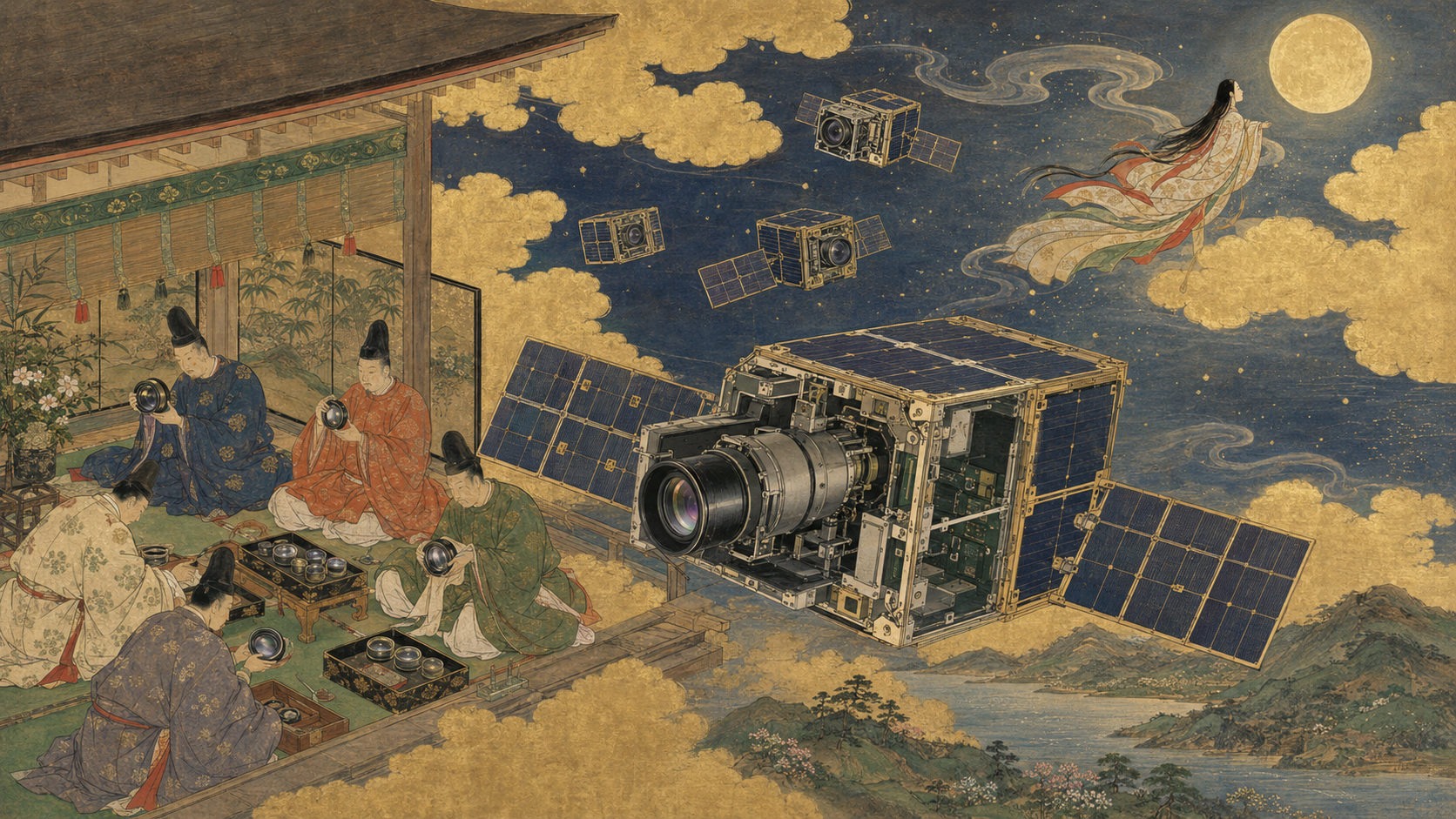
Seven satellites, seven Japanese eyes
Seven GRUS-3 microsatellites built by Tokyo-based Axelspace rode SpaceX’s Transporter-17 mission into orbit on July 7. Inside each is optical telescope technology supplied by Nikon. All seven spacecraft later returned first signals and completed critical initial operations.
The pairing is more consequential than a familiar camera name appearing on a payload list. Axelspace needs repeated, compact imaging instruments that can survive launch and produce comparable Earth data. Nikon is testing whether precision optics accumulated over more than a century can become an industrial component of a commercial satellite fleet.
What “telescope” means here
A remote-sensing telescope does not primarily photograph stars. It collects light reflected from a narrow strip of Earth and focuses it on detectors while the satellite races several kilometres each second. The instrument must resolve ground detail, separate useful wavelengths and maintain geometry accurate enough to place pixels on a map.
The public announcement identifies Nikon optical telescope technology aboard GRUS-3; it should not be read as proof that a retail NIKKOR lens or consumer camera was installed. Detailed aperture, focal length, detector and proprietary optical-layout specifications have not all been publicly disclosed. Responsible analysis separates confirmed supply from inference.
Why a space telescope is not a camera-store lens
On Earth, gravity, air and technicians are taken for granted. In orbit, launch vibration tries to shift mirrors and mounts; vacuum changes heat transfer and can release contaminants; repeated sunlight and eclipse produce thermal cycles; radiation ages electronics and detectors. There is no repair bench.
Optical surfaces, structures, coatings, adhesives and baffles must work as a system. A tiny alignment change can blur imagery or move it on the ground. Stray light from the Sun, Earth or internal reflections can wash out contrast. Materials must be chosen for low outgassing so vapour does not condense on cold optics.
The telescope is only one link in an imaging chain
Image quality is jointly created by the aperture and optical design, detector sampling, spacecraft pointing, motion compensation, exposure, electronics and ground processing. A superb telescope on a jittering bus produces poor data; stable pointing cannot recover detail the optics never transmitted.
Engineers summarize optical sharpness with the modulation transfer function: how well contrast survives at different spatial frequencies. Customers see its consequences in the ability to distinguish field edges, roads and roofs—not merely in a nominal ground-sampling-distance number.
Nikon before satellites
Nippon Kogaku K.K., the company that became Nikon, was established in 1917 by consolidating Japanese optical businesses. It developed binoculars, microscopes, surveying instruments and other precision equipment before the Nikon camera name became internationally famous after the Second World War.
Later businesses extended into semiconductor lithography and industrial metrology. Those fields demand control of lenses, stages, illumination, nanometre-scale positioning and manufacturing variation. Space optics is not identical, but it draws on the same institutional habits: optical design, glass and coating knowledge, precision machining, cleanliness, measurement and traceability.
The historical lesson is that industrial capabilities migrate. Consumer photography built brand recognition; scientific and production instruments built less visible knowledge that can be applied to orbit.
Japan’s longer optical-observation lineage
Japan’s spaceborne Earth observation grew through government missions such as MOS, JERS, ADEOS and the ALOS series. Large national spacecraft helped establish domestic competence in sensors, pointing, calibration, mapping and disaster response.
GRUS represents a different industrial model. Rather than designing one unique national instrument around a decade-long program, a startup orders and integrates repeated payloads for a commercial service. Established suppliers can sell specialized subsystems while the constellation operator concentrates on spacecraft integration, tasking and data products.
Axelspace and the microsatellite argument
Axelspace was founded in 2008 by engineers shaped by the University of Tokyo’s microsatellite movement and Japan’s Hodoyoshi approach. The idea was not that small satellites outperform large ones in every dimension. It was that right-sized requirements, shorter development and repeat production could make useful missions affordable.
After custom spacecraft, Axelspace launched its first GRUS Earth-observation satellite in 2018 and developed AxelGlobe as an imagery service. GRUS-3’s seven units move the company from proving spacecraft toward operating a fleet designed for frequent revisit.
Why seven identical telescopes are an industrial test
For one instrument, technicians can spend extraordinary effort tuning exceptions. Seven units expose whether drawings, tooling, supplier controls and tests can reproduce performance. The seventh telescope must not have a different colour response, focus or distortion that an analyst mistakes for Earth change.
Repeatability reduces integration surprises and permits common software, spare strategies and calibration procedures. It also creates learning: defects can be traced, assembly time shortened and later batches improved. This is the bridge from craftsmanship to production without abandoning precision.
Calibration makes a constellation one instrument
After launch, teams photograph known landscapes, compare overlapping scenes and model how each detector and telescope responds. Radiometric calibration aligns brightness and colour; geometric calibration aligns pixels with locations; cross-calibration aligns one satellite with the other six and, where possible, established reference missions.
If GRUS-3A sees a field on Monday and 3F sees it Tuesday, an apparent vegetation change must come from the field, not different optical personalities. Calibration is therefore part of the commercial product, not a scientific afterthought.
Thermal stability: focus without a focusing hand
Materials expand and contract as temperature changes. In a long-focus optical system, microscopic motion can alter focus or distortion. Designers manage this through low-expansion materials, matched coefficients, structural geometry, heaters, radiators and thermal models.
The satellite may also point away from its usual orientation to capture a target, changing which surfaces see sunlight. A useful instrument must remain predictable across operational attitudes, not only in a comfortable laboratory test.
Contamination: an invisible enemy
A fingerprint would be unacceptable on precision optics; molecular films can be equally damaging in orbit. Plastics, adhesives and lubricants may release vapour in vacuum. Thruster products or particles from deployment can reach sensitive surfaces.
Clean rooms, material screening, bake-out, covers and carefully planned vent paths reduce risk. Contamination control connects every supplier: a clean Nikon telescope can still be harmed by material elsewhere in the spacecraft.
Small satellites force difficult trades
More aperture gathers light and can improve diffraction-limited resolution, but larger optics add mass, volume, structural stiffness and cost. Longer focal length enlarges the image scale but complicates packaging. Narrower ground coverage may sharpen detail while reducing the area collected per pass.
GRUS-3 must balance resolution with swath, exposure time, pointing accuracy, downlink volume and fleet price. The best telescope is not the largest; it is the one whose performance fits the entire service.
A supply-chain story, not merely a component story
Commercial constellations need optics, detectors, structures, power systems, radios, processors, ground stations, launch integration, insurance and software. A recognizable supplier can increase customer confidence, but heritage alone is insufficient: schedules, yields, costs and documented performance determine whether a supply chain scales.
For Japan, the strategic opportunity is to connect established precision manufacturers with younger satellite companies. The risk is treating space as bespoke prestige work, with prices and lead times incompatible with replenishable fleets.
Economic promise—and hard questions
If Nikon can standardize space telescope production, it can reach customers beyond one mission. If Axelspace can buy proven domestic optics, it can reduce vertical integration and concentrate capital on constellation operations. Both gain only if manufacturing volume becomes repeat business.
| Question | Why it matters | Evidence to watch |
|---|---|---|
| Are seven units consistent? | Change analytics require comparability. | Cross-calibration results |
| Can production repeat? | Fleets need replacements and new batches. | Yield, schedule and follow-on orders |
| Does performance survive orbit? | Launch and thermal cycling can shift optics. | First-light and commissioning quality |
| Is the economics competitive? | Excellent optics can still be too costly. | Constellation price and service margins |
What not to conclude
Nikon’s participation does not by itself reveal classified-quality imaging, guarantee commercial success or prove that every future Axelspace satellite will use the same design. Nor does a telescope alone determine published resolution.
What it does demonstrate is concrete: a major Japanese precision-optics company has placed repeated optical technology aboard seven domestic commercial microsatellites. That is a meaningful step from experiments and one-off partnerships toward an ecosystem.
What to watch next
Watch first-light images, completion of geometric and radiometric calibration, consistency across all seven spacecraft and the formal start of GRUS-3 services. Later, watch whether Nikon and Axelspace disclose follow-on batches, export customers or expanded payload cooperation.
The enduring image is not a Nikon camera floating in space. It is a production relationship: seven carefully aligned eyes, built on Japanese optical history, expected to look at Earth as one dependable instrument.
Sources and further reading
- Axelspace press archive — GRUS-3 launch, Nikon optics and mission updates.
- Axelspace, July 10, 2026 — seven-spacecraft critical-operations status.
- Nikon corporate history — origins and development of the precision-optics business.
- Nikon technology — optical, precision and manufacturing capabilities.
- JAXA ALOS-3 — Japanese optical Earth-observation context.
- NASA Small Spacecraft Institute — remote-sensing payload engineering context.
- Exolaunch: Transporter-17 — launch integration and deployment.