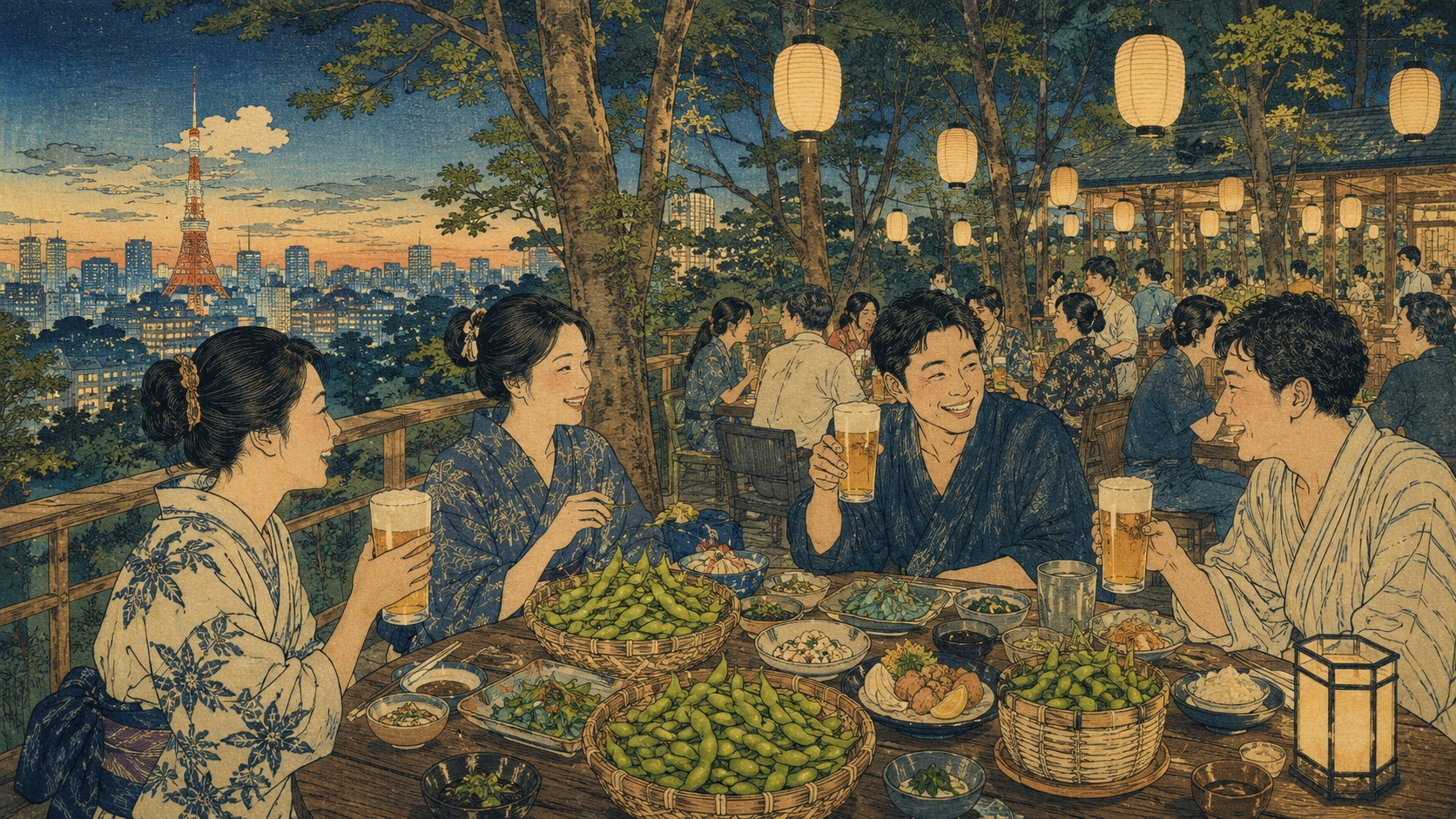
Niigata Prefecture announced on July 23, 2026, that Niigata-grown edamame would be served within each barbecue plan at the Forest Beer Garden beginning August 3. Tsumari chamame is the planned variety. The promotion will end when its planned inventory is exhausted, without advance notice. The announcement does not state a separate price, portion size or exact cooking method. This report is based on information available by 6:00 a.m. Japan time on August 1, so it does not treat the actual launch, final variety, inventory, taste or customer response as verified.
Tokyo is not receiving what Niigata had left over
By mid-afternoon at Meiji Jingu Gaien, the air carries the sound of meat hitting hot grills and the shine of condensation running down beer glasses. Into an outdoor venue of about 900 seats comes a mound of green pods. Edamame is so familiar at a Japanese beer table that it can become almost invisible. Unless diners are told that this batch comes from Niigata, that Tsumari chamame is the planned variety and that quantities are limited, the bowl may vanish before its story is noticed.
Yet this is not a generic side dish. It comes from the prefecture with Japan's largest edamame acreage, even though Niigata-grown pods are less common in metropolitan markets than that ranking might suggest. The prefecture explains the discrepancy with a striking cultural fact: local people eat a great deal of what the region grows. Bowls and baskets piled high with freshly boiled pods became such a recognizable domestic scene that the government named the custom the “Niigata Edamame Mound.”
Tokyo is therefore not being sent whatever Niigata failed to consume. A special share must be harvested at the right stage, cooled, graded, moved and fitted into a large restaurant operation before its quality clock runs down. Scarcity is created not only by limited production, but by strong home demand and a short window in which sweetness, aroma and umami remain intact.
First in acreage, seventh in shipments: the arithmetic of an edamame kingdom
The headline statistic is substantial. Using national vegetable production data, Niigata reports an average planted area of 1,510 hectares in 2021–2023 and says the prefecture held Japan's top acreage position for 16 consecutive years through 2023. The prefecture's 2026 campaign materials, however, place Niigata only seventh in shipment volume.
It would be too simple to calculate the entire gap as “what residents ate.” Acreage and shipments can diverge because of household consumption, direct sales, local distribution, grading losses, yields and cultivation patterns. The promotion does not publish a complete material balance. What it does document is a culture of unusually strong demand inside the producing region.
Even the often-repeated “No. 1 in consumption” line needs precise translation. The statistical basis is an average annual household purchase of 4,720 grams in Niigata City for 2022–2024, ranking first for 16 consecutive years among prefectural capitals and ordinance-designated cities. But the official household category is sayamame, or podded beans, which includes edamame as well as green beans, broad beans and others. It is strong evidence of a bean-eating city, not a direct measurement of pure edamame intake per person across the whole prefecture.
Remove the promotional shorthand and the paradox still holds. The largest growing region is not necessarily the largest national supplier. Food that remains embedded in local daily life may be less visible on Tokyo shelves. The Forest Beer Garden promotion turns that invisibility into an event.
In Edo they sold the branch; in Kyoto and Osaka they sold the pod
Edamame is not a modern wellness invention. The National Diet Library traces soybean's entry into Japan from northern China through the Korean Peninsula and notes its deep place among the country's ancient staple crops. Edamame is simply soybean eaten while the seed is still immature.
The exact beginning of the practice is uncertain, but the 1712 illustrated encyclopedia Wakan Sansai Zue records that young yellow-soybean pods were eaten. A later survey of urban customs, Morisada Manko, described a revealing regional difference: sellers in Edo kept the beans on their branches, which produced the name edamame, “branch beans”; in Kyoto and Osaka, they removed the branches and sold the pods, calling them sayamame.
The name thus carried the retail form. Edo buyers saw a seasonal plant, not an anonymous processed ingredient. Before refrigeration and express freight, the branch may also have acted as a visual promise that the crop had not traveled far. That is an inference rather than a claim made by the source, but it echoes today's labels—“morning picked,” farm named, field traced—that help diners imagine a field they cannot see.
In 2026 Tokyo, the branches are gone. The pods arrive through a refrigerated chain, and origin must be restored through menus, signs and staff explanation. The seller's task remains the same: persuade the customer that this flavor belongs to now.
From rice-paddy levees to a relay of about 40 varieties
Niigata's official brand history says edamame was long cultivated on the raised banks around rice paddies. During the Showa era, removing pods from branches could be a job for children. What looked like a supporting crop in Japan's most famous rice landscape gradually became a major horticultural identity of its own.
The prefecture's strength does not depend on one dominant variety. Roughly 40 types form a relay from May into October. Early green edamame gives way to Niigata chamame, then sweeter late-summer chamame and larger late varieties. The main period of rising production and greater out-of-prefecture availability runs from mid-July through early September. August 3 sits in the heart of that window.
The relay extends the selling season, but it also distributes farm labor, matches varieties to microclimates and gives local consumers a sequence of changing aromas. It creates a summer calendar that complicates Niigata's national image as a one-crop rice prefecture.
Official materials point to farms that harvest before dawn, use transplanting for tighter growth control, preserve and select local seed lines, or invest in compost and soil building. Not every producer follows one method. The larger point is competitive pressure: a population accustomed to eating large amounts of edamame compares varieties at close range, forcing production skills to improve.
Bigger is not always better
Edamame is an immature soybean. As it moves toward maturity, the seed becomes larger, but peak eating quality does not always coincide with maximum size. Niigata's brand guide says some chamame varieties are best at an “eight-tenths pod,” before the pod is completely filled. Aroma, sugar, savory components and texture can reach balance before the bean looks visually impressive.
This is one of the hardest truths to sell in agriculture. Size is easy to photograph, weigh and standardize. Peak fragrance must be judged by variety, field, weather and day. Waiting may add yield, but it can also move the crop away from the profile a grower wants. A producer chooses between the day that produces more crop and the day that produces better flavor.
The diner at a beer garden sees only a pod a few centimeters long. Behind it lies a decision about whether agriculture is optimizing kilograms or taste. The premium attached to a named chamame is payment not only for weight, but for that decision.
Tsumari chamame: selling Snow Country as aroma
The planned variety for the promotion is “Tsumari Chamame,” produced by Yanagi Nosan in the Tsumari region of Tokamachi and Tsunan. Its name places an old regional identity in the foreground. The customer is not buying a faceless green vegetable, but a place associated with heavy snow and mountain agriculture.
Yanagi Nosan says its fields lie at elevations of roughly 300 to 600 meters and describes large day–night temperature differences, snowmelt water and dark volcanic soil as elements of the growing environment. The company says it specializes in chamame across about 70 hectares and uses soil analysis, harvest judgment and cooling to protect quality. These are producer descriptions; this article has not independently measured how much each factor contributes to a particular serving. Their value is that they translate the vague romance of “Snow Country flavor” into specific agricultural claims that can be examined.
The beans also have a documented competition result. At the Japan Vegetable Sommelier Association's third National Edamame Championship in 2024, certified evaluators blind-tasted 26 entries with product, location and producer concealed. Tsumari Chamame received the highest gold award. The prefecture and producer also report that it won the first competition in 2022.
That does not create an eternal, universal ranking of every future harvest against every edamame grown in Japan. It records a strong result within a defined field and judging method. Still, blind evaluation carries more weight than a self-awarded slogan. For one day, among 26 anonymous entries, its balance of sweetness and umami rose to the top.
Freshness is not background; it is an ingredient
The most dangerous distance for edamame is not measured only in kilometers. It is time held at the wrong temperature. A 2015 postharvest study of two green-soybean varieties found that at 15°C or above, sugar content fell to roughly 80% or less of harvest level within three hours, while free amino acids fell to roughly 80% or less within six hours. At 10°C or below, appearance and key components were retained much longer.
The experiment did not test Tsumari Chamame itself. It does demonstrate the broader biology of edamame: harvested pods keep respiring and consuming what the plant accumulated. Sweetness and savoriness are not completed forever in the field. They can be preserved—or spent—after harvest.
Niigata's 2026 promotion describes cool early-morning harvesting as one of the prefecture's quality practices. Yanagi Nosan, in a 2025 product announcement, described a different “fresh-picked” system: harvesting during the day to target accumulated flavor, then immediately washing, removing field heat and rapidly refrigerating the crop. Those descriptions do not necessarily refer to the same lot or specification. They show that harvest time cannot be separated from variety, weather, cooling capacity and the speed of the entire chain.
The serious question for Tokyo diners is therefore larger than the phrase “morning picked.” How long passed before pre-cooling? At what temperature did the pods move? How were they held at the venue? How long before boiling? Freshness is not a poetic adjective. It is the performance of the supply chain.
From an 1875 Yokohama garden to a 1953 rooftop and a 1984 forest
The beer-garden half of the story has its own lineage. Kirin's historical archive identifies the oldest recorded Japanese use of “beer garden” with the small garden beside Spring Valley Brewery in Yokohama by at least 1875. It mainly served foreign sailors, with beer cooled in barrels near the brewery.
The postwar urban model arrived in 1953. New Tokyo opened what is regarded as Japan's first high-rise rooftop beer garden on the Dai-ichi Life Building near Osaka Station. Looking down on neon while catching a cooler wind turned the restaurant from an indoor dining box into a stage for consuming the city itself. In 1964, beer gardens offering barbecue appeared, joining outdoor cooking to beer as mass leisure.
The Forest Beer Garden began in 1984. Rather than looking down from a roof, it placed a large urban barbecue operation among the greenery of Meiji Jingu Gaien. The official site calls 2026 its 41st season. It translated the postwar rooftop experience into a park model: groups grilling meat together under trees in the center of Tokyo.
Niigata edamame entering that venue is therefore a meeting of two summer customs. The home basket piled high in a producing prefecture meets the large urban barbecue. An everyday regional food becomes an event in the capital.
2026 Forest Beer Garden guide
| Item | Published information | What to keep in mind |
|---|---|---|
| Niigata edamame | Limited service within each barbecue plan from August 3. Tsumari chamame is the planned variety. | Ends when inventory is exhausted, with no advance end notice. No separate price, portion or precise preparation has been announced. |
| Location | Nikoniko Park, Meiji Jingu Gaien, 14-13 Kasumigaoka-machi, Shinjuku, Tokyo. | About five minutes on foot from JR Shinanomachi or Oedo Line Kokuritsu-Kyogijo stations. |
| 2026 season | April 22 through September 30; generally open daily, with weather-related suspension possible. | The edamame promotion may end far earlier than the venue's season. |
| Summer hours | July 18–August 31: weekdays 2:00–10:30 p.m.; weekends and holidays noon–10:30 p.m.; last order 9:30 p.m. | Confirm operating status, reservations and inventory directly with the venue. |
| Scale | About 900 seats, including roughly 600 under tents. | Serving a delicate seasonal crop at this scale tests boiling, replenishment and temperature consistency. |
| Standard plan | Two-hour all-you-can-eat-and-drink plan, ¥5,980 for adults on July–September weekdays and throughout weekends/holidays. | Terms may change. No separate surcharge for the Niigata edamame was announced. |
| Weber BBQ plan | Two hours with all-you-can-drink, ¥6,980 for adults; food is not all-you-can-eat. | The regular menu lists another grilled-edamame item, which should not be assumed to be the limited Niigata serving. |
Why edamame and beer work—before anyone reaches for a health slogan
The pairing is sensory before it is nutritional. Fingers press a salted pod. A sweet bean and green aroma emerge. Cold lager bitterness and carbonation reset the palate and call for another pod. Eating one shell at a time inserts small pauses between drinks. Because the bowl is shared, it also keeps conversation moving.
Chamame is valued for a pronounced aromatic profile, helping it retain an identity beside grilled meat. The goal should not be to use excessive salt merely to accelerate beer sales, but to boil the bean so its own sweetness and savory depth remain visible. When a named regional crop looks like a free generic snack, the promotion may move volume while failing to communicate value.
Alcohol is not hydration. In an outdoor August setting, diners need water or nonalcoholic drinks, food, shade and attention to their condition. The Forest Beer Garden states that it will not serve alcohol to drivers or people below Japan's legal drinking age. The cultural and culinary value of Niigata edamame does not depend on drinking beer.
The bowl is part of a wider 2026 Niigata brand campaign
The Forest Beer Garden promotion is not an isolated placement. On July 17, Niigata Prefecture, Niigata City and JA organizations held a joint top-sales presentation at Tokyo's Ota Market. The prefecture announced concentrated promotion through August at restaurants, beer gardens and events inside and outside Niigata.
This marks a shift from selling agricultural products only by the box to designing places where people form a memory of them. Wholesalers at Ota Market receive acreage, quality and supply information. Consumers at Meiji Jingu Gaien encounter the crop within a Tokyo summer ritual. The same bean becomes a trade proposition in the morning and a story at night.
The likely economic ambition goes beyond awareness; this is an editorial inference from the campaign structure, not a stated result. If metropolitan consumers begin asking for “Niigata edamame” or “Tsumari chamame” by name, growers have a stronger chance of pricing the cost of optimum harvest timing, pre-cooling and refrigerated logistics into the product. Without visible origin, those investments disappear inside a generic bowl.
Sellout alone cannot measure the real Tokyo test
A limited product that sells out produces an easy headline. But because the planned quantity has not been disclosed, sellout alone cannot measure the scale of demand. The deeper test is whether customers leave with three words—Niigata, Tsumari and chamame—rather than only the impression that “the edamame was good.”
The restaurant faces an operational test. Across roughly 900 seats, can it maintain pod color, boiling point, salt, serving temperature and replenishment? The larger the service, the easier it is for quality created in the field to be lost in the kitchen. Even perfectly timed harvesting is wasted if beans sit warm for too long after cooking.
The producing region faces a longer test. Does the exposure generate repeat orders next season, fair returns to farms, investment in cooling, younger workers and employment in the region? A place brand is not completed by one photogenic night. It becomes durable when desire returns every summer and the value flows back to the field.
- What diners should notice: origin and variety labeling, aroma, pod color, boiling and serving temperature.
- What the venue must protect: cold storage, small-batch cooking, turnover and staff able to explain the crop.
- What growers should gain: named demand, repeat orders, price for quality and investment in logistics.
- What government should measure: not merely sellout, but recognition, purchase intent, future trade and farm return.
Open one pod and Snow Country, Edo and a Tokyo night connect
Edo sellers left beans on their branches and made season visible. Niigata households gathered around baskets large enough to help explain why the country's acreage leader is not its shipment leader. Tsumari farmers turned snowmelt, soil, harvest judgment and cooling into a language of place. A Tokyo beer garden now brings that language into an urban gathering of about 900 seats.
The pod is small, but folded inside it are a statistical paradox, postharvest biology, refrigerated logistics, Edo street commerce, modern brewing, postwar rooftop leisure and contemporary regional policy. Whether it is treated as a free appetizer or as concentrated season and place changes the value of the same bowl.
On August 3, the first basket is scheduled to reach a table in Gaien. Fingers press the pod; its aroma rises; the beans disappear in seconds. That brevity is the essence of edamame. Season, freshness and the limited chance to encounter it do not wait. What Niigata is sending to Tokyo is not a preserved souvenir, but a piece of time that must be caught.
Sources and verification
Japan.co.jp reviewed information published by Niigata Prefecture, the venue, the National Diet Library, the competition organizer, academic researchers and corporate historical archives through 6:00 a.m. Japan time on August 1, 2026. The August 3 promotion had not begun at the research cutoff, so the final variety, quantity, preparation, duration and customer response remain unverified. Promotional claims, official statistics, research findings and editorial inference are identified separately.
- Niigata Prefecture: limited Niigata edamame service at the Forest Beer Garden
- Official Niigata brand guide: history, varieties, harvest and season
- Niigata Prefecture: acreage and household “podded bean” statistics
- Niigata Prefecture: 2026 Ota Market sales campaign and promotion plan
- Forest Beer Garden: 2026 season, hours, prices, capacity and rules
- National Diet Library: edamame in 1712 and Edo–Kyoto/Osaka selling customs
- Japan Vegetable Sommelier Association: 2024 National Edamame Championship
- Yanagi Nosan: Tsumari Chamame origin, brand and cultivation description
- Yanagi Nosan: 2025 “fresh-picked” harvest and cooling description
- Horticultural Research: storage temperature and postharvest edamame quality
- Kirin History Museum: the 1875 Spring Valley Beer Garden
- Kirin History Museum: the 1953 rooftop beer garden
- Kirin History Museum: barbecue beer gardens in 1964
