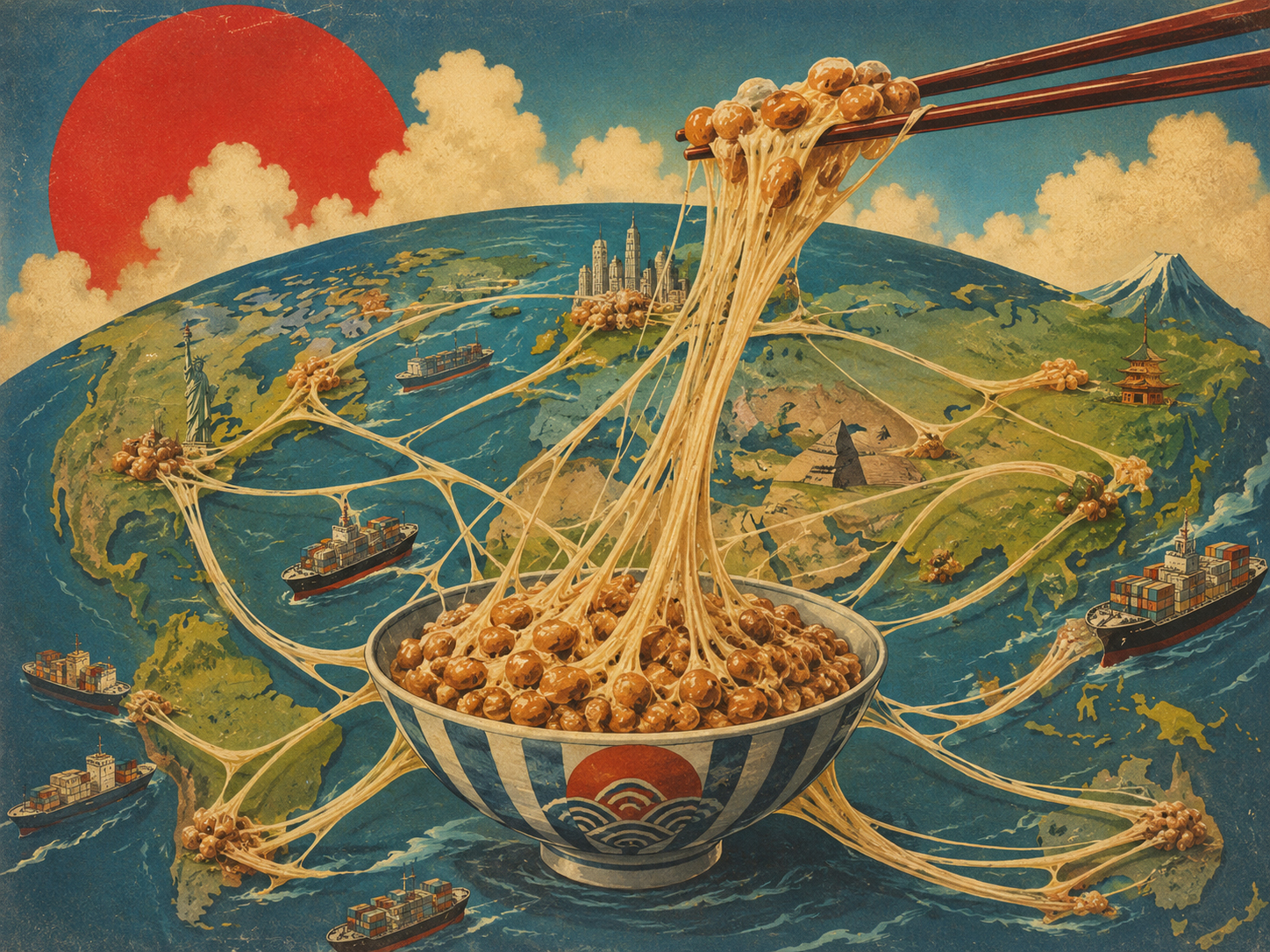
Threads stretching across the world
Open the small foam container. Peel back the film. Add sauce and mustard. Stir with chopsticks and white threads appear between the beans, multiplying with every turn. Lift one bite and the strands refuse to break. For many Japanese consumers this is breakfast. For a first-time eater it can resemble a laboratory event.
That food is moving abroad in rapidly growing quantities. According to 2026 reporting based on Ministry of Finance trade statistics, Japanese natto exports reached 5,248 metric tons in 2025. That was almost triple the 1,752 tons exported in 2017. China and the United States together took roughly half of the total, while demand also expanded in Taiwan, Hong Kong, South Korea, Canada and Australia.
Exports had been about 3,300 tons in 2023, meaning growth accelerated sharply in the following two years. Japan’s broader agricultural, forestry and fishery exports also reached a record ¥1.701 trillion in 2025, supported by global interest in washoku, inbound tourism and health-conscious consumption.
Why natto is selling now
The first reason is familiarity with Japanese food. Sushi, ramen, miso and matcha have become ordinary in major cities. Consumers interested in going deeper eventually encounter foods once considered too local or difficult.
The second is health culture. Natto contains soy protein, fiber, iron, calcium and potassium, and fermentation produces substantial vitamin K2, especially menaquinone-7. As yogurt, kimchi, kombucha and kefir gained status as fermented functional foods, natto entered the same conversation.
The third is frozen logistics. Much exported natto is frozen, shipped long distance and thawed for retail. Cold-chain distribution, Japanese supermarkets, Asian grocery stores and online sales make a pungent product with a short refrigerated life commercially manageable.
The fourth is market adaptation. A Hokkaido producer noticed that even numbers are often preferred in China and developed a four-pack rather than the standard Japanese three-pack. Japanese script was retained on packaging because it signaled authenticity and quality.
Who invented natto?
No one knows. Natto can emerge wherever cooked soybeans, warmth and Bacillus subtilis from rice straw, soil or air meet under favorable conditions. It may have been discovered independently in multiple places.
The Japan Natto Cooperative Society Federation discusses the possibility that natto-like beans emerged near the end of the Jōmon period, when rice cultivation, soybeans and straw containers became available. This is a plausible natural-fermentation theory, not a proven archaeological event.
Ancient Japan also received salty fermented soy products related to Chinese douchi. These temple and court foods differed from today’s sticky natto. Even the word “natto” may originally have referred to beans prepared in a temple storehouse or nassho.
Prince Shōtoku and Minamoto no Yoshiie
One origin legend connects natto with Prince Shōtoku. Leftover cooked soybeans intended for a horse were wrapped in straw, fermented and became sticky.
The better-known story concerns warrior Minamoto no Yoshiie. During campaigns in northeastern Japan in the 1080s, his troops were allegedly interrupted while boiling soybeans as horse feed. They packed the hot beans into straw sacks. Days later, the beans had fermented. Soldiers tasted them, then presented them to Yoshiie, who approved.
These are cultural legends rather than documented invention records. Their importance lies in the way they connect natto to military provisions, horses, rice straw, northeastern Japan and regional identity.
Rice straw was container and fermentation machine
Traditional sticky natto is made by wrapping steamed soybeans in rice straw and keeping them warm. Straw carries spores of natto-producing strains of Bacillus subtilis. The spores tolerate heat, so they can survive treatment that reduces competing microorganisms.
As the bacteria grow on warm beans, they transform proteins and carbohydrates, producing aroma, umami and sticky polymers. One major component of the threads is poly-γ-glutamic acid.
The slime is not failed spoilage. It is the visible result of a controlled microbial ecosystem.
Edo mornings and the natto vendor
Sticky natto became an everyday commoner’s food during the Edo period. Vendors walked city streets early in the morning calling out their goods. Chopped natto also entered miso soup with tofu and green onion.
The familiar breakfast of natto, rice, miso soup and pickles became established in this period. In a society where meat was not an ordinary daily food, soybean products provided important protein.
Popularity remained geographically uneven. Kantō, Tōhoku and Hokkaidō developed strong natto cultures, while many western regions consumed far less. Climate, distribution and local taste all played roles.
| Period | Change | Meaning |
|---|---|---|
| Possible ancient origins | Accidental fermentation of cooked beans in straw | No single inventor; independent discovery is plausible. |
| Nara and Heian periods | Salty fermented soy products at temples and courts | A preserved-bean tradition distinct from modern sticky natto. |
| Edo period | Morning vendors, natto soup and rice breakfasts | Natto becomes common urban food. |
| After 1889 | Mito railway and station sales | A regional food becomes a national souvenir brand. |
| Taishō era | Pure bacterial starters and industrial production | Reliable quality without depending on straw. |
| Postwar decades | Foam packs, included sauce and refrigerated supermarkets | Natto becomes a standardized national retail product. |
| 2020s | Frozen exports, health branding and local adaptation | A breakfast food enters the global fermented-food market. |
How Mito became the natto city
Mito in Ibaraki Prefecture is synonymous with natto. The Yoshiie legend survives in the region, and surrounding farms produced small soybeans well suited to straw wrapping and mixing with rice.
The decisive commercial change came with the opening of the Mito Railway in 1889. Seizaemon Sasanuma sold straw-wrapped natto near the station, turning it into a portable railway souvenir. Transport created the national “Mito natto” brand.
Today Mito supports museums, specialty dishes, giant natto imagery and eating contests. Fermented beans became municipal identity.
Natto entered the laboratory
Traditional straw fermentation varied with temperature, straw quality and competing microbes. Industrial food production required consistency.
In the early 20th century, Japanese researchers isolated natto bacteria and developed pure starter culture. Manufacturers could inoculate cooked beans directly rather than depending on straw as both package and microbial source.
Postwar foam containers, cold distribution, attached sauce and mustard, smaller beans and lower-odor strains completed the transformation from farm fermentation to predictable industrial breakfast.
Why stirring creates more threads
Stirring stretches and aerates the viscous material produced by fermentation. Sauce coats the beans more evenly and the texture becomes smoother.
Some people stir hundreds of times; others barely disturb the beans. There is no strong evidence that extreme stirring dramatically multiplies nutrition. It changes texture, aroma release and personal enjoyment more than health value.
Where the smell comes from
Natto aroma involves ammonia, pyrazines, short-chain fatty acids and other compounds. Strain, temperature, soybean variety, fermentation time and storage all matter.
Old or poorly temperature-controlled natto may develop stronger ammonia notes. Export products use freezing, packaging and lower-odor strains to improve acceptance. Yet eliminating aroma entirely could also remove some of natto’s fermented character.
Real nutrition, not a miracle drug
Natto is nutrient-dense. It provides protein, fiber, iron, calcium and potassium. Fermentation makes it exceptionally rich in the vitamin K2 form MK-7. A small human study found that eating natto increased circulating MK-7.
Vitamin K is essential for normal coagulation and bone-protein function. People using warfarin or other medication affected by vitamin K should not alter natto intake without medical guidance.
Nattokinase, an enzyme identified in natto, is studied for possible effects on clotting and blood pressure and is widely sold as a supplement. That research does not mean ordinary natto is a proven treatment for cardiovascular disease. Observational data and small trials are interesting; they do not replace medication or clinical care.
- Natto is a nutritious food rich in protein, fiber, minerals and vitamin K2.
- Its relationship with gut health is actively studied, but individual effects vary.
- Nattokinase research does not turn natto into a medicine.
- People with soy allergy should avoid it.
- Anyone using warfarin should follow professional guidance on natto intake.
Even many Japanese people dislike it
Natto is often introduced as a national staple, but Japan is divided over it. Western Japan historically consumed less, and many people reject the smell and texture. School meals, television advertising and nationwide supermarkets narrowed the gap without erasing it.
This matters overseas. Natto is not a flavor Japanese people automatically love by biology. Familiarity is learned. Consumers add mustard, green onion, egg, nori, kimchi or other ingredients and build a personal method.
New overseas eaters can do the same. A small amount on rice, mixed with kimchi or avocado, folded into noodles or placed on toast may be a more realistic introduction than a full unmodified bowl.
The paradox of frozen “living food”
Fermented foods are marketed as alive, yet much exported natto is frozen. Freezing slows fermentation and prevents aroma and texture from changing during long transport.
Bacterial spores are resilient, and the defining properties survive thawing, though texture can vary with handling. Meanwhile, local producers in the United States, Europe and Australia are creating fresh natto, bringing frozen imports into competition with domestic fermentation.
The people making natto outside Japan
Small producers abroad include Japanese emigrants, fermentation enthusiasts, vegans and former microbiologists. Some use local organic soybeans, black beans or even other legumes.
This does not necessarily destroy authenticity. Miso, soy sauce and tofu also adapted to local crops and tastes. Natto may preserve its microbial and technical core while changing its cultural surroundings.
The risk is that “superfood” branding strips away the everyday meal. Natto was not traditionally a supplement. It was ordinary food beside rice, soup and pickles. Its ordinariness made long-term consumption possible.
What comes after export growth
Rising exports do not solve Japan’s dependence on imported soybeans. Producers still face questions over domestic supply, pricing, labeling, energy-intensive cold chains, plastic packaging and competition from overseas manufacturers.
Health marketing also requires restraint. Natto’s greatest achievement is not miraculous medicine. It is an old technology that turns inexpensive beans into a flavorful, durable and nutritious food through microbial work.
Will the world accept the strings?
Natto may never become as universally popular as sushi or ramen. Aroma, texture, refrigeration and preparation remain barriers. But 5,248 tons suggests movement beyond a temporary curiosity.
Buyers now include not only Japanese expatriates but Chinese health consumers, American fermentation fans, plant-protein shoppers and chefs seeking deeper washoku knowledge.
Natto is going global without becoming completely easy. Its threads seem ready to break and then hold. Ancient straw, Edo morning vendors, Mito railway souvenirs, pure starter factories, frozen containers and overseas breakfast tables are now joined by the same persistent stickiness.
Sources and further reading
- Mainichi Japan, April 6, 2026: 5,248 metric tons exported in 2025, near-tripling since 2017 and major destinations.
- Japan Ministry of Finance trade statistics: underlying export data.
- Nippon.com: 2023 export volume, China growth and four-pack adaptation by a Hokkaido producer.
- Japan Natto Cooperative Society Federation: ancient accidental-fermentation theory and rice straw.
- Kikkoman Institute for International Food Culture: Edo vendors and breakfast history.
- SHUN GATE, “The Famous Region of Natto”: Mito, small soybeans and the 1889 railway.
- Afzaal et al., 2022: critical review of natto nutrition and health research.
- Tsukamoto et al., 2000: natto intake and circulating vitamin K2.