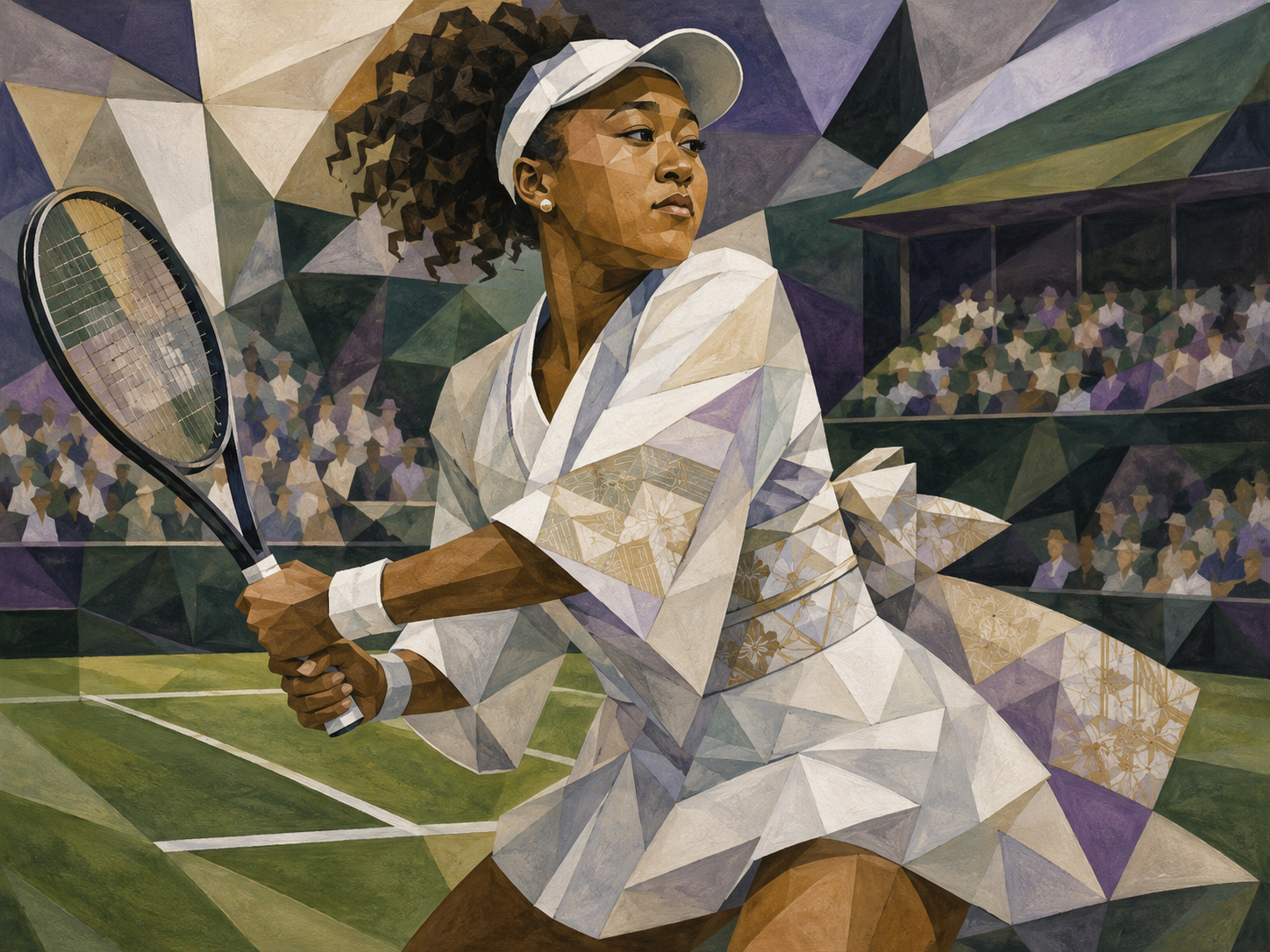
Wimbledon white is not just a color. On the grass courts of southwest London, it is a rule, a ritual, a brand, a memory of Victorian sport and a yearly reminder that tennis still carries the weight of old social codes. In 2026, Naomi Osaka used that white space differently. Before her first-round match, she entered Court 3 wearing a custom, kimono-inspired white look created with Tokyo designer Hana Yagi. It suggested shiromuku bridal dress, ceremonial fabric, cranes, cherry blossoms, an obi-like structure and a flash of cinematic reference to Kill Bill.
The tennis mattered. Osaka beat France’s Elsa Jacquemot 6-1, 7-5 and advanced to the second round. But the day will also be remembered for the walk-on: a few seconds in which sport, fashion, Japanese cultural memory, mixed identity and global media collapsed into one image.
Osaka has been turning Grand Slam entrances into small acts of theater. At the Australian Open she played with jellyfish imagery. At Roland-Garros she explored Parisian and couture ideas. At Wimbledon she chose kimono. For Osaka, clothing is not decoration after the fact. It is part of the match’s emotional architecture. It is a way to enter competition already carrying a story.
Finding another white inside Wimbledon white
Wimbledon’s dress code is among the most famous rules in sport. Players are expected to wear suitable tennis attire that is almost entirely white from the moment they enter the court. Trim is tightly limited. Shoes, headbands, hats and even small details are part of the visual discipline. The rule reaches back to 19th-century ideas of propriety, cleanliness and elite leisure; today, it is central to Wimbledon’s identity.
Osaka’s look did not rebel through color. It worked inside the rule. It made difference through texture, embroidery, layering, silhouette and movement. The effect was not to break Wimbledon white, but to add another kind of white to it: the ceremonial white of Japan.
What shiromuku brings to the story
One key reference is shiromuku, the all-white bridal kimono worn in traditional Japanese weddings. Its whiteness is not merely minimalism. It carries ideas of ceremony, purity, transition and a threshold between one life chapter and another. In older readings, the bride’s white could signal readiness to take on the colors of a new household; in contemporary use, it is often understood as sacredness, renewal and solemn beauty.
Wimbledon white and shiromuku white come from very different histories. One comes from Victorian sport and class-coded propriety. The other comes from Japanese ritual and life passage. Osaka placed them in the same visual field. The result was not costume, but translation.
Reported details such as cranes and cherry blossoms deepened the reading. In Japanese design, cranes often suggest longevity, auspiciousness and grace. Sakura evokes spring, renewal, impermanence and the beauty of a brief moment. On a tennis court, those symbols become surprisingly fitting: a match is short, pressure is intense, and a player’s timing either blooms or disappears.
Naomi Osaka as Japanese soft power
Osaka is not a simple national symbol. She was born in Osaka to a Japanese mother and Haitian father, moved to the United States as a child, represents Japan, and has lived in several cultural worlds at once. She lit the Olympic cauldron at the Tokyo Games and became the first Asian player to hold the world No. 1 singles ranking. She also became one of the few athletes who can make a tennis outfit a global cultural story.
Her 2018 US Open victory was a turning point in Japanese sports history: the first Grand Slam singles title by a Japanese player. She went on to win the 2019 and 2021 Australian Opens and the 2020 US Open. Yet Osaka’s significance reaches beyond trophies. She has spoken publicly about mental health, racism, motherhood, pressure and identity. She has made fashion, gaming, photography and pop culture part of her tennis language.
That is why this Wimbledon moment mattered for Japan.co.jp. It was not simply about a celebrity outfit. It was about how Japan is carried, remixed and seen abroad by a global athlete whose Japanese identity is real but not narrow.
Kimono is not a museum object
When kimono appears outside Japan, it is often flattened into a single idea: “traditional Japan.” But kimono itself has always changed. The garment developed through long shifts in cut, social class, fabric, dyeing, seasonality, urban taste and ceremonial use. In the Edo period, kimono became a canvas for status, style, wit and craft. In modern Japan, it remains present in weddings, coming-of-age ceremonies, tea, festivals, performance, tourism and fashion experimentation.
For contemporary designers, kimono is both heritage and structure. Its straight lines, layers, belts, seasonal motifs and economy of shape offer a different design logic from Western tailoring. Osaka’s Wimbledon look did not simply put a kimono on a tennis player. It translated kimono codes into a short, high-pressure walk-on ritual at one of sport’s most tradition-bound venues.
Tennis fashion has always been political
Tennis has long been a stage where women’s clothing becomes a debate about movement, respectability, sexuality, race, power and commercial visibility. Suzanne Lenglen helped change women’s tennis dress in the 1920s. Althea Gibson, Billie Jean King, Chris Evert, Martina Navratilova, Venus Williams, Serena Williams and many others turned court clothing into a visible part of athletic identity.
Wimbledon sharpens that conversation because the palette is restricted. Players cannot rely on color to differentiate themselves, so shape, material, fit, texture and body movement carry the expression. Osaka’s kimono-inspired walk-on stood out because it did not treat the rule as a wall. It treated the rule as a frame.
The Kill Bill loop
Osaka also cited inspiration from Lucy Liu’s character in Kill Bill. That detail is important because it shows how modern culture circulates. A Hollywood film reimagines Japanese visual codes; a Japanese-Haitian athlete raised partly in the United States later reclaims that cinematic memory and folds it back into her own Japanese self-expression at a British tournament.
This is not pure tradition in a glass case. It is the messy, creative loop of global pop culture. Japanese images travel abroad, become stylized, return home in altered form, and are then used again by artists, athletes and designers who have the right to make them personal.
Why this is a Japan story
This story belongs in sports, fashion and culture. But for Japan.co.jp, it is also a story about how Japan moves through the world. Japanese cultural export is not only anime, manga, food, tourism or government strategy. It can also be a player walking onto a grass court in London and making millions of viewers ask: What is a kimono? What is shiromuku? Why cranes? Why cherry blossoms? Why white?
Osaka’s Japan is layered. It is bridal white and Tokyo design. It is a Nike performance kit and an obi-like silhouette. It is Haitian family history, American sports media, Japanese citizenship, film memory and a player’s own imagination. That layered Japan may be more accurate than a cleaner, simpler version.
Japan.co.jp view
Naomi Osaka’s kimono-inspired Wimbledon look should not be reduced to a viral picture. It was a small lesson in how tradition can remain alive. Tradition survives not only by being preserved exactly, but by being understood, adapted and carried into new settings where new audiences can feel its force.
Wimbledon is one of the most tradition-conscious tournaments in the world. Into that space, Osaka brought another tradition. British white met Japanese white. Grass court met ceremonial garment. Competition met ritual. The result was a walk-on that felt both theatrical and sincere.
Then she won. That matters. Without the win, the outfit might have been remembered only as spectacle. With the win, it became part of a sporting day. In 2026, Naomi Osaka wore white at Wimbledon. But the white was not empty. It was filled with Japan, memory, craft, identity and the next chapter of a player still writing herself in public.
Reader guide
| Question | How to read it |
|---|---|
| What happened? | Naomi Osaka wore a white kimono-inspired walk-on look at Wimbledon 2026 and won her first-round match. |
| Why did it matter? | It reinterpreted Japanese ceremonial dress within Wimbledon’s strict all-white rules. |
| What were the cultural references? | Shiromuku bridal dress, cranes, cherry blossoms, kimono structure and cinematic memory. |
| What was the sports meaning? | The look became part of Osaka’s pre-match psychology, brand language and fan storytelling. |
| Japan.co.jp view | This was not just fashion; it was Japanese soft power translated through a global athlete. |
Sources and references
This article draws on Reuters, WTA, Vogue, The Guardian, People, Wimbledon dress-code reporting, WTA player information, and public references on kimono, shiromuku and Japanese visual symbolism. Match details, rankings and outfit information may be updated as Wimbledon continues.
- Reuters: Osaka defeats Jacquemot after Japanese-inspired kimono walk-on.
- WTA: Osaka’s Wimbledon walk-on and result.
- Vogue: Osaka’s ceremonial-dress-inspired Wimbledon look.
- The Guardian: Wimbledon reaction and cultural context.
- WTA player profile: Osaka biography and career information.