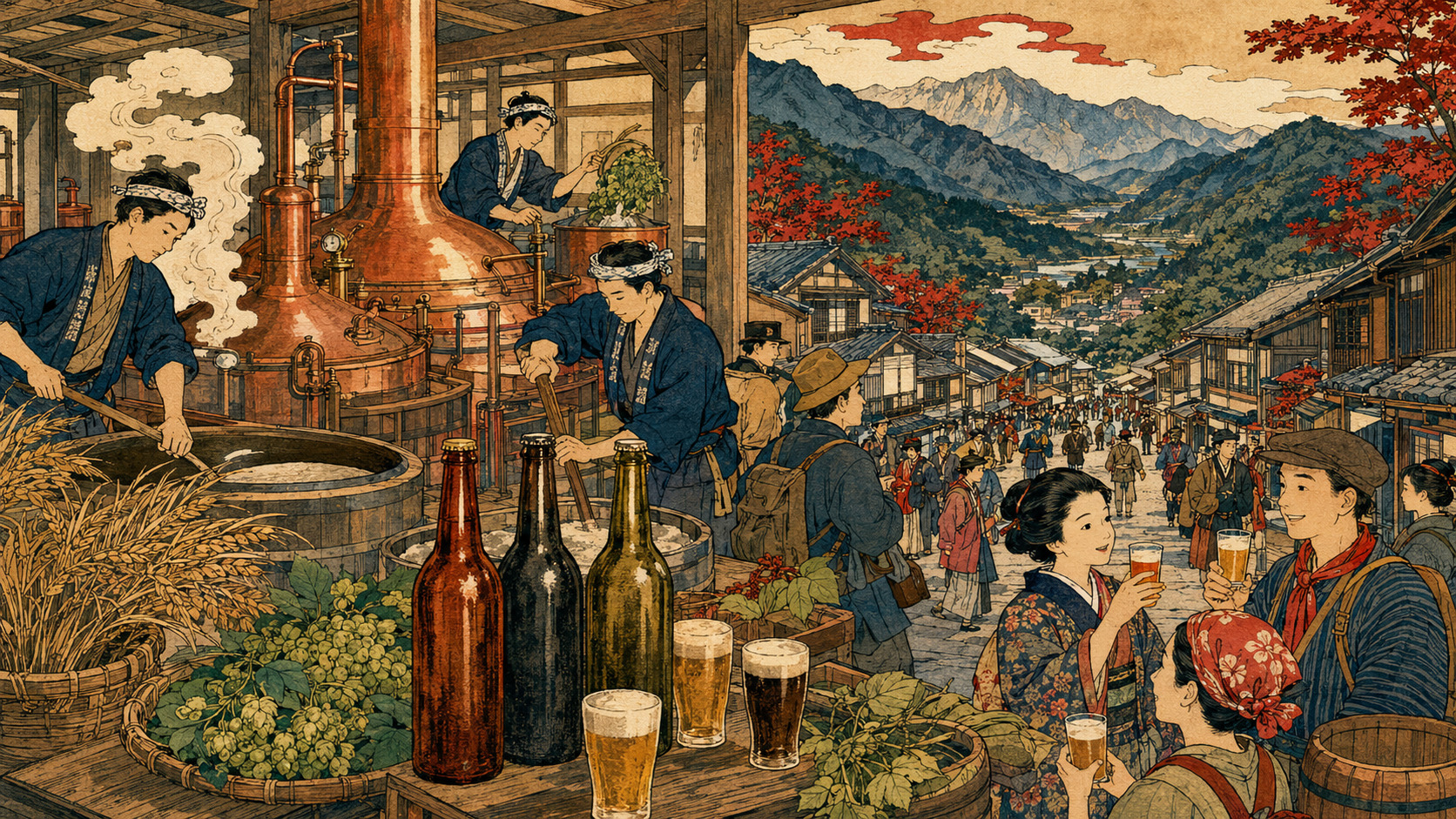
How Three Beers Reached the Bar
On July 12, 2026, Nakatsugawa Brewery released three original beers inspired by the city's nature, history and culture, sold through its attached beer bar and official online store. The company describes it as Nakatsugawa's first craft brewery.
Operator XShip was established in October 2024 with disclosed capital of ¥1 million. The taproom opened on September 12, 2025, alongside crowdfunding for brewing, labels, packaging and R&D. Before its own license, it served outside beer. Founder Kazuki Horikawa trained with CAMADO Brewery in Mizunami. The brewery says its license arrived May 18, 2026, followed by the three-beer launch.
Why Beer Can Become Regional Development
If it sells only liquid, a microbrewery competes with national brands on price and distribution. What a regional brewery can create is a reason to drink in that place. Equipment, aroma, conversation with the maker, local food and limited releases become one experience.
A pint can extend a visitor's stay and spread spending into food, lodging, retail and transport. A bottle ordered after the trip converts memory into repeat purchase and advertises the destination to someone who has not arrived.
A New Reason to Stop on the Nakasendo
Nakatsugawa contains three Nakasendo post towns: Nakatsugawa-juku, Ochiai-juku and Magome-juku. Magome was the 43rd station on the Edo–Kyoto road, and the roughly eight-kilometer walk to Tsumago is popular with international visitors.
The challenge is that many travelers see the landscape and continue. A brewery can become a modern stopping place. Connected with rail, downtown, the old road, meals and lodging, beer becomes a node that encourages circulation rather than an isolated product.
1994 Made Small Japanese Breweries Possible
Postwar Japanese beer was dominated by major producers. A brewing license once effectively required annual capacity of two million liters. Deregulation in 1994 lowered the beer threshold to 60,000 liters and produced a wave of ji-bīru, or local beer.
The first boom included novelty souvenirs with inconsistent quality and weak repeat demand. Technique, temperature control, hops, yeast and bar culture later matured, while the language shifted from local beer toward craft beer.
Nakatsugawa begins 32 years after deregulation. Novelty is insufficient. It needs consistent batches, local regulars, visitor take-home sales and online reorders.
What Happens Inside a Pint?
| Stage | Process | Microbrewery challenge |
|---|---|---|
| Mashing | Convert malt starch into fermentable sugar. | Temperature changes body and fermentability. |
| Boil and hops | Add bitterness, aroma and stability. | Imported hop cost and recipe consistency. |
| Fermentation | Yeast turns sugar into alcohol and flavor. | Sanitation, temperature and yeast health. |
| Conditioning and fill | Refine flavor; move to keg, bottle or can. | Oxygen, carbonation and cold chain. |
| Sale | Taproom, wholesale, events and e-commerce. | Tax, labels, stock and freight. |
Beer is mostly water, but good water does not automatically produce good beer. Minerals, malt, hops, yeast, temperature, oxygen and sanitation must work as one design. Local ingredients still come after quality and safety.
The Hard Economics of a Tiny Brewery
A fermenter occupied by beer cannot make the next batch. Tank turns determine revenue; unsold beer loses freshness and cash. Malt, hops, packaging, carbon dioxide, refrigeration, electricity and delivery are expensive, while small scale raises unit cost.
A taproom offers stronger margin and direct feedback but limited seats. Wholesale produces volume with lower margin. E-commerce reaches nationally but ships heavy liquid at high cost. Sustainability requires a portfolio of channels.
| Channel | Strength | Weakness |
|---|---|---|
| Taproom | Margin, experience, feedback. | Seats, hours, staffing. |
| Restaurants and retail | More local touchpoints. | Wholesale margin and stock control. |
| E-commerce | Post-trip reorders and national reach. | Freight, advertising, breakage, age checks. |
Crowdfunding Is More Than Advance Selling
Crowdfunding can generate capital, first customers, storytellers and feedback. A lender studies past performance; a supporter purchases a future expectation.
Support is not automatically recurring demand. A celebratory purchase by friends differs from a customer repeatedly paying full price. Delayed rewards or inconsistent beer can disappoint the earliest believers most severely.
Put Local Identity Beyond the Label
Mountains, post towns and chestnuts can make packaging look local. A genuine regional brand appears in procurement, employment, partnerships and experiences: food pairings, farm ingredients, festivals, trail walks and reuse of brewing by-products.
Local sourcing does not automatically lower environmental impact or cost. Quantity, quality and seasonality require honest disclosure. Precision about what “Nakatsugawa” means protects trust.
Alcohol Tourism Carries Responsibility
Brewery tourism must be designed with drink-driving prevention: rail, walking, lodging, designated drivers and nonalcoholic choices. A regional venue should welcome families and people who do not drink instead of treating alcohol as a universal solution.
Beer is for adults 20 and over in Japan. E-commerce age verification, responsible advertising, sanitation, liquor tax and labeling are heavy but essential fixed obligations for a tiny company.
How Success Should Be Measured
| Brewery | Tourism | Region |
|---|---|---|
| Repeat purchase, tank turns, waste and gross profit by beer. | Length of stay, lodging conversion, movement between trail and downtown. | Local purchasing, jobs, restaurant accounts and joint products. |
Opening-day lines and social reaction are only the beginning. The test comes a year later: do locals choose the beer normally, do travelers reorder at home, and do nearby restaurants keep it on?
From Passing Through to Tasting the Place
The Nakasendo was a road of movement. Regional revival can mean slowing that movement long enough for travelers to encounter local people and products. A microbrewery cannot defeat a giant on volume, but it can win through proximity and specificity.
Three beers will not transform Nakatsugawa by declaration. But a ¥1 million company gathered supporters, opened a bar, learned the craft, obtained a license and launched products carrying the city's name. That sequence is itself a lesson in regional entrepreneurship.
The goal is not merely “beer made in Nakatsugawa.” It is making someone think: “I want to spend a night in Nakatsugawa to drink it there.”