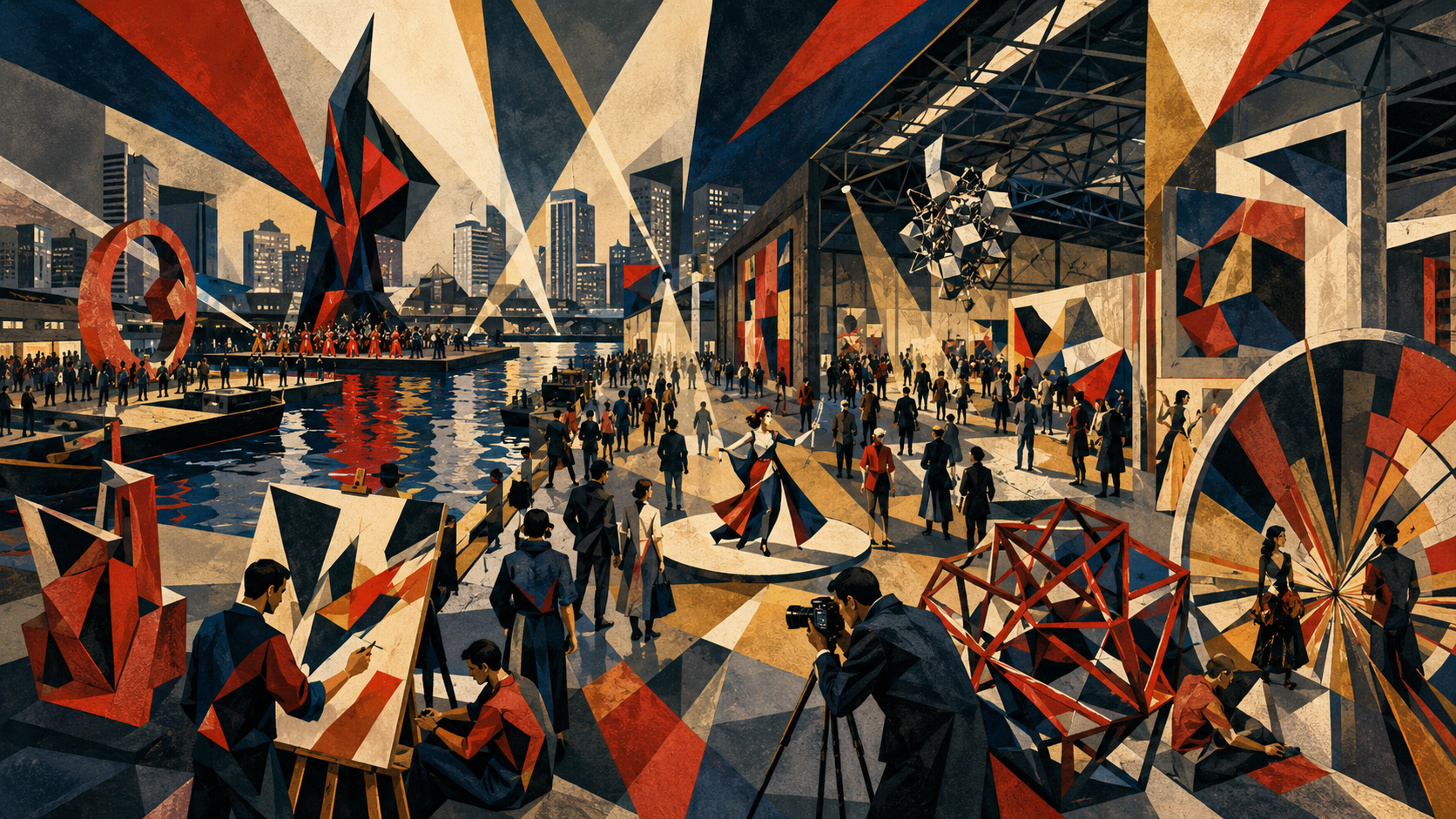
Four days, one waterfront, several different art worlds
MEET YOUR ART FESTIVAL 2026 runs Friday, October 9 through Monday, October 12, around Warehouse TERRADA and the Tennoz canal district in Shinagawa. The opening Friday emphasizes the market and live program while the art area holds previews; public hours follow through the holiday Monday. Some areas require a one-day ticket, while the market, general viewing for performances and talks are free.
The headline number—more than 150 artists—spans distinct programs. “REFLUX: Signs Rising” occupies G1-5F under artistic director Mirai Moriyama and curators Yama Yoshida and Kentaro Watanabe. The artist-centered MEET YOUR ARTISTS fair puts more than forty groups in B&C HALL. CO-CROSSOVER presents fifteen projects by more than forty artists in D HALL. Music takes place aboard T-LOTUS M; talks at WHAT CAFE; more than eighty shops and creators line the boardwalk, Bond Street and cafe.
A new PUBLIC ART NOW open call, organized with Pasona art now, seeks a symbolic outdoor work designed for the festival landscape. It will exist for four days. That short life is not an error: temporary art can test a public encounter before a city commits to permanence.
Festival school: exhibition, fair and public art are not synonyms
| Format | Primary purpose | Main question |
|---|---|---|
| Curated exhibition | Build an argument by placing selected works in relation. | What does the curator ask us to see differently? |
| Art fair | Bring works, artists, buyers and professional networks together. | Who is represented, who buys and how is value set? |
| Public art | Place work in shared space, often for non-ticketed audiences. | Who authorized it, who maintains it and who may object? |
| Performance | Create an event through bodies, sound and time. | What remains after the live encounter? |
| Talk | Expose ideas, methods and disagreement. | Does interpretation open the work or prescribe it? |
| Market | Circulate craft, editions, food and lower-priced objects. | Can a broad audience enter the cultural economy? |
Mixing these formats is strategic. The fair needs collectors but benefits from music audiences. An exhibition offers intellectual weight; a market lowers the threshold of entry. Talks create language for unfamiliar work. Food and the waterfront extend a visit. Cross-subsidy and cross-audience movement can make a larger platform than any single gallery could build.
“REFLUX”: history does not flow only forward
The main exhibition takes “reflux”—a backflow or recirculation—as its device. Its statement asks how to read reversals, reactions and intersecting currents in a period that celebrates acceleration, development and progress. The metaphor fits a tidal canal and a district repeatedly remade by security, logistics, property and culture.
The announced artists include Ideal Copy, Dan Isomura, evala, Michiko Tsuda, Osamu Tezuka, Shota Yamauchi and Ryu Ika, with more to come. The presence of Tezuka, who died in 1989, is a useful reminder that an artist list can include historical work and estates, not only living participants physically attending.
Moriyama’s role as artistic director also crosses categories. Known for acting and dance as well as direction, he embodies the festival’s effort to break the administrative wall between visual art, moving image, performance and music. Interdisciplinary does not mean unstructured; it transfers more responsibility to curatorial framing.
Before the island: sand, deity and Edo Bay
Tennoz began as a shoal at the edge of Shinagawa, where rivers, tides and human engineering continually redrew the shoreline. A local origin story dates the name to 1751, when a mask or sacred image associated with Gozu Tennō was said to have appeared from the water and was connected to Ebara Shrine. The “isle” was a water-made threshold before it was a development brand.
After Commodore Perry’s ships entered Edo Bay in 1853, the Tokugawa shogunate rushed to build batteries for coastal defense. The planned Fourth Daiba at Tennoz was left incomplete when money ran short, becoming known as the “collapsed battery.” Its remains sit beneath the modern district. The first great transformation of this waterfront was military: an artificial edge built in response to foreign pressure.
Later reclamation, shipbuilding, canals and port activity converted water into industrial land. The history matters because “public waterfront” is never simply natural. It is produced through dredging, walls, capital, law and labor.
Warehouse city: storing value before displaying it
Tennoz’s canals made it a logistics landscape. Warehouses received goods from water and road, protected them, documented ownership and released them when markets required. Thick floors, wide spans, loading access and controlled interiors were built for objects, not audiences.
Containerization and changes in Tokyo’s port geography reduced the advantage of many inner-harbor warehouses. The 1980s and 1990s brought office and mixed-use redevelopment; Tennoz Isle Station on the Tokyo Monorail opened in 1992, and the Rinkai Line later connected the district more directly to central Tokyo. The bubble economy’s waterfront modernity arrived in glass, plazas and corporate space.
Warehousing did not vanish. It specialized. Art needs many of the same functions as valuable freight: secure storage, stable climate, insurance, customs handling, packing, conservation and trusted records. The move from commodities to cultural assets was less a break than an upgrade in what the warehouse protected.
| Waterfront layer | Value stored or moved | Spatial legacy |
|---|---|---|
| Edo shoal and route | Fish, boats, people, ritual meaning. | Canal geography and the Tennoz name. |
| Bakumatsu battery | Military defense and state power. | Reclaimed fortification beneath the district. |
| Industrial port | Bulk goods, ships and warehouse inventory. | Large structures, quays and service roads. |
| 1990s redevelopment | Offices, hospitality and real-estate value. | Stations, towers, boardwalks and plazas. |
| Art district | Works, archives, exhibitions, reputation and experience. | Museums, studios, galleries, fairs and murals. |
Warehouse TERRADA: patron, landlord and infrastructure
Warehouse TERRADA’s art ecosystem now includes specialist storage, bonded facilities for international circulation, art-handling services, WHAT MUSEUM, WHAT CAFE, TERRADA ART COMPLEX, PIGMENT TOKYO, artist studios and awards. It also controls or operates many spaces the festival uses.
This integration solves real problems. An artist can make work in a studio; a gallery can show it; a collector can buy and store it; specialists can move and conserve it; a museum can exhibit a collection. International art can pass through bonded space before duties are settled. Cultural visibility grows on top of logistics.
It also concentrates power. The same private actor can be landlord, sponsor, service provider, venue operator and place-branding beneficiary. That does not invalidate the ecosystem, but it makes governance a legitimate cultural question. Which artists receive cheap space? Which histories are preserved? Which uses become unaffordable as the district gains prestige?
The art fair’s economic lesson
An artist does not earn a living from visibility alone. Work must be sold, commissioned, licensed or supported through fees, grants and teaching. Fairs reduce search costs by bringing artists and buyers together, but booth costs, shipping, staffing and commissions can be heavy. The 2026 MEET YOUR ARTISTS program describes itself as artist-centered and emphasizes dialogue with more than forty groups.
Dialogue can change the transaction. Instead of treating a work as a luxury object with a silent price, visitors can hear how it was made, what problem it addresses and what care it requires. But conversation is labor. A fair should measure not only attendance and sales, but artist fees, new commissions, institutional contacts and follow-up months later.
| Festival metric | What it reveals | What it hides |
|---|---|---|
| Visitor count | Reach and crowd flow. | Who attended, learned, bought or returned. |
| Artists shown | Breadth of platform. | Fees, sales, space and curatorial attention per artist. |
| Sales value | Immediate market activity. | Unequal concentration and later career effects. |
| Media impressions | Promotional circulation. | Depth of engagement and critical response. |
| Local spending | Some neighborhood economic effect. | Leakage to outside firms and rising rents. |
| Permanent works | Visible legacy. | Maintenance, consent and works lost to redevelopment. |
Japan’s long patronage chain
Art in Japan has never lived outside economics. Temples, shrines, courts and warrior governments commissioned buildings, sculpture, screens and ritual objects. Early-modern merchants and publishers supported ukiyo-e, ceramics, theater and poetry. Modern department stores built galleries that placed art beside consumption; newspapers, railway companies and corporations organized exhibitions and museums.
After 1945, public museums expanded while corporate patronage—often described through the French-derived word mécénat—funded halls, collections and prizes. During the asset bubble, corporate collecting became spectacular; after the crash, institutions and artists learned how fragile prestige spending could be.
MEET YOUR ART adds a twenty-first-century layer: a creator agency rooted in entertainment uses YouTube, e-commerce, live production and social media to develop art audiences. Avex Creator Agency describes the project as a combination of art programming, online sales and festivals intended to introduce emerging artists. The gatekeeper has not disappeared. Its tools and business model have changed.
Why art festivals multiplied across Japan
Since the early 2000s, festivals such as Echigo-Tsumari and later the Setouchi Triennale have treated villages, islands, empty houses and landscapes as exhibition media. The model promised several things at once: contemporary-art production, tourism, volunteer participation, reuse of vacant property and a new story for places bypassed by conventional growth.
Urban festivals adapt the formula. They do not need to rescue an abandoned village; they connect specialized cultural scenes to public circulation and real estate. Tennoz has warehouses, canals and transit, but not the pedestrian intensity of Shibuya or Ginza. A concentrated event gives people a reason to cross bridges and discover a district.
Critics rightly ask whether spectacle replaces policy. A four-day event cannot solve artist poverty, unaffordable studios, education gaps or exclusion from collecting. Nor does a mural automatically create public life. Festivals work when they are a gateway into year-round institutions, not an alibi for their absence.
Public art: public to whom?
The new PUBLIC ART NOW commission seeks a work that will stop people, create conversation and use the scale of Tennoz. It is time-limited to the festival. Its “public” quality comes from encounter in shared space, not necessarily public ownership or permanent duration.
Public art sits inside several rights: the artist’s copyright and moral interests, the owner’s control of the site, regulators’ safety requirements and the public’s ability to move, see or object. Accessibility must include wheelchair routes, captions, sound considerations and languages. A work that blocks movement or assumes perfect sight and hearing narrows its public.
Tennoz already contains a longer mural program begun in 2019. Its history shows impermanence. Yusuke Asai’s earlier mural disappeared when its building was demolished; a later work explicitly addressed memory and erasure. Urban art can become a landmark and still remain subordinate to redevelopment. Documentation, removal terms and artist consultation belong in the commission from the start.
The canal is not only scenery
T-LOTUS M turns water into a performance address, while the boardwalk organizes the market along the canal. Reflections, wind, ship movement and the industrial horizon become scenography that a white-walled venue cannot reproduce.
But the waterfront is infrastructure and ecology. Noise travels over water. Crowds generate waste. Temporary power, freight and food require deliveries. Tokyo Bay faces heat, heavy rain, storm surge and long-term sea-level risk. A serious waterfront festival should publish mobility, waste, energy and emergency plans rather than treat the canal only as a photograph.
Does art cause gentrification?
Artists are often attracted to large, unfashionable, relatively cheap space. Their presence makes a district culturally legible; visitors and investment follow; rents rise; the producers who created the appeal can be displaced. This sequence is familiar from warehouse districts worldwide.
Tennoz differs from the romantic version. Its art turn is strongly institution- and property-led, not merely a spontaneous occupation by poor artists. That can provide durable infrastructure and professional standards. It can also align culture tightly with land value.
The answer is not to keep neighborhoods culturally empty. It is to bind cultural growth to affordable studios, long leases, artist fees, public access and local participation. If “transformation” raises every asset price except the artist’s income, the cultural economy has failed its producers.
How to visit as a learner, not a checklist collector
| Before | During | After |
|---|---|---|
| Read the “REFLUX” statement and choose one question. | Spend ten uninterrupted minutes with one work. | Write what changed in your question, not which work was “best.” |
| Separate exhibition, fair and public-art programs. | Ask an artist about process, material or failure. | Follow the artist beyond the festival. |
| Map one free route and one ticketed venue. | Look at loading doors, canal edges and warehouse structure. | Ask how the site shaped the work. |
| Set a budget for an edition, craft object or book. | Ask how price, edition and care are determined. | Keep provenance and installation information. |
| Check access, weather and program times. | Leave room for performance and conversation. | Return to Tennoz when the festival is absent. |
What credible transformation would leave behind
First, artist outcomes: fair compensation, sales, commissions, representation and relationships that persist. Second, audience development: first-time visitors who later enter galleries, museums and studios without needing a festival. Third, shared space: permanent or repeatable access to the canal, not only branded event days.
Fourth, neighborhood capacity: local restaurants, workers and small firms receiving spending and skills. Fifth, critical memory: archives of temporary work, honest records of demolished murals and room for disagreement about redevelopment. Sixth, environmental accountability: measured waste, low-carbon access and flood-ready operations.
These outcomes require data beyond a crowd photograph. Organizers can publish artist pay ranges, sales distribution, free-versus-ticketed attendance, accessibility results, local procurement and post-event surveys. Transformation becomes credible when those with the least power can describe how the place changed.
The historical meaning: from guarding objects to circulating ideas
A warehouse is an institution for managing time. Goods arrive before they are needed; the building protects them until circulation resumes. Art storage does the same, but the stored value includes memory, authorship and cultural argument. Tennoz’s transformation is historically coherent: logistics became cultural logistics.
The district’s layers resist a simple progress story. A sacred object rose from water in local memory. A shogunate tried to close the bay with cannon. Industry reclaimed and stored. Corporate redevelopment opened offices and promenades. Art now invites circulation back through halls and canals. “REFLUX” is not only an exhibition title; it is a method for reading the place.
For four days, more than 150 artists will make Tennoz denser with images, objects, sound, sales and argument. The waterfront will look transformed. The deeper test begins on October 13, when the temporary signs come down. Do artists have stronger careers? Do new viewers return? Is public space more open? Can the district remember work that property removes?
Art does not redeem redevelopment automatically. It can decorate power, question it, redistribute attention or create livelihoods. Tennoz matters because all four possibilities occupy the same warehouse. The festival’s historical meaning lies in making that infrastructure visible—and asking who gets to use it next.
Sources and further reading
- MEET YOUR ART FESTIVAL 2026 official site — dates, venues, artists and program descriptions.
- MYAF 2026 artist list — announced participants across exhibition and fairs.
- PUBLIC ART NOW — temporary outdoor commission and open-call purpose.
- Avex Creator Agency — MEET YOUR ART’s media, commerce and audience-development model.
- Warehouse TERRADA: Art services and institutions — storage, bonded facilities, museum, studios, galleries and venues.
- WHAT MUSEUM — Tennoz museum and collection-based exhibition model.
- TENNOZ ART FESTIVAL — permanent and changing mural/public-art program since 2019.
- Shinagawa City — district history, waterfront planning and public information.
- Ministry of Land, Infrastructure, Transport and Tourism: Port of Tokyo — port geography and infrastructure context.
- Agency for Cultural Affairs: Arts and culture policy — national support framework.
- Echigo-Tsumari Art Field — the rural art-festival model launched in 2000.
- Setouchi Triennale — art, islands, tourism and regional regeneration.