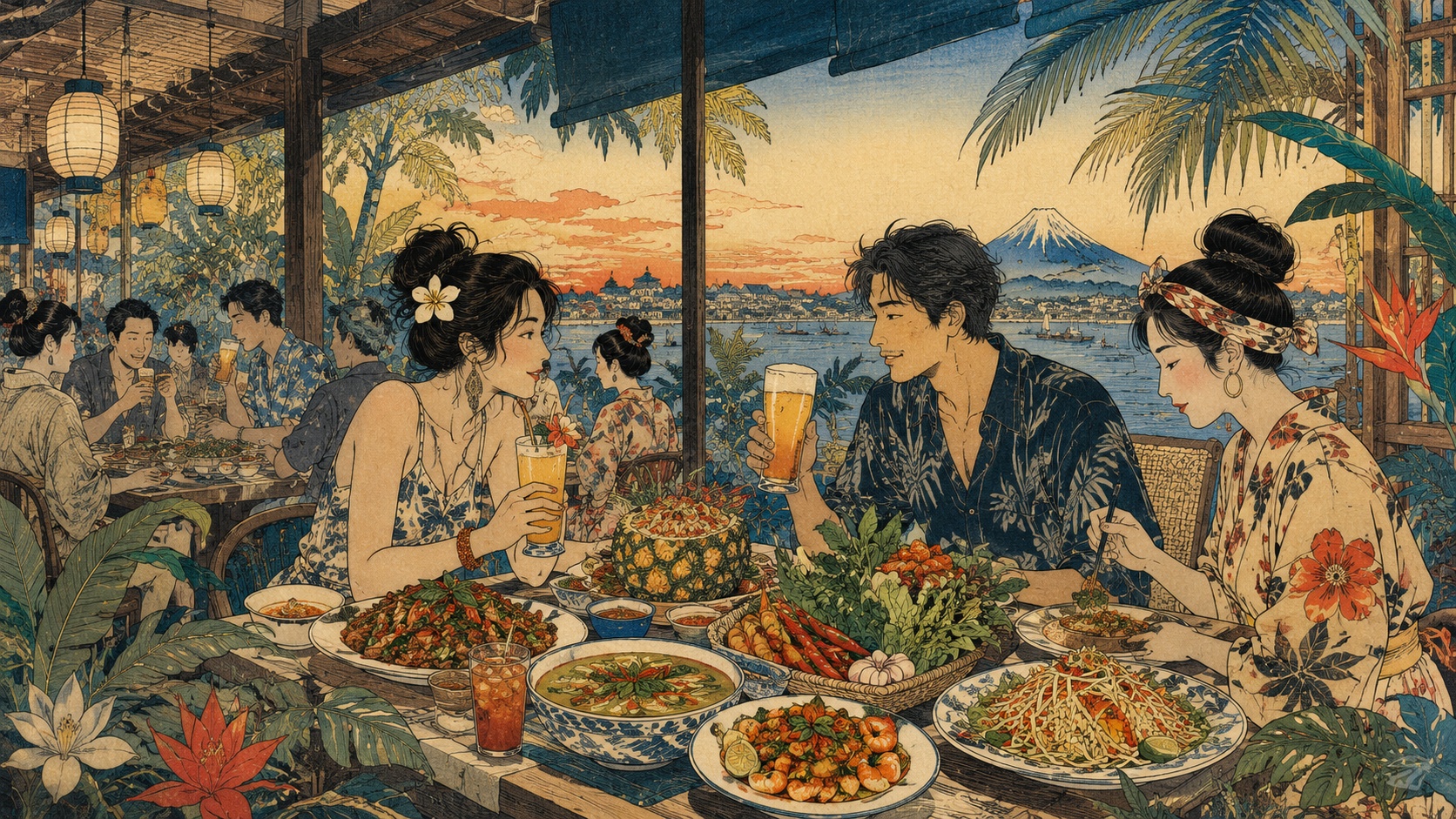
Meal Works announced on July 30, 2026, that all Mango Tree Café locations would begin a limited-time “Thai tapas” promotion on August 3. The release did not state an end date or individual plate prices, so this article does not invent them. “All locations” refers to the Mango Tree Café format, not every Mango Tree Tokyo, Kitchen or Deli operation. The operator describes the promotion as evening-focused, while its sales summary lists each restaurant’s operating hours; customers should therefore confirm local serving times, availability and campaign conditions.
A cold bottle sounds different in a Japanese heat wave
The pavement is still releasing heat after sunset. A short walk from the station has turned the back of a shirt damp, and the idea of a heavy dinner feels farther away than the thought of something cold. Then a bottle arrives beaded with condensation, followed by mussels, fried spring rolls, fermented sausage, tomato, chilli and the perfume of holy basil. Mango Tree Café’s August 3 promotion is not built around one theatrical new entrée. It is designed as a sequence: small plates that move the first beer toward a second, and two people at a table toward conversation.
The campaign is called “Thai tapas with beer.” That phrase should not be mistaken for the name of an ancient Thai category. Tapas is Spanish. Here it functions as an internationally legible ordering instruction: small, shareable, easy to add and made for drinks. The contents are Thai; the framing word belongs to the global restaurant vocabulary.
That act of translation is the most interesting part of the promotion. Protecting authenticity does not require sealing another country’s table behind glass. It requires showing what can change, what must remain, and why. The five dishes carry regional Thai food, street flavors, fermentation and herbs. They also use forms that customers in a Japanese shopping-center café can read immediately: a spring roll, cold chicken, chilled seafood, dressed cabbage and crunchy rice.
The announced offer: two bottles open a five-plate menu
| Item | Announcement | Why it matters |
|---|---|---|
| Start | Monday, August 3, 2026 | A coordinated summer launch across the café format. No closing date was announced. |
| Locations | All Mango Tree Cafés | Shinjuku, Ebisu, Tokyo Dome City LaQua, Kitasenju, Yokohama, Kawasaki, Omiya, Urawa Shibahara, Nagareyama Otakanomori S.C. and Osaka EXPOCITY. |
| Beers | Singha Lite, Leo and Singha | Singha Lite and Leo are limited-time choices. The operator describes Singha Lite as making its first appearance in Japan. |
| Offer | Order two eligible Thai beers together and receive one tapas plate | The incentive adds food rather than discounting alcohol, encouraging a wider table. |
| Food | Five small plates | Regional and popular Thai flavor structures are rebuilt for casual sharing. |
The two-bottles-for-one-plate mechanism is simple, but it may do several jobs. A customer does not have to arrive in a large group: one person can drink slowly, or two can split the bottles. Because the complimentary item is food rather than another drink, the table gains a new flavor and a reason to share. That is an editorial inference from the design of the offer; actual check averages, dwell time and ordering patterns cannot be known before operating data exists.
The company presents the promotion as the evening counterpart to its summer lunch item, tomyum cold noodles. Lunch is a self-contained chilled bowl. Evening becomes a spread of bottles and small dishes. The business is segmenting not only products but ways of eating.
Five dishes form a map of Thai flavor
| Dish | Construction | Cultural layers |
|---|---|---|
| Chilled mussels with gapao | Cold mussels coated in a spicy gapao sauce. | A highly recognizable holy-basil flavor moves into seafood and a summer temperature. |
| Gapao fried spring rolls | Spicy chicken gapao enclosed in a crisp fried wrapper. | A Thai stir-fry profile, the Chinese-derived spring-roll form and a Japanese bar-snack logic meet in one bite. |
| Tomyum “mouthwatering” chicken | Cold chicken given the sweet, sour and hot structure of tomyum. | A central Thai soup grammar crosses with the Sichuan dish name and format known in Japan as yodare-dori. |
| Thai sausage and crispy-rice salad | Sour fermented naem with crunchy rice. | Northern and northeastern preservation knowledge is turned into a sharply textured sharing plate. |
| Cabbage with nam prik ong | Cabbage dressed with a pork, tomato and chilli dip. | A domestic Lanna staple is translated into an approachable café vegetable dish. |
Placed together, the dishes expose the weakness of describing Thai food as merely “spicy.” There is the marine savor of mussels, fat in the fried wrapper, tomyum acidity, lactic fermentation in naem, tomato sweetness in nam prik ong and the perfume of basil. Thai cooking is powerful because aroma, salt, sourness, sweetness, fermentation and texture move at the same time.
Nam prik ong is especially revealing. Tourism Thailand describes the northern dish as a chilli dip based on pork and tomatoes, often accompanied by vegetables and other local foods. Mango Tree Café’s cabbage version is not a replica of a Lanna family spread. It preserves the dip’s core while turning it into a salad-like plate that a Japanese café customer can understand on the first forkful.
Naem carries another kind of history. Fermentation gives the sausage its characteristic acidity, joining preservation to flavor. Crispy rice adds a dry crackle against the sausage’s softness. Its affinity with beer comes not only from chilli, but from fermentation beside carbonation, fat beside bitterness, and soft meat beside hard grain.
Tomyum is also a memory of environment
The tomyum chicken on this menu is not the same thing as the Tomyum Kung inscribed by UNESCO in 2024. The distinction matters. UNESCO recognizes a traditional prawn soup of Thailand’s Central Plains—prawns boiled with lemongrass, kaffir lime leaves, galangal, shallots and local seasonings—together with the knowledge, environment and community transmission surrounding it.
The striking part of UNESCO’s account is its attention to riverside Buddhist communities, plentiful freshwater prawns, herbal knowledge, monsoon life and teaching within families and gatherings. The heritage is not simply a fixed ingredient list. It is a practice of reading local resources and carrying that judgment forward.
Mango Tree Café is not operating a museum. It takes tomyum’s sweet-sour-hot-aromatic grammar and applies it to a cold chicken format associated with Sichuan cooking and familiar to Japanese diners. The result is hybrid. That is not automatically a weakness. A restaurant can make hybridity an honest doorway when it clearly distinguishes a traditional dish from a new plate that borrows its flavor logic.
Does spicy food really make sense in the heat?
The popular explanation is neat: people in hot countries eat chilli, sweat and cool themselves. Human physiology is less tidy. Capsaicin activates heat-sensitive TRPV1 pathways and can affect thermal sensation and sweating. Some human experiments have found earlier or greater sweating under capsaicin stimulation; others have not shown a meaningful whole-body cooling effect under different conditions. A spicy plate cannot be promised to lower every diner’s core temperature.
There is limited human evidence that warm environments can reduce food intake, although the findings are not a universal rule and many social and biological factors intervene. The sensible restaurant claim is therefore not that chilli medically “restores appetite.” It is that cold temperature, acidity, herb aroma, fermentation and the ability to try several small portions may feel easier to begin than one dense entrée on a humid night.
Cold lager is not a chemical antidote to chilli either. Capsaicin is poorly soluble in water. Beer’s temperature offers immediate contrast, but it does not erase the compound. The pleasure lies in rhythm: carbonation after oil, bitterness after sweetness, a cold sip after aromatic heat. Pairing is sensory choreography, not treatment.
In 1933, Thailand brewed a modern national beer
Singha carries the longest history of the three bottles. The official brand presents it as Thailand’s original premium lager, produced since 1933. Its golden mythical lion has traveled through hotels, street meals, beaches, export markets and airline service, becoming part of the visual language through which modern Thailand presents itself.
The date belongs to more than beverage history. It marks Thailand’s movement from a market for imported beer toward domestic brewing, industrial standardization and an exportable national brand. A table that pairs traditional herb and chilli structures with a standardized lager places culinary inheritance beside twentieth-century manufacturing.
For this campaign, the operator calls Singha Lite a limited-time, first-in-Japan arrival. Singha’s own product information lists it as a 3.5% lager designed as a lighter option. Limited-time Leo joins it and the standard Singha, creating a three-way comparison of lightness, fruitiness and malt-bitter structure rather than a single prescribed pairing.
There is also an essential summer warning: alcohol is not hydration. A safe evening requires water, food, attention to heat and responsible consumption within the law. The quality of a restaurant’s “beat the heat” promotion depends partly on how well it supports those choices.
From one Bangkok house to the world’s cities
Mango Tree began in 1994 behind Surawong Road in Bangkok. According to the brand’s account, its first restaurant occupied a converted mansion more than a century old. The project presented “Authentic Thai Cuisine” not as an informal curiosity but through the architecture and service of a high-end contemporary restaurant.
After London, Mango Tree Tokyo opened on September 6, 2002, with the Marunouchi Building. It was the world’s third location, positioned on the 35th floor. The journey—from a garden mansion in Bangkok to the skyline of a redeveloped Marunouchi—moved Thai food into Tokyo’s world of business meals, anniversaries, views and polished service.
The operator says the Tokyo flagship received Thai SELECT Signature, a certification of Thailand’s Ministry of Commerce. Thai SELECT marks Thai restaurants and food products that meet standards for authentic taste and quality. It is less a device for freezing one national recipe than a confidence signal in a world where the label “Thai” can be applied loosely.
In 2006, Thai food descended from the special occasion into daily life
A high-floor flagship cannot make a cuisine ordinary by itself. Meal Works launched the casual Mango Tree Café format in 2006, followed by the faster, specialist Mango Tree Kitchen in 2012. Fine dining, café dining and quick-service counters placed related food into different budgets, schedules and social situations.
The café’s job is not simply to sell a cheaper version of the flagship. It reduces ordering anxiety. Recognizable gateways—gapao, khao man gai and tomyum noodles—sit beside selectable street-food lunch plates, small sizes for one or two people and larger dishes for sharing. A 2024 menu revision expanded small and à-la-carte options across more of the day.
The 2026 tapas promotion extends that democratization. Thai food no longer has to prove itself only through a large course or destination meal. It can enter as one plate after work, then become five dishes after shopping with a friend. A foreign cuisine becomes rooted not when it appears once a year at a festival, but when it becomes a repeatable weekday choice.
To protect “the real thing,” Mango Tree made rice noodles in Japan
The history of Mango Tree’s fresh rice noodles offers a useful lesson in authenticity. Beginning in 2015, the company worked with growers in Joetsu, Niigata, and a noodle manufacturer to process the Japanese rice variety Koshinokaori with Thai-style production methods. The noodles reached all stores by January 2017 and entered retail sale in 2019.
The project challenges the simple idea that importing a dry noodle from Thailand must always be more authentic. The goal was to achieve the texture and function required by Thai rice-noodle dishes through Japanese agriculture and manufacturing. Origin changed; culinary purpose and method remained central. Imported ingredients can be inauthentic when stale or badly handled, while local ingredients can serve authenticity when their function is understood.
The five summer plates face the same test. Spring rolls and cabbage are accessible. But if holy basil loses its perfume, nam prik ong becomes generic tomato sauce, or naem’s fermentation is flattened, the menu slips toward an interchangeable “Asian bar.” Translation should not delete the original. It should speak intelligible Japanese while allowing the Thai words to remain audible.
Japan and Thailand took six centuries to reach this café table
Japan–Thailand contact long predates restaurant chains. Japan’s Ministry of Foreign Affairs records relations between the Ryukyu Kingdom and Ayutthaya by the fifteenth century, followed by a flourishing Japanese community in seventeenth-century Ayutthaya. Modern diplomatic relations began in September 1887. People, silver, deerskins, ceramics, skills, beliefs and words moved along those routes; foodways were part of the wider circulation.
In 2024, about 1.05 million Japanese visitors traveled to Thailand and roughly 1.15 million Thai visitors came to Japan. Japan counted 65,398 Thai residents, while 70,421 Japanese nationals lived in Thailand. Thai food’s contemporary popularity is therefore not a one-way fantasy about a distant country. It is supported by travel, migration, marriage, companies, schools, social media and flights that allow more diners in both countries to compare taste with lived experience.
As knowledge grows, so does a restaurant’s obligation to explain. Gapao should not end at “spicy minced meat.” What is the role of holy basil? Where does nam prik ong come from? Why is naem sour? Good explanation moves a dish from novelty to culture.
Thai culinary soft power is completed at the table
Thailand uses Thai SELECT to identify restaurants and products that carry authentic Thai flavor, linking food to tourism, exports and cultural understanding. UNESCO’s recognition of Tomyum Kung similarly makes visible a system of community knowledge rather than merely crowning a popular soup.
Institutions can create an entrance, but no certificate earns a second visit by itself. Trust is completed by the plate: whether the herbs are fragrant, the acidity is clear, the chilli is forceful without becoming crude, staff can explain the food, Thai diners can recognize a memory and Japanese diners leave curious about another region.
The most important dish may therefore not be the campaign’s bestseller. It may be the one that makes a guest ask, “What exactly is nam prik ong?” or “Where else can I eat naem?” As a foreign cuisine becomes familiar, a successful brand must preserve a little productive unfamiliarity.
The chain test: can aroma be standardized?
Launching in ten cafés at once is cultural reach and operational risk. Kitchens must align heat, salt, fermentation, frying, cold holding and herb aroma across different teams. Too much standardization makes food flat. Too little creates inconsistency.
Gapao is a revealing example. In Japan the word has become the name of a whole dish, yet its defining center is the basil aroma. Without it, the plate becomes spicy minced meat. Nam prik ong can lose its northern identity if it drifts into ordinary tomato sauce. Chain quality control is not only weighing portions and timing fryers; it is agreeing on the aroma that constitutes a pass.
Small plates may also suit a labor-constrained restaurant economy. Components can be prepped consistently, portions controlled and add-on orders handled quickly. But a popular free-plate incentive can overwhelm kitchens, create shortages or slow regular service. Success should be measured not only in bottles sold, but in ticket times, waste, employee strain and the experience of guests who did not order the promotion.
What customers should confirm
- Period: Sales begin August 3. No end date had been announced at the research cutoff.
- Hours: The campaign is presented as evening-oriented, while the summary says each store’s operating hours. Check locally.
- Offer: Two eligible Thai beers must be placed in one order for one of the five plates. The release does not say separate orders qualify.
- Prices: The announcement does not list individual menu prices; the store menu is controlling.
- Stock: Singha Lite and Leo are limited-time products and may sell out by location.
- Alcohol: Drink water, eat, account for heat and consume responsibly within the law. The cultural value of the food does not depend on drinking alcohol.
It does not erase the heat; it changes the night
This promotion will not cure extreme weather. Thai beer is not water, and chilli is not air-conditioning. Yet a meal can restart an evening that heat has stalled: the sound of a bottle, herb aroma rising from a plate, fermented acidity, a crisp wrapper breaking and a hand passing food across the table. Appetite begins not only with biological need, but with anticipation and company.
The Bangkok mansion of 1994, the Marunouchi tower of 2002, the café format of 2006, Japanese-grown fresh rice noodles rolled out by 2017, and five small plates in 2026 are chapters in one movement. Mango Tree has spent its Japanese history carrying Thai food from a cuisine looked up to on a special occasion into one chosen on the way home from work.
When the first two bottles and one complimentary plate arrive on August 3, the customer may receive more than a promotion. Northern Thai pork and tomato, fermented meat knowledge, the tomyum grammar of the Central Plains, brewing modernity from 1933 and six centuries of Japan–Thailand exchange will appear at a new scale. The test is whether a summer café table can keep that map sharp enough to make the next journey irresistible.
Sources and verification
Japan.co.jp reviewed operator releases, official brand histories, government and international-organization material, and research papers available by 6:00 a.m. Japan time on August 1, 2026. The promotion was scheduled to begin August 3, so no post-launch foot traffic, sales or observed plate execution was available. Announced facts, historical context, scientific evidence and editorial inference are identified separately.
- Arcland Service Holdings / Meal Works: August 3 Thai tapas and beer campaign
- Mango Tree official: Café concept and 2026 topics
- Mango Tree official: 1994 founding, 2002 Tokyo opening and three-format strategy
- Mango Tree official: Tokyo’s 20th anniversary and Bangkok mansion history
- Meal Works: timeline of the 2006 Café and 2012 Kitchen formats
- Mango Tree official: development of fresh rice noodles using Niigata-grown rice
- Royal Thai Government Ministry of Commerce: Thai SELECT certification
- UNESCO: Tomyum Kung on the Representative List of Intangible Cultural Heritage
- Tourism Authority of Thailand: nam prik ong, naem and northern food
- Singha official: Thailand’s premium lager since 1933
- Singha official: Singha Lite product information
- Ministry of Foreign Affairs of Japan: Japan–Thailand history, residents and visitors
- PubMed: pilot randomized trial of warm ambient temperature and food intake
- PubMed: capsaicin stimulation, sweating and thermoregulation
