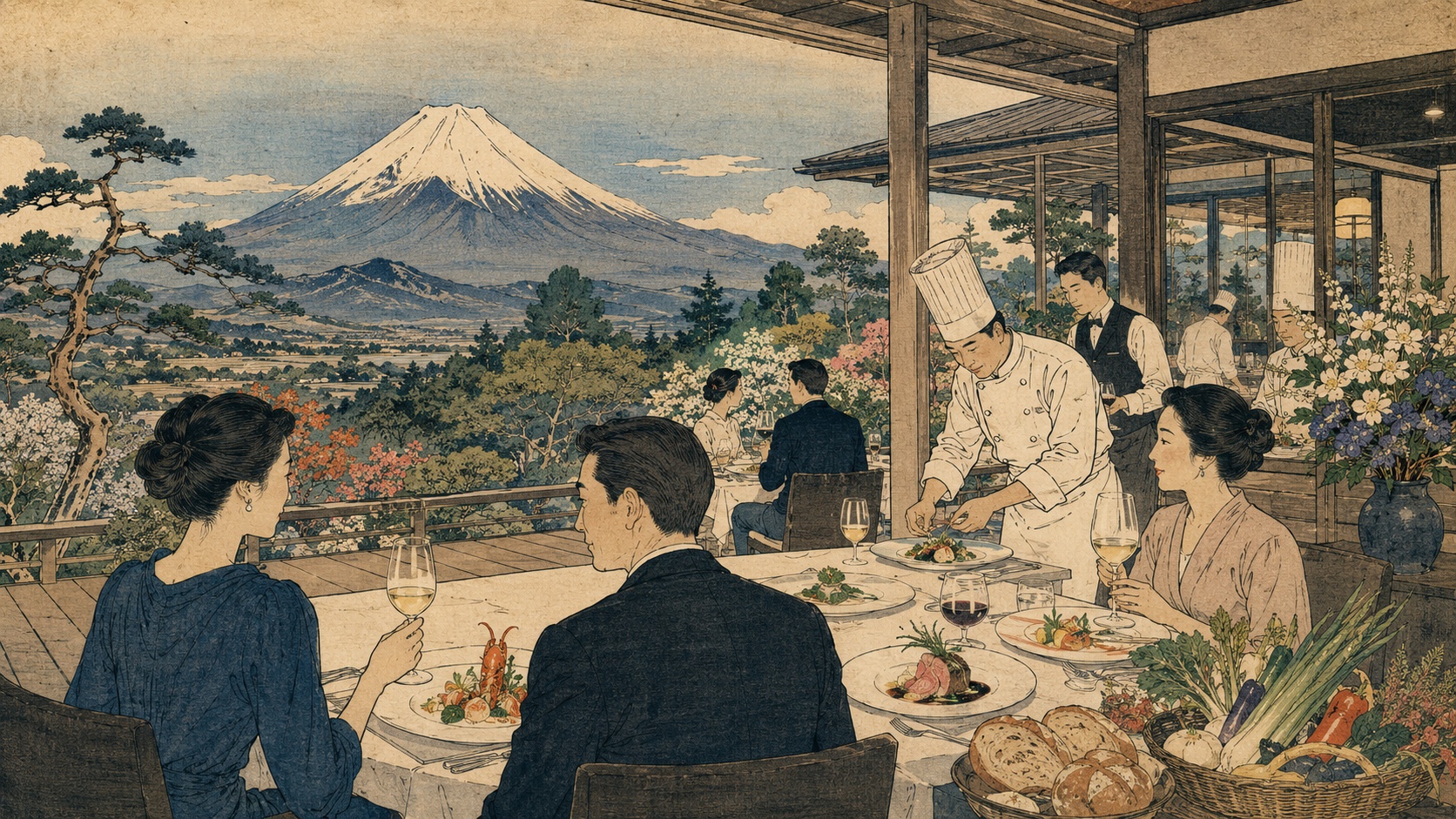
Maison KEI’s fifth-anniversary event is scheduled for Sunday, August 9, 2026, and had not yet taken place when this August 3 edition was prepared. The restaurant has announced the same six-to-seven-course surprise menu, a special PLAISIR, for lunch and dinner at ¥24,000 per person including tax but excluding service. Kei Kobayashi will return from France to work in the kitchen. The individual dishes and ingredients have not been disclosed, so this report does not invent a preview; it examines the people, place, history and operating philosophy that make the menu possible.
How do you report a plate that has not yet been served?
No one can promise that Mount Fuji will reveal itself on the morning of August 9. Summer clouds move quickly across Gotemba; the summit appears, disappears and returns. Inside Maison KEI, however, a more deliberate convergence is being prepared. Kei Kobayashi comes back from Paris. Chef Mitsuyoshi Sato and the team bring five years of daily knowledge. Herbs grown beside the dining room, ingredients from the surrounding region, French technique, and Toraya’s centuries-old discipline of season and precision will meet in one kitchen.
The menu has not been published. It would therefore be false confidence to promise foie gras, abalone or any particular local vegetable. The absence of a dish list makes the deeper story more visible. Maison KEI is neither a provincial branch of a celebrity chef’s Paris restaurant nor a French-food division attached to a wagashi company. It is an experiment in making Paris and Gotemba, five centuries of commerce and contemporary gastronomy, urban recognition and agricultural time speak across one table.
A fifth anniversary celebrates endurance, but it also invites examination. Maison KEI opened on January 30, 2021, during a period of profound uncertainty for restaurants, travel and international movement. It chose neither a Tokyo tower nor Kyoto’s historic center, but a place diners must deliberately reach by road or rail. That choice has survived for five years. Before the anniversary menu is tasted, that continuity is the first important fact.
August 9: the announced facts
| Item | Announcement | Why it matters |
|---|---|---|
| Date | Sunday, August 9, 2026 | A one-day event marking Maison KEI’s fifth-anniversary year. |
| Lunch | 11:30 a.m.–3:00 p.m.; last arrival 12:30 p.m. | The service most likely to place the changing mountain and herb garden in full view. |
| Dinner | 5:30–9:00 p.m.; last arrival 6:30 p.m. | The same special menu and price as lunch. |
| Menu | Special PLAISIR, six to seven courses, ¥24,000 including tax; service extra | An anniversary development of the restaurant’s regularly listed top course. |
| Reservations | Telephone or TableCheck; booking opened July 10 | Availability changes, so the restaurant remains the source for current seating. |
| Location | 527-1 Higashiyama, Gotemba, Shizuoka | About 15 minutes by taxi from Gotemba Station: diners travel toward the source. |
Maison KEI currently lists four regular lunch-and-dinner menus: DÉCOUVERTE at ¥6,800, VOYAGE at ¥9,800, PRESTIGE at ¥14,000 and PLAISIR at ¥19,000, with drinks and service excluded. The anniversary price of ¥24,000 is described not as a routine adjustment but as a special elevation of PLAISIR created around Kobayashi’s return.
The event and the ordinary restaurant must not be confused. Maison KEI does not acquire value only when its internationally famous founder is present. On the days Kobayashi is in Paris, Sato and the staff still source, prep, clean, serve, tend plants and make decisions under the same standard. The anniversary can exist only because that daily institution already exists.
Before the stars descended to the mountain
Kei Kobayashi was born in Nagano and trained in Nagano and Tokyo before moving to France in 1999. He absorbed the regional richness of southern France and Alsace, then spent seven years at Alain Ducasse au Plaza Athénée in Paris, including an extended period as sous-chef. In March 2011 he opened Restaurant KEI in Paris’s 1st arrondissement. It received one Michelin star in 2012, two in 2017 and, in 2020, made Kobayashi the first Asian chef to earn three stars in the French guide.
The Michelin Guide’s current listing still gives Kei three stars—its category for exceptional cuisine worth a special journey. The description emphasizes legibility as much as virtuosity: high-quality ingredients that retain their own voices, exact construction, and complex plates whose flavors remain clear. Kobayashi’s achievement is not a decorative Japanese layer placed over French cooking. It comes from deep command of French grammar, reorganized through his own memory and an intense respect for the life of ingredients.
When he prepared to place his name on a restaurant in Japan, he did not carry global recognition into the most obvious luxury district. He chose Gotemba. That reversal is the key to Maison KEI. A chef validated at the center of French gastronomy moved the center of attention toward a regional Japanese landscape—and asked the customer to move too.
The partnership began in a Paris restaurant before it opened
Kobayashi met Mitsuharu Kurokawa in Paris in 2010. Kurokawa, who would become the 18th-generation head of Toraya, was then working at the wagashi maker’s Paris shop, established in 1980. Kobayashi was preparing to open Restaurant KEI. Kurokawa accompanied him on ingredient sourcing and observed kitchen work and restaurant preparation. He saw the unglamorous architecture behind the finished dining room: purchasing, movement, pricing, quality control and obsessive repetition.
The relationship continued after Restaurant KEI opened in 2011. According to Maison KEI’s own account, what impressed Kurokawa was not fame but Kobayashi’s refusal to stop pursuing flavor. They did not rush into a branded collaboration. Planning in Gotemba began in 2016 and took roughly five years. From the first meeting to the restaurant’s opening was an eleven-year arc.
This is not merely a licensing arrangement in which a venerable company borrows a chef’s prestige. Toraya contributed land, management, confectionery knowledge, a culture of seasonality and long-term trust. Kobayashi contributed culinary philosophy, French technique, kitchen discipline and international perspective. Their most important common language was not “tradition.” It was the conviction that quality begins to decline the moment a craftsperson believes the work is finished.
Toraya’s five centuries are a technology of time
Toraya traces its founding to Kyoto in the early 16th century. It was already serving the Imperial Court during the reign of Emperor Go-Yozei, from 1586 to 1611, and established a Tokyo foothold in 1869 as the capital moved east. In 1980 it opened in Paris, presenting yokan and seasonal wagashi not simply as imported sweets but as a compact language of Japanese nature and culture.
Wagashi cannot be reduced to sugar. Blossom, moon, rain, snow, young leaves and autumn color are anticipated through shape, color, name and texture. A sweet asks the customer to imagine a season before tasting and leaves its poetic name after the bite has disappeared. The ingredients are often plant-based and visually restrained, but production requires exact judgment of heat, moisture, bean paste, agar and timing. That hidden rigor resembles the ideal behind Kobayashi’s plates: intense technique that does not smother the ingredient.
Calling Maison KEI a “fusion of French cuisine and wagashi” can therefore flatten the relationship. The point is not simply to put yokan into a sauce or decorate a French plate with Japanese motifs. It is to share a way of reading a short season, accepting responsibility for an ingredient’s life, and preserving it in the guest’s memory. Early reporting described a Maison KEI version of the Paris vacherin using Toraya anko. Its significance lies less in novelty than in allowing two highly developed crafts to remain distinct and intelligible inside one dessert.
Why Gotemba: water, access and Toraya’s existing home
Gotemba is regional Japan within deliberate reach of Tokyo. The city sits on Mount Fuji’s eastern foot where the Tomei and Shin-Tomei expressways, Route 138 and routes toward Hakone and the Fuji Five Lakes converge. It is close enough for a day trip, but its elevation, volcanic land, cool air and fast-changing weather make it materially different from the metropolis and from Shizuoka’s coast.
For Toraya, Gotemba was already a place of production and cultural investment. The local chamber of commerce records that Toraya chose the area for abundant Mount Fuji snowmelt and highway access, building its factory in 1978. Toraya Kobo followed in the Higashiyama woods in 2007, making modest sweets on site, using local eggs and seasonal ingredients, and asking visitors to walk through bamboo and garden before eating.
Maison KEI’s stated ambition—that ingredients should not do all the traveling, and guests should come to them—is therefore not an isolated slogan. It extends an idea Toraya Kobo had already tested: shorten the distance between production and customer, and make air, water, light, landscape and time part of the value. A packaged product can travel to the city. A place cannot. To experience the place, the customer must move.
Mount Fuji is not scenery; it enters the kitchen as water
The mountain beyond Maison KEI’s windows is a formidable stage set, but it is not merely background. Gotemba’s municipal water comes from groundwater beneath Mount Fuji and the Hakone mountains, and the same underground resource supports households, agriculture and industry. The city describes Fuji as a vast natural reservoir.
Water is the invisible base of French cooking. It washes vegetables, becomes stock, enters bread and pastry, cleans plates and sustains kitchen sanitation. A chef rarely serves “water” as the principal ingredient, yet its properties touch every process. Wagashi depends on it in the same way: cooking azuki, handling agar, controlling sweetness and clarity. Water is one of the deepest practical reasons that Kobayashi’s cuisine and Toraya’s confectionery culture can meet in Gotemba.
The romance of “Mount Fuji water” should not imply an infinite resource. Gotemba itself stresses groundwater management and the need to avoid depleted wells and falling levels. A restaurant that celebrates terroir inherits a responsibility to the conditions that keep terroir alive. Respecting the land means more than consuming its view; it includes sustaining the water, soil and agriculture that make the menu possible.
“Cuisine of the earth” is not a checklist of local products
Maison KEI defines its concept as daichi no ryori, “cuisine of the earth.” In the restaurant’s account, earth means soil, water, air and every life nurtured by them. Many restaurants can claim proximity to producers. Maison KEI goes further by describing the herb garden tended by chefs and staff, and the value of touching soil and sea before deciding how an ingredient should be cooked.
Gotemba promotes local Koshihikari rice, mizukakena greens, wasabi and Kinka pork among its distinctive agricultural products. None has been confirmed for the August 9 menu, and this article does not present them as promised courses. Their importance is structural: a diverse food landscape within reach gives cooks choices. As seasons change, technique must respond to what is alive now rather than force an identical luxury menu through twelve months.
“Cuisine of the earth” is not rustic theater. The plates remain precise; sauce, temperature, cooking and texture are unmistakably shaped by French discipline. The difference is purpose. Technique is not used to import the city’s prestige ingredients into the countryside. It is used to give local ingredients the same degree of attention normally reserved for internationally recognized luxuries—to turn regional produce from a cheaper substitute into a reason to travel.
When Kobayashi returns, Mitsuyoshi Sato’s five years become visible
Maison KEI’s daily kitchen is led by Mitsuyoshi Sato. Born in Mie, he studied at Ecole Tsuji Osaka, worked in Tokyo restaurants, moved to France at 24 and joined Restaurant KEI in 2015 after experience in regional French kitchens. He became chef of Maison KEI at the 2021 opening.
That path matters because Maison KEI is not a branch reheating a founder’s recipes. Sato absorbed Kobayashi’s speed of judgment, standards of preparation, cleaning and flavor in Paris, then developed the Gotemba restaurant with local suppliers, weather and staff. Five years of service contains knowledge no recipe binder can hold: spring vegetables never arrive in exactly the same condition, summer humidity changes pastry, reservation patterns shift, and local regulars experience the restaurant differently from destination guests.
Kobayashi’s presence on August 9 does not mean reclaiming control from the local kitchen. It means reconnecting two lines of development—the sensibility that has continued evolving in Paris and the sensibility that has evolved through five years in Gotemba. A one-way master-apprentice relationship produces a copy. A meeting between two current practices can produce renewal.
Mount Fuji outside the window, discipline behind it
Maison KEI is known for broad views toward Mount Fuji, a herb garden below the glass and a warm interior widely attributed to architect Hiroshi Naito. The mountain is not a fixed painting. In clear weather it overwhelms the room; when cloud hides it, the absence itself becomes perceptible. Nature changes the dining-room wall minute by minute.
A restaurant with a powerful view faces a risk: the meal can become an accessory to the photograph. Kobayashi’s kitchen interviews reveal an opposing obsession. In planning the kitchen he valued ease of cleaning alongside creative range, and installed equipment—including a Chinese range—that allowed technique to remain open rather than doctrinaire. The exterior is poetry; the interior is sanitation, movement, repetition and control.
Toraya knows the same tension. A beautiful fresh sweet fails if temperature, bean paste, tools or sale timing are neglected. The truest meeting of French cuisine and wagashi culture at Maison KEI may not occur in a decorative dessert. It may occur in the back of house, where both traditions insist that invisible work must be exact before beauty can look effortless.
A restaurant opened in the pandemic winter has now lasted five years
When Maison KEI opened in January 2021, restaurants and travel were constrained by pandemic uncertainty, shortened hours, disrupted supply and limited international movement. The conventional model for an international chef—frequent travel, global guests and a prime metropolitan location—was unusually difficult. Maison KEI instead began as a domestic destination restaurant rooted in a regional landscape.
That did not make survival easy. Opening publicity creates reservations; the second and third years return a restaurant to ordinary judgment. Persuading guests to spend on a high-end meal and travel to Gotemba requires more than cooking. Reservations, transport, hospitality and a reason to spend time in the region all matter. The restaurant had to become the destination rather than an optional stop before the outlet mall or Hakone.
Five years do not prove the model is complete. They reveal the next problems: durable purchasing relationships with farmers, climate instability, recruitment and retention of cooks and service staff, explaining higher prices, and remaining connected to residents rather than becoming an isolated luxury island. An anniversary is not only a medal. It is the border between a successful launch and long-term institution building.
Regional revitalization does not happen automatically on an expensive plate
At the opening, Kobayashi spoke of creating in Gotemba what could not be done in Paris and contributing to the vitality of a regional Japanese city. Destination restaurants can indeed spread demand to hotels, taxis, farms, shops and nearby attractions. When the customer moves toward the source, more of the spending associated with the ingredient can remain in the region.
But a famous chef opening outside Tokyo is not, by itself, regional revitalization. The questions are whether purchasing continues, whether producers receive prices that support their work, whether off-grade crops and byproducts find uses, and whether young cooks can build lives in the area. If the restaurant becomes a self-contained island, its success and the region’s success will diverge.
Maison KEI’s most consequential phrase is its belief that cooks accept the life of an ingredient and preserve that life in the guest’s memory. The next step is to preserve the producer there too. Who raised it? What water and soil sustained it? What must happen for the work to continue next season? The fifth-anniversary menu becomes truly regional when it can carry those questions as well as flavor.
A timeline from Kyoto and Paris to Gotemba
| Period | Event | Meaning for Maison KEI |
|---|---|---|
| Early 16th century | Toraya is established in Kyoto | A culture of season, handwork and trust measured across centuries. |
| 1869 | Toraya establishes a Tokyo foothold | Experience carrying tradition into a new capital without abandoning its origin. |
| 1978 | Toraya builds its Gotemba factory | Mount Fuji water and transportation become part of its production base. |
| 1980 | Toraya Paris opens | A durable bridge introducing wagashi culture to France. |
| 2010 | Kobayashi and Kurokawa meet in Paris | The relationship begins during Restaurant KEI’s preparation, not after success. |
| 2011 | Restaurant KEI opens | Kobayashi’s independent culinary philosophy takes institutional form. |
| 2016 | Joint Gotemba planning begins | Location, kitchen, food and business are developed over roughly five years. |
| 2020 | Restaurant KEI earns three stars | Global recognition does not divert the partners from the regional plan. |
| January 30, 2021 | Maison KEI opens | A destination restaurant launches amid pandemic uncertainty. |
| August 9, 2026 | Fifth-anniversary event | Paris’s present and Gotemba’s accumulated five years meet in one kitchen. |
The fifth anniversary is not a homecoming; it is another departure
To say that Kei Kobayashi “returns” to Gotemba carries two directions. Maison KEI is his creation and a home for his philosophy. Yet the daily restaurant has been raised by Sato, the team and the changing seasons of Gotemba. Kobayashi does not return merely to inspect what he left behind. He returns to encounter five years of development that did not happen in Paris.
The guest on August 9 will pay ¥24,000 for six or seven courses. The real sequence, however, begins in Paris in 2010, reaches back to 16th-century Kyoto, passes through a 1978 factory and crosses the anxious winter of 2021. The meal lasts hours; the plate contains histories moving at very different speeds.
If Mount Fuji appears, the landscape will give the anniversary an unforgettable emblem. If it does not, the restaurant’s argument remains intact. The mountain is already present as groundwater, moisture in vegetables, garden soil and steam in the kitchen. Maison KEI has spent five years trying to prove not simply that one can dine while looking at Fuji, but that a cuisine can exist because it is made at Fuji’s foot.
After the special menu ends, Kobayashi will return to Paris and ordinary service will resume. If the “cuisine of the earth” continues the next day, the anniversary will have been an update rather than a spectacle. The most important plate is not the one served for the celebration. It is the next plate—the one that begins the next five years.
Sources and verification
Japan.co.jp reviewed information published by Maison KEI, Toraya, the Michelin Guide, Gotemba City, the Gotemba Chamber of Commerce and reporting from the restaurant’s opening and kitchen development through the morning of August 2, 2026, Japan time. The dishes for August 9 have not been disclosed and are not inferred here. Event times, pricing and availability may change. The displayed exchange rate is 1 U.S. dollar = 157.57 Japanese yen. The supplied timestamp of July 31, 2026 at 9:00 p.m. UTC converts to August 1 at 6:00 a.m. Japan time.
- Maison KEI: official fifth-anniversary event announcement
- Maison KEI official: origin, cuisine, courses, hours and access
- Maison KEI official: Kobayashi, Toraya and joint planning from 2016
- MICHELIN Guide: three-star listing for Restaurant KEI
- Toraya official history: Kyoto origins, Imperial Court service, Tokyo in 1869 and Paris in 1980
- Gotemba City: Mount Fuji and Hakone groundwater
- Gotemba City: food and industry sustained by water
- Gotemba City: “Flavors of Gotemba Nurtured by Mount Fuji”
- Gotemba Chamber of Commerce: Toraya’s 1978 factory and location rationale
- GQ Japan: January 30, 2021 opening and early interview
- Fujimak: Kobayashi on Maison KEI’s kitchen design, part one
- Fujimak: Kobayashi on Gotemba and the restaurant’s future, part two
- AERA STYLE MAGAZINE: Kobayashi, Toraya and the Gotemba regional project
