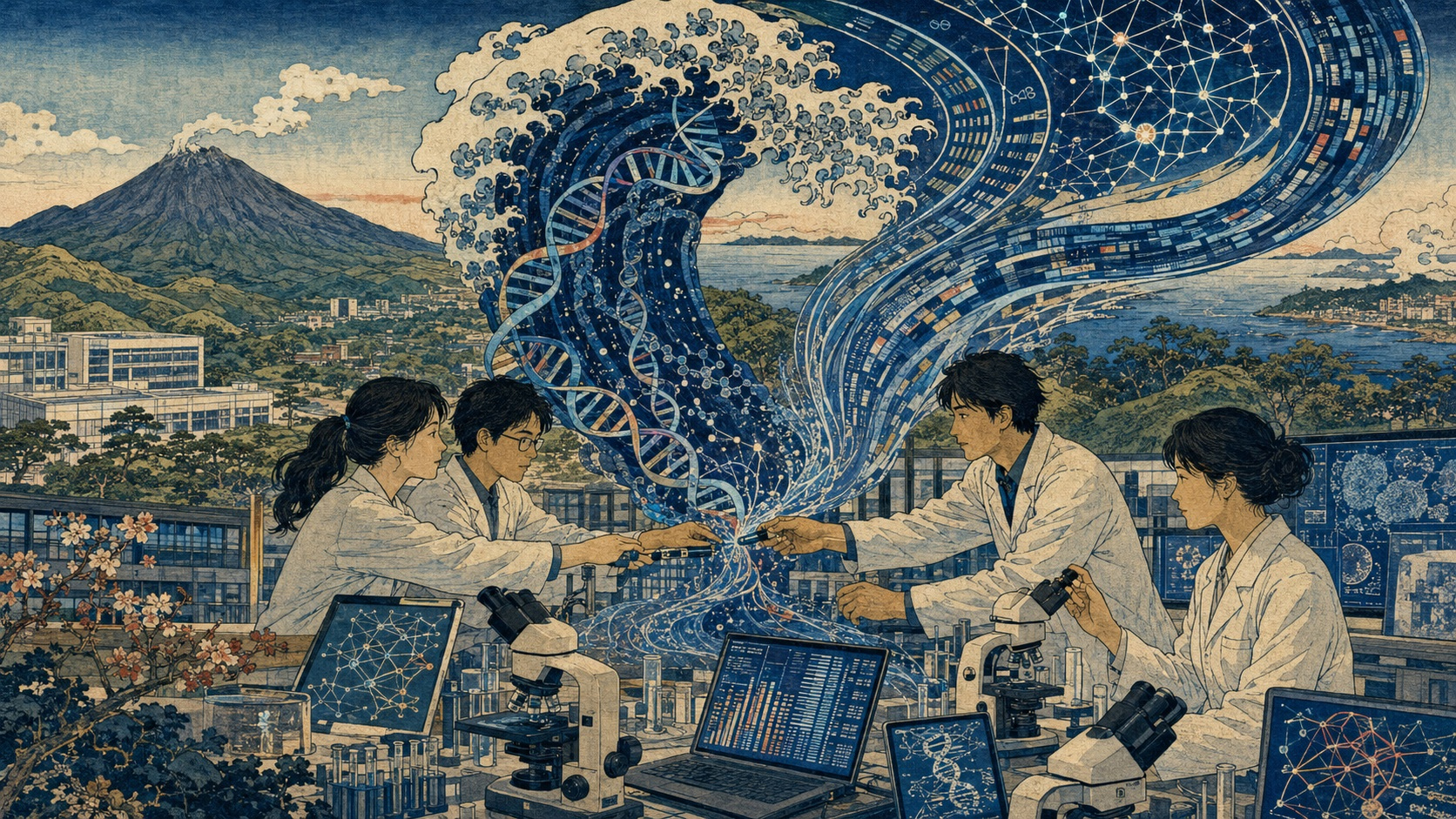
There is another laboratory after the machine stops
The sequencer finishes its run and a status light turns green. What would have been a historic quantity of sequence a generation ago becomes a set of files in hours or days. The most treacherous part of the experiment now begins: rejecting poor reads, aligning or assembling sequence, counting features, modeling group differences, correcting thousands of tests, identifying pathways or cell types, and translating an output into a biological claim. One reference build, filter or statistical assumption can alter the answer.
Cell Innovator operates in that second laboratory—the computational one. On July 21, 2026, Tokyo-based Iwai Chemicals said it had acquired shares in the Fukuoka company and made it a subsidiary effective June 2. The announcement arrived 49 days after the effective date. It did not disclose the price, number or percentage of shares, sellers, valuation method, financing, revenue, profit, employee arrangements, advisers or forecast impact.
The direction was disclosed. Iwai president Yoshiko Iwai becomes Cell Innovator's president and representative director, with Kaori Yasuda appointed director and COO. Iwai said existing customer and partner relationships and commercial flows would remain unchanged. It intends to use its sales network—particularly in Kanto—to expand outsourced-analysis capacity and service lines, combining Iwai's “things” with Cell Innovator's “knowledge.”
What is known—and what is not
| Supported by the announcement | Not disclosed |
|---|---|
| Iwai acquired Cell Innovator shares and made it a subsidiary, effective June 2, 2026. | Price, percentage acquired, sellers, valuation, earn-outs or other conditions. |
| The target is described as a Kyushu University-origin venture based in an industry-academia facility on the university's hospital campus. | Kyushu University's current equity, IP licenses, endorsement or role. The release does not say the university sold the company. |
| Cell Innovator offers contract analysis and consulting in gene expression, proteomics and related fields. | Revenue, profit, customers, project volume, capacity, retention or audited quality measures. |
| It markets support from experimental planning through analysis, figures and manuscript work, plus one year of free post-delivery support. | Service levels, turnaround, reanalysis policy, security history and independently verified outcomes. |
| Iwai plans expansion through its network and product portfolio. | Investment, hiring, integration timetable, revenue targets and conflict-management rules. |
Calling this simply “Kyushu University sold its bioinformatics company” would therefore outrun the evidence. University-origin describes lineage, not necessarily current ownership, licensing, endorsement or transaction participation. “Expanded research support” is likewise an intention today, not a measured result. The proper evidence will be future capacity, turnaround, reproducibility, staff retention, customer outcomes and data stewardship.
The buyer is a transport network for research
Iwai Chemicals has ¥20 million in capital and says it generated ¥19.4 billion in sales for the year ended September 2025 with 208 employees. Beyond Tokyo headquarters, it has offices in Tsukuba, Tama, Kashiwa, Kawasaki and Mishima. Its published customer list includes major pharmaceutical companies, the University of Tokyo, Keio University, the University of Tsukuba, RIKEN and the National Cancer Center.
A specialist distributor is the unobtrusive transport network of science. It keeps temperature-sensitive reagents moving, helps researchers choose and install instruments, coordinates service and understands how budgets turn into laboratory work. Iwai's recent catalog extends far beyond boxes: spatial transcriptomics, digital spatial profiling, single-cell services, spatial proteomics, cloud NGS analysis and even analysts dispatched to work on customer premises.
The acquisition is thus less a sudden diversification than a vertical integration of capabilities Iwai has already distributed. The practical attraction is the removal of handoff failures. Researchers commonly pass sample preparation, measurement, computation, statistics, figures and repository submission among separate vendors. Metadata disappear at the boundaries; sample names drift; nobody owns the full cause of a failed result. An analyst involved before measurement can prevent defects that no algorithm can repair afterward.
A company born in the microarray wave
Cell Innovator was established in Fukuoka on October 27, 2008. Its early catalog emphasized microarray analysis and end-to-end support from experimental planning through data mining. Microarrays had moved simultaneous measurement of thousands of genes into ordinary laboratories, delivering biological researchers immense expression tables that demanded new statistical and computational skills.
The company later moved with the field into next-generation sequencing. A recent service document describes help with sample collection, RNA extraction, sequencing, expression analysis, volcano plots, heat maps, Methods text and GEO registration, and advertises access to a DNBSEQ instrument and lane-based plans. This is not merely software execution. It is an attempt to maintain the chain of evidence required for publication.
The acquisition release stresses an 18-year history, custom analyses and one year of free support after delivery. The defensible asset is probably not code alone but accumulated judgment: turning an ambiguous biological question into an analyzable comparison, detecting when batch structure is confounded with treatment, knowing what metadata will matter six months later and deciding when the data cannot support a requested conclusion.
Kyushu's lineage of treating the genome as information
Kyushu University's Graduate School of Systems Life Sciences now describes bioinformatics as an integration of life science, information science, instrumentation, inference and high-performance computing. That interdisciplinary lineage is older than the company. A 1993 Kyushu University technical report thanks Satoru Kuhara, then associated with genetic resources engineering, for introducing the author to genome informatics. Kuhara later became a Kyushu University professor emeritus and was identified as a Cell Innovator director; a 2022 regional biotechnology forum listed him with the company for a lecture on gene analysis and R&D.
That does not make the business equivalent to the university. It does show how a local academic culture—one that regarded sequences as objects to compare computationally and return to biological hypotheses—could generate a service company. Locating the company in Collaboration Station I on Kyushu University's hospital campus also shortened the physical distance between clinical research, basic biology and enterprise.
Acquisition is one possible exit for university ventures, not a lesser form of IPO. METI materials show Japan's university startups rising from 3,305 in 2021 to 4,288 in 2023. A specialized scientific service may benefit more from integration into a company with sales coverage, compliance resources and stable cash flow than from pursuing public-market scale. But continued use of university-origin trust creates an obligation to state the current IP, equity and institutional relationship precisely.
Public infrastructure came first: DDBJ in 1986, KEGG in 1995
Japan's commercial bioinformatics layer rests on public infrastructure. The DNA Data Bank of Japan began full-scale activity at the National Institute of Genetics in 1986 and became one of the three partners in the international nucleotide sequence archive, alongside the United States' GenBank and Europe's EMBL/ENA lineage. Researchers around the world submit and retrieve a shared record of sequence data.
Kyoto University's KEGG project began in 1995 under Japan's Human Genome Program. It connected genes to metabolic and signaling pathways, diseases, drugs and other functional systems, helping researchers move from strings of letters to maps of biological activity. Together with GenomeNet, it became a Japanese-built international layer for interpreting genomes.
The Human Genome Project, launched in 1990 and completed in 2003, was a multibillion-dollar international effort that included Japan. Sequencing then fell dramatically in cost and time. That did not make interpretation easy. Cheaper measurement increased samples, time points, cell counts and data types. RNA-seq escaped the fixed probes of microarrays; single-cell methods decomposed tissue averages; spatial omics restored physical location; proteomic and epigenomic layers added further dimensions. Democratizing data generation made interpretive capacity scarcer, not less important.
What an integrated service can prevent
The chief benefit of “one stop” is not convenience. It is continuity of causation. If analysts enter at the planning stage, they can challenge technical replicates masquerading as biological replication, batches perfectly aligned with treatment groups, weak statistical power, imbalanced patient characteristics, missing metadata or secondary uses that exceed participants' consent.
After measurement, one connected team can trace an anomaly backward through sample quality, library preparation, instrument run and pipeline rather than letting vendors point across organizational boundaries. Through publication, it can align figures, Methods, public deposits and the analyzed data. For a small laboratory or biotechnology company unable to recruit a full-time bioinformatician, that is genuine infrastructure.
Yet a single provider is not automatically a quality system. Removing boundaries also removes external checks. A mistaken assumption can flow from intake through the manuscript without an independent challenge. Integration works best with explicit review gates, reproducibility packages, outside statistical review for high-stakes studies and a contractual right to take every useful data layer elsewhere.
Analysis begins before the experiment
The most consequential bioinformatics decisions happen before any software opens: the hypothesis, primary endpoint, exclusion criteria, sample size, randomization, blinding, confounders, batch allocation, metadata and missing-data plan. Even exploratory studies should record where exploration ends and confirmation begins.
High-dimensional experiments generate false discoveries with ease. Test 20,000 genes independently at a nominal 5% threshold and, under a deliberately simplified null scenario, roughly 1,000 can pass by chance. Real analyses control false discovery, examine effect size and uncertainty, and seek biological and independent validation. Normalization, reference genome, annotation release, filters and covariates all influence the list.
A good contract laboratory does not manufacture the conclusion its customer hopes to see. It must be able to say that a design cannot distinguish treatment from batch, that the evidence is underpowered, or that more samples are needed. Post-acquisition sales pressure must not weaken that power to refuse. Scientific-service quality is measured not just by turnaround and attractive figures, but by the clarity with which analysts state what cannot be concluded.
Reproducibility must be part of the deliverable
A PDF report and a folder of PNG images do not reproduce an analysis. A serious delivery package includes links and checksums for raw data, the sample map, QC outputs, processed matrices, code or workflows, software and library versions, reference genome and annotation releases, every parameter and random seed, exclusion reasons, logs, computational environment and a README that rebuilds the figures.
Containers and pinned workflows improve computational repeatability, but invisible manual steps still matter: renamed files, deleted spreadsheet rows, copied values and figure-specific filtering. Those operations need a record. Depositing data in GEO supports reuse, but an accession number does not prove consent, de-identification, metadata quality or reproducibility.
The reproducibility package customers should contract for
Raw-data references and checksums; sample, group and batch maps; QC thresholds and exclusions; code and pipelines; all versions and parameters; reference and annotation releases; intermediate matrices; execution logs; figure-rebuild instructions; and records of publication, retention and deletion. Acceptance should include a rerun by a university analyst or another provider.
A genome is not ordinary confidential information
Human genomic information implicates relatives as well as the participant and can be difficult to anonymize completely. Japan's privacy regime treats medical and certain genetic information with particular care, while the Ethical Guidelines for Life Science and Medical Research Involving Human Subjects govern consent, protocols, ethics review, information management and secondary use. Outsourcing computation does not outsource the research institution's accountability.
A contract should allocate the roles of institution and processor; identify the data, purpose, location, people with access, cloud services and subprocessors; and address cross-border transfers, encryption, keys, logs, backups, vulnerability management, incident notification, retention, return, certified deletion and audit rights. If generative AI is used, customers need separate answers about retention, training and reuse.
“Anonymized” is not a sufficient control statement. Sequence combined with clinical attributes, a rare disease, pedigree, location or dates can increase re-identification risk. Controlled-access resources including the Japanese Genotype-phenotype Archive exist for data that should not be openly released. The objective is to preserve useful science without sending participant data into uses that consent did not cover.
When an instrument seller also recommends the analysis
Iwai distributes spatial-analysis instruments, single-cell services and computational platforms. This breadth can help customers compare methods. It also creates the possibility that product relationships, inventory, commissions or sales goals influence experimental recommendations. When the same door leads to instrument selection and analysis, a researcher may not know where a sales proposal ends and independent scientific advice begins.
The answer is not necessarily separation. It is conflict architecture: disclose commercial relationships with recommended technologies, compare unrepresented alternatives, separate analyst evaluation from sales quotas, document the scientific basis for each method and permit outside review for consequential studies. Customers must be able to select another measurement or analysis provider and receive their data in standard, useful formats.
There is also key-person risk. If Cell Innovator's value resides in a small group of experienced analysts, their departure can destroy capability faster than integration can create it. Compensation, research time, conference participation, recruitment, junior training, peer review and documented workflows matter. Acquiring code does not transfer the experience that turns a vague consultation into the right scientific counter-question.
Manuscript support, authorship and the danger of claim manufacture
Help with figures, Methods, GEO submission and reviewer requests is valuable. Modern computational Methods can be long, and peer reviewers often request code or additional analyses. One year of post-delivery support can therefore be more than a sales promise; it can follow the actual rhythm of publication.
But “manuscript support” demands contribution transparency. Authorship should depend on substantive intellectual contribution, involvement with the manuscript, final approval and accountability—not on payment or corporate affiliation. Analysts who meet authorship standards should not disappear into acknowledgments, while routine processing should not confer automatic authorship. Services, software, company roles, conflicts and AI assistance should appear accurately in Methods, acknowledgments and contributor statements.
Most important, support cannot become claim manufacture: selecting only comparisons that fit a desired story, moving thresholds after seeing results, hiding adverse QC or presenting exploration as a prespecified hypothesis. A dated analysis plan, change log, complete comparison inventory and preservation of negative results protect both researcher and provider.
The first 100 days should produce evidence, not just synergy language
| Domain | Evidence to disclose or verify | Warning sign |
|---|---|---|
| People | Retention of lead analysts, hiring, training, peer review and conference activity. | Sales hiring rises while analyst departures and workloads remain invisible. |
| Quality | Reanalysis, QC failure, reproducibility tests and customer audits, not merely turnaround. | Project volume and revenue are treated as quality measures. |
| Independence | Conflict policy, comparison of alternatives, external review, sales-analysis separation. | Parent-distributed products quietly become the default method. |
| Data governance | Storage, permissions, subprocessors, transfers, incident response and deletion evidence. | “Secure” and “anonymous” appear without operational details. |
| Portability | Raw data, code, standard formats and environment information returned to the customer. | Only figures and PDFs are delivered; rerunning requires a new contract. |
| Scientific outcome | Transparent methods, deposits, reproducibility and reduced research time. | Paper counts or customer logos substitute for methodological quality. |
Iwai promises that existing relationships and commercial flows will not change. That reassurance matters, but integration is valuable because something does change. The companies need to state which functions—administration, sales, pricing, branding, IT, data storage, contracts and method review—will combine and which will remain independent.
The questions researchers should ask before procurement
| Question | Why it matters |
|---|---|
| Will you review hypotheses, comparisons, power and batch design before measurement? | It prevents defects that analysis cannot rescue. |
| Who is the lead analyst, peer reviewer and replacement if that person leaves? | The provider's brand is not the same as assigned expertise. |
| Which recommended products generate revenue for you, and will you compare unrepresented options? | It distinguishes scientific advice from channel incentives. |
| Do deliverables include code, versions, parameters, intermediate data and logs? | It permits reproduction, audit and migration. |
| In which country and cloud will data reside, and which subprocessors receive it? | The answer must match ethics approval, consent and privacy terms. |
| How do you prove incident notification, return, retention limits and complete deletion? | Risk continues after the project ends. |
| How are changes to the analysis plan and exploratory work recorded? | It exposes hindsight bias and undisclosed analytical flexibility. |
| Who decides Methods text, authorship, acknowledgment and conflicts? | Publication needs transparent responsibility. |
Can regional expertise travel nationally without losing itself?
For a small analysis business in Fukuoka, selling, contracting and supporting projects across Kanto imposes heavy fixed costs. Iwai's existing research network can reduce that friction. Researchers can begin reagents, instruments, measurement and analysis through one consultation, while Cell Innovator's specialists spend more time on scientific work. A stable parent can invest in cybersecurity, quality systems, recruitment and computing.
The danger is that nationwide expansion turns a craft service into a throughput factory. Custom analysis consumes consultation time and resists predictable margins. Standardize too aggressively and the biology disappears; customize everything and the business cannot scale. The right objects of standardization are intake, QC, data exchange, records, reproducible environments and ethical checks—not the research hypothesis itself.
Nationalizing regional expertise does not require moving every expert to Tokyo or forcing every study through one pipeline. It requires distributed consultation and review, shared computational and documentation systems, and a community to which difficult judgments can escalate. The acquisition will test whether Kyushu's academic lineage can remain alive while its services reach Kanto demand.
This is not yet an “AI company” story
A 2026 acquisition tempts an AI label. Cell Innovator's actual history begins with microarrays long before generative AI. Machine learning may appear in analyses, but the announcement centers on contract bioinformatics and consulting. No model, AI product or AI-derived revenue was disclosed that would justify recasting the transaction.
The essential capabilities are precisely those AI finds hardest to own: detecting ambiguity in a research question, identifying a defective design, choosing among multiple defensible methods, explaining conflicting results and returning computation to clinical or biological context. A model can accelerate code and prose drafts. It cannot define the scope of participant consent or accept responsibility for a false conclusion.
Any future AI use should record model and version, inputs, prompts where relevant, output validation, human-data transmission, training policy and reproducibility. Fluent explanations of gene function must be checked against real literature; invented pathways and citations are not made scientific by polished language. Speed is not validity.
A small transaction with a larger duty
Iwai has moved from delivering objects to researchers' desks toward influencing what researchers may believe. The quality of the first business is visible in temperature, stock, delivery and service. The quality of the second depends on design, statistics, transparency, ethical restraint and the ability to say no. It looks like an extension of the supply chain, but the kind of responsibility changes.
If integration works, researchers will spend less time managing fragmented vendors, obtain computational judgment before experiments, and proceed to publication with reproducible records. A small Kyushu University-origin company will gain distribution and investment capacity. Universities, pharmaceutical groups and biotechnology firms will gain access to scarce specialists. Reagents, instruments, data and interpretation can become one quality chain.
If it fails, convenience will harden into dependence. Sales incentives will choose methods, black-box pipelines will produce attractive figures, customers will be unable to move their data, and experienced analysts will drown in volume. In the long run, the opacity of scientific boundaries matters more than the undisclosed acquisition price.
The best evaluation will not count the words “total solution” in a release. It will count unsuitable experiments stopped before measurement, analyses another team could rerun, data customers could take away, consent restrictions preserved, conflicts disclosed—and occasions when analysts resisted customer expectations and said, “The evidence does not support that conclusion yet.”
Primary sources and research method
- Iwai Chemicals: Notice of acquisition and subsidiary conversion of Cell Innovator, July 21, 2026
- Iwai Chemicals company profile and bioinformatics portfolio
- Cell Innovator official site, 2008 service catalog and 2024 contract-analysis deck
- Kyushu University bioinformatics course and 1993 Kyushu University technical report documenting the genome-informatics lineage
- DNA Data Bank of Japan, KEGG history and foundational KEGG paper
- NHGRI Human Genome Project history and cost and cost of sequencing a human genome
- Japan Personal Information Protection Commission and Ethical Guidelines for Life Science and Medical Research Involving Human Subjects
- NBDC Human Database and Japanese Genotype-phenotype Archive
- METI survey of university-developed ventures and 2025 reference materials including university-startup counts
Editor's note: This report cross-checked the companies' announcement and official materials with university, government and public-database sources. We did not obtain independent interviews with the parties, contracts, financial statements, a shareholder register, customer records or analysis-audit logs. A third-party startup database gives an approximate headcount for the target, but it could not be verified as current and is not used as a fact in the article. “Kyushu University-origin” follows the announcement; it does not establish the university's current equity, endorsement or role in the acquisition. Synergies are management plans, not demonstrated outcomes. Discussion of ethics and privacy identifies general procurement issues and is not legal advice for a specific study. The exchange-rate strip uses the supplied figure, “1 US Dollar = 162.49 Japanese Yen.” The supplied July 21, 1:27 a.m. UTC timestamp converts to July 21, 2026, 10:27 a.m. Japan Standard Time. The hero is a contemporary editorial illustration, not a historical Hokusai work.