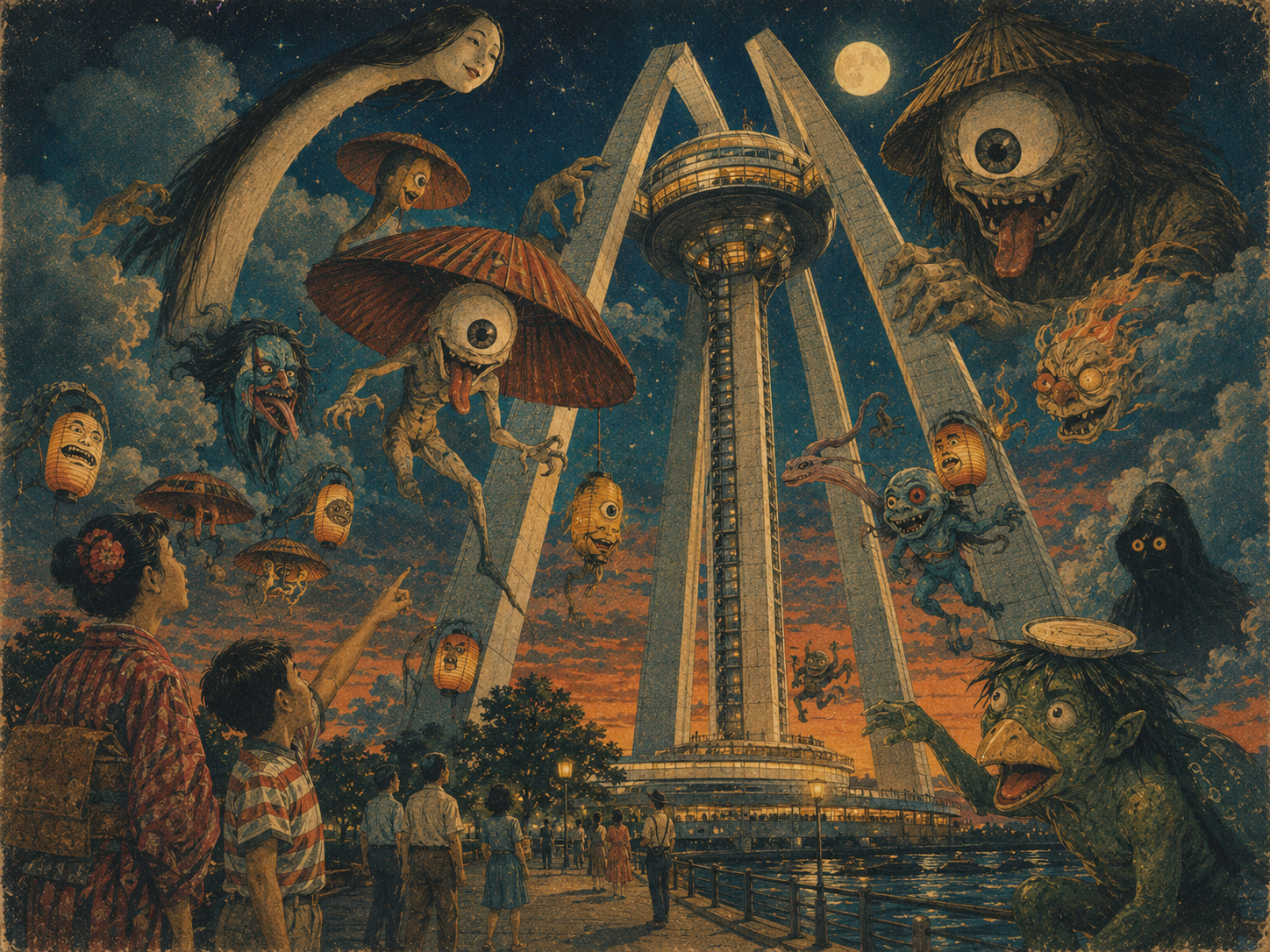
An elevator becomes an entrance to the other world
By day, visitors ride to Twin Arch 138’s observation floor and look across the Kiso River, the Nōbi Plain and distant mountains. At night, the windows darken into mirrors. Oni, kappa, tengu, animals and walking household objects can appear in the same glass as the visitors.
Ichinomiya City’s Twin Arch 138 Yokai Exhibition runs from August 8 through 16, 2026, every evening from 7:00 to 9:00 p.m. The venue is the tower’s observation floor. The city describes the content as projection mapping featuring yokai associated with Ichinomiya.
The exhibition itself is free, though normal tower admission is required. During the same period, the park remains open until 9:00 p.m. and hosts bon dancing, handheld fireworks, yukata admission promotions and stargazing. Yokai are part of an entire summer-night ritual rather than an isolated gallery show.
Why 138?
Ichinomiya is pronounced Ichi-no-miya. Its sounds can be playfully represented by the digits one, three and eight. The number 138 appears repeatedly in local branding, including the park and tower.
The park opened in April 1995 as part of the national Kiso Sansen Park system. Two curved arches meet toward the top, giving Twin Arch its name. The observation floor at 100 meters overlooks the river, plain and, in clear conditions, the Japanese Alps.
A city name becomes a number; the number becomes architecture. Now an unstable population of supernatural beings enters that precisely measured structure.
What is a yokai?
English translations include monster, ghost, spirit and demon, but none covers the whole category. Yokai include oni, tengu, kappa, foxes, monster cats, tsukumogami, mountain women and sea apparitions. They can also describe mysterious sounds, lights, illness, getting lost, sleep paralysis or weather phenomena.
They sometimes overlap with yūrei, the ghosts of dead humans, but are not identical. Yokai can emerge from animals, objects, natural places, social anxieties and unexplained events.
The common element is not biology but uncertainty. A person was pulled in a dark river. A traveler returned repeatedly to the same path. An old tool made noise at night. Naming the experience gave mystery a face.
Ancient anomalies and the later yokai category
Ancient chronicles and Buddhist tale collections contain demons, serpent gods, animal transformations, curses and strange beings. Their audiences did not necessarily place all of them inside a single yokai encyclopedia.
They belonged to different systems: kami, Buddhist spirits, vengeful dead, animal transformation and local taboo. The word yokai is old, but its modern use as a broad umbrella became more standardized later.
Yokai are therefore not unchanged zoological species preserved from antiquity. Every era classifies, names, illustrates and invents them again.
Hyakki Yagyō: the night parade
Medieval Night Parade picture scrolls show countless supernatural beings marching through darkness: demons, animals, vessels, instruments, umbrellas and boxes.
“One hundred” means an uncountable multitude rather than an exact total. The parade imagines that after ordinary human order ends, discarded objects and hidden beings gain their own time.
Projection mapping returns the parade to motion. Figures travel across surfaces, reflections mix with visitor shadows and still illustrations become processions again.
| Period | Main media | Social role |
|---|---|---|
| Ancient–medieval | Oral tale, temple history, Buddhist story and scroll | Explain disaster, illness, taboo, curse and otherworld |
| Muromachi–early Edo | Night Parade scrolls and popular tales | Organize supernatural beings into visible stories |
| Edo period | Woodblock books, prints, shows and ghost gatherings | Urban entertainment, classification and seasonal fear |
| Meiji–prewar | Folklore studies, newspapers and schools | Suppress “superstition” while documenting regional tradition |
| Postwar | Manga, television, film and toys | Mizuki and others rebuild yokai as shared national characters |
| 2020s | Games, AR, projection and tourism | Turn folklore into digital local experience |
Tsukumogami: old objects stand up after a century
Among the Night Parade’s most memorable figures are tools that become alive: one-eyed umbrellas, walking instruments, bowls and boxes with faces. These are often described as tsukumogami.
A familiar explanation says that tools acquire spirit after a long life, often imagined as one hundred years. Objects discarded carelessly may resent humans; those treated with respect may return kindness.
This logic connects with ceremonies thanking needles, dolls and knives. Disposal becomes a social ending rather than simple waste.
In an age of electronics replaced every few years, tsukumogami can read like an environmental warning spoken by abandoned objects.
Edo publishing standardized monsters
As cities and woodblock publishing expanded, yokai moved from local storytelling into commercial print. Ghost books, ukiyo-e, toys and spectacles brought distant regional beings to urban readers.
Toriyama Sekien published illustrated yokai encyclopedias in the late 18th century, including Gazu Hyakki Yagyō. He drew from older traditions but also used wordplay and invention.
Printed pictures became reference images. A phenomenon that once lacked a fixed form could acquire an apparently authoritative face.
What happens after one hundred ghost stories?
Hyakumonogatari involved telling supernatural stories one by one while extinguishing lights. After the final tale, a genuine apparition was expected to appear.
Ghost storytelling became summer entertainment, linking fear’s physical chill with the season of Obon and long nights.
Twin Arch’s event also begins only after 7:00 p.m. The technology is new, but the structure is familiar: gather on a summer night, reduce ordinary light and share the arrival of strange beings.
Kappa explain dangerous water
Kappa inhabit rivers, ponds and marshes. They are said to carry dishes on their heads, drag humans and horses into water, enjoy cucumbers and practice sumo.
Warnings that a kappa would take children functioned as water-safety rules. Currents, sudden depth and flooding became an intentional being that children could remember.
When kappa appear above the Kiso River, they reconnect a national character with the actual water landscape below the tower.
Tengu combine mountain fear and authority
Tengu are now recognized by red faces, long noses, wings and mountain-ascetic clothing. Earlier forms were often more birdlike.
They lead travelers astray, create wind and challenge ascetics, but may also teach swordsmanship or hidden knowledge. Mountain religion, warnings against clerical arrogance and the prestige of otherworldly wisdom overlap.
Yokai are rarely fixed as simply good or evil. They follow older rules and may coexist with humans who behave correctly.
Are oni yokai?
Oni can represent Buddhist hell guards, epidemic, outsiders, mountain people or human rage. The familiar horns, fangs and tiger-skin garment accumulated through visual history.
Setsubun drives oni outside, yet some regional traditions welcome them as divine messengers or beings that drive away greater misfortune.
A local oni story can therefore reveal who society defined as “outside” and what fear was being managed.
Modern Japan recast yokai as superstition
The Meiji state expanded schools, medicine, police and science while attacking yokai belief as ignorance. Illness should be explained medically; weather should be measured.
At the same time, folklorists recorded disappearing traditions. Kunio Yanagita and others transformed local supernatural stories into evidence about premodern social life.
Science did not erase yokai. It moved them from accepted explanation into literature, folklore and entertainment.
Shigeru Mizuki gave yokai modern identity papers
No postwar creator did more for yokai than Shigeru Mizuki. He researched classical imagery, folklore collections and stories heard in childhood, then rebuilt them in GeGeGe no Kitarō and illustrated encyclopedias.
His world mixed documented tradition, uncertain oral tales and original invention. Because his images circulated so widely, they became standard forms in popular memory.
The television anime began in 1968 and returned repeatedly across generations. Creatures expelled from modern education as superstition reentered children’s daily lives through manga and television.
Yokai towns revive through tourism
Sakaiminato, Mizuki’s home city, turned an 800-meter street into Mizuki Shigeru Road. It now contains 178 bronze yokai statues, a yokai shrine, special mailbox and museum.
For towns confronting commercial decline or depopulation, yokai provide a reason to visit and a shared language. Regional space becomes narrative space.
Ichinomiya’s tower can perform a similar connection, joining observation, Kiso River scenery, summer festival and local tales.
What does “yokai associated with Ichinomiya” mean?
The official announcement does not yet list every projected creature, so individual names should not be invented.
“Associated with” may include old city and village traditions, river or agricultural apparitions, temple histories, neighboring folklore or contemporary local creations.
A meaningful regional exhibition should ask where the being appeared, who told the story and what danger or rule it explained. Away from place, a yokai becomes a character. Returned to place, it becomes history.
- Which river, road, temple, field, forest or house was linked to the being?
- Is the earliest source oral, visual, journalistic or found in a local history?
- What accident, illness, weather event or social rule did it explain?
- Was the current appearance shaped by folklore, an Edo artist, manga or the exhibition designer?
- What does tourism preserve, and what does it simplify?
The tower is a modern boundary
Yokai favor thresholds: village and mountain, land and water, day and night, life and death, human and animal.
An observation tower is also a threshold. It stands on earth but enters the sky. It changes the scale of the everyday city. At night its windows show both outside darkness and reflected interior.
A 100-meter glass room is an artificial otherworld built by modern urban engineering.
Does projection “bring yokai to life”?
Projection can animate old art, enlarge it, add sound and surround visitors. It can make a tiny historical image legible to children.
Movement alone does not guarantee understanding. Spectacle can erase place, storytellers, religion and social function, reducing folklore to a monster show.
The strongest digital exhibitions use surprise as an entrance to names, old sources, locations and competing interpretations.
Why gather monsters at the top?
Yokai are often imagined in wells, forests, rivers and old houses. Moving them upward reverses expectation.
Yet tengu fly, Night Parade beings travel, and wind or thunder apparitions arrive from the sky. Height is not foreign to yokai.
From an observation deck, roads, rivers, houses and factories become a map. The projection can present yokai not as relics from an old village, but as an alternate way of seeing the entire modern city.
Yokai never disappear; they change media
Yokai did not lose to science and vanish. They moved from scroll to print, ghost gathering to newspaper, folklore archive to manga, television to game and projection mapping.
People once imagined a kappa in dark water. A child in 2026 may see a luminous kappa at a 100-meter window. The experience changes, but the human act of giving shape to uncertainty remains.
For nine summer nights, yokai will not conquer Twin Arch 138. They will do what they have always done: move into the newest place humans have prepared for them.
Sources and further reading
- Ichinomiya City, 138 Tower Park Summer Festa: 2026 dates, hours, venue, content and fees.
- Official Ichinomiya tourism site, 138 Tower Park: the 138-meter tower, 100-meter observation floor and panoramic views.
- Ichinomiya tourism facility guide: Twin Arch structure and park overview.
- Museum of International Folk Art, “Yokai: Ghosts and Demons from Japan”: the breadth of the yokai category and visual culture.
- Japan Foundation, “Yokai Parade”: Night Parade scrolls, Edo prints and modern supernatural imagery.
- Mizuki Shigeru Road and Museum: 178 bronze yokai and regional tourism.
- The New Yorker, 2015: Mizuki’s role in reviving yokai for postwar popular culture.
- Yokai.com illustrated reference: terminology and traditional creature profiles.