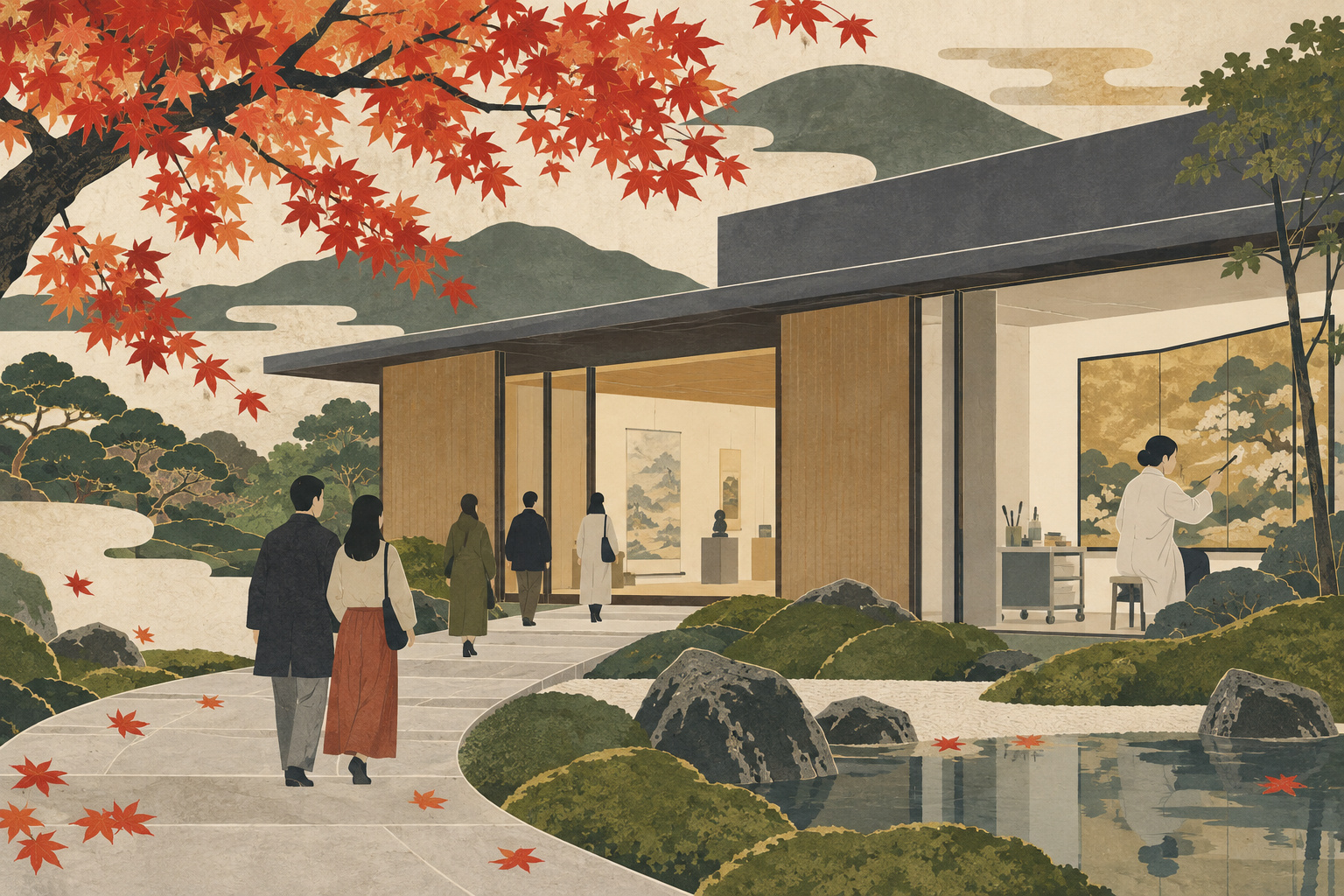
Before a museum can welcome its public back, it must be ready to welcome its collection. That is the less visible story behind the planned October reopening of the Tanabe City Museum of Art: artworks moved into temporary accommodation, equipment replaced and rooms prepared to hold objects whose working lives extend far beyond those of the machines around them.
The museum reports that renovation is complete. Exhibitions at its main building and its branch, the Kumanokodo Nakahechi Museum of Art, are scheduled to resume on October 10, 2026. The announced work includes air-conditioning and electrical renewal and LED lighting for display cases. For this September 21 edition, the reopening remains ahead—a chance to examine what the closure reveals about caring for art in southern Wakayama.[1]
A regional collection reaches its thirtieth year
Opened in 1996 in Shinjo Park, on high ground overlooking Tanabe Bay, the museum describes its remit as serving both Tanabe and the wider Kinan region. Its collection centers on Japanese literati painting and modern painting. Collecting, preserving and exhibiting are linked parts of that public purpose.[2]
The November 1 opening date makes 2026 its thirtieth-anniversary year. That history places the renovation in perspective: a museum established to preserve objects over generations must periodically renew the infrastructure that makes preservation possible.[3] An anniversary exhibition draws attention to the art. A building project asks what will allow the art to remain available for the next anniversary.
For residents, continuity can be personal. A painting encountered on a school visit may look different decades later. Keeping such encounters possible requires an institution that can remain dependable even when individual exhibitions, staff and equipment change. This is one way to understand the public value of maintenance.
The collection moved before the machinery did
The museum’s October 2025 newsletter describes adapting galleries at the branch for temporary storage, adding shelving and improving enclosure. Moving the works took about three weeks, with repeated inspection, packing, transport, unpacking and checking. The museum reported that the transfer was completed safely.[4]
That account makes an otherwise abstract closure concrete. An artwork does not simply leave one building and appear in another. Its condition must remain part of the record as responsibility follows it through each stage. Moving a collection is therefore a sequence of decisions about handling and accountability, as well as a transport task.
The arrangement also shows the interdependence of the two venues. The branch could support the main museum by providing space, while exhibitions at both were interrupted. This was a practical use of a shared institution, with a real consequence for the public: a period without access to either exhibition program.
What it means to prepare a room for art
In its April 2026 newsletter, the museum set out the intended sequence after equipment installation: commissioning, checks of temperature and humidity stability and the air environment in storage and display rooms, then the return of works from the branch.[3]
The sequence is revealing. Finishing construction and confirming that rooms are suitable for a collection are distinct responsibilities. A museum reopening depends on both. The earlier explanation helps readers understand the work behind the current completion announcement.
The project is principally a story about the environment around the art. Replacing equipment does not mean that paintings themselves have undergone restoration. What the published account establishes is the work undertaken and the museum’s approach to preparing its spaces.
A collection gives a place more than one history
The official English collection leaflet names artists including Noro Kaiseki, Hara Katsushiro and Hieda Kazuho. Its examples range from Kaiseki’s 1817 landscape with a plum grove to Hara’s 1935 Seto Landscape and Hieda’s 1989 Sky and Universe. These are examples of the collection, not a promise that every work will be on view at reopening.[5]
Such a range offers several ways into a region’s cultural life. Visitors can follow differences in subject, material and pictorial space, rather than expecting a single regional style. The question becomes how artists understood the world around them—and how those understandings changed.
A regional museum can also bring that local inquiry into a wider conversation. The museum’s newsletter records cooperation with the Museum of Modern Art, Wakayama, for its 2025 Murai Masanari exhibition, including loans and curatorial support.[4] Relationships of this kind allow a municipal institution to present questions that reach beyond the boundaries of its own holdings.
For a visitor, the result can be a reason to look again at familiar surroundings. A landscape painting is a selection, not an inventory of a place. Comparing the painted scene with the world outside invites attention to what an artist emphasized, omitted or transformed. That experience can deepen a visit without turning the museum into an illustrated sightseeing guide.
Reopening with history and storytelling
The anniversary special exhibition focuses on Kobayashi Kokei (1883–1957), examining his treatment of historical subjects and narratives. Scheduled for October 10–November 23, it brings the interpretation of earlier stories into a celebration of the museum’s own history.[6]
There is an accessible question at its center: how does a painter turn a story into an image? Knowing a narrative is one route into a work, but viewers can also consider posture, spacing and the moment chosen for depiction. A story unfolds over time; a painting asks a single arrangement to carry that movement.
Alongside the special exhibition, a modern Japanese painting collection exhibition is divided between the two venues. The main museum considers the development of modern Japanese painting and Kokei; the branch addresses innovation in Japanese painting.[7] For visitors able to see both, the pairing offers a comparison of approaches within a broad artistic category.
The program continues beyond reopening day
The published annual schedule follows the autumn exhibitions with a contemporary painting collection show from December 5 to January 24, 2027, and a literati painting collection show from February 6 to March 22. The latter draws on the collection formed by a local businessman and held on deposit from a local scholarship foundation.[8]
That distinction matters. A deposit is not a donation transferring ownership to the museum. Public access can depend on a continuing relationship between an owner and an institution entrusted with the works. Understanding that relationship helps explain why collection care extends beyond the objects a museum owns outright.
The April newsletter also reports that collecting continued during closure.[3] The institution was therefore still making decisions about its future while its galleries were unavailable. A reopening restores the public face of that work; it does not mark the resumption of every museum activity from a standstill.
Planning a visit
The Kokei exhibition is advertised for 10 a.m.–5 p.m., with last admission at 4:30 p.m. General admission is ¥600; students and visitors under 18 enter free. The main museum will be closed on November 7 because of access restrictions associated with the National Tree Nurturing Festival, while the branch is scheduled to remain open. Check the official calendar before traveling.[6]
The main museum’s access leaflet describes a five-minute walk from either the Minami-Wakayama Iryo Senta Mae or Shinjo Byoin Mae bus stop.[2] Leave room in an itinerary for transport and for an unhurried visit.
The first measure of reopening will be whether people can return to the galleries. Its longer significance lies in whether the renewed institution can keep making those encounters possible. Much of the work supporting that promise will remain out of sight, even when the paintings are back in view.