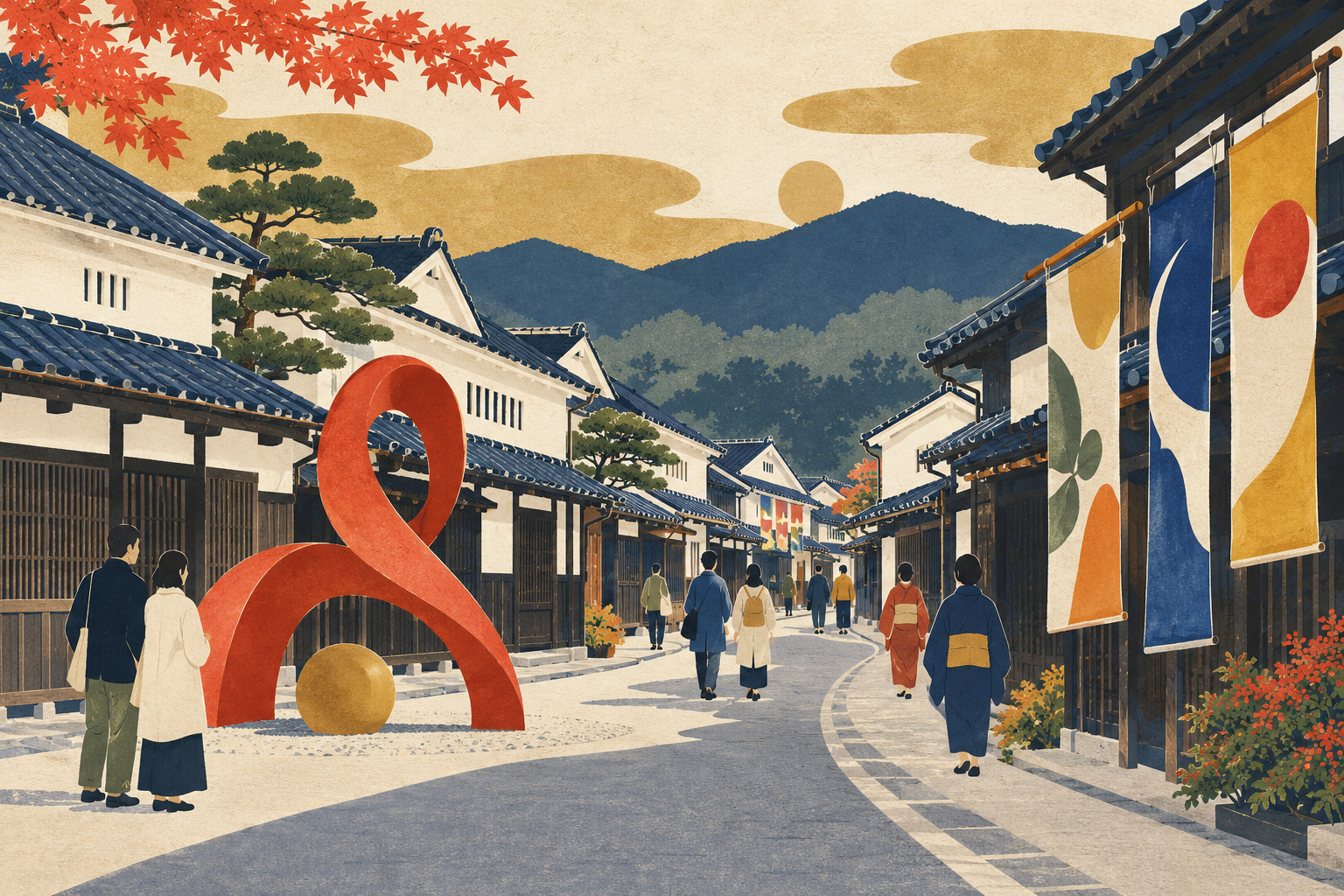
A contemporary artwork placed inside an old merchant house has to share attention. Timber, thresholds and the depth of the rooms are already making their presence felt. At Tamba-Sasayama’s Historic Street ART Festival, that encounter between an artwork and an inhabited townscape is the point of the visit.
The 2026 festival runs from September 19 to 27, with galleries closed on September 24. Its centre is Kawaramachi, the historic merchant quarter in this Hyogo Prefecture castle town. The prefecture’s arts network describes roughly 40 artists working across about 30 traditional townhouses, with sculpture, painting, installation, photography and crafts among the forms represented.[1][2]
The appeal reaches beyond seeing contemporary work in an attractive setting. Entering a participating building can change the way a visitor understands the street outside. A narrow frontage becomes a sequence of spaces. A historic house becomes somewhere that people make decisions about, care for and use.
From castle town to exhibition setting
Sasayama Castle was built in 1609. Its grand hall, the Oshoin, was also constructed that year, but burned down in 1944; the present hall is a reconstruction completed in 2000.[5] That distinction is useful when exploring the town: surviving fabric, repaired buildings and reconstructed monuments tell different kinds of historical stories.
Kawaramachi developed as a commercial centre. The city’s tourism guide describes a street extending about 600 metres, lined with merchant houses whose narrow frontages can conceal considerable depth—more than 40 metres in some cases. Latticework and other traditional details give individual façades their character.[3]
An exhibition inside one of these buildings offers something a view from the pavement cannot. Visitors can attend to the relationship between entrance and interior, to the way a room frames an object, and to the distance between street activity and the space in which they are looking. Architecture becomes part of the encounter rather than a photograph taken before it begins.
Artists, students and the spaces between generations
The festival dates to the late 2000s, developing around the idea of connecting art with merchant houses to bring activity into the community.[1][6] Its history belongs alongside the conservation effort: keeping buildings available and giving people fresh reasons to encounter them are complementary tasks.
The 2026 flyer lists invited artists, including JUN TAMBA, alongside artists connected with the region. It also names a student-art contribution involving volunteer members of the art clubs at Tamba-Sasayama Municipal Sasayama Junior High School and Nantan Municipal Sonobe Junior High School.[8] This makes the programme a meeting of different stages of creative practice, not simply a gathering of established exhibitors.
The flyer’s reverse provides a visual account of the festival’s approach: artworks appear within timber interiors, across tatami rooms and outside along buildings. It explicitly identifies these photographs as past displays that differ from the current exhibition.[9] They are evidence of how the festival has used space, not an illustrated checklist for a 2026 visit.
Those examples suggest a productive question for visitors: what does the room contribute? In a conventional gallery, an uncluttered wall can direct attention towards the work. In a merchant house, the artist encounters a space with an existing visual and social identity. An object may echo that setting or interrupt it. Either relationship can make the building more noticeable.
Student participation adds another possibility. Heritage can be encountered as a place for present-day expression, as well as something to learn about from the past. That does not establish what any individual student experienced. It does show how an exhibition’s structure can make room for younger participants in a town’s cultural life.
What the preservation designation actually covers
The nationally selected preservation district is formally listed as “Tamba-Sasayama-shi Sasayama.” It covers approximately 40.2 hectares and was selected on December 10, 2004. Kawaramachi belongs within this wider castle-town designation; the protected district is not simply another name for the festival street.[4]
Japan’s preservation-district system began with the 1975 revision of the cultural-properties law. Municipalities establish districts and conservation plans, while the national government selects those considered particularly valuable. The framework supports the preservation of historical settlements and townscapes, including repair, streetscape improvements and disaster-prevention work.[7]
The city’s account supplied to the Agency for Cultural Affairs records repair and townscape projects in the Sasayama district from 2005, and the removal of utility poles on Kawaramachi Street in 2021. It also describes preservation associations and work to bring older buildings back into use.[6]
This longer history matters because the festival’s temporary access depends on buildings that require continuing attention. A house cannot be sustained by admiration alone. Decisions about maintenance, use and public access are part of what makes the exhibition possible, even when visitors encounter only the finished display.
A resident is more than a provider of atmosphere
The town’s official tourism account describes the festival as an undertaking that brings residents of merchant houses together with artists.[1] That relationship should remain visible in any assessment of the event. The place is not an empty set waiting for cultural programming.
Using a domestic or commercial interior raises practical questions. How will visitors enter? Which spaces can be opened? How does an installation coexist with the building’s usual activity? These are considerations inherent in the format, rather than claims about a particular disagreement or arrangement in 2026. They make clear why the host’s knowledge of a building is part of the exhibition’s foundation.
For the visitor, respect for that relationship can be straightforward: follow the marked route, check before photographing interiors and avoid treating every doorway as an invitation to enter. Attention to a work and consideration for the people hosting it belong to the same experience.
There are several ways to keep a merchant building working
A nearby example helps place the festival in a broader setting. Odagaki Shoten, known for black soybeans, has a group of ten buildings registered nationally as tangible cultural properties. The city’s tourism account identifies a shop and café renewal, with the café and garden designed by New Material Research Laboratory.[10]
The business traces its founding to 1734, but its own history explains that it changed to the seed trade in the Meiji period. Its renovated direct-sales shop and adjoining café opened in April 2021.[11] Commercial continuity, in other words, has included changes of use and presentation.
This is not evidence that the art festival caused that renewal. It is a separate example of how older buildings can accommodate current activity. Nor should the registration of individual buildings be confused with the wider preservation-district designation. Both are relevant to heritage, but they describe different frameworks.
Read together, the shop and the festival suggest a townscape sustained through more than one rhythm: the daily work of a business, the longer cycle of maintenance and the concentrated period of an exhibition. A successful visit can reveal how those rhythms occupy the same streets.
What remains after the exhibition closes?
Art can introduce people to a building they would otherwise have passed. It can encourage a return visit or a purchase from a local business. These are plausible routes through which cultural activity may help a town; they are not a measured economic impact.
Evaluating that impact would require more than counting visitors. It would mean asking about maintenance costs, demands on hosts, local spending and whether residents want to participate again. An enjoyable festival and a sustainable neighbourhood are connected ambitions, but neither should be used as automatic proof of the other.
The event’s most immediate contribution may be simpler: it gives people a reason to look inside, then to look differently when they return to the street. Contemporary work makes the old buildings available to new interpretations, while the buildings prevent the work from floating free of place.
Planning the walk
The official visitor route uses a bus from JR Sasayamaguchi Station to the Hon-Sasayama stop.[1] Check current services and the return journey before travelling. Free festival admission does not mean that every surrounding museum or attraction is free.
| Dates | September 19–27 |
|---|---|
| Galleries closed | Thursday, September 24 |
| Hours | 10:30–17:00; until 16:00 on the final day |
| Main location | Kawaramachi merchant quarter, Tamba-Sasayama |
| Admission | Free |
The schedule follows the official tourism listing and the 2026 flyer.[1][8] Use the latest venue information on arrival. Allow time to pause in a room rather than treating the walk as a race to collect stops. The artwork may be temporary; the memory of how it changed a familiar kind of building can last considerably longer.

