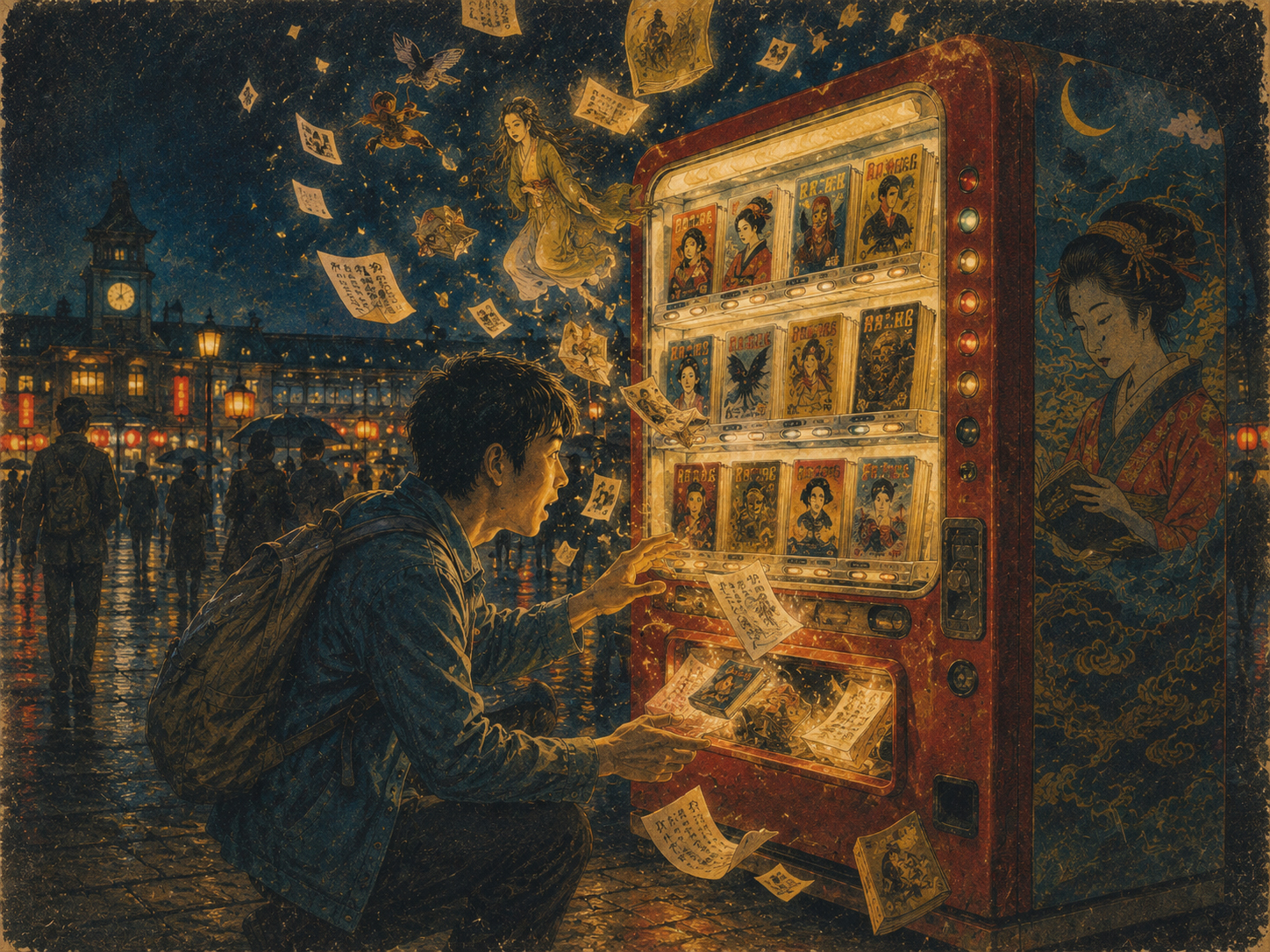
Paper slowly emerges from the machine
A user selects one of several words on a screen. The internal printer starts. A narrow strip of paper extends from the slot, carrying a short story, essay, excerpt or piece of student writing instead of a price and product code.
Tohan’s “Story Vending Machine” began its trial at Setagaya Literary Museum in Tokyo on October 22, 2025. The machine is approximately 118 centimeters high, 38 centimeters wide and 30 centimeters deep. It contains a tablet and printer and operates from a standard 100-volt outlet.
Use is free. One registered text is chosen at random and printed. Each item contains roughly 500 to 2,500 Japanese characters and is designed for a three-to-five-minute read.
Why call it a vending machine when nothing is sold?
The machine does not collect the price of a drink or book. Museums, universities, companies or event organizers cover the cost and distribute the texts free.
The business model resembles cultural programming, tourism and promotion. Content can change with location. Future plans include collaboration with authors and publishers so excerpts lead readers toward full books.
“Vending” remains the useful metaphor because the machine preserves the familiar act: make a selection and receive a physical object. The currency is attention rather than money.
The first stories belonged to the Setagaya Line
The initial museum installation accompanied the institution’s 30th anniversary and an exhibition marking 100 years of the Tokyu Setagaya Line.
Users selected words connected to stations and received texts associated with those places. A story became a second map—one that could change how the next stop looked.
The machine was scheduled to circulate to Tamaden Café Yamashita and Seikatsu Kobo Gallery. It became a literary device traveling along the same corridor it described.
At the chocolate museum, the stories became sweet
At Felissimo Chocolate Museum in Kobe, the machine presented 11 memorable scenes connected to Roald Dahl’s Charlie and the Chocolate Factory.
Visitors could move from visual exhibition and taste toward the original narrative. The machine did not replace the novel; it created a low-risk entrance into it.
On campus, students become authors
At Aoyama Gakuin University, the project planned to present books selected by students and original student short stories. The Aoyama campus installation began in late 2025, with Sagamihara scheduled from April 2026.
A text written by someone in the same building can appear unexpectedly near a cafeteria or hallway. Literature becomes not only the work of famous authors but the voice of an unknown peer.
The printed strip is more private than a noticeboard and less algorithmically exposed than a social-media post.
| Location | Content | Purpose |
|---|---|---|
| Setagaya Literary Museum | Works connected to Setagaya Line stations | Link museum, railway and local memory |
| Tamaden Café Yamashita | Setagaya Line stories | Place literature inside ordinary eating and waiting |
| Seikatsu Kobo Gallery | Location- and exhibition-specific texts | Create a circulating reading route |
| Felissimo Chocolate Museum | Eleven scenes from Charlie and the Chocolate Factory | Lead exhibition visitors toward the original book |
| Aoyama Gakuin University | Student recommendations and original writing | Turn readers into selectors and authors |
Japan’s first was not the world’s first
The best-known contemporary precedent began in Grenoble, France. Publishing startup Short Edition installed cylindrical short-story dispensers in public spaces in 2015.
Readers chose one-, three- or five-minute lengths and received free fiction. Machines spread through city halls, libraries, transit hubs and social centers, reportedly printing around 10,000 stories in the first month.
The concept later moved to airports, hospitals, universities and stations internationally. Japan’s version belongs to that global lineage while emphasizing content tailored to each place.
Why use a long paper strip instead of a book?
A book announces weight and commitment through its cover, spine and thickness. A narrow strip feels temporary and approachable.
Its resemblance to a receipt matters. A familiar record of consumption becomes a fictional memory.
The paper rolls into a pocket and encourages one-direction reading. It lacks the navigability of pages, but suits a short work designed to end quickly.
Can paper compete with the smartphone?
During transit or medical waiting time, many people automatically reach for a phone. News, messages, games and videos continue without end.
The printed story has no notification and no link to another tab. It ends. Completion is possible.
This is not a simple paper-versus-digital argument. The dispenser uses a tablet, printer and digital database to create reading away from a screen.
Railways and literature have long belonged together
Modern rail travel created reading time. Passengers sat for predictable intervals, moving between landscape and page. Station kiosks sold newspapers, magazines and pocket books.
Japanese bunko paperbacks were suited to commuting. Stations and suburban lines became settings in modern fiction, and rail operators used literary walks and memorial sites as tourism.
The dispenser reintroduces reading into transit space after kiosks shrink and newspaper-buying habits fade.
Machines have sold printed words before
Automated publishing has older precedents. In 19th-century Britain, radical publisher Richard Carlile reportedly devised a machine to distribute prohibited texts without a shop clerk, connecting automation to censorship resistance.
Newspaper boxes, paperback dispensers and magazine machines appeared in many countries during the 20th century. Japan also used machines for newspapers, magazines and books.
Older machines sold finished inventory. The new dispenser prints on demand and changes its database by location. It behaves more like a tiny editorial network than a shelf.
Chance without recommendation algorithms
Online bookstores recommend titles from prior purchases and clicks. That is efficient, but it can trap readers inside established taste.
The Story Vending Machine selects randomly within a chosen theme. A reader may begin without knowing the author or title.
It imitates the bookstore accident of noticing an unexpected cover—though the range remains curated by human editors.
A small entrance in an era of disappearing bookstores
Japanese bookstores continue to close, and many municipalities now have none. Population decline, online retail, e-books, magazine contraction, rent and distribution costs all contribute.
One machine cannot replace a bookstore’s staff recommendations, browsing, ordering, events and role as cultural gathering place.
It can create additional points of contact. In hospitals, government offices, airports, universities and hotels, it can hand one text to someone who had not planned to read.
How should authors be paid?
During the trial, host organizations cover costs and users read free. Expansion with publisher and author content requires clear licensing and compensation.
Short Edition’s model has included payments to selected authors from machine rental revenue. Japan’s version will need equally transparent treatment of print counts, duration and promotional value.
Free reading does not mean free writing.
- Permission from rights holders and transparent compensation tied to use.
- Clear author, title, source and full-book purchase information.
- Responsible paper sourcing, disposal and recycling.
- Options for children, multilingual users and easy-to-read Japanese.
- Editing that does not reduce local history to shallow tourism anecdotes.
- Privacy disclosure if usage data is collected.
Is all that paper wasteful?
Free output can be abandoned unread. Thermal paper may also create preservation and recycling concerns.
Allowing users to choose genre, reading time and language before printing can reduce unwanted output. A QR-only system would save paper but destroy the project’s screen-free purpose.
Recycled stock, double-sided printing, collection bins and foldable formats can make physical literature more responsible.
Does short fiction make literature shallow?
Three to five minutes cannot provide the architecture of a long novel. But flash fiction, poetry, essays, ghost stories and comic tales have long used brevity as strength.
Japan has Kawabata Yasunari’s “palm-of-the-hand stories,” Shinichi Hoshi’s short-shorts, newspaper serialization, mobile fiction and social-media writing.
Rather than trimming novels into advertisements, the dispenser could cultivate works designed specifically for its length and paper form.
Multilingual stories can alter tourism
A destination could offer Japanese, English, Chinese and Korean versions—or different stories by different writers about the same station.
Visitors might receive fiction rather than an explanatory brochure. Residents could see familiar streets from an outsider’s imagination.
Machine translation can increase volume, but literary rhythm, dialect and cultural implication require human translators if the work is to remain literature.
The machine is not the editor
The device randomizes output. Humans decide which texts enter the database, which themes they belong to and whose voices are excluded.
A narrow selection can erase minority history or uncomfortable local memory. Corporate copy can turn the machine into an advertising receipt.
The quality of the project depends more on editorial policy than printing hardware.
The paper continues moving after it is read
A book usually returns to an owner’s bag or shelf. A story strip can pass through a train, across a café table, into another person’s hand or become a bookmark.
Folds, notes and stains give each printout a history that did not exist in the database.
Digital files can be copied identically. Printing makes one instance materially different.
Japan’s vending culture rebuilds accidental reading
Japanese vending machines symbolize speed, precision and 24-hour convenience. The Story Vending Machine gently betrays that logic.
The output is not fully predictable. The user must stop and read. Meaning takes longer than product delivery.
Yet the ritual remains familiar: press a button, hear a machine and take something from the slot. A known action leads toward an unfamiliar text.
When the paper emerges, it carries more than a short story. It carries a publishing hypothesis: literature can begin anywhere, even outside the bookstore.
Sources and further reading
- Tohan, October 22, 2025: specifications, story length, locations, cultural-agency support and business model.
- ITmedia NEWS, October 22, 2025: 118-centimeter machine, tablet, printer and random selection.
- Asia News Network / The Japan News, October 28, 2025: reporting on Japan’s first literary vending machine.
- Setagaya Literary Museum: museum programs and Setagaya Line centennial context.
- The New Yorker, 2015: Short Edition’s Grenoble dispensers and author model.
- World Economic Forum, 2018: one-, three- and five-minute short-story printing and global rollout.
- Japan House Los Angeles: the social history of Japanese vending culture.
- SOMPO Institute, 2026: declining vending-machine numbers and market structure.