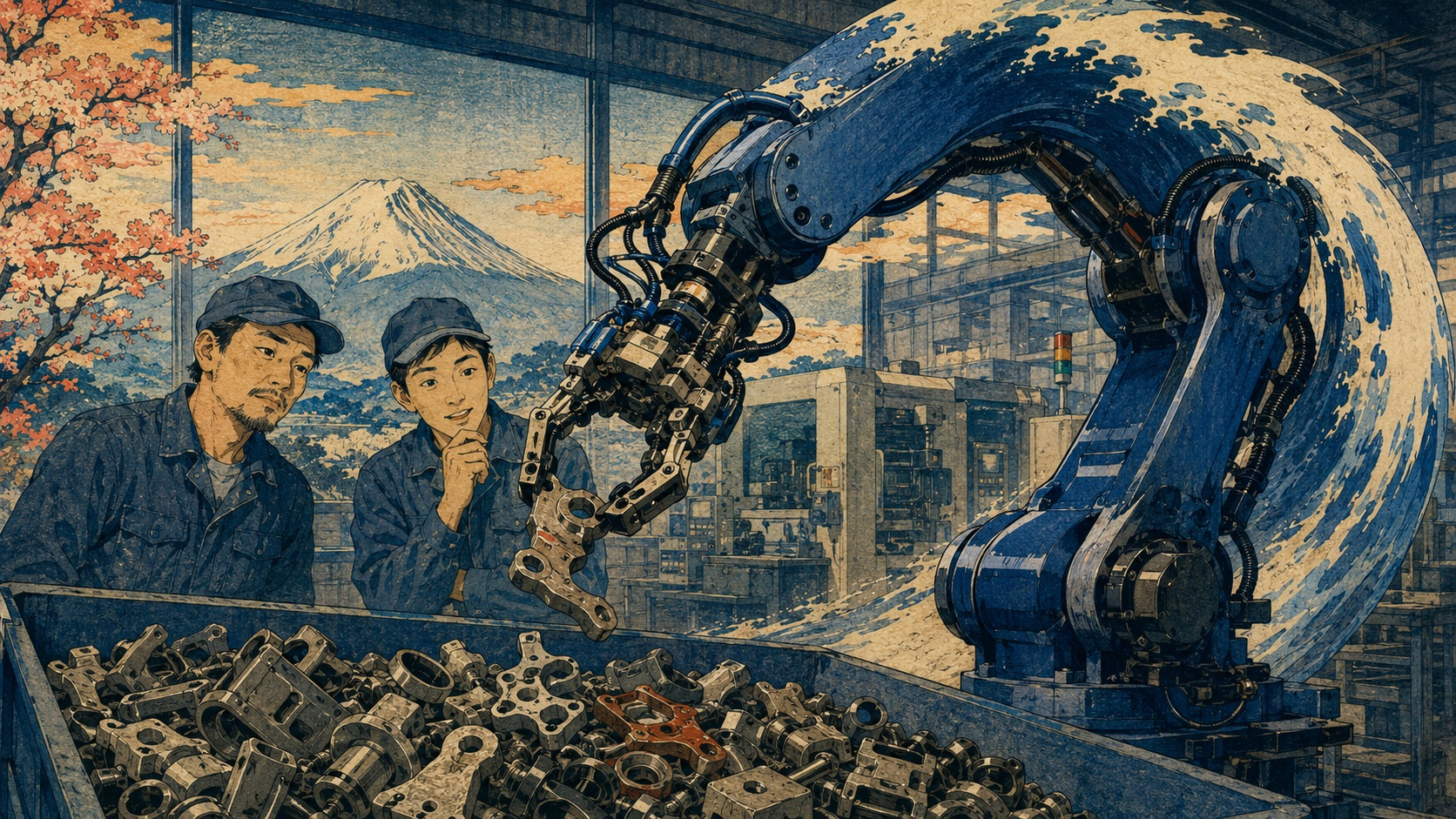
The bin is half a century's unfinished business
A human hand makes the job look trivial. It reaches into a box of interlocked metal parts, feels for one exposed edge, nudges a neighboring piece aside and lifts without scratching either one. The eyes cannot see underneath, so the fingers fill the gap. If the part slips, the grip changes. If two pieces catch, the hand tries another angle. A few seconds of human motion quietly combine recognition, pose estimation, grasp selection, collision avoidance, force control and failure recovery.
Factories have traditionally removed that uncertainty before asking a robot to move. Parts are aligned in trays, shaken into a single orientation by a feeder or locked into fixtures. The robot is then extraordinarily fast, precise and tireless. But when the product changes, the feeder, tooling and program may have to change with it. That is an excellent bargain in mass production and often a poor one in a small factory switching among orders of tens or hundreds of pieces.
On July 17, 2026, the uncertainty acquired a government product number. Thinker announced that the TMA-U3e version of its Thinker Model A had been placed in the official catalog as the first product in the category “random-bin-picking robot system.” Its listing is PD-00002810. The package combines a collaborative arm, hand, camera and control hardware; according to the company, the subsidy listing currently applies to systems sold directly by Thinker.
What “eligible for 50%” actually means
The headline needs a guardrail. Japan's SME Labor-Saving Investment Subsidy, administered by the Small and Medium Enterprise Agency and the Organization for Small & Medium Enterprises and Regional Innovation, subsidizes one-half or less of eligible costs. A product's appearance in the catalog does not turn every purchase into an automatic half-price transaction. An SME facing a labor shortage applies jointly with a registered seller, presents a labor-saving and productivity plan, and must receive a grant decision.
| Employees | Normal subsidy ceiling | Ceiling if wage conditions are met |
|---|---|---|
| 5 or fewer | ¥2 million | ¥3 million |
| 6–20 | ¥5 million | ¥7.5 million |
| 21 or more | ¥10 million | ¥15 million |
Those are the rules for applications under the program revision effective March 19, 2026. The ceiling varies with headcount. Even at a nominal one-half rate, costs above the recognized product price or the ceiling raise the buyer's effective share. Companies also have to watch the timing of contracts, which expenses qualify, reporting obligations and the cash-flow gap before reimbursement. A subsidy reduces the capital cliff; it does not convert an ill-suited process into a profitable one.
The catalog mechanism still matters. An industry association helps define a product category and its labor-saving standard. Products are reviewed before listing, and registered vendors support the application. The official FAQ says a multi-component system should be registered as the minimum package required to deliver the claimed labor-saving effect. The category for random-bin-picking systems was added on January 22, 2026. Thinker's listing six months later gave it its first product.
Why picking one part is so hard
“Random bin” means the parts do not arrive with a known location or orientation. They overlap, occlude one another and touch the container. A robot must separate target from background, infer its three-dimensional pose, select a reachable grasp, find an extraction direction, avoid the bin wall and neighboring pieces, and know what to do when the plan fails.
Researchers have treated bin picking as a chain linking perception, grasp planning, motion planning, control and learning. Depth cameras and machine learning have transformed the field, but factories are more adversarial than clean demonstrations. Black polymers absorb infrared light. Polished metal returns glare. Transparent parts show the background. Sheet material, bags, cables and rubber deform. Oil, dust, changing daylight, fewer parts in the bin and normal manufacturing variation all disturb the measurement. A 99% success rate still means about ten interventions per thousand attempts—enough to defeat an unattended night shift.
For a stable, high-volume line, a dedicated feeder or fixture eliminates uncertainty mechanically. An SME wants something else: the ability to handle modest volumes of changing workpieces without keeping a robotics specialist beside the cell. The decisive specification is therefore not the arm's repeatability. It is how cheaply the system can absorb variation and how quickly an ordinary operator can change it over.
Not touch, but the instant before it
Thinker's answer is proximity perception in the fingertips. Its TK-01 sensor emits infrared light and reads the reflection to estimate distance and local shape before physical contact. The company calls the idea “pre-touch.” It is not human touch and not a claim that the hand thinks. It is a short-range sense between camera vision and physical contact.
The camera has not disappeared. Model A's registered package includes one. The design divides the job: a camera identifies a broad region, and the fingertips correct position and tilt during the final approach. Instead of forcing an expensive dedicated 3D camera and an exact object model to account for every error, the hand measures the scene again close to the target. Coarse vision brings the hand near; local sensing shrinks the remaining uncertainty.
Thinker says the system can handle reflective or transparent surfaces, delicate or flexible items and shifted workpieces, while compliant fingers can move neighboring pieces aside. It packages an arm-mounted camera, controller and computer loaded with a basic program, and says workpiece registration in a June 2025 model took one-twentieth the time required in its January 2025 model. These are promising manufacturer claims, not an independent guarantee across every material, bin and production rate. A buyer needs an acceptance test on actual parts, including the bad, oily and dimensionally marginal ones.
| TMA-U3e | Published configuration and specifications |
|---|---|
| Core package | Universal Robots UR3e collaborative arm, Think Hand F, camera, controller box and computer with a basic program |
| Footprint | 612mm wide × 810mm deep × 865mm high, excluding the arm's working envelope |
| Reach | 500mm |
| Power | 385W maximum, 166W in ordinary operation, according to Thinker |
| Supply | 100–120V AC, 50/60Hz |
| Indicative lead time | About three months; workpiece fit, surrounding equipment and safety measures require separate confirmation |
From laboratory fingertips to an Osaka product
The hand did not appear overnight. Keisuke Koyama—now a Thinker director and an Osaka University researcher—and his collaborators were presenting pre-shaping with resistor-network proximity sensors at the IROS robotics conference in 2013. Work in 2015 used time-to-contact to control grasp approach. In 2016 the team presented integrated control of a multi-fingered hand and arm using fingertip proximity sensing. A 2018 paper addressed high-speed measurement of tilt, distance and contact. Their 2019 journal article described feedback that adjusted the arm, wrist and fingers together and demonstrated grasping of both stationary and moving objects.
The unifying idea was to avoid a rigid sequence of “see, calculate, then move.” If an object moved or the original estimate was slightly wrong, the system could react as it approached. A person reaching for a cup does something analogous, refining the trajectory without first constructing a millimeter-perfect model of the world. A machine, however, needs sensing speed, surface-reflectance compensation, stable control and fingertip geometry to turn that intuition into repeatable motion.
Thinker was established in Osaka in August 2022. Its president, Hiromichi Fujimoto, had previously led ATOUN, a Panasonic-born venture that developed wearable assistive robots. The startup joined Koyama's sensing research with Fujimoto's experience commercializing physical machines. It announced Model A in January 2025, publicized a packaging deployment at Nasu Packaging in 2026, and secured the UR3e configuration's catalog listing in July.
Japan's robot history comes full circle
Japan's industrial robot era began by importing an idea. Kawasaki Heavy Industries signed a technology agreement with the American company Unimation in 1968 and produced the Kawasaki-Unimate 2000 in 1969, the first industrial robot made domestically in Japan. Its large hydraulic arm took on hot, dangerous die-casting and welding work. Toyota and Nissan adopted robots for spot welding in 1973, opening an age in which automation reinforced automotive volume and consistency.
Electric drives and microprocessors expanded the field in the 1980s, spreading robots into painting, assembly, handling, semiconductors and electronics. Japan became exceptionally good at using a machine to handle the same object, in the same place, with speed and precision over tens of thousands of cycles. The robot thrived as long as the factory map remained stable.
That success clarified the next boundary. A major company's dedicated line could be automated, while the bin in a job shop, the part that changed each day and the low-volume operation adjusted by an experienced worker remained stubbornly manual. Collaborative arms reduced the footprint of safety fencing and made programming more accessible. But bringing an arm near a person does not finish the job if the end-effector cannot understand what it is approaching. Thinker's listing brings the history from the powerful arm toward the situationally aware fingertip.
The robot superpower's diffusion paradox
Japan installed 44,453 industrial robots in 2024, second only to China, according to the International Federation of Robotics. Its operational stock reached 450,500. Japanese suppliers produced 38% of the world's robots that year. This is not a country short of robot expertise.
But those machines are not spread evenly. Large automotive and electronics plants have multiyear capital plans, resident engineers, systems integrators and predictable throughput. In a smaller company, a single failed cell can interrupt the whole process, while the payback period moves with customer orders. Tooling, vision, fencing, conveyors, electrical work, training and maintenance can turn the arm itself into only one line in the total quotation.
Japan's Ministry of Economy, Trade and Industry launched the Robotics & Regional Initiative Networking Group, or RING, in 2025 to build regional adoption capacity. The 2026 SME White Paper makes the economic reason explicit: as labor supply tightens, companies must raise productivity and earning power if wage increases are to last. Labor's share of income at SMEs is already close to 80%, leaving limited room to finance wages simply by squeezing profit. Automation policy is therefore not only about replacing a person. It is about preserving output with fewer available workers and producing the margin from which higher pay can come.
A packaging cell shows both promise and limits
In a case study published by Thinker in April 2026, Nasu Packaging, a company in Nishinomiya that packages automotive service parts, introduced Model A. Previously, an operator removed one component from an unsorted pile, placed it into a bag presented by a packaging machine and let the machine seal it. In the new cell, the robot picks the part and deposits it in the bag before sealing. The company aims for an operator to oversee several lines or product types.
The example makes the value of random-bin picking tangible, but it is a release from the vendor and customer, not an independently audited study. It does not publish a verified cycle time, uptime or return-on-investment period. Counting only the operator who used to pick can also mislead. Refilling the bin, clearing bag jams, checking exceptions, changing products and recovering the night shift all belong in total labor hours.
There is a broader opportunity. Moving repetitive picking to a machine can shift people into inspection, setup, maintenance and supervision across several cells. The companies say redesigning jobs could widen employment for women, older people and workers with disabilities. That is an aspiration, not an automatic social effect: work height, interface design, training and employment conditions still have to be designed around people.
What the subsidy cannot buy
Catalog listing does not mean the government has guaranteed performance or profitability in every factory. Registration reviews the product against category rules and labor-saving standards. The factory contains frictions the catalog cannot see.
| Test before purchase | The practical question |
|---|---|
| Workpiece fit | Has the cell been tested on actual good and bad parts—oily, scratched, transparent, black and at dimensional limits? |
| Effective cycle | Does the timing include bin changes, replenishment, machine waiting, failure recovery and product changeover—not just the successful pick? |
| Unattended duration | Has it run for the required shift rather than a 100-pick demonstration? Can it handle the last pieces in the bin? |
| Surrounding equipment | Are risk assessment, guarding or scanners, stand, conveyor, power, network and maintenance included in the total? |
| Operations | Who registers a new product, diagnoses errors and cleans or replaces fingers and sensors? |
| Economics | Does payback work before and after subsidy under lower orders, financing costs and realistic downtime? |
The phrase “capable of 24-hour operation” also requires parsing. A mechanism's ability to run continuously is not the same as a process that never needs a person. Empty bins, tangles, double picks, dropped parts, exhausted packaging material and upstream stoppages happen outside the robot hand. Unattended production succeeds not by eliminating every failure, but by detecting failure, entering a safe state and providing enough information for remote diagnosis.
Is the package the real invention?
In industrial robotics, a deep gap separates selling an arm or gripper from selling a job a customer can perform the next morning. A systems integrator combines cameras, lighting, tooling, controls, PLCs and safety devices around the part and production rate. The expertise is essential, but small projects cannot spread engineering costs across enormous volumes.
Model A tries to narrow that gap by bundling the arm, Think Hand F, camera, controller and computer with a basic program. Its published base is 612mm by 810mm and it accepts ordinary 100–120V power. The proposition is closer to an appliance placed beside a process and re-registered for different work than to a giant dedicated machine.
Whether it is truly a general-purpose product will not be decided by the catalog entry. It will be decided by the number of companies and workpieces it handles, and by the additional engineering cost and commissioning time each one requires. Product number one is the beginning of measurement, not the end of the market. If competing systems enter the same category, buyers may eventually compare price, workpiece range, recovery, service and setup time rather than commissioning every cell from a blank page.
The hand is moving beyond picking
Thinker has recently publicized demonstrations of gear meshing, wire-harness insertion and rail-maintenance work. For simple removal from a bin, suction or an ordinary gripper may already be enough. The deeper promise of local sensing lies in what comes next: correcting the pose after grasping, reading the relationship to a hole or mating part, and inserting without damage.
That does not turn a demonstration into production evidence. Insertion adds force sensing, tolerance stacks, structural stiffness, counterpart location and inspection. Yet if one hand can bridge “recognize and pick” with “fit and assemble,” a factory could eliminate feeders, regrasp stations and some dedicated fixtures. For a smaller manufacturer, redeploying one cell across several tasks may be more valuable than maximum speed on only one.
The numbers that should come next
Three measurements will tell whether this announcement becomes an industrial shift. The first is not approved applications but systems operating in production. The second is not catalog price but total installed cost including safety and integration. The third is not best-case pick speed but the monthly cost per good part after failure recovery and changeover.
Policy must learn too. If a subsidy merely pulls purchases forward, demand will contract when it ends. If Japan builds regional seller networks, operator training, service parts, cybersecurity practices, incident sharing and a market for redeployment, a robot becomes infrastructure rather than a one-off project. Publishing anonymized uptime, labor hours saved and commissioning problems—not only recipient names—would let the next SME avoid repeating the first SME's mistakes.
From a strong arm to a fingertip that can hesitate
The 1969 Unimate offered Japanese factories force: a great arm to take repetitive, dangerous work away from a person. The small catalog number of 2026 stands at the other end of the story. The machine approaches a fragile object, reads before touching, corrects a small error and, when uncertain, moves neighboring pieces before trying again. It gives machinery not more strength, but a capacity for hesitation and revision.
SMEs do not need a universal robot that perfectly imitates a human. They need a tool that can move one tedious job—taking parts from a box, putting them into bags, feeding a machine—from today's product to tomorrow's without another expensive engineering project. The subsidy lowers the cost of reaching for that tool. Adoption will ultimately be decided in the same place as the fingertip makes its decision: very close to the actual work.
Principal sources and methodology
- Thinker: subsidy-catalog announcement, July 17, 2026, and official product catalog entry PD-00002810
- Official Thinker Model A product page and Thinker's English explanation of proximity sensing
- Official SME Labor-Saving Investment Subsidy catalog-order portal and official FAQ, updated June 5, 2026
- Labor-saving product catalog update history and category definition for random-bin-picking robot systems
- Thinker and Nasu Packaging: automotive service-parts packaging case study
- Koyama et al., integrated control using fingertip proximity sensing, International Journal of Robotics Research (2019), and Keisuke Koyama publication record
- J-GoodTech: Thinker company and technology profile, and JAPAN Forward interview with founders Hiromichi Fujimoto and Keisuke Koyama
- Fujita et al., “What are important technologies for bin picking?” (2019)
- Kawasaki Heavy Industries: history of Japan's industrial-robot business and Kawasaki Robotics 50-year history
- International Federation of Robotics, World Robotics 2025
- Japan's 2026 SME White Paper summary and METI announcement establishing RING
- Thinker application demonstrations: gear meshing, wire-harness insertion, and railway-work tests with JR East
Editor's note: Product specifications, setup-time reduction, 24-hour operation, workpiece capabilities and deployment effects are attributed to Thinker or its customer where appropriate. Catalog listing is approval against product and category rules; it does not guarantee that a buyer will receive a grant, receive the maximum amount, achieve performance on a particular process or earn a return on investment. The legal subsidy rate is “one-half or less.” The ceiling table reflects conditions for applications from March 19, 2026. The market strip reproduces the supplied rate of 1 US dollar to 162.49 yen and converts the supplied update time, July 21 at 1:27 a.m. UTC, to 10:27 a.m. Japan Standard Time. The hero is a contemporary editorial illustration, not a historical Hokusai work.