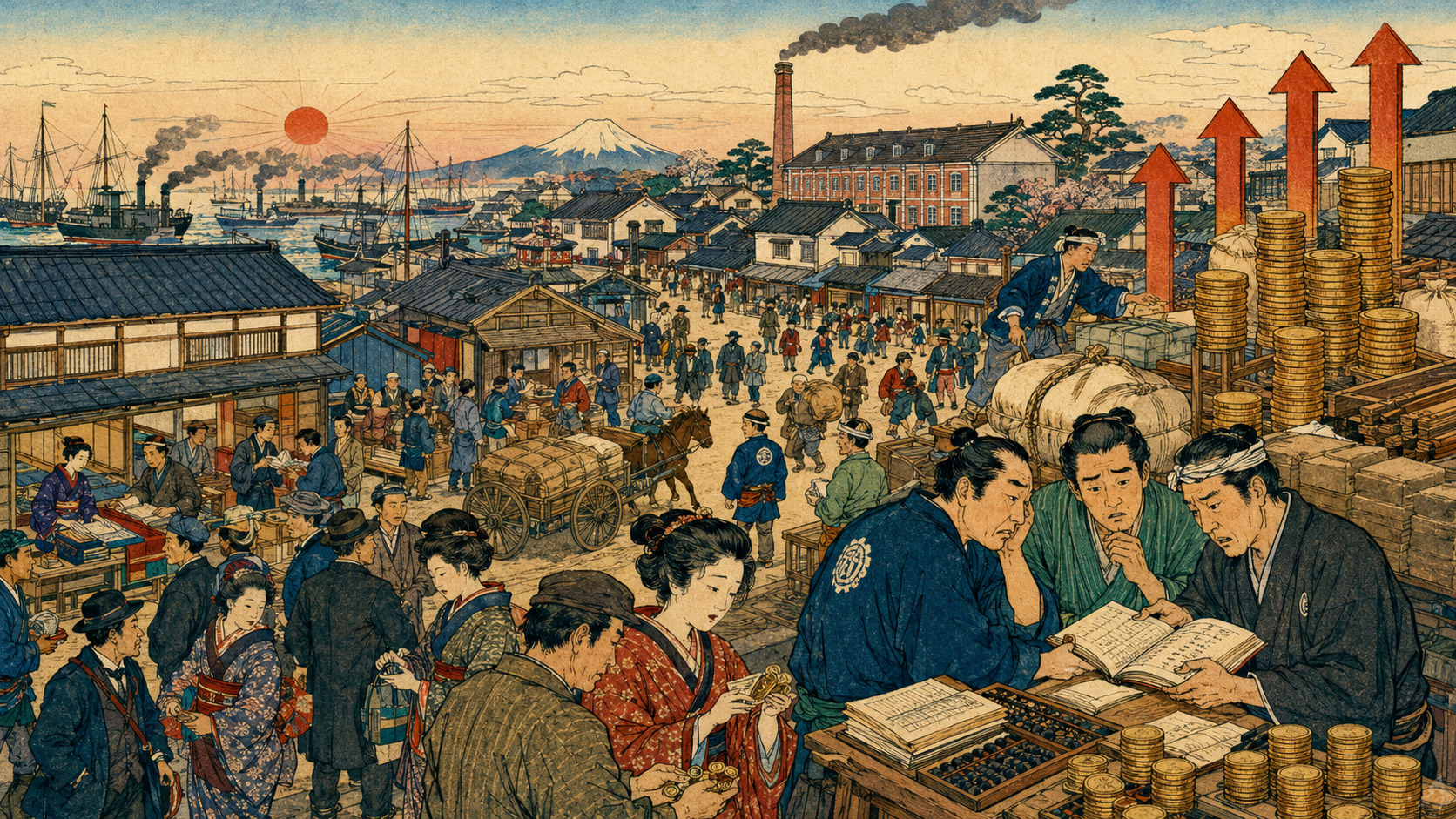
When Costs Rise ¥100, Only ¥42 Reaches the Price
The same calculation is being repeated inside Japanese workshops, trucking firms, restaurants, builders, inns and food processors. Suppose the combined cost of materials, energy and labor rises by ¥100. Apply the 42.1% average pass-through rate reported by Teikoku Databank in February, and the company recovers only about ¥42 through a higher selling price. It absorbs the remaining ¥58.
Sales can rise while profit falls. Consider an item sold for ¥1,000 with a cost of ¥800, producing ¥200 in gross profit. If cost rises ¥100 and the business raises its price only ¥42, the new price is ¥1,042 against a ¥900 cost. Gross profit falls to ¥142—a 29% decline. Rent, debt service, maintenance, investment and the owner's income must still come from what remains.
Why Smaller Firms Are Hit Harder
Small and midsize enterprises are not a side story. Long-run structural data from the SME Agency show they account for 99.7% of Japanese companies, roughly 70% of employment and about half of added value. A margin shock at small firms therefore becomes a national problem through wages, jobs, tax revenue, supply chains and the survival of regional communities.
Large corporations can buy in volume, lock in long contracts, hedge currencies, diversify suppliers and use brand power. Small companies often buy smaller quantities closer to spot prices, carry inventory with limited cash and depend on a handful of customers or prime contractors. A customer can answer a mathematically justified price request with a commercially devastating sentence: “We will find another supplier.”
Consumer-facing businesses confront a different barrier. During Japan's long deflationary era, maintaining the same quantity, quality and price became a sign of trust. Changing a price was not merely arithmetic; it altered a psychological contract with regular customers.
The 2026 Shock Comes from Four Directions
| Pressure | How it spreads | Exposed businesses |
|---|---|---|
| Oil and energy | Beyond fuel and electricity into resin, chemicals, packaging, fertilizer and building materials. | Transport, manufacturing, farms, fisheries, laundries, lodging. |
| Weak yen | Raises the yen cost of dollar-priced commodities, ingredients and machinery. | Food processors, import retailers, machinery, construction. |
| Logistics and labor scarcity | Driver shortages, overtime restrictions and warehouse wages lift delivery rates. | Regional firms, low-price goods, chilled and frozen food. |
| Wages | Pay must rise to retain workers, but labor cost is particularly difficult to pass through. | Care, restaurants, construction, lodging, services. |
The Bank of Japan says the country obtains more than 90% of its crude oil from the Middle East, while mineral-fuel imports equaled about 3% of nominal GDP last year. Dearer oil transfers national income overseas while squeezing corporate profits and household purchasing power. In April 2026, the import price index jumped 4.9% month to month in contract-currency terms. The producer price index rose another 0.4% in June.
Oil is not merely gasoline. Petrochemicals enter packaging film, detergent, synthetic fibers, construction materials and farm inputs. Fuel runs fishing boats, delivery vehicles and cold-storage warehouses. The BOJ has warned that increases in fuel and chemical prices could amplify distribution costs already driven higher by labor shortages.
Bankruptcies Reveal a Quiet Emergency
Teikoku Databank counted 556 “inflation bankruptcies” in the first six months of 2026—107 more than the 449 recorded a year earlier, a 23.8% increase and the highest first-half total since tracking began in 2018. June alone produced a record 113 cases.
All corporate bankruptcies reached 5,335 in the half, up 6.6%. Debts below ¥50 million accounted for 62.2%. This is less a spectacle of giant collapses than a process in which one regional light goes dark at a time. Among 2025 inflation bankruptcies, raw materials were cited in 43.3% of cases, labor in 24.8% and energy in 24.2%. Labor exceeded one-fifth for the first time.
Bankruptcy is also a lagging indicator. Owners first reduce their own pay, postpone equipment replacement, borrow, rely on family labor and shorten opening hours. Only after those buffers are exhausted does distress appear as a legal filing. Closures, frozen hiring, deteriorating service and abandoned investment occur before the statistic.
The Oil Shock, Fifteen Years of Deflation, and Now
Japan has experienced import-price shocks before. The 1973 oil crisis drove a burst of inflation remembered as kyōran bukka—“raging prices.” Government and industry responded with conservation, fuel substitution and industrial upgrading, helping transform Japan into a far more energy-efficient economy.
From the late 1990s, the country entered the opposite world. The BOJ's historical review dates deflation from the late 1990s and describes roughly 15 years in which inflation averaged minus 0.3%. The decline was shallow but persistent, embedding the assumption that wages and prices would not rise. Companies competed through cost reduction; consumers learned to punish increases.
The commodity, food and currency shocks that followed 2022 forced a rapid reversal. What distinguishes 2026 is the collision of an external oil shock with domestic labor scarcity and wage pressure. The 1970s taught resource efficiency. Deflation taught relentless cost control. The present transition requires something Japan practiced less often: explaining value and negotiating prices continuously.
Can Price Pass-Through Become Normal Business?
Japan's amended subcontracting regime took effect in January 2026 as the SME Transactions Act. It strengthens the principle that a buyer may not refuse meaningful negotiation and then unilaterally impose a price, and it bans promissory-note payment in covered transactions. The Japan Fair Trade Commission now speaks of “structural price pass-through” across the supply chain, including labor—not only materials and energy.
Law cannot restore a margin by itself. Suppliers must know product-level costs, document the reason for increases, schedule negotiations and reduce dependence on a single customer. Buyers must look beyond the first-tier supplier and ensure that money for higher costs reaches the second and third tiers.
The 2026 SME White Papers prescribe a broader transition: price pass-through, higher-value products and services, growth investment, restructuring through succession and M&A, and better allocation of labor through AI and digitalization. In other words, policy is not merely offering relief. It is asking companies to move from “selling cheaply for longer” to “earning a price that reflects value.”
Five Numbers Every Owner Should Watch
| Number | Question | Action |
|---|---|---|
| Gross profit by product | Which item is losing profit, regardless of sales growth? | Update cost sheets monthly; discontinue structural loss-makers. |
| Pass-through rate | Of every ¥100 in higher cost, how much reached the price? | Negotiate materials, freight and labor separately. |
| Cash runway | How many months remain at the current cash burn? | Speak early with lenders, JFC and business-support groups. |
| Customer concentration | Could the firm survive losing its largest buyer? | Diversify sales channels to improve bargaining power. |
| Value added per worker | Is productivity creating room for higher wages? | Invest in labor-saving tools, digital systems and redesign. |
Smaller, regular price reviews may be easier to explain than one enormous increase after years of delay. The case cannot stop at “our costs rose.” Businesses need to show the customer value being protected: quality, delivery, safety, regional employment and continuity of supply. Quietly shrinking a product while holding the sticker price may attract less attention, but it can damage trust.
A Price for Continuity, Not Merely Expense
Pass-through is not a battle of companies against consumers. If a business supplies below cost long enough, the loss returns to the community as closure, unemployment and fewer choices. Yet opportunistic increases without explanation also destroy trust. The durable answer is transparent evidence and a fair sharing of the burden.
The BOJ expects core consumer inflation of 2.5–3.0% in fiscal 2026 and says elevated oil will suppress corporate profits and real household income. But the national average cannot tell us which company survives. The decisive variables are firm-specific: power to price, ability to add value, capacity to negotiate and cash to endure.
For decades, Japan often treated the company that did not raise prices as the honorable company. Selling below sustainable cost is not long-term honor. A price that pays workers, repairs equipment and allows the firm to deliver again tomorrow may become the new definition of trust in inflationary Japan.
Sources and Further Reading
- Teikoku Databank: Inflation Bankruptcies, First Half of 2026.
- Teikoku Databank: Price Pass-Through Survey, February 2026.
- Teikoku Databank: Corporate Bankruptcies, First Half of 2026.
- Bank of Japan: Outlook for Economic Activity and Prices, April 2026.
- Bank of Japan: Economic Activity and Prices, June 2026.
- Bank of Japan: Corporate Goods Price Index, June 2026.
- METI: 2026 White Papers on Small and Medium Enterprises and Small Enterprises.
- Japan Fair Trade Commission: FY2026 organization and the SME Transactions Act.
- Bank of Japan: Price Dynamics in Japan over the Past 25 Years.