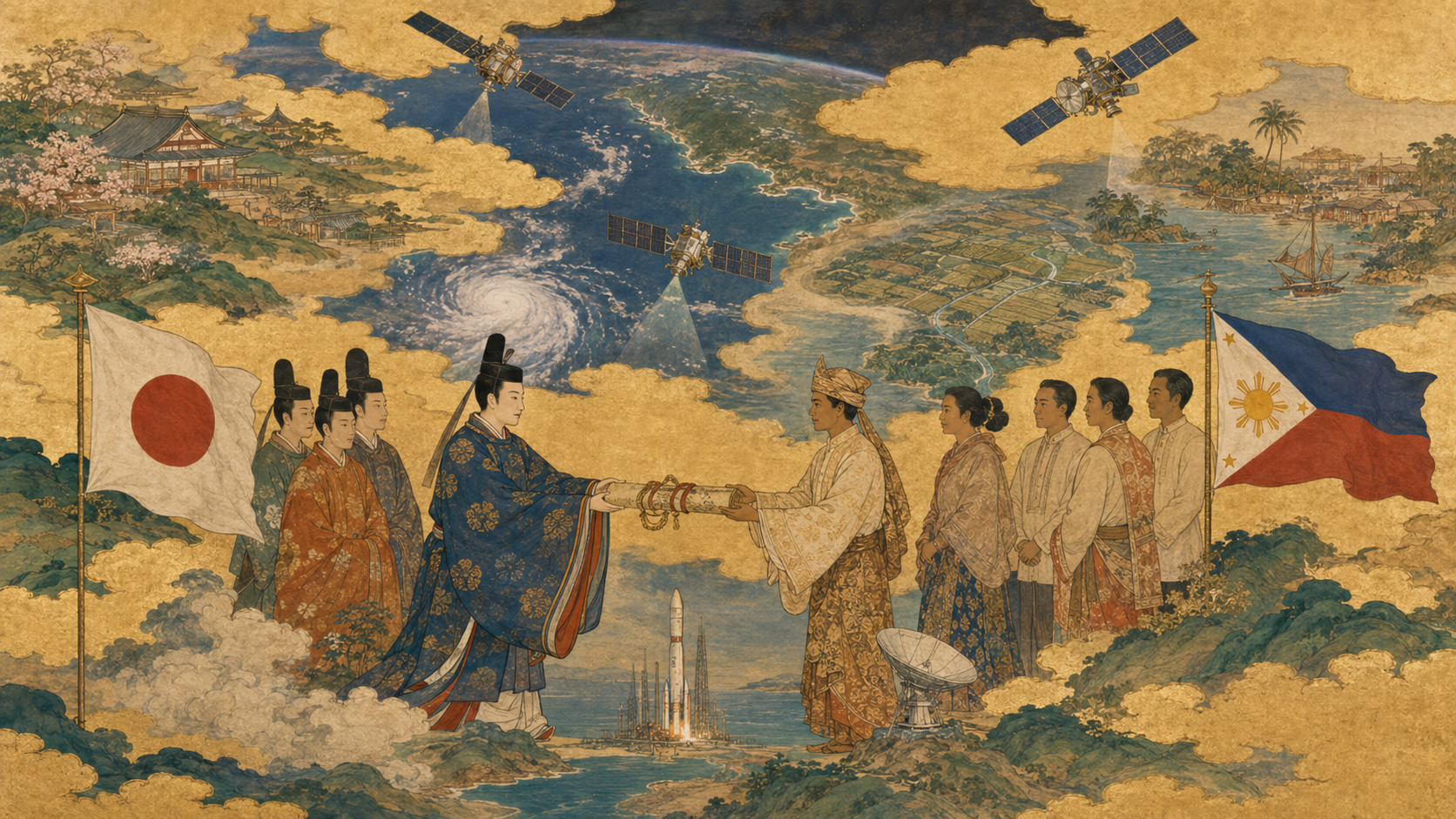
A first agency-to-agency pact
At SPACETIDE 2026 in Tokyo on July 6, JAXA President Hiroshi Yamakawa and National Space Agency of Singapore Chief Executive Ngiam Le Na signed a Memorandum of Cooperation on the peaceful uses of outer space. It is the first bilateral space-agency agreement between Japan and Singapore.
The timing carries diplomatic symbolism. Japan and Singapore are marking 60 years of relations, and Prime Ministers Sanae Takaichi and Lawrence Wong elevated ties through a strategic partnership in March. The space memorandum implements one piece of that wider commitment.
Its fields are deliberately broad: technology development and applications, space science and exploration, industry development, education and outreach, and policy and regulatory exchange for a safe and sustainable orbital environment. The agencies are to act as hubs connecting companies, universities and research institutions—not merely government laboratories.
What a memorandum does—and does not do
A Memorandum of Cooperation creates an official channel, identifies subjects and authorizes agencies to explore joint work. It can make introductions easier, align priorities and provide confidence to researchers and companies considering cross-border projects.
It is not a funded mission contract. It does not promise a satellite, specify a budget, transfer intellectual property or guarantee procurement. Those require later implementing arrangements, competitive selections, research agreements and commercial contracts.
That distinction protects the story from two errors: dismissing the document as empty ceremony, or treating it as if Japan and Singapore have already approved a joint spacecraft. A memorandum is connective tissue. Its value depends on what flows through it.
The business letter beside the diplomatic document
Alongside the memorandum, JAXA and NSAS exchanged letters under JAXA’s Co-funded Business Promotion Framework. The framework is designed to help companies from partner countries form teams and pursue projects of mutual interest. Singapore is the third partner after the United Kingdom and France.
Co-funding matters because early space-business collaboration often dies between a promising meeting and a bankable contract. Each side may be willing to support its own company but unable to finance the foreign partner. Coordinated programs can align application dates, technical reviews and national funding.
The framework does not remove market risk. It can reduce the transaction cost of finding partners, testing a concept and crossing the first “valley of death” between research and commercial deployment.
Why Singapore created a space agency
Singapore established NSAS on April 1, 2026 under the Ministry of Trade and Industry, absorbing and expanding the Office for Space Technology and Industry. OSTIn had been building small-satellite capability, industry policy and international relationships since 2013.
Singapore has almost no room for a conventional orbital launch range, and rockets are not the centre of its strategy. Space economies are much larger than launch. They include satellite electronics, communications, remote-sensing analytics, cybersecurity, finance, insurance, regulation, ground systems and services delivered through space data.
A compact city-state can specialize in high-value nodes. Singapore already functions as a maritime, aviation, financial and digital hub. NSAS aims to make space another layer supporting those roles.
Japan brings full-spectrum capability
Japan can design and build satellites, launch them on H3, operate Earth-observation and navigation systems, conduct deep-space missions and manage the Kibo laboratory aboard the International Space Station. Its industrial base includes major primes, precision manufacturers and a growing startup sector.
JAXA also brings institutional memory: international projects, technology qualification, data calibration, safety and mission operations. Japanese universities have produced CubeSats, remote-sensing instruments and planetary science.
What Japan sometimes lacks is fast access to overseas applications, regional customers and internationally scaled venture capital. Singapore can help translate mature technology into Southeast Asian services.
Singapore brings a regional test bed
Singapore sits beside one of the world’s busiest maritime corridors and within a region exposed to floods, haze, tropical storms, coastal change and rapid urbanization. It offers demanding real-world problems that satellite data can address.
Its universities—especially the National University of Singapore and Nanyang Technological University—have built expertise in small satellites, remote sensing, communications and robotics. NUS’s Centre for Remote Imaging, Sensing and Processing has decades of experience receiving and analysing Earth-observation data.
Singapore’s value is not a large domestic territory to image. It is a dense network of ports, firms, regulators, researchers and ASEAN relationships capable of turning data into decisions across borders.
Opportunity map
| Field | Japanese contribution | Singapore contribution |
|---|---|---|
| Maritime awareness | Optical/SAR satellites, sensors, mission operations | Port, shipping and regional customer expertise. |
| Climate and disasters | Earth-observation archives and instruments | Tropical applications, analytics and ASEAN deployment. |
| Satellite manufacturing | Precision components, buses and qualification | Electronics, small-satellite integration and regional supply chains. |
| Optical communications | Space terminals and mission heritage | Photonics, terrestrial networks and equatorial ground links. |
| Research and education | JAXA facilities, Kibo access, universities | NUS/NTU talent, multilingual regional programs. |
| Policy and finance | Licensing and space-sustainability experience | Commercial law, insurance, capital and regulatory agility. |
Watching ships from orbit
Singapore’s port and the Malacca and Singapore Straits make maritime applications an obvious early market. Automatic Identification System signals show cooperative vessel identity and position, but can be absent, falsified or incomplete. Optical and synthetic-aperture radar imagery provide an independent view.
Fusing satellite imagery with AIS, weather, port records and machine learning can identify congestion, illegal anchoring, suspicious rendezvous, oil spills and changes in coastal infrastructure. Japanese operators such as Synspective, QPS Institute and Axelspace can contribute data; Singapore firms can build maritime products.
Regional services must navigate data sovereignty and security. A technically impressive map is not automatically shareable among governments. Policy exchange under the memorandum can be as important as the sensor.
Climate, carbon and the tropical cloud problem
Southeast Asia needs timely information about flooding, forest loss, peat fires, haze, subsidence, crops and coastlines. Optical imagery is intuitive but frequently blocked by cloud. Radar observes through cloud and at night, while other instruments measure greenhouse gases, temperature and vegetation.
Japan’s long Earth-observation record—from ALOS radar missions to GOSAT greenhouse-gas satellites—can combine with Singapore’s tropical research and analytics. Joint projects could validate satellite products against dense local measurements and turn research algorithms into services for cities, insurers and development banks.
Carbon markets are a particular opportunity and warning. Satellites can improve measurement, reporting and verification, but no image alone proves a carbon credit. Field data, transparent methods and independent audits remain necessary.
Universities as diplomatic infrastructure
Universities often sustain cooperation when commercial cycles and politics change. Students build instruments, exchange data and create professional relationships lasting decades. The memorandum explicitly includes education and research because human networks are strategic infrastructure.
Potential work includes joint CubeSats, hosted payloads, Kibo experiments, remote-sensing challenges, doctoral exchanges and shared courses in space law and systems engineering. Singapore can offer Southeast Asian application sites; Japan can offer flight heritage and access to specialized test facilities.
The challenge is to avoid ceremonial memoranda between universities that never fund a student or instrument. Success should be measured in exchanged researchers, completed experiments, open datasets and companies formed from joint work.
Existing bridges: Warpspace, Transcelestial and FUSIC
The official Singapore release pointed to agreements surrounding SPACETIDE: cooperation involving Singapore Space & Technology and the Society of Japanese Aerospace Companies; optical-communications companies Transcelestial and Warpspace; and Nanyang Technological University with Japan’s FUSIC.
These examples show the agreement’s logic. Government does not need to select one giant flagship mission immediately. It can create a portfolio of smaller bridges: business matching, communications demonstrations, student projects and data pilots.
Optical communications are especially complementary. Laser links can move large satellite datasets without scarce radio spectrum, but clouds obstruct ground links. A geographically distributed network—including equatorial sites and Japanese stations—can improve availability.
A gateway to ASEAN—but not ownership of ASEAN
Singapore is an effective regional business hub, yet Southeast Asia is not a single market. Indonesia, Thailand, Vietnam, the Philippines, Malaysia and others have their own agencies, security concerns, procurement systems and local industries.
Japanese companies should not assume a Singapore partner automatically opens every government door. The stronger model is co-development: build a product in Singapore, validate it with regional users, localize training and share value with national partners.
NSAS’s participation in ASEAN space forums and the UN Committee on the Peaceful Uses of Outer Space gives it convening power. Convening is useful when paired with patient country-by-country relationships.
Rules for a crowded orbit
The memorandum includes policy and regulatory exchange on safe, sustainable use. This is not a decorative clause. Small-satellite growth raises licensing, spectrum coordination, collision avoidance, debris mitigation, re-entry liability and data-governance questions.
Singapore joined the UN space committee in 2019 and signed the Artemis Accords in 2022. Japan has extensive launch, remote-sensing and space-traffic experience. Comparing rules can make it easier for a jointly built satellite to be licensed, insured and operated responsibly.
Good regulation should be predictable enough for investment and strict enough that one company does not impose debris risk on everyone else. A financial hub understands the value of trusted rules.
The geopolitical balance
Space cooperation sits within a wider Indo-Pacific landscape shaped by U.S.–China competition, supply-chain security and growing concern over dual-use technology. Both Japan and Singapore maintain extensive international relationships and emphasize peaceful, rules-based use.
Earth-observation, communications and navigation have civilian and security applications. Partnerships need export-control, cybersecurity and data-access arrangements from the beginning. Avoiding the subject does not make dual use disappear.
The agreement’s strength may be its practical middle-power character: build useful technology, diversify partners and support common rules without demanding that every project become a geopolitical bloc.
How to judge the pact in five years
Count joint calls for proposals, not speeches. Count companies receiving matched support, university instruments reaching orbit, datasets used by public agencies, researchers exchanged and products sold beyond pilot stage. Track whether intellectual-property and export questions were solved quickly enough for small firms.
Also count failures. Serious cooperation attempts experiments that may not work. A portfolio that produces no technical disappointment may be a portfolio that attempted little.
Singapore does not need to become Japan, and Japan does not need Singapore to build rockets. Their advantages are different. The July 6 memorandum matters because it turns those differences into a design: Japan supplies depth in spacecraft and exploration; Singapore supplies density in markets, capital, regulation and regional application. The next test is whether institutions can move as quickly as the companies they hope to connect.
Sources and further reading
- JAXA International Cooperation — July 6 memorandum and institutional purpose.
- NSAS–JAXA joint release — scope, CBPF and parallel partnerships.
- NSAS international partnerships — Singapore’s bilateral and multilateral framework.
- Channel News Asia — independent reporting and historical context.
- National Space Agency of Singapore — mandate and ecosystem.