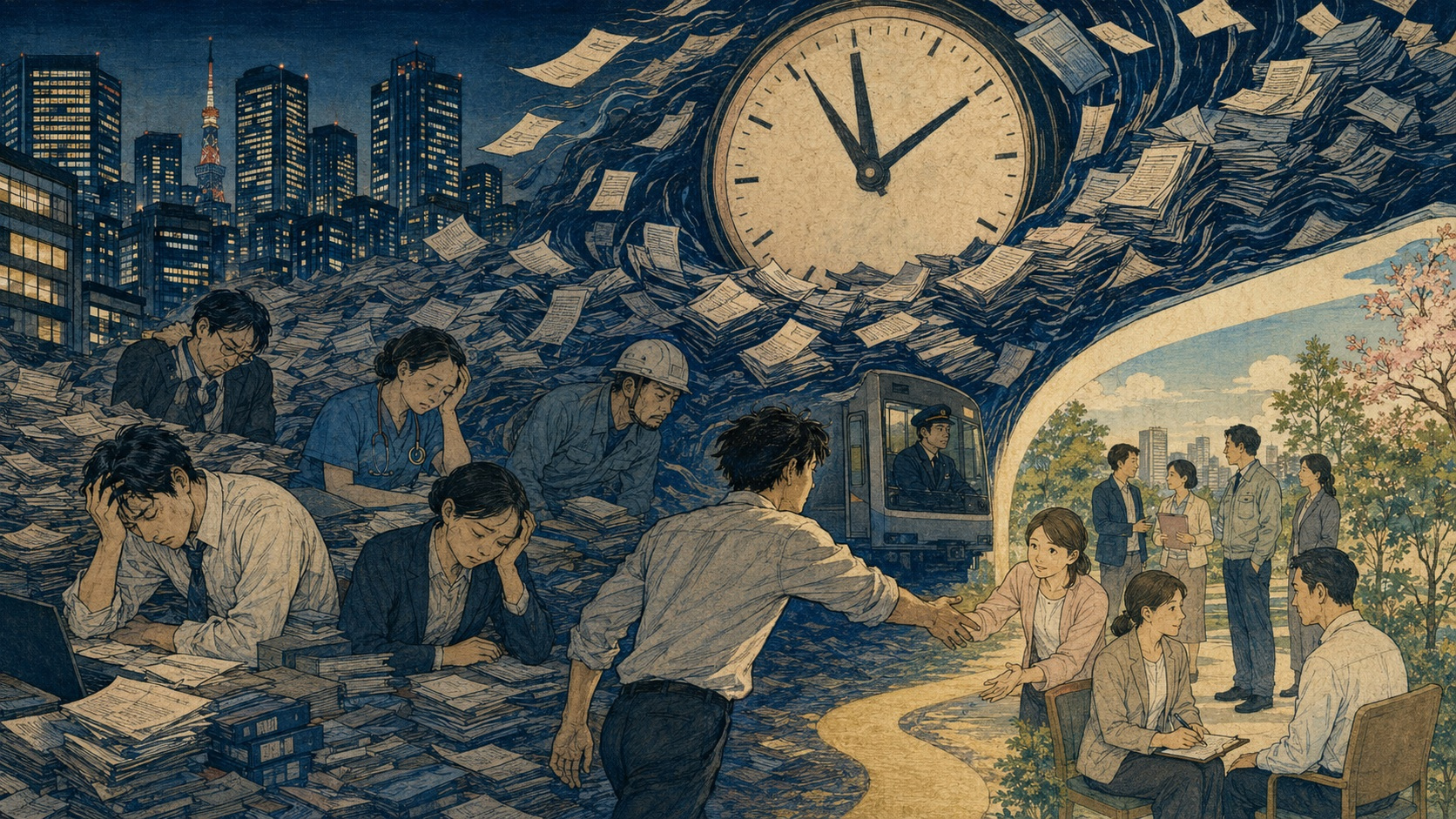
What sits inside 6,212
The Ministry of Health, Labour and Welfare's July 15 release combines two distinct classes of disease. There were 1,254 claims for work-related brain and heart conditions—including strokes and myocardial infarctions—and 4,958 claims involving mental disorders attributed to intense occupational stress. Together they make 6,212.
The total rose from 4,810, an increase of 1,402. Brain and heart claims added 224; mental-disorder claims added 1,178. Mental illness therefore generated 84% of the increase and almost four out of five claims. The classic image summoned by karōshi—a fatal heart attack after extreme overtime—can no longer explain the administrative record on its own.
Claims, decisions and awards are three different clocks
A claim is a request for workers' compensation filed during the fiscal year. It is not a finding that work caused the disease. Some people who suspect a connection never file because they do not know the system, cannot collect evidence, fear an employer, lack a diagnosis or are outside the visible employment relationship. Conversely, broader criteria, media coverage and better legal or family support can increase claims even if incidence is unchanged.
The ministry made 4,692 decisions during the year, including both awards and denials. It awarded 1,310. But these do not form a simple 28% approval rate: FY2025 decisions include claims from earlier years, and many FY2025 claims will be decided later. Dividing 1,310 by 6,212 compares different cohorts.
| Measure | FY2025 | Meaning |
|---|---|---|
| Claims | 6,212 | Requests entering the system that year—not all illnesses and not findings of causation. |
| Decisions | 4,692 | Awards plus denials issued that year, including older applications. |
| Awards | 1,310 | Cases recognized as occupational or multiple-employment-factor disasters. |
| Awarded deaths/suicide events | 145 | Includes attempted suicide in the mental-disorder category. |
Physical overwork remains concentrated in transport and older workers
Of 1,254 brain and heart claims, 303 involved death. Awards fell by 24 to 217; awarded deaths held at 67. Transport and postal services produced 257 claims, miscellaneous services 166 and construction 164. Road freight alone led the detailed industries with 179 claims and 50 awards.
Transport and machine-operation occupations recorded 231 claims and 55 awards; motor-vehicle drivers accounted for 215 and 53. Age was heavily tilted upward: workers in their 50s filed 508 claims and those 60 or older filed 452.
Among awards, the most common single-month overtime band was 100 to under 120 hours, with 27 cases. For a two-to-six-month average, 60 to under 80 hours was the largest band, at 48. This does not mean 60 hours is safe. Recognition also considers consecutive work, intervals between shifts, irregular and night work, travel, physical burden and psychological strain.
Mental-health claims converge on medicine, welfare and care
Health and welfare generated 1,288 mental-disorder claims, followed by manufacturing at 720 and wholesale/retail at 645. Within health and welfare, social insurance, welfare and care services led detailed industries with 706 claims and 151 awards. Professional and technical occupations filed 1,367 claims, clerical workers 1,137 and service workers 733. General clerical work alone accounted for 833 claims.
Counts are not incidence rates. The release gives no worker denominator by industry or occupation, and sectors differ in employment, gender, age, awareness, unions and access to advice. It would be unsound to call the highest count the most dangerous rate. Still, the absolute burden in health and care cannot be dismissed: staffing shortages, emotional labor, shifts, responsibility for life, and exposure to patients, users and families combine.
The ministry awarded 1,082 mental-disorder cases, 26 more than the prior year. Claims involving suicide or attempted suicide reached 215 and awards 76. Better denominators and breakdowns by gender, contract, workplace size and diagnosis are needed to see who remains outside the system.
Why “under 20 hours of overtime was the largest group” misleads
Among recognized mental-disorder cases tabulated by overtime, “under 20 hours” was the largest band at 57, followed by 40 to under 60 at 55. This does not prove overtime irrelevant, nor does it estimate the risk of becoming ill after 20 hours. It is a count among recognized cases assigned to a band, without the population in each band as a denominator.
Mental-disorder recognition centers on events that create intense psychological burden. Assault, sustained humiliation, serious accidents, sexual harassment, customer aggression, transfer and abrupt increases in workload can be devastating without extreme measured hours. Long hours can also be a severe event in themselves or amplify other events.
Time still matters. But a prevention system built only around timecards will miss fear during a shift, degradation, isolation, suppressed emotion and unpredictable demands. Contemporary occupational health must govern both time and psychosocial hazards.
Abuse by superiors led with 222 awards
Among the classified events associated with awarded mental-disorder cases, physical or psychological attacks by a superior or others—power harassment—led at 222. Serious misconduct by customers, clients or facility users and sexual harassment each accounted for 127. Major change in job content or volume followed at 113.
These are not simple cause labels. The recognition framework classifies events and evaluates the overall intensity of psychological burden; several pressures may coexist. Even so, the shift from “how long did the person work?” toward “what happened to the person at work?” is unmistakable.
A 2023 revision added severe customer or user misconduct—customer harassment—and work with high exposure to infectious disease or accidents as explicit events. It expanded examples for all six forms of power harassment and attacks involving sexual orientation or gender identity. Part of the later claim increase may reflect this new vocabulary becoming usable. Broader criteria do not invent illness; they can make previously illegible harm visible.
Before karōshi became a word
Postwar high growth joined long hours and powerful corporate belonging to a male-breadwinner model. Japan created recognition criteria for occupational brain and heart disease in 1961, but proving the link between chronic work and a sudden event remained difficult. In the late 1970s, researchers used the term karōshi—death from overwork—to recast deaths treated as private physiology or bad luck as a labor and public-health problem.
In 1988, lawyers, doctors and bereaved families opened nationwide karōshi hotlines, collecting cases that official systems had not seen. Litigation in the 1990s around young employees' work-related suicide made employer duties around long hours and psychological pressure more visible. Administrative criteria evolved; a 2001 revision broadened consideration of accumulated fatigue in brain and heart disease.
The history shows that statistics are constructed through social capacity. A diagnosis, recognition rule, adviser, document trail, court precedent and family willing to persist must exist before a private catastrophe becomes a public record.
In 2014, bereaved families' campaign became law
The Act Promoting Measures to Prevent Death and Injury from Overwork passed in June 2014 and took effect that November. It defined karōshi and related harm in law, covering death and disease from overloaded work leading to brain or heart conditions and suicide or mental disorder caused by severe psychological load. It required national research, awareness, consultation and support for private groups, and designated November an awareness month.
The conceptual advance was prevention. Compensation arrives after damage and places evidence burdens on the worker or family. Prevention changes time, staffing, job design, autonomy, violence response, consultation and return-to-work systems before breakdown.
Claims continued rising after the law. That is not proof of success or failure by itself. Awareness can raise reporting before underlying risk falls. Evaluation needs incidence, sickness absence, turnover, sleep, hours, workforce surveys and time from complaint to corrective action—not compensation claims alone.
Work-style reform closed one gap and exposed others
Japan's 2018 work-style reform legislation put overtime ceilings into statute. Beginning in 2019 for large companies and 2020 for smaller ones, the general rule became 45 overtime hours a month and 360 a year. Even under exceptional circumstances, limits include 720 a year, under 100 in a single month, and an average no greater than 80 across multiple months. The package also required five days of annual leave and strengthened occupational-health arrangements.
Construction, motor-vehicle driving and physicians received a five-year delay; rules reached them in April 2024 with special provisions. Road freight still leading brain and heart cases demonstrates that a statutory ceiling cannot by itself redesign demand. Waiting at loading docks, compressed delivery schedules, freight prices, medical coverage, construction deadlines and staffing shortages extend beyond one employer's attendance system.
A ceiling is not a healthy target. It is a backstop against extremes, not permission to operate just below it. Second jobs, take-home work, standby communication, under-recorded self-reports, managers and discretionary work can fall outside the visible clock.
Harassment is not an interpersonal mismatch
Employer measures against power harassment became mandatory in 2020 and extended to small and midsize firms in 2022. Employers must declare policy, provide reporting channels, investigate promptly, protect privacy, respond to victims and offenders, prevent recurrence and prohibit retaliation.
Yet power harassment remains the leading recognized event. A training video and anonymous mailbox do not alter power on their own. When performance targets conflict with staffing, and supervisors can meet them only by pushing subordinates past safe limits, abuse becomes an output of management design, not merely personality. Silence also follows when the reporting channel controls performance reviews, investigations drag on, only victims are transferred or customer revenue is valued above worker safety.
Zero complaints are not proof of safety. When trust improves, reports may initially rise. Better measures ask whether reports arrived early without retaliation, immediate danger stopped, root causes changed and treatment and return were supported.
Why care work sits near the center of the crisis
Health, welfare and care workers manage their own emotions while receiving the pain, anger and anxiety of others. Understaffing raises caseloads; shifts erode recovery; mistakes can threaten life. Violence from users or families may be normalized as part of service.
High care-sector claims do not show weak workers. They suggest high demands combined with low resources and autonomy, plus moral responsibility that makes leaving difficult. Teaching only resilience or self-care returns an organizational hazard to the individual who was exposed.
Prevention requires staffing headroom, authority to suspend service during violence, two-person response, recording and escalation protocols, protected rest, safer night shifts, support for supervisors, psychological first aid, treatment and income continuity. Payment systems and public expectations also shape the hazard; a single facility cannot solve it alone.
Where small workplaces and precarious workers disappear
Annual stress checks became mandatory in 2015 for workplaces with 50 or more employees. Smaller businesses often lack occupational physicians, nurses, HR and legal staff; the employer may be the only reporting target. A thinner institutional net does not mean less illness.
Workers' compensation broadly covers employees, but contractors, freelancers, nominal managers, multiple-job workers, migrants and short-term staff may not know whether or how to claim. Japan now permits burdens across simultaneous employers to be assessed together, yet only seven brain/heart and four mental-disorder multiple-employment cases were awarded in FY2025. More evidence is needed to know whether the low number reflects rarity or access difficulty.
Without claim, decision and workforce denominators by establishment size, contract, nationality and region, the people least able to speak remain outside the picture.
Seven systems employers can change now
| System | Practice | Measure |
|---|---|---|
| Actual work time | Reconcile PC, entry, vehicle and message logs with declarations; include waiting and take-home work. | Intervals, consecutive days, nights and recording discrepancies—not ceilings alone. |
| Psychosocial risk | Assess violence, harassment, workload, autonomy and role conflict by team. | High-risk units and completed corrections, not only averages. |
| Independent reporting | Offer routes outside supervisors and HR, external advice, anonymity and anti-retaliation. | Response time, protection, retaliation and recurrence. |
| Customer aggression | Define prohibited behavior, service termination, two-person response and escalation. | Events, absence, repeat customers and manager intervention. |
| Staffing and job design | Align targets and deadlines with capacity; review load after major changes. | Vacancies, hours, turnover and symptoms after change. |
| Treatment and return | Protect leave, income, privacy and graded return. | Sustained return and repeated absence. |
| Board oversight | Treat severe cases and root causes as safety indicators. | Investment in hazard removal—not suppression of claims. |
How the statistics could become stronger
The tables provide counts, not rates. Japan should publish worker or hours-worked denominators by industry, occupation, age, gender, contract and establishment size. Cohorts organized by filing year should show when each claim was awarded, denied or remained pending, separating processing delay from recognition differences.
The effect of the 2023 mental-health criteria can be evaluated by comparing new events such as customer harassment before and after revision. Secure research data could test interactions among multiple events, overtime, company size, union presence and workplace prevention. Reasons for denial, appeal outcomes and time from diagnosis to filing also matter.
Compensation data select severe cases that reach the system. They need triangulation with workforce surveys, sickness benefits, health care, absence, turnover, suicide statistics, working-time records and stress surveys. Privacy-preserving access for independent research would turn an annual count into a prevention system.
Compensation is the last safety net
An award is not recovery. It may arrive after illness, job loss, family damage and years spent proving causation. Nor is a low claim count proof that a company is safe. A company can keep numbers low by discouraging claims, losing workers and failing to retain records.
A responsible employer explains access to compensation, preserves evidence, does not obstruct filing, and supports care and return. At the same time it removes the hazard before another claim becomes necessary. Compensation teams and prevention teams should share lessons rather than operate as separate worlds.
If you need help
Persistent inability to sleep, depressed mood, severe headache or palpitations, or thoughts of self-harm require help without waiting to prove a work connection. In immediate danger in Japan, call 119 or 110. MHLW's Kokoro no Mimi portal lists counseling routes for workers and families. Eligibility for compensation is not a condition for receiving treatment.
What the increase of 1,402 asks of Japan
Two Japans overlap in the number. One coined karōshi, built hotlines, used family testimony, medicine and litigation to win recognition, passed a prevention law and enacted overtime limits. The other still holds drivers at depots, makes care workers absorb anger, describes attacks by superiors as instruction and asks an ill worker to prove the system caused the illness.
The rise does not show that reform was meaningless; awareness and clearer criteria may be working. It does not prove work-related illness itself rose 29%. Yet 4,958 workers or families formally linked mental illness to work in a single year. That fact is consequential without exaggeration.
The next reform cannot stop at counting overtime. It must treat damaging job design, power, violence, customer relations, staffing scarcity and financial insecurity as hazards. Safety is not selecting people who can endure. It is engineering work that does not require endurance of abuse.
Primary sources and method
- MHLW, FY2025 Compensation Status for Karōshi and Related Disorders, July 15, 2026, including detailed brain/heart, mental-disorder, discretionary-work and multiple-employment tables
- MHLW FY2024 release for comparison
- 2023 revision to recognition criteria for mental disorders caused by psychological burden
- Overtime limits for construction, drivers and physicians and work-style reform handbook
- MHLW karōshi definition and prevention portal
- 2025 White Paper on Karōshi Prevention, Chapter 2
- MHLW workplace-harassment prevention measures
- Kokoro no Mimi worker mental-health portal
- ILO history of Japan's administrative measures for occupational disease
Editor's note: We recalculated the ministry's FY2025 counts and use rounded percentages where stated. Claims, decisions and awards are not one cohort, so we do not present a simple approval rate. Industry and occupation counts lack employment denominators and are not ranked as risk rates. Administrative data omit undiagnosed, unfiled and uncovered cases; they are not total incidence. Historical synthesis and prevention recommendations are editorial analysis, not medical or legal advice. The exchange strip uses the supplied “1 US Dollar = 162.49 Japanese Yen.” The supplied July 21, 1:27 a.m. UTC timestamp converts to July 21, 2026, 10:27 a.m. JST. The image is a contemporary editorial illustration, not a historical Hokusai work.