When a satellite operator invests in the mechanic
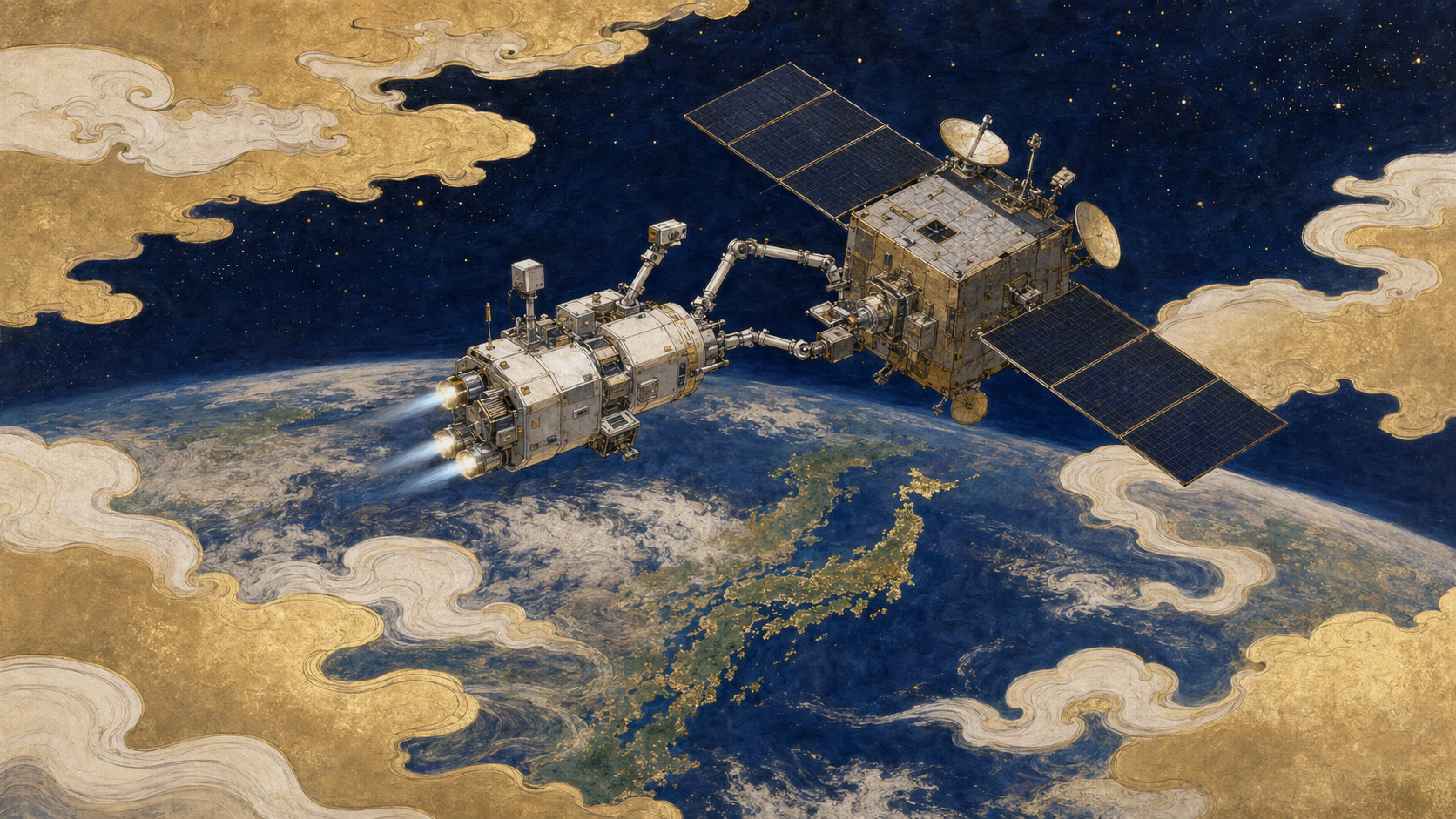
SKY Perfect JSAT’s investment in and partnership with Astroscale joins two sides of Japan’s orbital economy. One company operates valuable communications satellites and understands the cost of replacing them. The other is developing spacecraft that can approach, inspect, move and potentially extend the lives of objects already in orbit.
The agreement should not be read as a declaration that JSAT satellites will immediately be refueled or repaired. Its importance is strategic: a major operator is helping shape a market in which spacecraft are no longer always abandoned when fuel, attitude control or a component reaches its limit.
One label, several different services
“On-orbit servicing” bundles capabilities with very different difficulty and business models. Inspection takes pictures and measurements. Life extension attaches a propulsion vehicle to maintain orbit or attitude. Disposal moves a client toward reentry or a graveyard orbit. Refueling transfers propellant. Repair manipulates or replaces hardware.
A company that has demonstrated inspection has not automatically demonstrated refueling. A vehicle designed to tow a cooperative satellite is not necessarily able to capture a tumbling piece of debris. Precision language matters because each step adds mechanical, legal and safety risk.
The servicing ladder
| Service | Physical task | Market status |
|---|---|---|
| Inspection | Rendezvous and image | Demonstrated by ADRAS-J |
| End-of-life removal | Capture and deorbit | Contracted demonstrations |
| Life extension | Dock and provide propulsion | Under development |
| Refueling | Transfer compatible propellant | Standards and demonstrations emerging |
| Repair/upgrade | Manipulate components | Most complex; largely developmental |
Why SKY Perfect JSAT cares
A geostationary communications satellite may cost hundreds of millions of dollars including construction, launch and insurance. Its antennas and electronics can remain useful after station-keeping fuel becomes scarce. If a servicer adds propulsion or corrects an anomaly, several extra revenue years could be worth far more than the service fee.
JSAT also operates in a changing market: flexible payloads, low-Earth constellations and new observation investments sit beside its established GEO fleet. Servicing could protect existing assets, improve fleet planning and create new services for other operators.
An operator contributes something a technology startup lacks: real maintenance priorities, risk thresholds, insurance experience and economic data.
From disposable machines to maintained infrastructure
Most satellites were designed as sealed, expendable products. They launch with all fuel and components needed for life, operate without physical contact and are retired when resources run out. That architecture minimized interfaces but made maintenance impossible.
Aviation and shipping assume inspection, refueling and repair. Space did not because reaching the customer was extraordinarily expensive and rendezvous was dangerous. Lower launch costs, autonomous navigation and denser orbital commerce are beginning to change the calculation.
The analogy has limits: a service truck in orbit must itself survive launch, navigate at kilometres per second and match a client’s orbit before touching it.
The historical foundation: rendezvous and docking
Human spaceflight developed orbital servicing first. Gemini demonstrated rendezvous; Apollo docked in lunar flight; Soviet and later international space stations normalized repeated docking, refueling and component replacement.
NASA’s 1984 Solar Maximum repair and five Hubble servicing missions showed astronauts could rescue and upgrade scientific satellites. Robotic cargo vehicles later demonstrated automated approach. But these targets were designed or prepared for interaction, and human missions were too costly for routine commercial servicing.
The new industry seeks robotic economics without losing human-spaceflight discipline.
Astroscale’s first proving ground: ELSA-d
Astroscale founded its business around orbital sustainability. The ELSA-d demonstration, launched in 2021, used a servicer and a client fitted with a magnetic docking plate to test release, rendezvous and capture concepts.
The mission demonstrated important capabilities but also encountered anomalies that limited its planned sequence. That mixed result is instructive. Servicing is not a single docking trick; it depends on sensors, autonomy, propulsion, communications and contingency planning working together.
Cooperative clients with standardized fixtures are much easier than legacy debris.
ADRAS-J: approaching an object that cannot help
JAXA selected Astroscale for the Commercial Removal of Debris Demonstration program. ADRAS-J launched in 2024 to approach and inspect an H-IIA upper stage left in orbit since 2009.
The rocket body had no docking marker, navigation signal or attitude-control assistance. ADRAS-J had to find its relative position, characterize motion and fly around it without collision. The spacecraft produced detailed images and approached to roughly 15 metres, a major commercial rendezvous-and-proximity-operations achievement.
Inspection reduces uncertainty: capture engineers need to know spin, structure and possible damage before choosing where and how to grab.
ADRAS-J2: from looking to touching
The second phase is more consequential. Under a five-year JAXA contract valued at about ¥12 billion, ADRAS-J2 is intended to capture the same upper stage with robotic technology and remove it from orbit by the end of the project period.
Capture transfers forces between two large bodies. The servicer must synchronize motion, tolerate uncertainty, avoid fragmentation and control the combined stack. Deorbit then requires sufficient propulsion and reliable guidance.
This is active debris removal, not repair. But the rendezvous, navigation and robotics are foundational for many services.
ISSA-J1: orbital inspection as a product
Astroscale’s planned ISSA-J1 mission aims to inspect two defunct Japanese satellites—ALOS and ADEOS-II—in different orbits during one mission. If successful, it would demonstrate approach, inspection, departure and orbital transfer as a repeatable route rather than a single-target stunt.
Close images can reveal failed solar arrays, impact scars, insulation condition and attitude motion that ground telescopes cannot resolve. Operators, insurers and governments could use that information to diagnose failures, plan recovery or refine future designs.
Inspection may become the first scalable service because it creates value without physical contact.
Life extension: selling years, not hardware
A life-extension servicer docks with a functioning satellite and supplies station-keeping or attitude control. The client’s communications payload continues earning revenue while the servicer acts as an external propulsion module.
Northrop Grumman’s Mission Extension Vehicles demonstrated the concept commercially in geostationary orbit by docking with Intelsat satellites. Astroscale’s LEXI program targets a related market with a servicer intended to support clients in GEO.
The economic unit is an added month or year of service. Value depends on the satellite’s revenue, health, spectrum rights, replacement schedule and the servicer’s reliability.
Refueling is harder than docking
Refueling requires compatible valves, seals, pressure, propellant chemistry and thermal conditions. Many existing satellites were never designed to receive fuel after launch. Piercing or adapting an unknown interface risks leakage and contamination.
Future spacecraft can include standardized refueling ports and fiducial markers. Depots might store propellant, while tankers transfer it. But standards must align among manufacturers, operators and nations before a broad market forms.
“Refuelable” is an architectural choice made before launch, not a capability a servicing company can safely improvise later.
Repair and upgrade: the highest rung
Repair may mean freeing a stuck antenna, reconnecting a cable, replacing a modular box or adding a new computer. Each requires manipulation, force control and a client designed—or carefully understood—for contact.
Traditional satellites hide bolts, connectors and components beneath thermal blankets. A robot may lack handholds and visual access. Future serviceable designs need modular interfaces, accessible fixtures and software that recognizes new hardware.
The deepest opportunity is not recreating an astronaut’s hands but redesigning satellites so robots need fewer human-like skills.
The prepared-client advantage
Astroscale and other firms promote docking plates or servicing interfaces installed during manufacture. A small passive fixture can give a future servicer a known capture point even after the client loses power.
This resembles a tow hook and standardized diagnostic port. It costs mass, money and integration effort today for an uncertain future benefit. Insurers, regulators or large constellation buyers may make the business case by rewarding prepared satellites.
More than 100 docking plates ordered by Airbus from Astroscale UK indicate that design-for-servicing is moving beyond isolated experiments.
Orbital mechanics determines the business
A servicer cannot drive freely around space. Changing altitude, inclination or orbital plane consumes propellant. Visiting two satellites that look close on a map may be energetically expensive.
GEO clients share a common ring but are separated by longitude; LEO constellations may share planes, enabling route-based service, while debris in different inclinations can be impractical to combine.
Profitable operations require selecting compatible clients, carrying enough propellant and spreading launch and spacecraft cost across multiple jobs.
Who is liable when a repair goes wrong?
Under international space law, states retain jurisdiction over registered objects and launching states may bear liability. A private servicer cannot simply capture abandoned hardware because it appears unused; ownership does not disappear in orbit.
Contracts must allocate collision, failed capture, contamination, data and consequential-revenue risks. Governments authorize and supervise proximity operations, while national-security concerns arise whenever one spacecraft approaches another.
Transparency, consent and shared approach protocols are commercial infrastructure as surely as robotic arms.
Insurance could create—or block—the market
An insurer might support servicing if it reduces total loss, provides inspection evidence or extends revenue. It may also demand a premium if docking introduces new collision risk.
To price coverage, insurers need flight heritage, failure probabilities, clear contracts and independent data. Early government missions help generate that evidence when private customers are unwilling to fund first-of-a-kind risk.
A mature market may bundle satellite, servicing plan and insurance from launch.
Debris removal has a public-goods problem
Removing a dead rocket stage benefits every operator by reducing collision risk, but no single operator owns enough of that benefit to pay the full cost. The polluter, owner and threatened satellites may all be different parties.
That is why JAXA and other governments are anchor customers. Policy tools could include removal contracts, disposal bonds, licensing requirements or fees that reward reliable end-of-life plans.
Commercial technology does not eliminate the need for public institutions; it gives them something concrete to buy.
Japan’s emerging servicing cluster
Japan combines JAXA procurement, Astroscale’s rendezvous and robotics, major operators such as SKY Perfect JSAT, spacecraft manufacturers, insurers and startups exploring laser-assisted debris work and propulsion.
JSAT spun out Orbital Lasers to study using laser ablation to reduce debris rotation, potentially making capture safer. Its Astroscale investment therefore fits a broader move from operating communications capacity to managing the orbital environment around assets.
Japan’s opportunity is to set interfaces, operational rules and services early enough to export them.
How to judge the JSAT–Astroscale partnership
| Promise | Evidence to watch | Why it matters |
|---|---|---|
| Operator-driven design | Requirements based on real JSAT fleet cases | Prevents technology without a buyer |
| Commercial service | Paid inspection or extension contract | Moves beyond grants |
| Prepared satellites | Docking interfaces on future spacecraft | Lowers capture risk |
| Repeat economics | One servicer visits multiple clients | Spreads launch cost |
| Risk acceptance | Insurance and regulatory approval | Enables customer adoption |
What comes next
Watch the detailed scope and amount of JSAT’s investment, any named demonstration involving a JSAT asset, docking provisions on new satellites, and whether the partnership produces a paid commercial mission. Track ADRAS-J2, ISSA-J1 and LEXI separately; they prove different rungs of the ladder.
Japan has long excelled at launching and operating machines no human will touch again. Orbital servicing asks a different question: can those machines become maintainable infrastructure? The answer will be written not only by robotics, but by operators, insurers, standards and contracts.
Sources and further reading
- Astroscale News — SKY Perfect JSAT partnership, investment and mission updates.
- SKY Perfect JSAT Space Business News — operator strategy and partnership context.
- Astroscale ADRAS-J — commercial debris inspection demonstration.
- JAXA CRD2 — commercial debris-removal demonstration program.
- ESA Space Debris — debris environment and sustainability context.
- UNOOSA space-law treaties — jurisdiction, registration and liability framework.
- NASA Hubble servicing missions — historical repair and upgrade precedent.
- Reuters — ADRAS-J2 contract and commercial context.