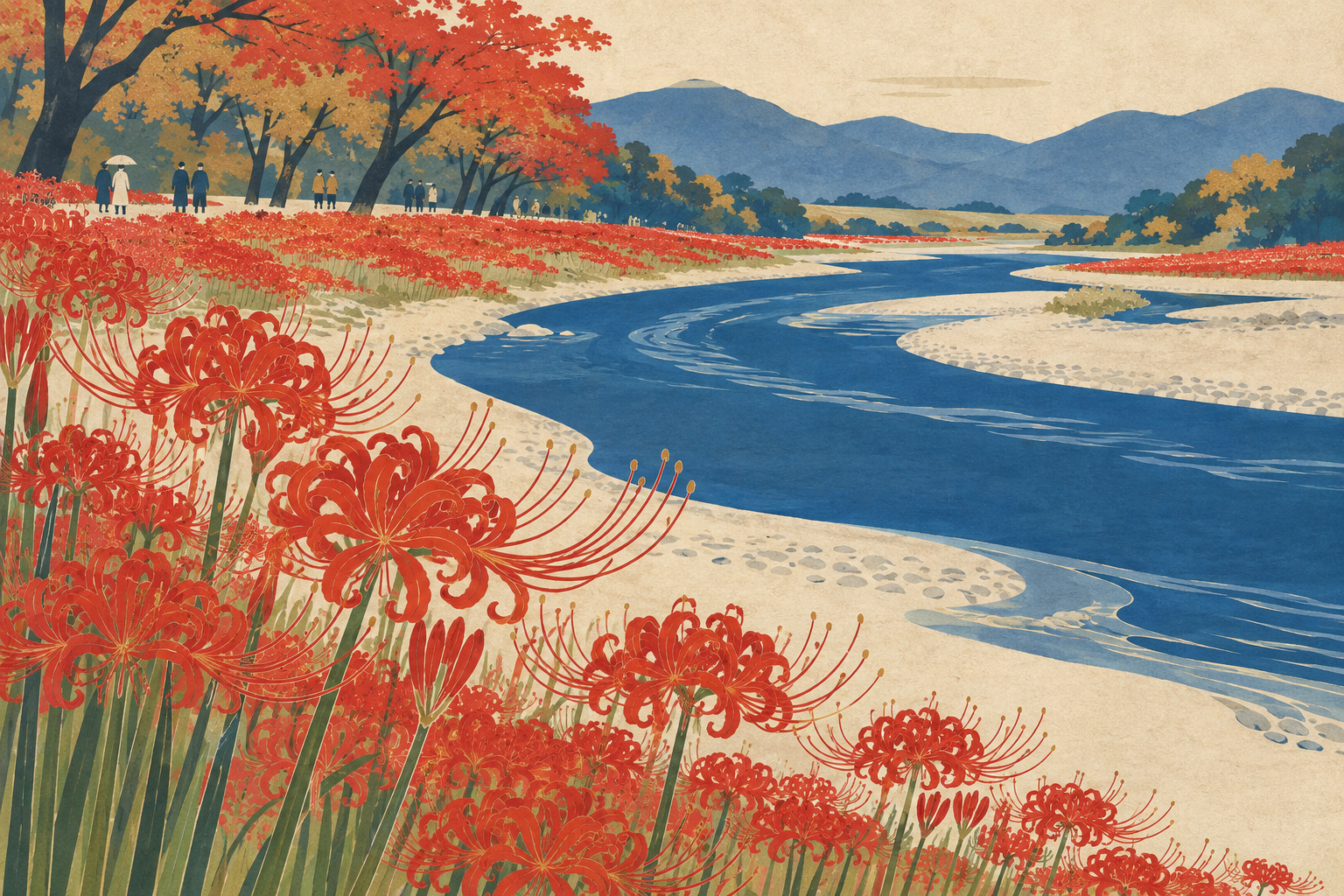
The red spider lilies draw the eye first. At Kinchakuda, in Saitama Prefecture’s Hidaka City, the larger story begins with the river curving around them—and with the people who have worked the ground inside that bend. This is a flower destination with an agricultural past and a continuing maintenance schedule, not a spectacle that appears independently of its surroundings.
For 2026, Hidaka lists the Kinchakuda Manjushage Festival for September 21–October 6. Its September 18 notice reported the start of flowering and expected some areas to approach their best display; it did not declare the entire park in full bloom.[1] A separate city notice issued that day warned of potentially warning-level heavy rain overnight September 20 into the morning of September 21 in connection with Typhoon No. 25. Visitors should check current conditions and operating announcements before travelling.[2]
The river is the beginning of the picture
Kinchakuda takes its name from a kinchaku, a drawstring pouch. The management office explains that the Koma River’s meandering course formed the surrounding shape over time. The enclosed flat land measures approximately 500 metres across and 22 hectares.[3]
Those dimensions describe the wider landscape. The tourism association places the lily colony itself at approximately 3.4 hectares and promotes it as a five-million-flower destination. That figure describes the attraction’s scale; it should not be read as a count of flowers simultaneously open on a visitor’s chosen day.[4]
At walking height, a river bend becomes a succession of smaller views: a stretch of water, a wooded edge, a path turning away. Holding the overall shape in mind changes how the visit feels. The flowers occupy a place made by the river, rather than a garden whose boundaries happen to include some water.
Before the famous autumn display
The management office’s history says the land was once entirely rice fields, with a small portion remaining in cultivation.[5] That background complicates the easy division between “natural” scenery and a landscape made by people. Long before visitors arrived for photographs, this was ground that people used and tended.
The office dates the former town’s land acquisition to the early 1970s and the mowing that revealed the extensive colony to around 1989. It suggests that bulbs carried downstream during high water took root here. That is the office’s explanation of the colony’s origins, not an independently established account of precisely when and how the plants arrived.[6]
The revealing action was mowing. Something already present became visible through management. This gives conservation a practical meaning: decisions about vegetation, access and continued care influence what survives and what people are able to appreciate. Calling a place beautiful is easier than deciding how to maintain it through an entire year.
The plants have a calendar of their own
The local name manjushage refers to the red spider lily, also known in Japanese as higanbana. Hidaka’s explanation emphasizes the separation between its flowering and leafy seasons: after the flowers finish, slender leaves appear, producing a green winter scene and feeding the bulbs through photosynthesis.[7]
The spectacle therefore ends before the plant’s work is done. A visitor who knows only the red display has seen one phase of a longer cycle. Protecting that cycle asks for attention after the most photogenic moment has passed.
Temperature also influences flowering. The management office explains that cooling encourages growth, while lingering late-summer warmth can delay the bloom.[6] A festival schedule organizes vendors and visitors; it cannot order every patch of flowers to reach its best condition at the same time. Treating a published opening day as a guarantee of peak bloom creates an expectation the landscape cannot reliably meet.
Who keeps the paths open?
The management office describes year-round work that includes repairing walking routes, mowing the lily colony and sowing other seasonal flowers.[5] These ordinary tasks deserve a place beside the dramatic pictures. The ease of a short visit depends in part on labour carried out when there is little reason for an autumn sightseer to be there.
The tourism association lists itself and the Hidaka City Society of Commerce and Industry as festival organizers, with cooperation from the city, the Kinchakuda management council and the incorporated management office.[4] Community stewardship here has identifiable institutions and responsibilities. It should not be reduced to a vague assumption that unnamed volunteers look after everything.
Other parts of the setting require attention too. Hidaka records completion of repairs to the waterwheel building in March 2024.[7] A maintained path or repaired structure can look so ordinary that the work behind it disappears from view. Yet these are among the things that make a landscape usable beyond a brief flowering season.
The opportunity—and the pressure—of a short season
The festival includes local food and product stalls.[1] A flower visit can consequently become an opportunity for local businesses, extending spending beyond the journey and the entrance gate. But a busy park does not automatically tell us how much benefit remains in the community.
Vendors must prepare stock and staffing; organizers must provide information and manage movement; residents still need to make everyday trips. If rain changes attendance or the bloom shifts, those preparations may no longer match demand. These are the planning pressures of a concentrated season, rather than claims about any business’s actual 2026 sales.
The management office’s transport guide warns that queues on surrounding roads can sometimes stretch five to ten kilometres or more during flowering. This is its general congestion warning, not a forecast for a particular September day. It recommends public transport and gives an approximate fifteen-minute walk from Seibu’s Koma Station.[8]
Rail does not eliminate every access problem, especially for someone for whom walking is difficult. It does, however, offer many visitors a way to avoid adding another vehicle to the immediate approach. The useful planning question is how a person can reach the site comfortably while imposing as little pressure as possible on the roads around it.
A few distinctions that matter in 2026
The festival’s advertised hours are 9 a.m.–4:30 p.m. The paid daytime admission window is different: 7 a.m.–5 p.m., at ¥500 per person per day, with junior-high-school-age children and younger admitted free. Paid entry began September 19, before the scheduled festival opening. Check the city’s page for exemptions and changes.[1]
Photography has its own limits. During the paid flowering period, tripods, monopods and lighting stands are prohibited throughout the day inside the colony. The park also asks visitors to refrain from flying drones.[9] These rules make sense in a space shared by people walking at different speeds and stopping to look in different directions. A photograph should not require other visitors to negotiate an obstacle course.
A separate illumination is scheduled for September 24, 25, 28, 29 and 30, between 6 p.m. and 8 p.m., in two sessions. The city lists free evening entry but requires reservations for illumination parking; the published reservation deadline was September 18. Daytime parking does not entitle drivers to leave a vehicle in place for the evening. Visitors without a parking reservation should not assume they can arrive by car and be accommodated.[10]
The distinction between daytime and evening arrangements is more than a ticketing detail. Different hours create different arrival patterns, visibility and staffing needs. Before choosing an evening visit, check the official instructions and the return journey as carefully as the attraction itself.
Leaving room for the river
The city’s September 18 weather notice is especially relevant to a destination shaped by a river.[2] A bloom report, a festival schedule and a weather bulletin answer different questions. None can substitute for the others. Changing a plan when conditions require it is part of visiting this landscape on its own terms.
Even in good conditions, a considerate visit leaves space: space on the path for another person, space around plants instead of stepping into them, and space in the itinerary for delays. Keeping litter out of the landscape and respecting marked boundaries are small contributions compared with year-round maintenance, but they avoid adding unnecessary work.
Kinchakuda’s autumn is memorable because the colour is so concentrated. Its history is worth remembering for the opposite reason: the river, fields, maintenance and local organization unfold over much longer spans. Looking beyond the red flowers reveals how much has to continue for that brief season to return.