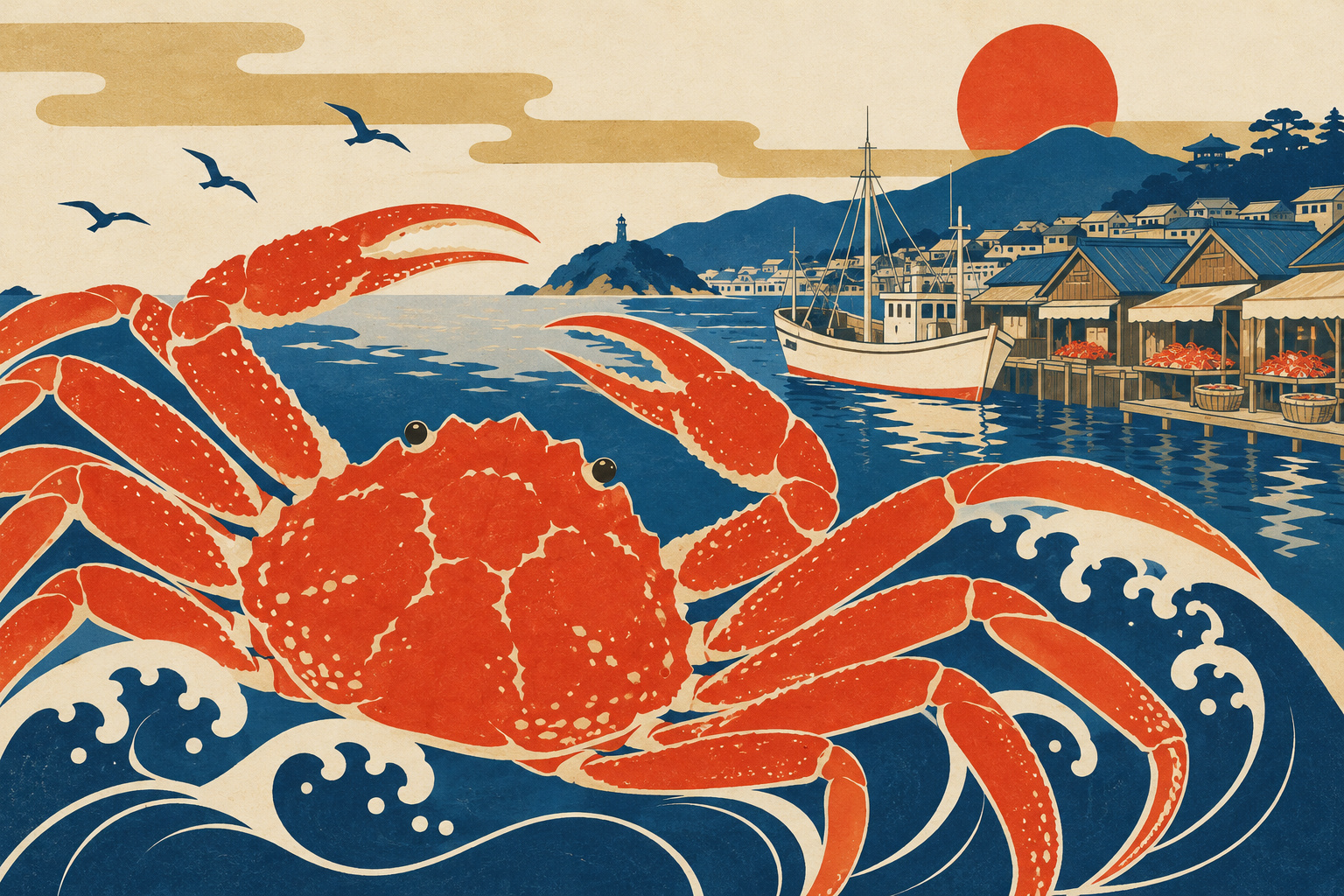
A crab served in Kasumi carries more than a place name. Behind the meal are a fishing boat, a landing market, people who sort and prepare the catch, and businesses that turn it into a reason to visit this part of northern Hyogo. The connection between them is what makes a seafood brand a local economy.
The autumn Kasumi Crab Festival offers a way to examine that connection. The published schedule placed its 16th edition at Kasumi Fishing Port’s western harbour on September 19, 2026. For this September 21 feature, the announced programme is a starting point for understanding the town, rather than a substitute for a verified account of attendance or sales.[1]
Two crabs, two seasonal stories
Kasumi-gani is the local brand for red snow crab landed at Kasumi. It should not be confused with Matsuba-gani, the regional name for male snow crab. The town’s tourism authority treats them as distinct products, not different seasonal names for the same crab.[2]
Tajima Fisheries Cooperative describes Kasumi’s red snow crab season as September through May, while Matsuba crab landings belong to November through March.[3] The autumn festival therefore does not mark the opening of the winter Matsuba fishery. Its economic significance is partly that it gives crab-centred travel a longer calendar.
That longer season can matter to a small accommodation business. It creates scope for a seafood stay before the winter rush and again in spring. Yet a season is not a promise that every product, size or meal will be available every day. A booking still needs to identify the crab offered, the preparation and what the price includes.
The work beneath the brand
Red snow crab are caught with baited pots rather than the bottom trawls associated with the local Matsuba fishery. The cooperative describes pots containing bait such as mackerel being set in linked arrangements on seabeds 800–1,800 metres deep. It distinguishes roughly day-long operations by smaller boats from multi-day trips by larger vessels.[4]
Those depths help explain why seafood supply cannot respond like a stocked shop shelf. Gear must be managed, a vessel operated and the catch brought ashore. Time, weather and working conditions intervene before a customer sees a price. A burst of festival demand does not itself create another landing.
Nor is the harbour a single-product operation. The cooperative describes several fisheries, including trawling, coastal line fishing and fixed nets.[3] Crab provides a recognisable introduction, but a functioning port depends on a wider range of catches, skills and seasonal work. The familiar brand can conceal that diversity as easily as it promotes it.
Before seafood tourism, the sea was a route
The coast’s commercial history extends beyond modern crab holidays. The municipal Geopark and Sea Culture Museum links nearby Shibayama Bay and Imagoura with the history of coastal shipping and sheltered anchorages. Its Kitamaebune display includes shipping materials and explains the value of these inlets to vessels waiting for suitable conditions.[5]
This offers a different way to look at the scenery. A bay is not only a view from an inn: its shape can provide shelter, determine where vessels can approach and help explain why commercial activity developed nearby. The same coastline has served people as a source of food and as a means of connection.
For the red snow crab fishery’s more recent history, local processor Kaneryo Shoten provides a business account. Writing in 2022, it placed the fishery’s beginnings approximately 50–60 years earlier.[6] That is an attributed local recollection, not an independently established founding date. It nevertheless points to a useful distinction: what visitors encounter as tradition can also be the result of adaptation within living memory.
Why processing belongs in the story
A landing is not yet a dinner. Between boat and table come selection, trading, preparation, packaging and distribution. Each stage can preserve or diminish the value of the catch. The skill lies not simply in handling more crab, but in matching its condition to the product and customer.
Kaneryo Shoten describes its own origins in selling to inns at Kinosaki Onsen and its development of a method of cooking crab in crab stock.[7] This is the company’s account of its practice, not a method attributed to every Kasumi processor. It shows why the businesses between vessel and dining room deserve attention: they have techniques and customer relationships of their own.
The price of a restaurant meal consequently cannot be read as a fisher’s income. It also pays for preparation, service, premises and other costs. Equally, the harbour’s landing value does not capture every purchase a visitor makes in town. Different figures describe different stages of the same economy.
A credible account of local benefit must keep those stages separate. Higher sales can support wages and investment, but margins and purchasing arrangements determine where the benefit goes. The attractive idea that every visitor’s yen stays in the town is not a substitute for evidence about actual transactions.
A festival makes the connections visible
The official 2026 programme advertised crab sales, boiled and grilled crab sold by fishers, an amateur seafood auction, and stalls offering agricultural produce and processed products. A crab-eating-skills contest was also listed.[8] These are announced activities; they are not presented here as verified observations from the event.
The programme’s interest lies in the range of relationships it can expose. Direct selling brings producers closer to customers. A demonstration or explanation can make an unfamiliar purchase less intimidating. Learning how to handle and eat a whole crab may matter to a future order as much as a one-day discount.
The inclusion of produce and other local goods also creates an opening beyond seafood. Someone arriving for crab may discover a different producer or shop. Whether that becomes wider benefit depends on what happens after the harbour visit: another purchase, a restaurant meal, an overnight stay or a later order.
That is why crowd size alone is an incomplete measure. A visitor who shops once and leaves has a different spending pattern from a guest who stays overnight. Neither should be dismissed, but an economic-impact claim needs more than the impression of a busy waterfront.
Giving a seafood trip more time ashore
Kasumi’s official tourism material connects its seafood with coastal scenery, the Amarube railway bridge and Daijoji temple.[9] The opportunity is to let a food-led visit become time spent understanding the place. It need not mean adding a hurried list of stops to every itinerary.
The municipal Geopark and Sea Culture Museum offers a particularly relevant connection. It introduces marine culture and fishing, and provides information about seafood-processing experiences.[10] The visitor can move from eating a product to asking how people learned to catch, preserve and prepare it. Activity dates and booking conditions need checking with the facility.
For hosts, the practical details are less glamorous but essential: restaurant reservations, transport connections, the handling instructions for purchases and which areas of the harbour are open to visitors. A working waterfront must still allow boats, equipment and vehicles to operate. Respecting that work is part of visiting the source of the food.
An additional night may create another breakfast, a shop visit or an excursion, but those purchases are not automatic. Clear information makes them possible. A recommendation is useful when the business is open, the guest can reach it and the timing fits the rest of the journey.
A long season does not mean an unlimited resource
The cooperative’s fishing-method guide describes a June voluntary closure under a resource-recovery plan, alongside its explanation of the authorised operating period.[4] This helps reconcile that description with the September–May season promoted to visitors. It would be misleading to turn a regulatory end date into a promise of fresh local landings throughout June.
A closure is evidence of a management measure, not proof that a stock is abundant or recovering. Catch volume, fishing effort and a scientific stock assessment answer different questions. Neither a popular brand nor a well-stocked stall establishes the condition of crab populations offshore.
The economic challenge is therefore to find value without assuming that more sales must always mean more animals caught. Careful preparation, suitable processing, less waste and an accurate explanation of origin can increase what customers receive from the available catch. Whether better returns reach vessel operators depends on the terms of trade, not just the quality of the marketing.
The skills that must survive the festival
A seafood town needs successors ashore as well as at sea. Gear handling, product selection, cooking judgement and customer explanation are different skills, and each takes time to develop. A harbour could retain its boats yet lose part of its commercial strength if the supporting knowledge disappeared.
Visitors can begin with straightforward questions: What species is this? Where was it landed? How has it been prepared? What quantity and condition suit the journey home? Such questions make the place name meaningful without demanding that a holidaymaker become a fisheries specialist.
The Kasumi Crab Festival is an invitation to see that larger system. Its most lasting promise is not a morning of exceptional sales but a relationship between the people who work the sea and those who value what they bring ashore. The measure of a successful crab town is that those connections remain strong when the stalls have gone and the next working day begins.