Turn the handle after the drink drops
The traditional beverage vending machine offers a clean promise. Insert money, press the desired button and receive exactly what you selected. Surprise is a defect. Reliability is the product.
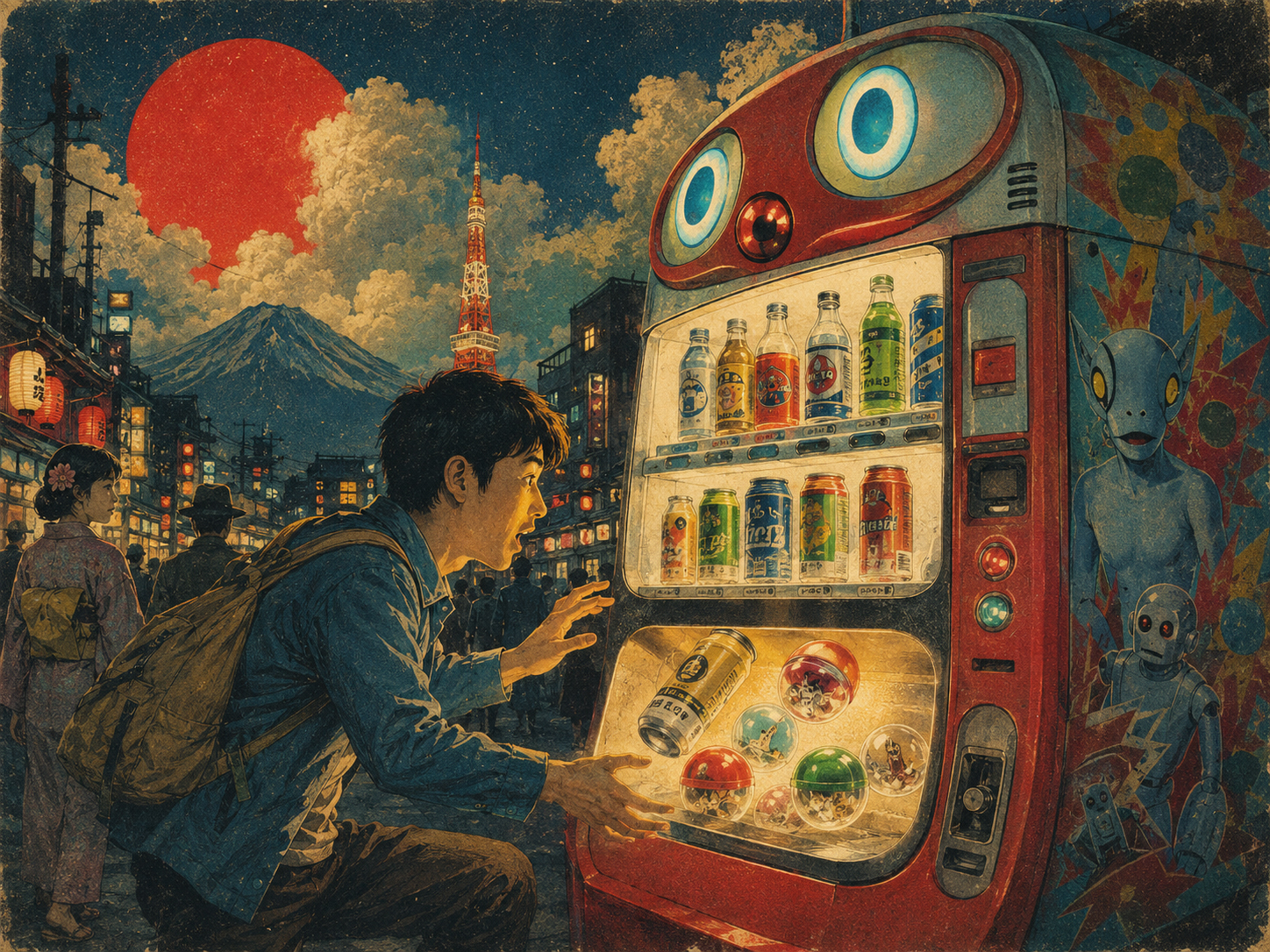
Gachaemon C adds uncertainty after the reliable transaction. A customer buys any participating beverage and a digital roulette begins. If the numbers produce a win, the customer turns a dedicated mechanical handle. After the clicking resistance, an unknown prize emerges.
The machine was announced June 17, 2026 by SDRS, formerly Sanden Retail Systems. The company describes it as an industry-first integration of a prize-winning function into a drink vending machine.
The prize does not have to be inside a capsule
The name suggests a plastic sphere. The system’s important innovation is that it can dispense objects in other forms.
Boxed novelties, beverage-company merchandise, cosmetic or food samples, cards and small promotional goods can be stored and released without being repacked into a traditional capsule.
The result is broader than a drink-plus-toy machine. A beverage purchase can lead into samples, regional souvenirs, event exclusives, character goods and coupons.
Why vending machines now need entertainment
Japan was long called the vending-machine kingdom. Machines stood at stations, on residential streets, beside farms, factories and mountain roads. Cold tea and hot coffee were available at night without staff.
The population is shrinking. Analysis based on industry association data put all vending and automated service machines at about 3.88 million in 2025. Drink machines fell below two million after declining from a 2014 peak.
Population loss, supermarket discounts, convenience-store coffee, material costs, electricity, currency-system upgrades and driver shortages all weaken the model. The machine appears unmanned to the customer, but people must deliver stock, remove waste, collect cash and repair it.
Only the moment of sale is automatic
Route workers drive trucks, load cans and bottles, replace slow products and service recycling bins. A machine with poor sales may still require the same visit as a profitable one.
Higher logistics wages and labor scarcity make low-volume locations difficult. When the same tea is substantially cheaper at a nearby drugstore or supermarket, consumers increasingly walk farther.
Gachaemon C therefore sells a reason to stop: watch the roulette, wait for the result, turn the handle, reveal the prize and show someone else.
Japan’s oldest surviving machine sold stamps
Japan’s oldest surviving vending machine is generally identified as a 1904 stamp-and-postcard machine built by woodworker Takashichi Tawaraya. It reportedly combined merchandise delivery with a mailbox.
After World War II, the ¥100 coin, refrigerated machinery, canned drinks and road logistics enabled rapid expansion. By the 1970s and 1980s vending machines symbolized economic growth and 24-hour urban life.
The combined machine population peaked around 5.6 million in 2000, then declined. Functions expanded even as numbers fell: hot-and-cold selection, electronic money, touchscreens, disaster release, facial interfaces and remote stock monitoring.
| Period | Machine culture | Value offered |
|---|---|---|
| 1904 | Stamp and postcard machine | An experiment in staffless selling |
| 1950s–70s | Coins, canned beverages and refrigeration | Reliable products at any hour |
| 1965 | American capsule-toy machines arrive | The pleasure of not knowing what will come out |
| From 1977 | Character toys and higher-quality miniatures | Collecting, swapping and completing sets |
| 2000s | Cashless systems, specialty shops and tourism gacha | Adult markets and purchases beyond loose coins |
| 2026 | Drink purchase linked to prize roulette | A guaranteed product combined with a chance reward |
Gacha crossed the ocean in 1965
Japanese capsule-toy culture begins conventionally in 1965, when Penny Shokai imported coin-operated toy machines from the United States.
Ryuzo Shigeta, later called the grandfather of Japanese gacha, promoted the format and placed each item inside a plastic ball. The capsule improved cleanliness and hid the object until purchase.
“Gacha” or “gasha” imitates the sound of the crank. “Pon” evokes the capsule landing in the tray. The act of purchasing became the name.
Why the physical handle matters
A phone can perform a random draw with one tap. SDRS nevertheless designed a dedicated mechanical handle.
Resistance, gear clicks and the pause before delivery create agency. The result may be predetermined by the machine, but physical participation makes the customer feel that they personally drew it.
A drink purchase normally ends in seconds. The roulette and second action increase dwell time, attention and the likelihood of filming or social sharing.
Winner roulette already existed
Japanese drink machines have long offered number displays that award a second free drink when digits align. DyDo machines are especially associated with that familiar post-purchase lottery.
Gachaemon C changes the reward from another known drink into a different unknown item and requires the winner to operate a gacha handle.
A free second drink is primarily economic value. A mystery object creates anticipation, opening, swapping and collecting.
From children’s trinkets to an adult collecting economy
Early capsule machines belonged to candy stores and supermarket entrances. Licensed character goods expanded in the late 1970s, and manufacturing quality rose through the following decades.
By the 2000s specialty stores held dozens or hundreds of machines. Subjects expanded beyond anime into animals, furniture, food, tools, traffic signals, pipes, Buddhist statues and detailed miniatures of corporate products.
Tourist areas use local souvenir capsules. Airports turned leftover ¥100 and ¥500 coins into final gifts. Japan marked the format’s 60th anniversary in 2025 with major exhibitions.
Is removing the capsule automatically greener?
Gachaemon can dispense plush objects, cards, apparel accessories and boxed goods without a round capsule. That may reduce one form of plastic waste.
Environmental value depends on the whole system. Promotional goods may still be individually wrapped, transported and discarded. Beverage packaging and electricity remain.
Wooden local goods, paper coupons, reusable objects and digital prizes could preserve the playful mechanism while reducing waste.
Is this shopping or a lottery?
The customer chooses and receives a beverage for the stated price. The prize draw is an added benefit rather than the direct product being purchased.
That differs from ordinary gacha, where payment directly buys one random item. Still, unclear odds, prize value or stock can mislead people—especially children or customers tempted to buy repeated drinks.
- Explain the basic draw mechanism or winning probability.
- Display prize types, quantities, campaign dates and out-of-stock handling.
- Do not inflate beverage prices unfairly to finance the prize.
- Avoid design that pressures children into rapid repeat purchases.
- Handle allergy products, age-restricted goods and data-linked prizes appropriately.
- Provide support for empty delivery, damaged prizes and machine failure.
The border with gambling psychology
Random merchandise uses some of the same psychology as gambling: uncertain reward, near-miss frustration and the desire to repeat until a preferred item appears.
Physical capsule toys usually guarantee an object with every payment. Gachaemon C guarantees the beverage, while the prize is a free bonus. That distinction matters legally and psychologically.
Even so, a campaign built around “buy one more drink and perhaps win” can become irresponsible if it encourages waste or compulsive repetition.
A vending machine becomes an advertising medium
Beverage companies can distribute samples, character items and campaign codes while selling cans and bottles. Screen, sound, exterior design and prize inventory become one promotional package.
With cashless payment and remote management, the operator can study time, location, product selection and campaign performance. The machine becomes a miniature test store.
If app identity and purchase history are linked, data collection must be explained. The cheerful crank should not conceal invisible tracking.
Regional souvenirs and emergency uses
The format suits stations, roadside rest areas, airports, museums and stadiums. A drink could unlock a chance at a local pin, craft object or shop coupon.
Some Japanese beverage machines can release stock free during disasters. The prize compartment could theoretically hold emergency cards or sanitary supplies, but chance should disappear in emergency mode. Entertainment and public-service functions require a clear separation.
Can one machine become a tiny theme park?
SDRS described the original Gachaemon as a “small theme park,” combining multiple product lines, cashless payment, premium items and a physical crank.
Gachaemon C adds an everyday beverage purchase. People who would never enter a toy shop encounter the draw while buying water or tea.
If successful, the machine becomes a destination rather than a box placed in leftover space. If unsuccessful, it becomes an expensive system with additional prize restocking and maintenance.
From the age of convenience to the age of memory
In the 20th century, buying a drink after every shop had closed felt remarkable. Convenience stores, delivery and smartphones have made that convenience ordinary.
Machines now compete through how the transaction feels: whether it is memorable, shareable and worth returning to.
Gachaemon C delivers the chosen beverage and hides a small story behind it. The digits align. The handle turns. The gears click. An unknown object drops.
Japan’s vending machines built trust through perfect predictability. To survive, they are beginning to sell carefully engineered uncertainty.
Sources and further reading
- SDRS, June 17, 2026: Gachaemon C functions, development background and the drink-machine count falling below two million.
- SDRS press release: roulette, physical handle and flexible prize sizes.
- Shokuhin Shimbun, June 18, 2026: industry-first positioning and market-revival objective.
- SDRS, February 4, 2026: original Gachaemon, cashless payment and non-capsule merchandise.
- SOMPO Institute, March 16, 2026: 3.88 million total vending/service machines in 2025 and long decline.
- Financial Times, March 15, 2026: drink-machine contraction, restocking labor and price competition.
- Takara Tomy Arts, history of gacha: arrival in Japan in 1965 through Penny Shokai.
- Embassy of Japan in Singapore: Ryuzo Shigeta and the development of Japanese gachapon culture.