From 47 to 212: what was counted
The July 17 ministry series covers rental-car crashes in which a foreign driver using an international driving permit or a qualifying foreign license was the first party—the participant generally assigned greater responsibility. There were 47 in 2020 and 212 in 2025, an increase of 351%, or 4.51 times.
These are not crashes limited to the three airports. A national trend supports intervention in three selected regions with high foreign rental use, many visitors from right-driving markets and national highways on principal airport routes. Conflating an airport policy with a national crash count would be wrong.
Without exposure, “four times more dangerous” is unsupported
2020 is an extraordinary baseline. JNTO recorded roughly 4.12 million visitor arrivals, 87% below 2019. Around 42.7 million arrived in 2025—more than ten times the 2020 number. Dividing by all arrivals would show crashes increasing more slowly than tourism.
But even that is not a risk rate. Most visitors do not drive, while geography, length of stay, rental uptake and distance changed. The useful denominators are contracts issued against foreign permits, unique drivers, vehicle-days and kilometers. The release provides none. A comparison with Japanese renters should also adjust for location, age, distance and road conditions.
The defensible claim is therefore that absolute crashes rose 4.5-fold. It does not prove a foreign renter became 4.5 times more likely to crash, that countermeasures failed or that the rate worsened. The Tourism Agency's planned usage survey is an opportunity to build the missing denominator.
Why a right turn can lead into opposing traffic
A driver habituated to right-side traffic has a motor pattern: after turning right, enter the right side of the divided road. In left-driving Japan, the vehicle must enter the left side. A broad junction, multiple lanes, darkness, rain, jet lag, navigation and conversation can let the old habit reappear for seconds.
ITARDA's 2019 study emphasized right-turn conflicts and crossing collisions. A right turn requires crossing oncoming traffic and choosing the correct receiving lane at once. Stop signs, priority, mandatory pauses at rail crossings, narrow roads and parking add national differences.
This is not a national character. Japanese drivers can make the mirror error abroad. Safe-system design assumes habit, fatigue, first-time exposure and language load instead of blaming people for failing to override them perfectly.
The first 30 minutes after an airport
A traveler reaches the rental counter after a flight, immigration, bags, children and time-zone change. The person processes a contract, insurance, ETC, fuel and navigation in another language; adapts to a right-hand-drive car's width, indicators, wipers and mirrors; then confronts left-side traffic, signs, toll roads and unknown place names on leaving the lot.
Rental outlets cluster near airports, putting many adapting drivers on the same roads. New Chitose adds snow, ice and long distances; Fukuoka combines dense urban roads and expressways with Kyushu touring; Naha adds heavy tourism traffic and congestion.
Intervening on the network from airport to major attractions is therefore rational. A correct first junction helps establish a new motor pattern. A short pre-rental briefing and repeated road cues can become one learning sequence.
Left-side Japan and Okinawa's “730” memory
Left-side travel became embedded in modern Japanese road and rail institutions and in right-hand-drive vehicles. Britain, Australia, Thailand and Hong Kong share that side; continental Europe, North America, China, South Korea and Taiwan are among major right-driving markets.
Naha has a special historical memory of reversal. Okinawa retained right-side traffic during U.S. administration. On July 30, 1978, six years after reversion to Japan, it switched to left-side traffic in an operation remembered as “730.” Signs, signals, buses, stops, vehicles, police and public communication changed together.
Today's visitor performs a small personal version at the airport. The 1978 lesson is that information alone is insufficient: road, vehicle, enforcement, transit and repeated cues must align.
Who may legally drive in Japan
A short-term visitor without a Japanese license generally needs an international driving permit under the 1949 Geneva Convention. Documents under a different convention or unofficial format are not valid. Drivers from designated jurisdictions including Switzerland, Germany, France, Belgium, Monaco and Taiwan may use their home license with an authorized Japanese translation, subject to time limits.
Rental firms inspect documents, but legal validity does not demonstrate familiarity with Japanese roads. An international permit authenticates home-country licensing; it is not a Japan-specific road test. Stop signs, pedestrian priority, railroad crossings, parking and strict drink-driving rules still require learning.
Complex document review also adds counter stress. Country-specific requirements and image pre-checks at reservation are safer than discovering a defect after arrival.
ETC2.0 experiments since 2017
In FY2017, MLIT began pinpoint countermeasures around five high-use airport regions: New Chitose, Chubu, Kansai, Fukuoka and Naha. ETC2.0 probes, hard-braking events, speed, routes, dashboard cameras and rental-company records identified locations where foreign-used vehicles appeared to struggle.
Routes from Fukuoka Airport toward Beppu and Yufu tested multilingual warnings and pavement markings, with the ministry reporting reductions in hard braking. General-road experiments followed in 2019. The policy evolved from universal pamphlets toward intervention where behavior actually destabilized.
Hard braking is a surrogate, not a crash. It may respond to traffic, season, speed and route choice. Full deployment needs before-and-after comparisons normalized by traffic, with untreated sites, sustained-effect measurement and checks that risk did not simply move elsewhere.
In 2026, the road begins talking to the driver
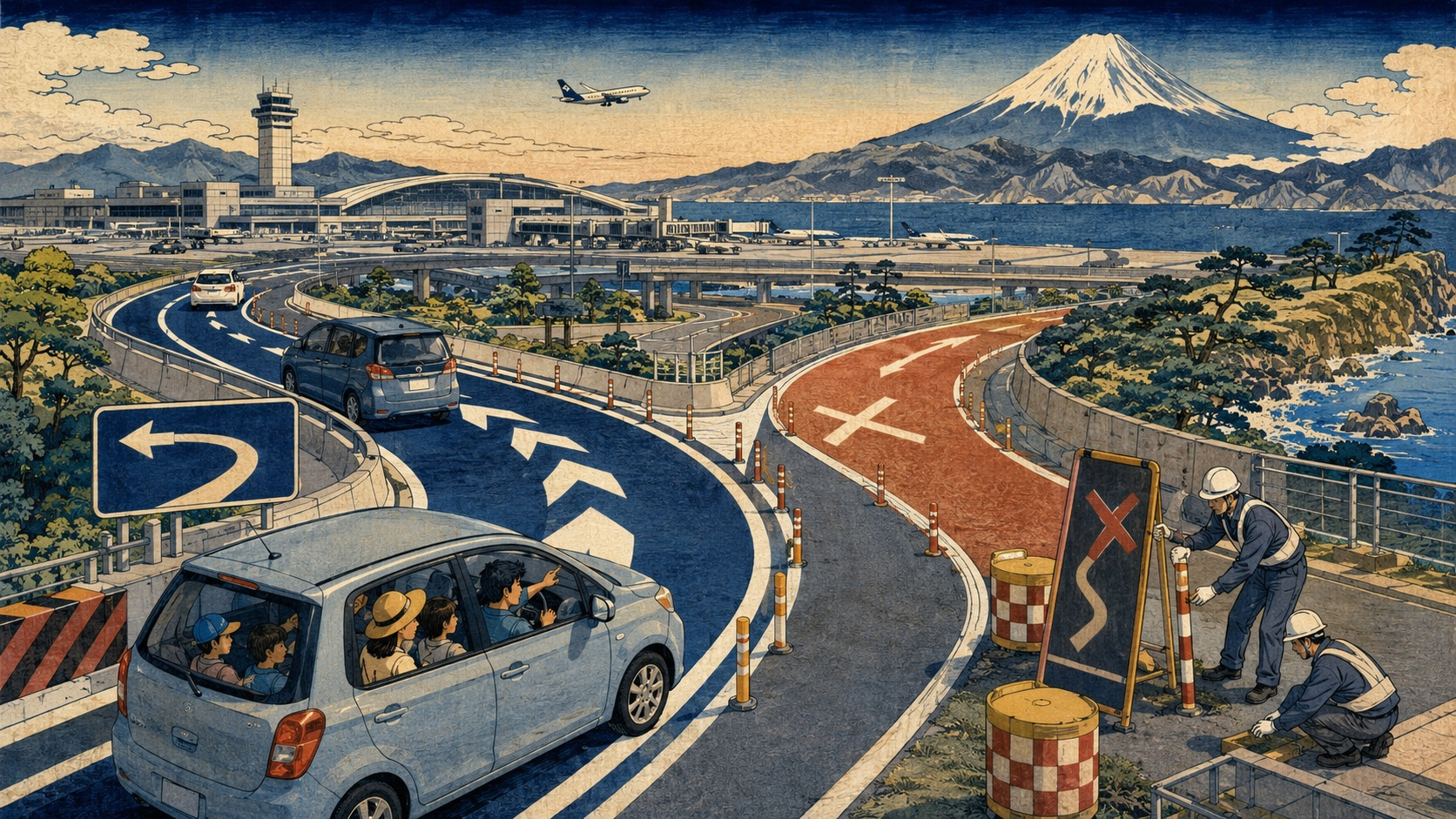
The new plan paints a right-turn trajectory through intersections and uses markings and rubber posts to make entry into the opposing lane less inviting. Signs near rental clusters repeat left-side travel. Installation on national highways is planned progressively during FY2026.
This is a self-explaining road, stronger than education alone. Shape and color work without fluent language and make an error recoverable early. The same cues may help tired Japanese drivers and domestic visitors unfamiliar with a junction.
Consistency matters. If colors mean different things by region, the system creates confusion. Designs require tests for rain, darkness, snow, color-vision differences, motorcycles, pedestrians, snow removal and emergency vehicles, without stigmatizing signs that distract or single out foreigners.
A safety layer inside the car
Reservations and vehicles can also intervene. A five-minute adaptation module can test understanding; a practice loop can cover turns, indicators, braking and vehicle width. For travelers from right-driving systems, navigation can announce before a junction: “After turning right, enter the left lane.”
In 2026, Aioi Nissay Dowa and NAVITIME announced plans for a foreign-renter crash-reduction app after trials in Okayama and Hokkaido, with staged release during FY2026 and nationwide expansion in the first half of FY2027. Telematics can warn about speed, harsh maneuvers and local risk.
Location histories are sensitive travel data. Purpose, retention, use in insurance pricing or claims, third parties, overseas transfer and deletion must be explicit. Consent should not be hidden inside a safety service, and core warnings should survive loss of connectivity or battery.
The Japan unreachable without a car
In regional tourism, rental cars are often infrastructure rather than luxury. Sparse rail and buses in Hokkaido, Okinawa and rural Kyushu make cars decisive for nature, hot springs and villages. Individual, repeat, family and small-group travel has displaced some group-bus touring.
If safety policy becomes blanket denial or discriminatory pricing, it damages regional economies and mobility equity. The answer is not treating every legal foreign driver as one risk class, but supporting the driver according to normal traffic side, experience, weather, vehicle and itinerary.
Public transport is also a safety measure. Airport coaches, luggage forwarding, demand-responsive transit, one-way rental and station-based mobility let visitors who do not wish to drive avoid it. A rental car should not be the only gateway to regional Japan.
The danger of the label “foreign-driver crash”
Foreign is too broad to explain a mechanism. Drivers from the United Kingdom, Australia, Hong Kong or Thailand know left traffic; drivers from right-side systems face reversal. Japanese experience, visit frequency, age, driving frequency, snow experience, language and vehicle type vary.
Crude nationality rankings invite prejudice and obscure the cause. The ministry's attention to the share of visitors from right-driving regions is closer to mechanism. Analysis should use normal traffic side, first rental day, distance, weather and road type.
Japanese renters also crash on unfamiliar roads. Safety engineering seeks a common design in which any first-time user's error is less likely to become serious, rather than a culprit population.
The statistics Japan actually needs
| Measure | What it answers |
|---|---|
| Crashes per contract, driver, vehicle-day and kilometer | Separates tourism recovery from individual risk. |
| Property, injury, fatal, single-car, police and insurance cases | Clarifies definition and severity. |
| First rental day, elapsed time and airport distance | Targets the adaptation window. |
| Usual traffic side and Japan-driving experience | Measures reversal rather than nationality. |
| Junction form, turn, wrong-way, crossing and parking | Matches road and vehicle interventions to mechanism. |
| Weather, night, snow, road and vehicle | Adjusts environmental confounding. |
| Before/after plus comparison sites | Estimates effects of markings and posts. |
| Near misses, hard braking and comprehension | Evaluates early without waiting for rare crashes. |
Relevant data sit with rental firms, police, road managers, insurers and ETC2.0. Common definitions, privacy-preserving identifiers and independent research access are needed. Safety use must remain separate from unjustified exclusion or opaque pricing.
An airport safety package
| Moment | Intervention | Pass condition |
|---|---|---|
| Reservation | License, traffic side, signs, insurance and snow guidance by market and itinerary. | Understanding before arrival; fewer counter refusals. |
| Handover | Short video, controls, practice loop and emergency steps. | Driver demonstrates lane, crossing and crash procedure. |
| Airport exit | Repeated keep-left cues, simple lanes, color and physical guidance. | Fewer wrong entries, hard brakes and wandering. |
| Key junction | Turn paths, posts, arrows and all-weather visibility. | Turn/wrong-way events fall versus comparison sites. |
| In vehicle | Multilingual contextual warnings for speed, stops and hazards. | Behavior improves without warning fatigue. |
| After a crash | One-screen access to 110, ambulance, rental, insurer and interpretation. | Fewer unreported events and secondary crashes. |
| After return | Anonymous near-miss and route feedback. | Rapid input to the next road improvement. |
Beyond the fourfold headline
There is no reason to dismiss 212 as small. Every crash affects travelers, passengers, other vehicles, pedestrians, police, medical staff and rental workers. If regional tourism increases exposure, reducing absolute crashes matters even without a worsening rate.
At the same time, a 4.5-fold comparison with 2020 easily manufactures fear. Sound policy states the limitation, obtains the missing denominator, identifies behaviors and locations, and evaluates interventions against controls. It teaches visitors their duties and gives roads and vehicles a duty to contain error.
Colored pavement and rubber posts are not glamorous. But safety history often advances when moral instruction—“pay more attention”—gives way to systems that do not kill when attention briefly fails. Median barriers, seatbelts and automatic emergency braking follow the same logic.
Japan should not design roads on which foreigners must imitate expert locals perfectly. It should design roads on which the unfamiliar, the nonreader and the exhausted can pass the same junction safely. What begins at airports can protect everyone.
Primary sources and method
- MLIT and Japan Tourism Agency: full-scale foreign-rental road-safety measures around airports, July 17, 2026
- ITARDA: Rental-car crashes involving visitors, 2019
- MLIT ETC2.0 pinpoint experiments, 2017 and Fukuoka–Beppu/Yufu general-road pilot, 2019
- Cabinet Office Traffic Safety White Paper: visitor rental countermeasures
- JNTO annual visitor arrivals
- National Police Agency: foreign-license rules and foreign-driver leaflet
- JNTO rental-car and traffic guidance
- Aioi Nissay Dowa and NAVITIME foreign-renter safety app, 2026
- Shikoku Transport Bureau inbound rental-car study
Editor's note: The 47 and 212 figures are national crashes involving rental cars driven by holders of international or foreign licenses, not crashes at the three airports alone. Related ministry material defines the series around first-party drivers. Pandemic 2020 is an exceptional baseline. Without rental contracts, vehicle-days or kilometers, we do not say the crash rate rose 4.5 times. Dividing by all visitors is also not driving exposure. The roughly 2.7 comparison concerns the share of crash types, not individual crash probability. Historical and system-safety synthesis is editorial analysis. The exchange strip uses the supplied “1 US Dollar = 162.49 Japanese Yen.” The supplied July 21, 1:27 a.m. UTC timestamp converts to July 21, 2026, 10:27 a.m. JST. The image is a contemporary editorial illustration, not a historical Hokusai work or real crash.