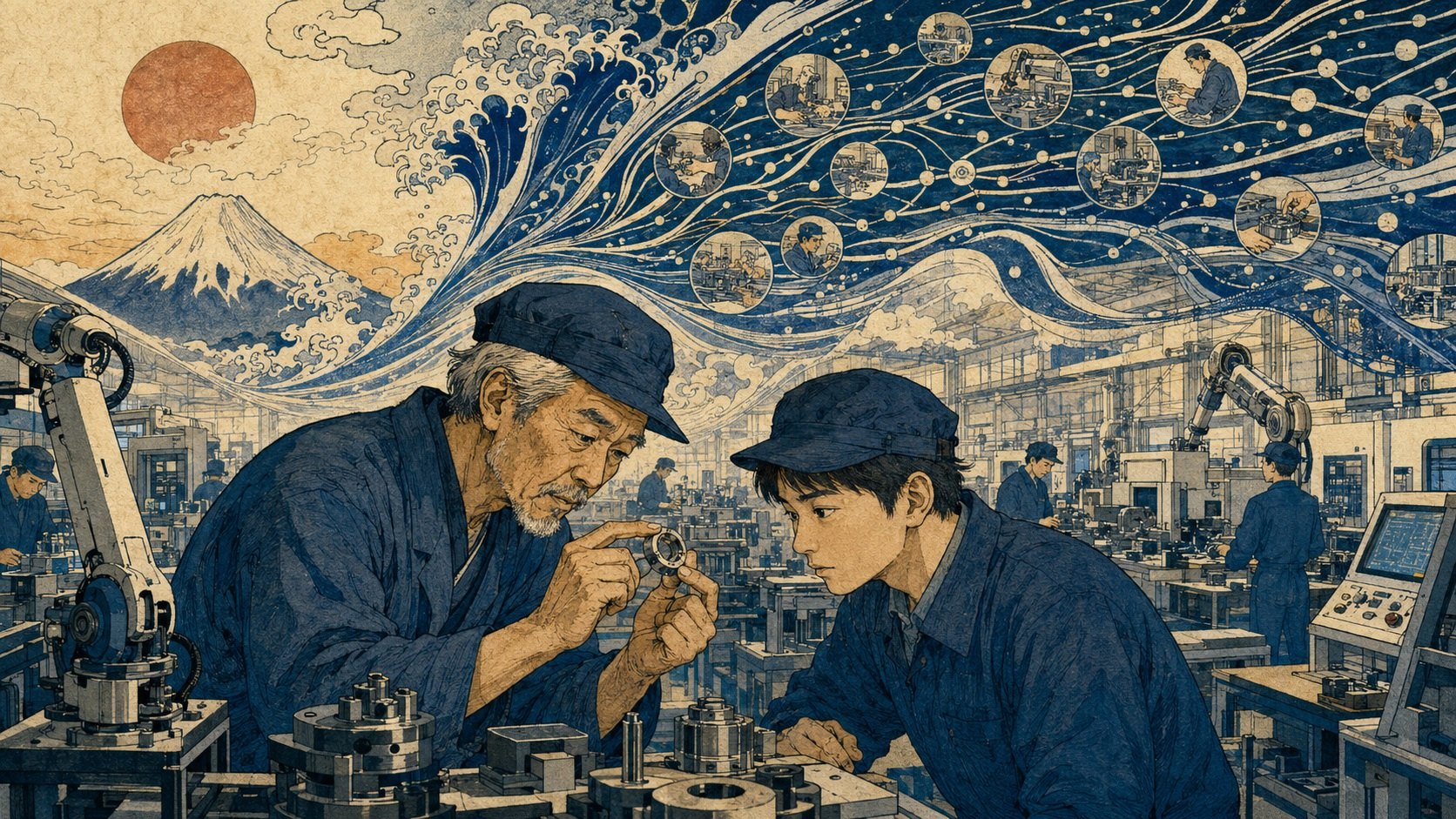
At 2 a.m., the person who knows is not there
A machining center on the night shift begins to make a slightly higher sound. The dimensions remain inside tolerance, but the chips look darker than usual. A young operator must decide whether to reduce the feed, change the tool or stop production and call the quality manager. During the day, a supervisor with 40 years of experience might listen for three seconds, inspect the tool tip once and say: “The material lot changed. Check the coolant first.”
The procedure says to inspect the machine if it makes an abnormal sound. Maintenance records show when the last part was replaced. The drawing carries the tolerance. What is missing is the order of attention: which clue to distrust first, which signal means danger and where the line should stop. Recording only the final answer does little when the next anomaly is different. What disappears with the veteran is not merely an answer. It is a way of noticing.
That is the gap LIGHTz says its new “Hanchika AI” platform is designed to close. According to the company, its proprietary tacit-knowledge extraction engine, Re:Quid, structures ordinary workplace conversations and decisions to capture the “why,” the path to a choice and the criteria used. It pairs that material with retrieval-augmented generation, or RAG, so an answer can include internal documents, analogous cases, reasons and a recommended action. Specialized applications can then carry knowledge across research, design, production, maintenance and sales.
What the new platform promises—and what remains unknown
LIGHTz frames the problem as three barriers. The reasoning behind decisions leaves when people leave. Documents accumulate but are not usable at the point of work. Knowledge stays trapped inside departments. The company says Hanchika AI learns decision grounds through routine exchanges between younger and experienced employees, returns reasoning rather than a bare search result and becomes more useful as organizational knowledge accumulates. A free trial is being offered to the first 20 companies.
The July 21 release does not disclose price, normal implementation time, the underlying foundation models, cloud or on-premises choices, data residency, encryption and access architecture, measured answer accuracy, rate of unsafe responses or quantified savings at customer sites. Statements that the platform improves through use or enables consistent decisions are product claims, not results of an independent benchmark. A system may become more useful as sound examples accumulate. It can also reproduce a factory’s habits faster if bad judgments enter the same loop.
In May, LIGHTz’s research project won second place in Theme 1 of the Ministry of Economy, Trade and Industry and NEDO’s Manufacturing DX Challenge for a dialogue-based skills-transfer system using expert-thinking AI. That public award is evidence of technical promise, not certification of every feature or operating condition in the released product. First place went to CraftSense, which combines whole-body skeletal motion, hand and arm movement, and force. The juxtaposition matters: industrial skill includes decisions that can be articulated and bodily performance that may be learned only by doing.
Knowing more than we can explain
The intellectual history begins with Michael Polanyi, the Hungarian-British scientist and philosopher whose 1966 book The Tacit Dimension argued that people know more than they can state explicitly. We can recognize one familiar face among a thousand without producing a complete verbal specification of how. Balancing a bicycle, judging a polished surface or hearing a bad bearing presents the same difficulty.
Two different lessons follow. With better questions, video, sensors and comparisons between cases, people can express part of what previously went unsaid. But it is dangerous to assume all skill can be converted into words. A fluent sentence on an AI screen is not a duplicate of mastery. Experience may still be required to judge whether the sentence is correct.
LIGHTz chief executive Shingo Otobe has drawn a similar boundary. In a 2026 interview, he described the company’s principal target as intellectual judgment in design and problem solving, not primarily the physical movements of a master craftsperson. That limitation makes the proposition more credible. The order in which an engineer investigates possible causes can be modeled through conversation and cases. Reproducing the tiny counterforce felt through a wrist may require motion capture, force sensing and supervised practice.
Postwar Japan moved knowledge through human circles
Japanese factories practiced knowledge management long before the term became fashionable. In apprenticeship and on-the-job training, a newcomer worked beside a senior employee, watched, imitated and was corrected. Standardized work made the current best method visible, but it was never meant to be the eternal answer. When an abnormality appeared, people stopped, investigated and revised the standard.
The postwar quality movement organized this loop. The Union of Japanese Scientists and Engineers spread statistical quality control, and QC-circle activity took hold from 1962: small groups of workers selected a shop-floor problem, gathered data, analyzed causes and tested an improvement. The Toyota Production System placed just-in-time production and jidoka—often rendered as automation with a human touch—at its core, while Taiichi Ohno and others built the discovery of waste and the authority to respond to abnormality into production itself.
The source of strength was not a mountain of manuals. It was a social circuit in which workers noticed something unusual, discussed it with a team leader, asked why repeatedly and changed the standard. Knowledge was motion, not storage. If a new AI system succeeds, it will not replace that circuit. It will extend it to a night shift, another plant and another generation.
Ikujiro Nonaka’s spiral is not a one-way extraction pipe
In 1991, Japanese management scholar Ikujiro Nonaka introduced a global business audience to “the knowledge-creating company” in Harvard Business Review. His 1994 research developed a dynamic theory of organizational knowledge creation. The model later known as SECI describes a cycle of socialization, externalization, combination and internalization.
| SECI stage | What happens in a factory | Where AI helps—and where it does not |
|---|---|---|
| Socialization | People work together and share tacit understanding through observation and experience. | Video and sensor logs can preserve traces, but a screen cannot transfer bodily sensation or trust by itself. |
| Externalization | A veteran expresses why a choice was made in words, diagrams and models. | Dialogue, follow-up questions, summaries and relationship graphs are natural areas for AI assistance. |
| Combination | Drawings, standards, failure histories and knowledge from other departments are connected. | RAG, search and analogous-case retrieval help, but require strict permissions and version control. |
| Internalization | A younger worker tests the idea, fails safely and makes the judgment part of personal practice. | AI can create scenarios and support reflection; it cannot substitute for the practice itself. |
The key is that SECI is not a one-way operation that vacuums information out of veterans and deposits it in a database. Younger workers use the knowledge, test it, find exceptions and feed new learning back into the spiral. The real measure of Hanchika AI will not be how elegantly it answers a question. It will be whether it makes that cycle faster and more reliable.
The 1980s also dreamed of putting experts in a box
Using AI to preserve expertise is not a new ambition. In the 1980s, expert systems translated specialist judgments into rules—if A, then B—and combined knowledge bases with inference engines. Japan’s Ministry of International Trade and Industry launched the Fifth Generation Computer Systems project in 1982, committing roughly ¥54 billion to logic inference, knowledge processing and parallel computing.
The period left a lesson deeper than processor speed. Experts could not enumerate every important rule in advance. As exceptions accumulated, rules collided. As equipment, materials and customer requirements changed, the knowledge base grew stale. Eliciting and maintaining knowledge became a bottleneck in its own right, while the center of AI research moved toward other hardware and statistical approaches.
Generative AI and RAG lower parts of this “knowledge acquisition” barrier. They can summarize natural conversation, retrieve relevant passages from large document collections and accept questions despite variations in vocabulary. They do not abolish the old problem. Conflicting rules return as inconsistent documents and veterans with different methods. The brittleness of a fixed rule base can reappear as a generative model’s plausible but fabricated answer.
Japan’s “2007 problem” was postponed, not solved
When the large cohort born from 1947 to 1949 began turning 60, Japanese industry warned of the “2007 problem.” At the time, 51.6% of manufacturing workplaces said they faced difficulty transferring skills. Many employers bought time through later retirement, continued employment and rehiring on fixed-term contracts. The 2026 manufacturing white paper shows that keeping older employees at work remains the most common transfer measure, used by 54.8% of companies.
That bridge has been useful, but it is not the opposite bank. In the 2026 survey, only 33.3% of manufacturers said skills transfer was going well or somewhat well, while more than four in five expressed some anxiety about the future. Among manufacturing establishments reporting a human-development problem, 62.8% lacked instructors, 54.4% said trained people leave and 45.4% lacked training time. Only 21.7% cited smooth skills transfer as a purpose for using digital technology. The problem was understood; teacher, learner and time were all scarce at once.
Among businesses not collecting data to visualize veteran know-how, nearly 70% cited the difficulty of turning knowledge and experience into an explicit form. AI enters a workplace that says it has no time to record knowledge, then asks that workplace to review, correct and maintain what it captures. Unless that paradox is solved, the knowledge system becomes another shelf nobody updates.
LIGHTz’s first decade: from intensive interviews to daily work
LIGHTz was founded in Tsukuba, Ibaraki Prefecture, in 2016. Otobe had been a mechanical engineer at Canon, designing precision polishing equipment for aspherical lenses. In an interview, he said his path toward creating a regional business grew from volunteer work in his native Iwate after the 2011 Great East Japan Earthquake, where local people urged him to create jobs. The company’s name evokes a light illuminating the future.
An early core product was BrainModel. A trained interviewer repeatedly questioned an expert, analyzed the language and built a visual network of viewpoints and branches in the expert’s reasoning. In a 2025 account, LIGHTz said a complex subject could require at least eight interviews of two hours each. The team would produce a thinking model and explanatory manual, then put the result into an AI system where appropriate. The company calls the broader process from visualization to use “Hanchika”—turning knowledge held by a few into something more widely usable.
That care was a strength, and also a barrier to scale. A 2024–25 industry-academia-government field test worked with smaller metalworking firms in the Yurihonjo region of Akita. At Marudai Kiko, it examined large precision five-axis machining; at Sanei Kikai, it examined the machining-program process. Knowledge was divided into input, process and output, then rendered in BrainModels and manuals. The report found value in the structure but also concluded that the full Hanchika method was a high hurdle for small and midsize manufacturers. A lighter version and continuing support were needed. Generative AI summarization of interview notes was identified as one way to offset limited staff and skill.
The new platform can therefore be read as an attempt to distribute painstaking knowledge elicitation across ordinary work. If Re:Quid structures daily questions and answers, a company can move away from an emergency interview campaign just before retirement and toward continuous capture. Yet automation does not remove governance. Someone still has to decide whether an extracted point is material, approve it, reconcile disagreement and retire it when conditions change.
What has happened in a real company
Organo, a major water-treatment engineering company, formed a capital and business alliance with LIGHTz in 2024. Its 2025 integrated report said the work had advanced visualization of experienced engineers’ thought processes, digitization of know-how and quantification of skills, supporting younger engineers’ development and the transfer of technology. It reported 18 Hanchika items in fiscal 2024 against a fiscal 2030 target of 70. This is a customer’s own disclosure, not an independent study proving a causal effect on profit or training time, but it is a more concrete trail than a laboratory demonstration.
Other public examples are more opaque. A 2021 Tsukuba research-support document described a case in which the sensitivity and experience of a flavorist were modeled with AI and the fragrance-development period was cut in half, but it did not identify the customer, measurement period or sample. Confidentiality is understandable when industrial AI reaches a company’s competitive core. A mature market will still need comparable, anonymized measures: answer accuracy, escalation, rework, education time, update effort and the rate at which workers reject an AI recommendation.
The danger of AI as a plausible old hand
The dangerous AI is not one that stays silent; it is one that answers with the confidence of a senior worker and the context of an obsolete machine. Generative models can produce false statements, commonly called hallucinations or confabulations, and grounding them in retrieved documents does not reduce the risk to zero. A past success may no longer fit a new material or machine. A mistaken answer may contaminate future retrieval. A poorly designed permission layer may carry a customer’s design secret into another department.
Japan’s Ministry of Internal Affairs and Communications and METI address confidential prompts, intellectual property, misinformation and security incidents in the AI Guidelines for Business, Version 1.1. The U.S. National Institute of Standards and Technology’s generative-AI profile likewise treats confabulation, data privacy, information security and human overreliance as central risks. LIGHTz’s launch material does not detail the access-control model, whether customer inputs train broader models, audit logging or an operational kill switch. Manufacturers should establish those conditions in technical review and contract, not infer that they exist.
| What must be protected | Required design |
|---|---|
| Provenance | Show the original source, case, author, equipment and material conditions, version and date behind every answer. |
| Access | Separate visibility by plant, department, project and customer so secrets do not flow sideways. |
| Freshness | Give knowledge an owner and expiry date; require reapproval after equipment or process changes. |
| Dissent | Do not flatten veteran disagreements into one “truth.” Preserve alternative views with the conditions under which each applies. |
| Safety | Require human approval for quality, safety and regulatory advice; never let the knowledge assistant operate machinery by itself. |
| Dignity | Agree in advance whose knowledge is being used, for what purpose, with what credit, reward and post-retirement rights. |
Who owns a veteran’s knowledge?
A veteran’s know-how developed around company machines and customer work. It is also the product of a professional life—decades of mistakes, experiments and judgment. When an employer records interviews, converts them into an AI system and keeps using the result after retirement, who controls the work, attribution, correction, scope and compensation? Trade-secret clauses may establish legal control without producing the trust required to elicit the best knowledge.
If the project sounds like “we are extracting what we need so we no longer need you,” the richest context will stay unspoken. A better purpose is to reduce repetitive burden, develop the next generation and move the veteran toward higher-order judgment. Knowledge contributors should remain editors and reviewers. Younger workers face the opposite danger: automation bias can weaken their own reasoning. Training should ask them to form a hypothesis first, compare it with the AI’s evidence and return the outcome to the system.
Measure judgment, not chat volume
A skills-transfer AI project should not begin with a company-wide rollout. Start with one decision where retirement risk is high, failure affects quality or delivery, past cases exist and an expert can verify the result: machining chatter, mold quotation, the first response to an equipment alarm or omissions in a design review.
| Stage | Work | Pass condition |
|---|---|---|
| 1. Select | Define a specific decision and loss, not an entire person or job. | The target quality, safety or delivery measure is explicit. |
| 2. Capture context | Record inputs, rejected options, exceptions and confidence—not just the conclusion. | Another engineer can follow the reasoning path. |
| 3. Shadow mode | Let AI advise without acting, then record its differences from human judgment. | Teams understand the patterns of dangerous error and abstention. |
| 4. Limited use | Open low-risk decisions first and retain approval gates for high-risk work. | Sources, permissions, audits and the shutdown procedure have been tested. |
| 5. Learning loop | Return younger workers’ outcomes and new failures to the knowledge base. | Time to competence, repeated defects, rework and waiting for advice improve. |
User counts and question counts prove only that the system can be opened. Better measures include the time until a younger engineer can make a sound decision independently, recurrence of the same defect, interruptions to veterans, time to first response, correct escalation to a person and the age of the underlying knowledge. One unusually valuable metric is how often a junior worker discovers that the AI is wrong.
Not a digital double—a living organizational memory
The phrase “digital double” is appealing and misleading. Human expertise includes machine sounds, trust among colleagues, a customer’s expression, responsibility for failure and bodily memory. AI holds a finite model assembled from what people and organizations choose to articulate, capture and validate. A person may retire; the model also ages. New material, equipment and regulation require a new review.
A finite model can still be enormously useful. A night-shift operator can see a similar case and its evidence instead of paging through a hundred-page manual. A designer in another division can learn what failed on the production floor before freezing a new design. A veteran can spend less time answering the same basic question and more time teaching exceptions and emerging technology.
What Japanese factories need to preserve is not yesterday’s answer. It is the capacity of people to gather around an abnormality, ask for reasons, revise a standard and teach the next person to question it again. If LIGHTz’s platform can enter that loop, AI will not become a veteran’s memorial. It will become a new workbench where veterans and younger workers continue thinking about the same problem.
Primary sources and research notes
- LIGHTz: Hanchika AI launch release (July 21, 2026) and company profile
- NEDO Manufacturing DX Challenge: awards and technologies and LIGHTz’s award announcement
- Japan Telecommunication Users Association: interview on tacit-knowledge transfer with Mitsubishi Research Institute and LIGHTz
- New Media Development Association: field test visualizing technology and skills at smaller manufacturers
- ORGANO GROUP REPORT 2025 and Tsukuba Center Inc.: LIGHTz technology profile
- 2026 White Paper on Manufacturing Industries: retention and skills transfer and AI, digital technology and know-how visualization
- 2019 White Paper on Manufacturing Industries: the “2007 problem” and skills transfer
- OECD, Artificial Intelligence and the Labour Market in Japan (2025)
- Michael Polanyi, The Tacit Dimension (1966); Ikujiro Nonaka, “The Knowledge-Creating Company” (1991); and “A Dynamic Theory of Organizational Knowledge Creation” (1994)
- Toyota: history and philosophy of the Toyota Production System and Union of Japanese Scientists and Engineers: quality control and QC circles
- IPSJ Computer Museum: Fifth Generation Computer Systems project
- MIC/METI, AI Guidelines for Business, Version 1.1 and NIST Generative AI Profile
Editor’s note: Claims about Hanchika AI’s capabilities, Re:Quid’s automated extraction, improvement through use and consistent decision quality are descriptions published by LIGHTz; they have not been verified in an independent benchmark cited here. Second place in the NEDO challenge is a competition result, not certification of every operating condition in the commercial product. Corporate cases are identified as company self-reporting. We do not infer undisclosed price, security architecture, accuracy or return on investment. “AI knowledge system” means a partial model of elicited and approved knowledge, not a copy of a person. The exchange-rate panel uses the supplied figure, “1 US Dollar = 162.49 Japanese Yen,” and converts the supplied July 21, 2026, 1:27 a.m. UTC update to 10:27 a.m. Japan Standard Time. The main image is a contemporary editorial illustration, not a historical Hokusai work.