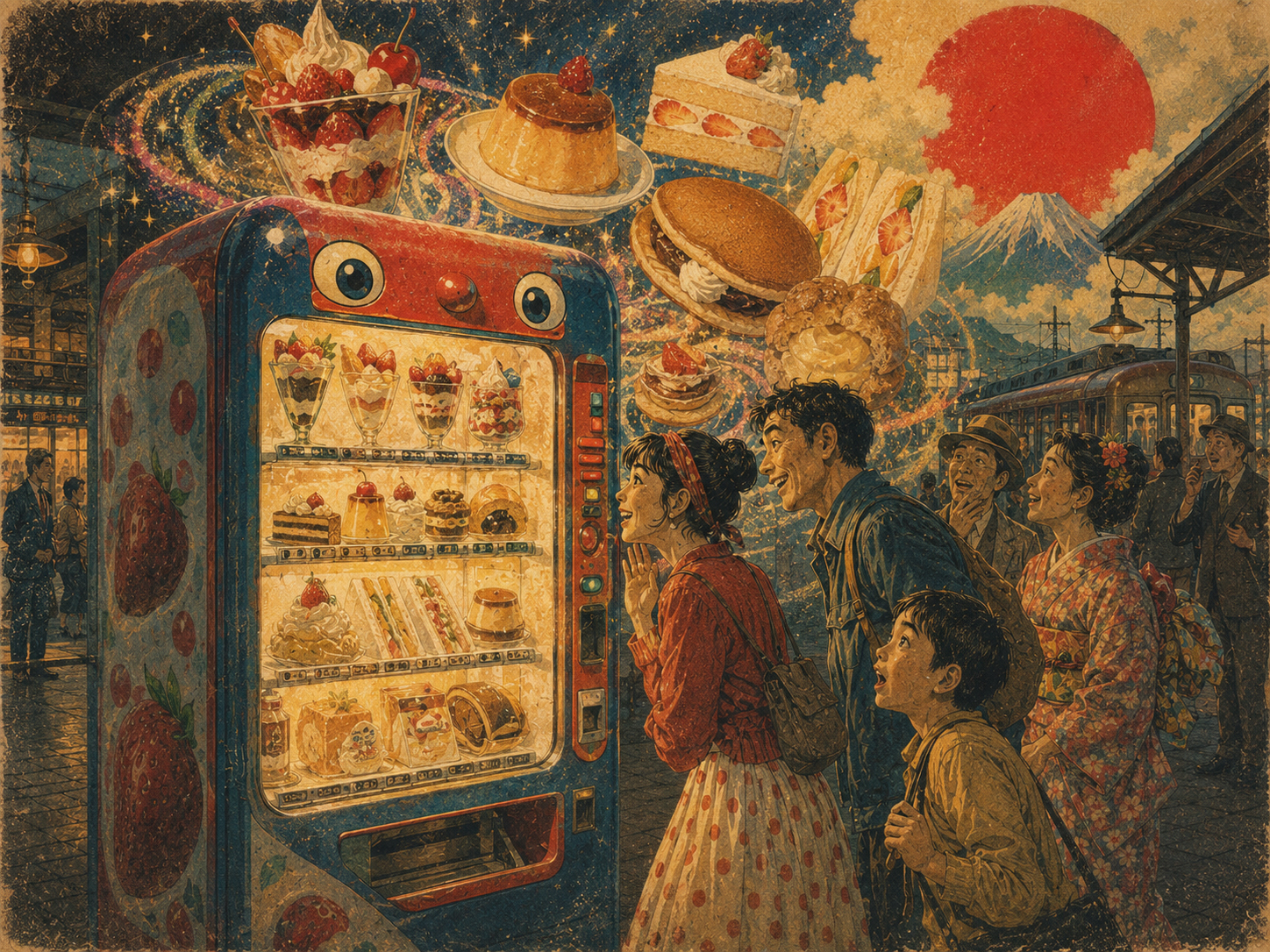
Pudding and cake enter the drink rows
The traditional Japanese beverage machine presents orderly rows of cans and bottles. In spring 2026, selected machines around Matsuyama began replacing some of those slots with desserts—products intended to create a reason to stop even when the customer was not thirsty.
NKY, part of the Sampuku Group, began introducing a “new product category” at about 60 sites in March. The company selected desserts compatible with existing beverage equipment, avoiding the cost of an entirely new frozen-food machine.
The stated priorities were volume, novelty and social-media visibility. The machine’s role would expand from quenching thirst toward delivering a “small reward,” conversation and visitor satisfaction.
Is Japan really tired of soda?
The headline is useful, but not literally true. Japanese consumers still buy huge volumes of water, tea, coffee, soda and functional drinks.
The problem is the channel. Supermarkets and drugstores sell the same bottles more cheaply. Convenience stores offer wider selection, points, fresh coffee and hot food. Reusable bottles and home delivery further weaken the vending premium.
Consumers are not necessarily tired of beverages. They are tired of paying more without receiving a strong reason. The failing product is the old transaction model.
The two-million barrier breaks
Japan’s soft-drink vending population fell to 1.95 million in 2025, below two million for the first time in roughly three decades. The count dropped about 90,000 in one year.
That placed the sector about 20 percent below its 2014 peak. Coca-Cola Bottlers Japan reduced its footprint from around 700,000 to approximately 650,000 machines, while DyDo also announced further removals.
The vending landscape will not disappear. Operators are becoming more selective, removing weak sites and demanding greater revenue from those that remain.
The sale is automatic; the business is not
Customers press a button, but people drive the trucks, load inventory, clean machines, collect containers and cash, and repair failures.
Labor scarcity, higher wages, fuel, electricity, refrigeration, parts and currency-system upgrades all increase cost. Low-volume machines are especially vulnerable because a restocking visit costs nearly as much as one to a busy machine.
Desserts can raise ticket size and gross margin. A location unable to survive on bottled tea alone may become viable when sweets and snacks share the same route.
When did vending become synonymous with drinks?
Japan’s oldest surviving machine is a 1904 stamp-and-postcard dispenser. Early machines also sold sweets, tobacco and alcohol.
After World War II, canned beverages, the ¥100 coin, refrigeration, electricity and road logistics made drinks dominant. During high growth, machines became unattended refrigerators serving workers and commuters at all hours.
Dessert expansion is therefore less a bizarre deviation than a return to vending’s original identity as a machine capable of selling many categories.
| Period | Main vending role | Supporting conditions |
|---|---|---|
| Early 1900s | Stamps, postcards, confectionery and tobacco | Coin mechanisms and mechanical engineering |
| 1950s–70s | Canned and bottled beverages | Refrigeration, logistics, ¥100 coin and urban growth |
| 1980s–2000s | Hot/cold drinks and 24-hour convenience | Population density, safety and long working hours |
| 2010s | Cashless payment, screens and local products | Connectivity, tourism and electronic money |
| Early 2020s | Frozen dumplings, ramen, cake, meat and souvenirs | Cold technology, pandemic behavior and unattended retail |
| 2026 | Desserts mixed into existing drink machines | Drink decline, higher ticket value and experience selling |
Frozen vending broke the food barrier
During the pandemic, frozen vending expanded as restaurants faced shorter hours and customers sought contactless buying. Machines sold dumplings, ramen, meat, sushi, cakes, macarons and regional mail-order food.
Industry data cited in a 2024 survey put food vending machines at 77,700 by the end of 2022. While drinks contracted, food machines gained a purpose as stores that never had to open.
Dedicated frozen equipment is expensive. NKY’s approach differs by selecting products that fit existing beverage machines and distribution routes.
Put cheesecake inside a can
Beverage manufacturers are also blurring the boundary between food and drink. DyDo launched a shakeable canned Basque cheesecake in September 2025.
Customers shake the can to break the contents into a thick mixture of cream cheese, dairy and caramel. The product adapts dessert to the dimensions and handling system of a drink machine.
Japanese machines have long sold corn soup, sweet red-bean soup, amazake, jelly drinks and sweet-potato milk. Canned cheesecake pushes an existing continuum further.
Japan’s drinkable-dessert tradition
Japan has a strong middle category between eating and drinking: yogurt drinks, jelly beverages, tapioca, shakes, pudding flavors and amazake.
Such products work in stations and offices because they require no plate or spoon and can use beverage manufacturing and vending networks.
Yet liquid dessert changes perception. A slice of cake is visibly dessert; a can may be consumed at beverage speed, affecting fullness and awareness of sugar intake.
Sweets top the wish list
A 2024 survey of 362 adults by Jidōhanbaiki JP ranked confectionery first among products respondents wanted from machines, followed by batteries and stationery. Ice cream and sweets also appeared in the broader ranking.
The sample is limited and should not be read as national demand measurement. It nonetheless shows that consumers imagine vending as broader than beverages.
Sweets suit the format: manageable storage, impulse appeal and more emotional value than an ordinary bottle.
Why dessert works on social media
People rarely photograph a standard bottle of water. A canned cake, layered cream dessert or unexpected pudding can turn the purchase itself into content.
The surprise of seeing it emerge, opening the package and showing texture creates a complete short video. Customers become marketers.
Novelty alone does not create repeat business. Appearance must be supported by taste, value and reliability.
The economics of a small reward
During uncertain economic periods, consumers may postpone travel or luxury goods while still buying a few-hundred-yen treat. Japanese convenience-store desserts have long used this “small indulgence” logic.
Vending desserts fit moments when entering a store feels unnecessary: night shifts, hospitals, factories, hotels, campuses and remote facilities.
Inflation also makes small treats vulnerable. Every product will be compared with supermarket and convenience-store alternatives.
Temperature control is harder than selling tea
Sealed water or tea has a comparatively long shelf life. Desserts containing milk, cream or egg are more sensitive to temperature and time.
Operators must manage actual cabinet temperature, direct sun, power outages, door opening and restocking exposure. First-expiring inventory must move first.
Remote temperature monitoring and automatic sales shutdown are desirable. Unattended retail cannot mean unattended responsibility.
- Clear storage temperature, use-by dates and post-thaw limits.
- Visible allergen information before purchase.
- Automatic sales suspension after refrigeration failure or outage.
- Inventory rotation and discounting to reduce expired stock.
- Spoons, napkins and a place for packaging disposal.
- Refund and contact procedures for damage or failed delivery.
Sugar and public health
Part of the beverage market’s shift favors water, unsweetened tea and reduced-sugar choices. Filling machines with rich desserts can appear to reverse that trend.
Dessert need not be treated as inherently bad, but calories, serving size and nutrition should be easy to see. Liquid cake may be consumed faster and produce less immediate satiety than a solid portion.
Smaller portions, fruit, fermented dairy, wagashi and lower-sugar options can broaden the concept beyond a box of high-sugar novelty.
Competing with the konbini dessert shelf
Japanese convenience stores launch seasonal pudding, cream puffs, roll cakes and wagashi constantly. They offer refrigeration, lighting, loyalty points and staff.
Machines win where the store is absent or closed: inside workplaces, at rural attractions, in hotels after midnight and outdoors.
Exclusive regional products also avoid direct price comparison. Partnerships with local pastry shops, farms, dairies or supported-employment workshops can turn the machine into a regional showcase.
The strength and limit of reusing existing machines
Compatibility with installed equipment reduces capital cost and allows rapid deployment across 60 sites. Power, contracts and routes already exist.
Drink mechanisms impose strict size, shape and drop requirements. Delicate cake can collapse; containers that must remain upright may not work.
If the model succeeds, manufacturers may begin designing a new category of “vending-standard desserts” engineered around machine geometry.
A machine as employee benefit
NKY plans proposals connecting the new products with employee benefits, visitor satisfaction and heat-safety services.
Night-shift factories, hospitals, suburban offices and dormitories often have few food choices after cafeterias close. A small dessert can improve the break experience.
Calling it welfare requires more than sugar: pricing support, nutrition, allergies and varied dietary needs matter.
Does cake belong in disaster response?
Some Japanese machines can release beverages free during emergencies. NKY has also discussed adding disaster and stockpiling functions.
Fresh cream cake is not a first-priority disaster supply, but shelf-stable sweets and energy jelly can provide calories and psychological comfort.
Emergency inventory should be separated from ordinary refrigerated dessert and remain safe without power.
Can dessert save the vending machine?
Sixty locations cannot reverse a market of 1.95 million machines. Dessert restocking is more complicated and waste risk is higher.
The important shift is refusing to define one machine permanently. Drinks, sweets, local products and emergency goods can change by place and time. Remote inventory and cashless data can turn each unit into a miniature unattended shop.
The future may be fewer identical machines and more locally programmed machines.
From convenience to emotional value
In the 20th century, the miracle was receiving a cold drink when every shop was closed. By 2026, that miracle had become invisible.
The new machine offers canned cheesecake, midnight pudding and photogenic novelty. It sells satisfaction, story and surprise after convenience.
Japan did not literally invent dessert vending; frozen sweets machines exist worldwide. What it is reinventing is the meaning of a massive beverage-only infrastructure.
Putting cake among the cans looks like a small merchandising decision. It reveals a vending-machine nation moving its sales target from the throat toward the emotional gap between ordinary moments.
Sources and further reading
- Sampuku Group / NKY, March 30, 2026: dessert rollout at about 60 sites, 1,100-machine network and experience-value strategy.
- Vending Times, April 7, 2026: 1.95 million soft-drink machines, 90,000 annual decline and 20% drop from 2014.
- SOMPO Institute, March 2026: long-term structure of Japan’s vending-machine market.
- DyDo, August 28, 2025: shakeable canned Basque cheesecake sold through beverage machines.
- Jidōhanbaiki JP survey, February 2024: sweets as the most desired non-drink product and growth of food vending.
- Japan House Los Angeles: social conditions behind Japanese vending culture.
- DyDo Group Holdings investor information: vending operations and business structure.
- Consumer Affairs Agency, food labeling: allergen, expiry and nutrition rules.