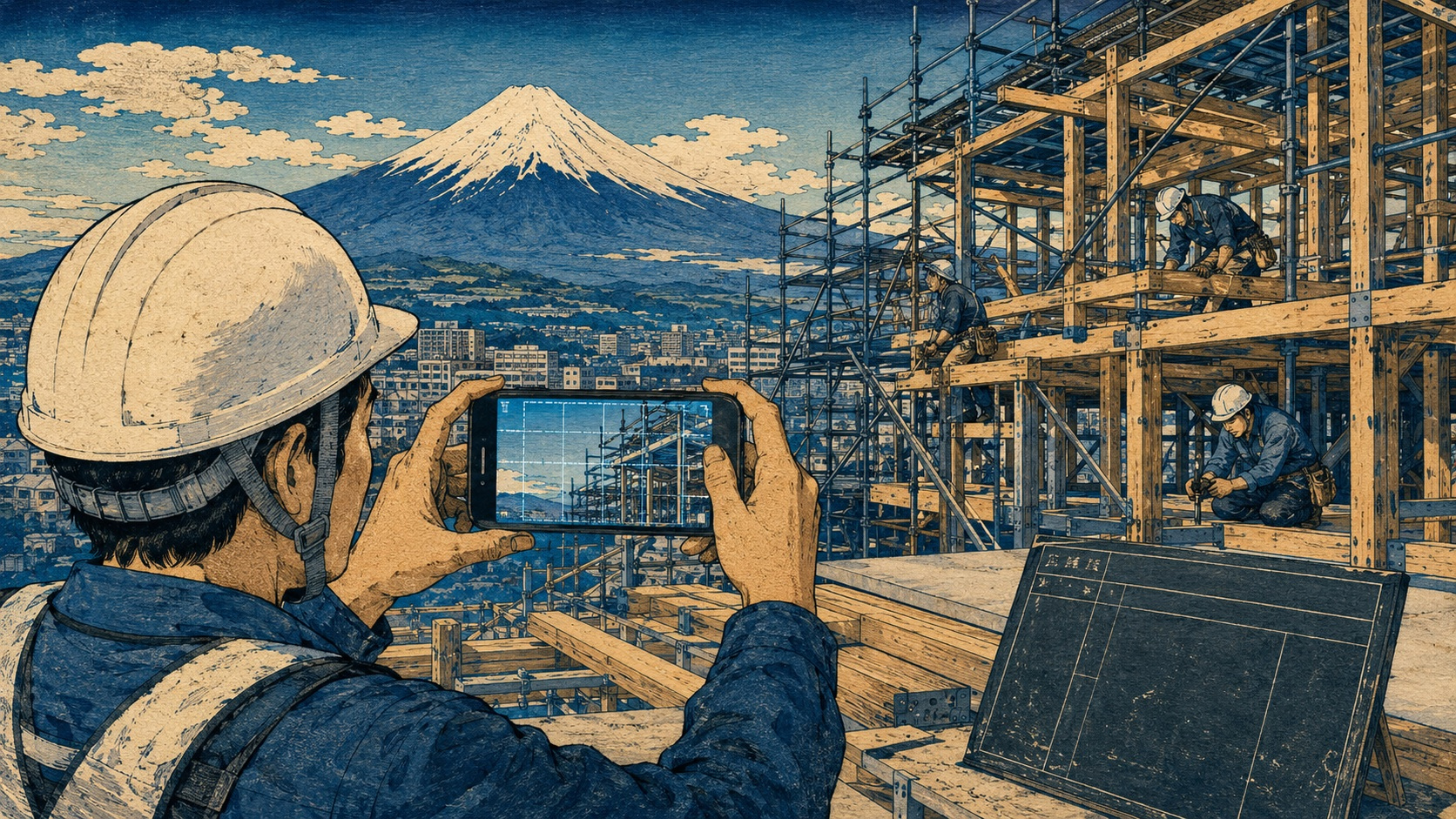
The board that stands in front of the concrete
Once concrete is poured, the reinforcing steel disappears. Once a wall is closed, its pipes and insulation cannot be seen. The construction photograph preserves the moment before work becomes inaccessible: proof that something was placed at this location, at this stage and at this dimension. The small board at the edge of the frame gives the image a project name, work type, station, design measurement, actual measurement and sketch. It is not a prop. It is physical metadata.
That interface carries friction. The writing changes from shot to shot. Someone positions the board so it is readable, sometimes while machinery and workers are moving around it. Rain smears chalk. Dust dulls the surface. A shadow hides a dimension. If a supervisor discovers the omission after a trench has been backfilled, “take it again” is no longer a simple instruction. The evidence may be gone.
An electronic small board moves those fields into the camera workflow. Yet its true purpose is not to erase the board. It is to remove the handling without weakening the relationship between the subject and its explanation. That is both the appeal of a cheap single-purpose app and the source of its hardest requirement.
Inside the ¥300 Android app
Studio Rack One's Brain announced the app at 9 a.m. on July 21. Its formal Google Play name is Digital Construction Blackboard Pro. The listing advertises 12 standard templates, ten saved custom templates, registration of up to ten photos at once, font choice, size and bold controls, free adjustment of board position, scale and transparency, and JPEG output. The use cases span buildings, civil engineering, electrical and equipment work, roads, apartments and inspections. It is aggressively single-purpose: make the board, place it in a site image, save the result.
The price is almost frictionless. As of July 21, Google Play said all functions cost ¥300 a month through an in-app purchase—about $1.85 at ¥162.49 to the dollar. A small builder that cannot justify a full project-management cloud does not need scheduling, chat, procurement and cost control to solve this one nuisance. “Only the board” can be a coherent product strategy.
The public descriptions, however, do not yet form a clean record. A July 4 release called the same app a ¥300 one-time purchase; Google Play says monthly. The July 21 PR TIMES announcement drops “Pro” from the product name and omits price. The store says the app was last updated on July 2 and displayed “50+” downloads. The launch release is therefore closer to a second introduction of an early product already in the market than its first instant of availability. These are small discrepancies, but a product for controlled construction records should make identity, version, price and capability unusually precise.
Japan digitized delivery before it digitized the board
The construction-photo story began before the smartphone. Under MLIT's CALS/EC program, final deliverables for national public projects began moving to electronic media in fiscal 2001. By fiscal 2004, every directly administered construction project and professional assignment was covered. Photographs went into prescribed folders with filenames and attributes such as project, category and date recorded in standardized data structures. The wooden board remained in the frame, but the album beyond it was becoming data.
Digitization created a new vulnerability: photo software made cropping, brightness adjustment, compositing and correction easy. In 2006, MLIT established measures against unauthorized modification of digital construction images, including checks at supervision and inspection and expert spot audits. A 2013 CIM technical report already proposed allowing an electronic board when backed by tamper detection. Convenience would be admitted only if authenticity could be tested.
After trials, MLIT issued an operational notice on January 30, 2017, applying to general civil works entering tender procedures from February 1. Government building works followed in April, then ports and airports in June. Adoption spread among prefectures, railways and expressway operators. In 2021, the testing and verification functions moved from the earlier JACIC-linked council to the Japan Construction Management Software Industry Association, or J-COMSIA. Nine years after national operation began, the electronic board is not an experimental novelty. It is infrastructure with a compliance history.
| Date | Milestone | Operational meaning |
|---|---|---|
| Fiscal 2001 | MLIT begins phased e-delivery. | Photos and their attributes enter the electronic completion record. |
| Fiscal 2004 | All directly administered works and assignments are covered. | Digital photo management moves from exception to standard practice. |
| 2006 | Measures address unauthorized photo editing. | The tension between convenient images and trustworthy evidence becomes explicit. |
| 2013 | A CIM report proposes electronic boards with tamper detection. | Electronic inscription is conceived as a controlled exception, not free editing. |
| 2017 | MLIT begins operational use. | Capture efficiency, sorting and authenticity become one workflow. |
| 2023–26 | The notice is revised and retained in the latest standard. | Ordinary photo editing remains prohibited; authorized board inscription is the exception. |
The gulf between “can composite” and “can be delivered”
Japan's March 2026 construction-photo standard continues a blunt rule: in the interest of authenticity, photo editing is not permitted. The exception is electronic small-board inscription performed under MLIT's March 15, 2023 notice. That notice is equally clear about its purpose. Board information is recorded at the same time as the subject image, and the photograph's authenticity is checked, reducing work at capture and sorting while preventing later alteration.
The required equipment must enter the fields prescribed by the photo-management standard and provide tamper detection based on technology listed by CRYPTREC, Japan's government cryptography program. At delivery, the contractor uses photo-management or viewer software—or a checking service—to verify authenticity and submits the result. J-COMSIA tests implementations that use SHA-256 hashes and publishes passing products. Procurement is not legally restricted to that list, but the contractor must still demonstrate that the selected system satisfies the project requirement.
This is where the new app's wording matters. The release says it can “easily composite” a board into construction and inspection photographs already taken. The Play listing says it composites a digital board into a site photograph and saves JPEG files. That language can be read as post-capture editing. The public material does not mention simultaneous capture, hashes, tamper detection, J-COMSIA testing, authenticity-result export, board-data interoperability or electronic-delivery XML. We did not find the app or developer name in J-COMSIA's public list of software that had passed its authenticity-function test as of July 21.
None of this proves that the app is noncompliant. Requirements vary by commissioning body, trade and special specification. J-COMSIA's list is an example path, not the only legal route. A short public description may omit an implemented control. The defensible answer comes only after the supervisor checks the contract and the vendor provides implementation details, test evidence and any certificate. What can be said now is narrower: a broad marketing reference to public works does not perform that verification.
Why post-capture compositing is a different act
If one board image can be attached to today's photograph or last month's photograph with equal ease, the result may look orderly while its evidentiary force is weak. A site image is supposed to show that the stated station, measurement and construction stage corresponded to the pictured subject at capture. Free composition after the event returns that relationship to an editor's choice.
Tamper detection does not magically prove truth. A worker can enter an incorrect measurement before a cryptographic seal is made. The camera can be pointed at the wrong location and preserve that wrong location perfectly. The control still matters: it can show whether pixels or attached board information changed after capture, and it can identify the software format and version that a verifier understands. Human review and cryptographic sealing prevent different failures.
There is a second distinction between appearance and data. A board burned into JPEG pixels is readable to a person, but the work type, station and date may not be reusable by software. When the same fields travel as structured data, photo-management systems can automatically sort images, build albums and prepare electronic delivery. That is why J-COMSIA separately tests small-board information interoperability. Drawing the right-looking board and handing off reliable metadata are different capabilities.
There is still a place for a focused tool
A possible gap in public-works compliance does not make the app useless. Private residential progress reports, renovation before-and-after images, internal quality records, equipment inspections and customer reports can have requirements agreed directly by the parties. An electronic board can eliminate rain-smeared writing, shadows, awkward placement and the need to carry hardware. Reusing a template can also reduce repetitive transcription.
Full construction clouds solve a larger problem. ANDPAD says it serves more than 260,000 companies and 690,000 users, integrating photos with drawings, inspections, communication, orders and management. Kuraemon combines apps, dedicated devices, albums, cloud storage and electronic-delivery workflows. Their prices pay for more than a board: support, certification, data flows and organizational controls may be included. A ¥300 app is not a miniature version of the same contest. It extracts one action—make and position the board—from the suite.
That can fit Japan's small sites. Company-wide digital transformation often stalls when every process changes at once. A tool that removes one daily irritation without training can be a powerful doorway. But if its output cannot enter the required final workflow, it creates double work. Selection should begin with where the photograph must go and what it must prove, not with the app-store price.
The other risk inside “tiny developer”
Studio Rack One's Brain has an exceptionally small public footprint. Its PR TIMES company profile gives a representative whose name is listed in Japanese as 光原 光, but no head-office location, founding date, capital or company URL. Google Play lists a Yokohama address, a Gmail support account and a Google Sites privacy page. On July 15, the developer also announced an app that overlays reference images on the camera to standardize field-photo angles—evidence of a coherent focus on the narrow problem of site photography. Public material does not establish the legal form, team size, support hours or continuity plan.
Smallness is not a defect. A micro-developer can notice one irritation an enterprise suite ignores, ship it cheaply and respond to a user faster than a large vendor. That is a healthy software market. Yet maintaining construction-photo software brings a long obligation: Android changes, camera differences across devices, file corruption, cryptographic requirements, regulatory revisions, security fixes and support all continue after the exciting launch week.
A site photograph may be needed years later. If the app disappears, a subscription stops or a handset fails, the organization still needs the original image, board fields, export and verification result. The buyer of a ¥300 function is also buying—or declining to buy—a way to separate the life of its records from the life of the tool.
Local-only storage is a strength with a wording problem
The privacy policy first says the app may collect photographed images, typed information such as project, place and date, device details and usage logs. Later, it says photographs are saved only on the device and never transmitted to company servers, then says all created and edited data stays on the device with no server transfer. Google Play's safety declaration likewise says no data is collected and none is shared with third parties.
Keeping site imagery out of a vendor cloud can be a major advantage. Photos may reveal unannounced facilities, home interiors, customer names and precise locations. Local operation may also work in basements, mountains and concrete interiors with poor reception, and it avoids a vendor-server outage. But the policy should reconcile “may collect” with “does not transmit.” Does collection mean local processing? Do crash logs leave the handset? Can Android's own backup synchronize app data? A mature answer should map every permission and destination.
Local storage is not automatically safe storage. It is vulnerable to a lost phone, a departing employee, accidental deletion and flash-memory failure. A contractor still needs rules for export, encryption, device lock, mobile-device management, backup, retention and handover. “Not in the cloud” can become “not in the company” surprisingly quickly.
Why saving one minute matters after the 2024 labor reform
Since April 2024, Japan's construction industry has been subject to statutory overtime limits. The basic ceiling is 45 hours a month and 360 a year; even exceptional arrangements face a 720-hour annual cap, a limit below 100 hours in a single month and an 80-hour multi-month average, among other conditions. MLIT's 2026 material still shows workers aged 29 or younger at roughly one-tenth of construction employment, keeping recruitment, aging and succession near the center of policy.
In that environment, one minute rewriting a board, five minutes finding an image and half an hour transcribing fields into an album accumulate across every photograph and every site. Electronic small boards are less theatrical than drones or BIM/CIM. Their importance comes from repetition. MLIT's own 2017 rationale paired capture efficiency and photo-album organization with authenticity.
Time savings nevertheless need measurement. The new app has published no per-photo timing, re-shoot reduction, album-preparation study, named deployment or field trial. A “50+” download display is not evidence of effectiveness. A buyer should run its own 20- and 100-photo jobs and time the entire path: field entry, capture, correction, sorting, handoff and any rejected submission.
¥300 is cheap; the cost of failure is separate
The price nearly eliminates procurement friction. Five users cost ¥1,500 a month, and existing Android devices avoid specialized hardware. With no advertising and no vendor-server storage, a low operating-cost model is plausible.
Costs outside the price card are larger: reorganizing photos a public client rejects, losing an image of work now underground, migrating to a new phone, waiting for support, being unable to shoot after an OS update, or pushing an uncertified JPEG through a second system. Comparing ¥300 with a product that costs tens of thousands of yen does not identify the difference. The latter may include albums, sharing, audits, electronic delivery, support and tested authenticity.
The useful division is by job. If a private internal report needs a JPEG and agreed visual fields, the micro-app may be exceptionally economical. If a public owner requires a formal electronic deliverable, the main cost is not the app license. It is the operational chain that proves authenticity and compatibility. Using a cheap tool for the right job is different from bending the job around a cheap tool.
Fifteen field tests before adoption
| Area | Question or test |
|---|---|
| Project scope | Does the owner, supervisor and special specification permit electronic boards, and which certificates are required? |
| Capture method | Is board information recorded at the same instant as the subject, or added to an existing JPEG later? |
| Tamper detection | Which CRYPTREC-listed technique is used? Can the vendor show a J-COMSIA or equivalent certificate for this version? |
| Authenticity check | Can the contractor export a result that the commissioning body can independently verify? |
| Required fields | Can project, work type, station, design and actual measurements, and sketches match the job specification? |
| Interoperability | Can structured board data enter photo-management software, or is only a visual JPEG produced? |
| E-delivery | Can the output reach the required folders, filenames, XML and photo attributes without manual reconstruction? |
| Image integrity | Are subject and text readable without improper changes to resolution, color, pixels or Exif? |
| Bad conditions | Test glare, darkness, rain, dust, gloves, no signal, cold and an overheating handset. |
| Wrong carry-over | Does the app expose a station or dimension accidentally copied from the previous photograph? |
| Volume | Time capture, naming, sorting and export for 100 images against the current process. |
| Migration | Can images and templates leave the device when a phone changes, an employee leaves or the app closes? |
| Backup | Assume a lost handset. Preserve originals, outputs and verification results in company-controlled storage. |
| Privacy | Reconcile “may collect” data with “no server transmission,” including logs and Android backup behavior. |
| Support | Confirm incident contact, response window and maintenance policy for Android, vulnerabilities and rule changes. |
A clean demonstration set is insufficient. Deliberately retain the previous board, enter a wrong station, edit an image after capture, move it to another device and shoot 100 photographs offline. Then take the batch through photo-management software, authenticity checking and the e-delivery validator. Causing realistic failures before the project does is the cheapest insurance available.
What the small developer should build next
If the product truly intends to enter public works, the roadmap is legible. Record the subject and board fields together through the in-app camera. Attach tamper-detection information using an appropriate method such as SHA-256. Obtain J-COMSIA testing or publish equivalent technical proof with exact supported versions. Implement structured board-data handoff, authenticity-result export and round-trip tests with major photo-management systems. Align the product name, billing model and privacy language across the store and every release.
The virtues of a single-purpose interface can remain. It need not become a giant construction suite. Warn when a copied measurement has not changed. Preserve template history. Read the station and dimension aloud on the final capture screen. Keep original and deliverable images distinct. Package verification data on export. Work offline, then synchronize safely to company-controlled storage. These features strengthen the image as evidence without abandoning “only the board.”
Above all, say exactly what the app does and does not yet support. “Public works” is too large a label. Name the standards, commissioning bodies, tests, versions and unsupported delivery paths. For a tiny developer, specificity can turn smallness from a source of uncertainty into an advantage in transparency.
An app does not replace the board; a chain of trust does
Digital Construction Blackboard Pro is compelling because its ambition is disciplined: ¥300, Android, 12 templates, one daily nuisance. On private sites and internal records, that may be enough to produce a real improvement. It also matters that construction DX can begin with one function from a micro-developer, not only a corporate platform.
The public evidence does not yet support handing it formal public-work proof without further verification. Is information bound at capture? Is tampering detectable? Can an authenticity result and structured data move to the final system? The price descriptions and privacy wording also need alignment. These are not objections to a small developer. They are the design brief for crossing from convenient image editing to trusted construction documentation.
The wooden board survived because a third party could look at a photograph and read the context in the same frame. Digital technology must do more than remove the weight. It should strengthen provenance, change detection and future readability. The board will eventually disappear from many sites. What must remain is not the black rectangle, but the chain of trust that turns a picture into evidence.
Sources and research method
- Studio Rack One's Brain: Digital Construction Blackboard release, July 21, 2026
- Google Play listing: functions, monthly price, update date, download display and data safety
- Official privacy policy: photographs, typed information, permissions and local storage
- July 4 release record: the “¥300 one-time purchase” wording and product summary
- JACIC: phased introduction of e-delivery in fiscal 2001 and coverage of all MLIT direct projects in fiscal 2004
- Fiscal 2012 CIM Technical Review report: proposal for electronic board inscription with tamper detection
- MLIT: electronic small-board information in digital construction photographs, January 30, 2017
- MLIT: revised electronic-board notice, March 15, 2023
- MLIT: March 2026 construction-photo management standard comparison
- J-COMSIA: electronic boards, authenticity checking and test programs; public list of software passing the authenticity-function test
- MLIT white paper: construction overtime limits from April 2024; MLIT 2026 reference material: the construction workforce's age structure
- ANDPAD official site: user scale and integrated construction management; Kuraemon Camera official site: electronic boards, cloud workflow and J-COMSIA support
Editor's note: We compared public developer announcements, the Google Play listing and privacy policy with primary documents from MLIT, JACIC and J-COMSIA available through July 21, 2026. We did not test the app, inspect its source code or private technical specifications, view a certificate, or review a customer's accepted delivery. The absence of public references to tamper detection, J-COMSIA testing, structured board-data interoperability and e-delivery—and our inability to find the product or developer name on the public passing-software page—does not prove that those functions do not exist or that the app is unusable on every public project. Acceptance must be checked against the commissioning body, special specification, supervisor and exact product version. We treat Google Play's ¥300 monthly display as the current price and disclose the conflict with the July 4 “one-time purchase” wording. The exchange strip uses the supplied rate of ¥162.49 per U.S. dollar. The supplied July 21, 1:27 a.m. UTC timestamp converts to July 21, 2026, 10:27 a.m. Japan Standard Time. The hero is a modern editorial illustration, not a historical Hokusai artwork.