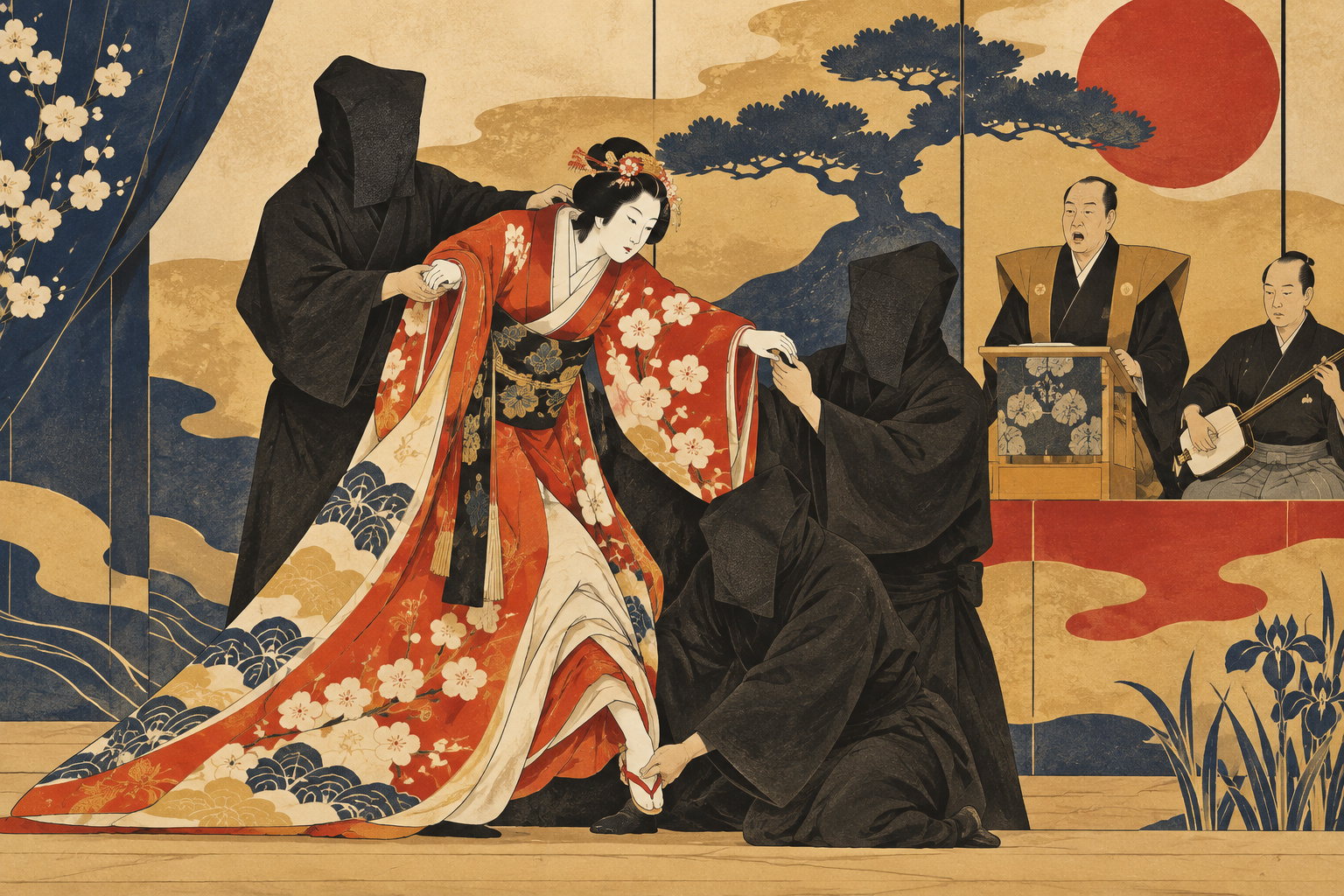
The puppeteers are visible. The voice comes from elsewhere. The music has a performer of its own. Yet a bunraku character can seem to hesitate, plead or grieve as a single being. The attraction is not simply that an object moves convincingly. Separate human efforts become one dramatic intention.
September’s introductory programme at Tokyo’s Koto City Culture Center Hall offers a useful starting point. The Japan Arts Council scheduled its Bunraku Appreciation Class for September 10–20, with September 13 and 20 also billed as introductions for adults.[1] The programme offers a lasting introduction to the art, beyond its scheduled closing date.
An introduction that leads into serious drama
The council’s programme account describes a sequence beginning with Ninin Sanbaso, a celebratory dance associated with wishes for good harvests and peace. A performer-led explanation follows, before scenes from Kanadehon Chushingura centred on the tragedy of Hayano Kanpei.[2]
That structure matters. An introduction does not have to remove difficult emotions from the repertoire. It can give audiences ways to understand who is acting, what they want and how the performance communicates their predicament. A dance introduces the relationship between movement and sound; an explanation makes the division of labour visible; a longer dramatic sequence lets those discoveries become part of watching.
There is no need to absorb every detail immediately. A newcomer can begin with the puppet, shift attention to the voice, then return to the stage with a different sense of what is happening. Bunraku rewards that movement of attention.
The narrator is also the characters
The tayu does more than explain the plot. The narrator voices different characters while also describing surroundings and emotional states. The Japan Arts Council’s Japanese guide distinguishes dialogue, called kotoba, descriptive narration, or jiai, and more songlike passages, or fushi, within the Gidayu-bushi tradition.[3]
A change in voice can therefore alter the listener’s relationship to the scene. The audience may hear a character speak, then receive a perspective beyond that character’s own words. The narrator’s delivery is part of the drama’s action, rather than a commentary laid over a self-sufficient puppet show.
For an English-speaking visitor, language support can help establish the situation. But even before every word is understood, changes in vocal pressure and pace provide something to follow. Listening for those changes does not replace the text; it supplies another route towards it.
The shamisen is a dramatic partner
Gidayu-bushi uses the thick-necked futozao shamisen. Its range includes weighty low sounds, delicate expression and a percussive force as well as melody. The council describes the player as a partner who can support and propel the narrator.[4]
Calling the music “accompaniment” can obscure that relationship if it suggests something merely decorative. Listen for how a musical phrase changes the expectation of the next words. Notice what happens when movement on stage becomes restrained. Sound can sustain an encounter even when very little seems to happen visually.
On a conventional bunraku stage, narrator and shamisen player occupy the yuka, a platform to the audience’s right.[12] Their visibility is part of the experience. The spectator can look between the character and the people producing the character’s audible world.
Three operators, one action
In three-person manipulation, the principal puppeteer, or omozukai, supports the body and controls the head and right hand. The hidarizukai handles the left hand, while the ashizukai supplies the feet’s movement. Silent signals coordinate their work.[5]
The division is easy to describe and difficult to turn into convincing action. A reaching hand, a turning head and a shifting body must seem to belong to the same intention. If each part merely arrived at the correct position, the result would not necessarily feel alive. What matters to the viewer is the relationship between movements.
The puppet is also less like a miniature human body than it may appear. Female puppets usually have no feet: movement of the kimono’s hem creates the impression of walking.[14] The audience supplies what the material object does not contain. Conviction comes from performance, not from anatomical completeness.
Black clothing establishes the convention that operators are not part of the fictional scene, although the principal puppeteer may perform with the face uncovered.[5] Newcomers need not force themselves to ignore the operators. Watching the teamwork can become the route by which attention eventually settles on the character.
A tradition made through change
The form emerged from the meeting of musical storytelling and puppet performance around 1600.[13] In 1684, Takemoto Gidayu opened the Takemoto-za in Osaka’s Dotonbori district. His association with the playwright Chikamatsu Monzaemon helped develop the expressive world of puppet drama.[6]
The three-person system was a later innovation. The Japan Arts Council’s history says it is traditionally associated with a 1734 production of Ashiya Doman Ouchi Kagami at the Takemoto-za. Competition between theatres encouraged changes in puppet mechanisms and dramatic construction.[7]
The name “bunraku” came later still, through the company descended from the enterprise of Uemura Bunrakuken, which adopted the name Bunraku-za in the Meiji period.[8] The history is one of combinations, experimentation and changing institutions. It is not the story of a finished art that appeared all at once.
That distinction helps explain why introductory performances belong within the tradition’s life. Teaching an unfamiliar audience how to watch is another way of sustaining a relationship between performers and spectators. It need not mean simplifying the art until its particular demands disappear.
Access depends on the details
For the September Tokyo programme, the organiser advertised Japanese and English support and a free bilingual programme. Subtitles were available through an app, rather than projected above the stage.[1] That difference affects how a visitor prepares and where their attention goes during the performance.
The provider’s notice states that EG-G subtitles were free, while app-based audio commentary cost ¥500 per device. Both offered Japanese and English. Audio and subtitles could not run simultaneously on one device.[10] These were arrangements for this production, not a promise about every future bunraku performance.
Such practical details are part of welcoming an audience. “English available” is useful only when the visitor knows whether that means spoken explanation, commentary, a printed synopsis or translated text on a screen. Each serves a different purpose.
Knowing the broad story before entering can also reduce the pressure to read continuously. A spectator can then choose moments to consult support and moments to look directly at the stage. There is no single correct balance for every audience member.
Preserving skills means creating a future for them
Bunraku became an Important Intangible Cultural Property in Japan in 1955. Osaka’s National Bunraku Theatre opened in 1984. UNESCO proclaimed the tradition a masterpiece in 2003, followed by inscription on the Representative List of the Intangible Cultural Heritage of Humanity in 2008.[8] Those dates mark recognition, but recognition is not itself a performance.
Skills have to pass between people. The council’s educational account describes both direct apprenticeship and a route through foundational training at the National Bunraku Theatre before further study with practising performers.[11] An introductory class for spectators and the long education of an artist operate on very different timescales, yet both are necessary to the future of a shared theatrical experience.
The council describes appreciation classes as combining explanation, demonstrations and performance.[9] Their value lies in providing a foothold: enough understanding to make the next encounter richer, without pretending that a short explanation exhausts the art.
A first visit may leave one lasting detail—a hand stopping in mid-gesture, a change of voice, a shamisen sound that makes a silence feel charged. The next visit can begin there. Bunraku’s visible ensemble invites the audience to keep asking how these separate efforts become a person before their eyes.