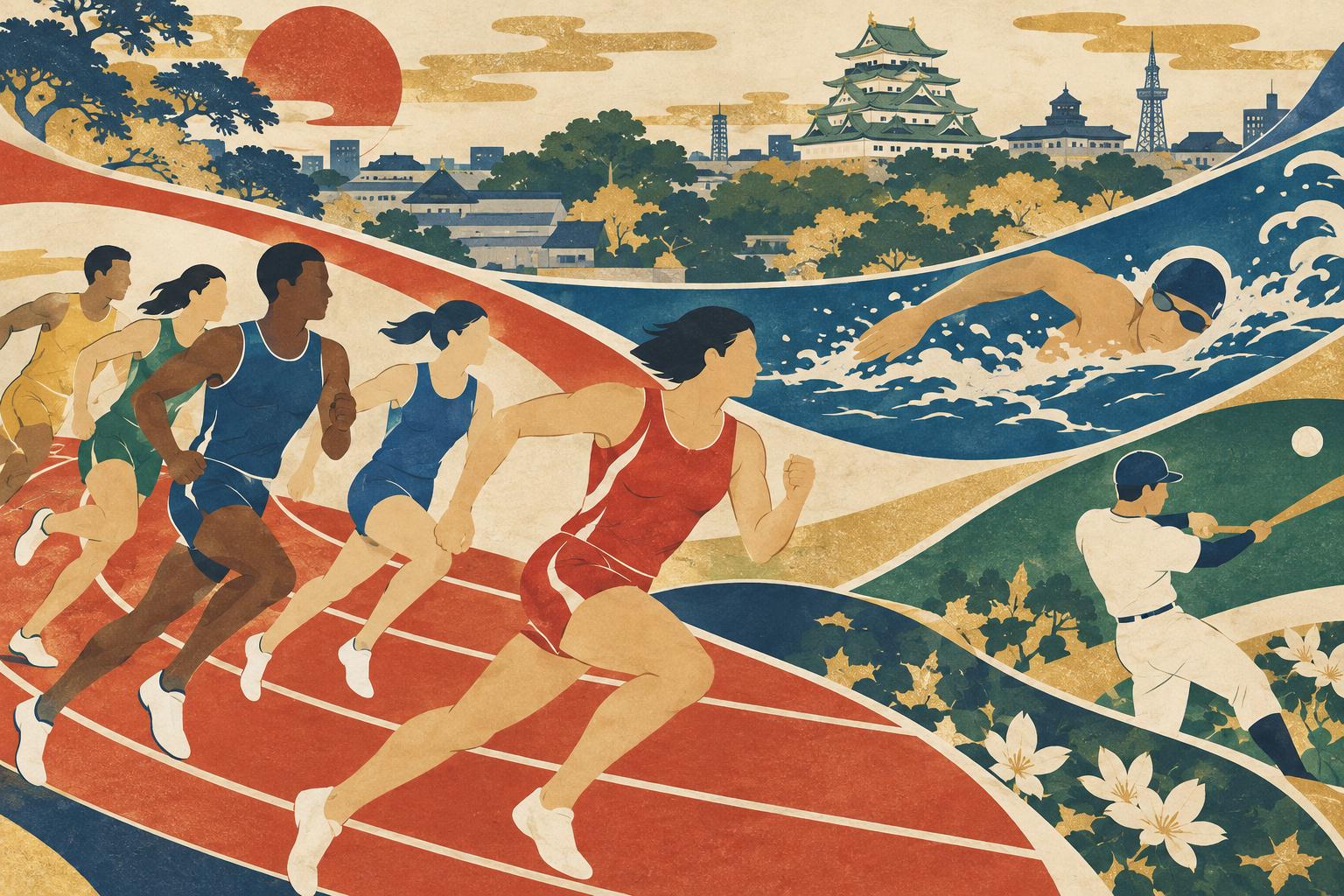
A medal was already assured for Japan before the Asian Games formally opened. Its women’s football team had also won twice, scoring sixteen goals without conceding. The opening weekend in Aichi and Nagoya therefore begins with sporting momentum—and with a separate test of whether the machinery around the competition can keep pace.
The 20th Asian Games run from September 19 to October 4.[1] This report draws on announcements and reporting available through September 19, Japan time. It includes completed pre-ceremony competition, not results from September 20 onward.
The results behind the opening celebrations
Japan’s women defeated Thailand 8–0 on September 14 at Ecopa Stadium in Shizuoka. The Japan Football Association’s account describes a side built largely around WE League players, with five starters making their national-team debuts.[2] It was an emphatic beginning, but also an opportunity to test players in an international tournament.
On September 17, Japan beat Vietnam by the same score at the same venue. Six starters changed; forward Chiina Kamiya scored twice.[3][5] Japan reached six points in Group E and secured a place in the knockout stage. Its remaining group match, against Chinese Taipei, was scheduled for September 21.[3]
| Event / date | Result | Meaning |
|---|---|---|
| Women’s football / Sep 14 | Japan 8–0 Thailand | Opening group win [2] |
| Women’s football / Sep 17 | Japan 8–0 Vietnam | Knockout place secured [3] |
| Men’s basketball / Sep 18 | Japan 97–77 China | Semifinal win [4] |
The basketball result carries a different significance. A Kyodo report published by the Japanese Olympic Committee says Japan’s men beat China 97–77 in their September 18 semifinal, becoming the first Japanese competitors at these Games assured of a medal. The final against South Korea was scheduled for September 20.[4] A guaranteed podium place is a confirmed achievement; the colour of the medal remains outside this report’s cutoff.
These early outcomes also explain why an opening ceremony is not a starting gun for every sport. Tournaments with multiple rounds can be well advanced when delegations enter the stadium. For a reader encountering the Games for the first time this weekend, the important distinction is between the formal opening and the competition already completed.
A host city that extends beyond its stadiums
Reuters reported the Games’ opening ceremony in Nagoya on September 19.[6] Away from the ceremonial stage, the hosts have built other ways for residents and visitors to participate.
The official ONE ASIA WORLD fan zone uses Hisaya-odori Park as a city-centre meeting place. Its programme brings together public viewing, athlete celebrations, food, music and cultural activities.[11] That design addresses a characteristic of this edition: the sporting action is dispersed, while a sense of shared occasion needs somewhere to gather.
Another programme, centred on the south plaza of Mizuho Park, presents traditional industries, technology and cultural experiences.[12] Its relevance is more than decorative. Someone arriving for a match can encounter the host region through an exhibition or activity, while a resident without a competition ticket can have another route into the event.
Those programmes show how the hosts intend to carry the Games into ordinary urban space. Their success will depend on participation, access and the quality of the experience, rather than the number of attractions listed. A public viewing area can turn a distant match into a shared local moment; confusing directions or an inaccessible journey can have the opposite effect.
The practical difficulties behind the welcome
Reuters reported delegation complaints about accommodation and transport during the buildup.[6] In a separate September 19 report, it said the Olympic Council of Asia defended the organisers and said work was underway to address problems.[7] That is the governing body’s response, rather than independent evidence that the difficulties have ended.
For athletes, reliable logistics are part of the conditions of competition. A delayed journey can reduce the time available for preparation or recovery. A bed allocation problem can become a team-management problem. It would be unwarranted to attach an individual result to such difficulties without evidence, but their sporting relevance is clear.
A dispersed event makes the connections between facilities particularly important. A venue may be ready and a room may be available, yet the athlete still needs to travel between them at the right time. The performance of that chain is not captured by the quality of its most visible building.
What the hosts have put in place
Aichi Prefecture’s spectator-access guidance directs visitors primarily towards public transport. It also identifies selected venues with shuttle buses and reservation-based accessible shuttles for people who need mobility support.[8] Separately, the Chubu Regional Development Bureau’s Games traffic-management site publishes priority congestion areas, road information and traffic restrictions.[10]
These are concrete measures to help people move around the event. They should be judged on their own purpose: spectator guidance and traffic management. They do not, by themselves, establish that complaints about athletes’ transport or accommodation have been resolved.
The distinction matters because a Games involves several overlapping travel systems. A spectator may use a railway and a local shuttle, while a delegation depends on dedicated arrangements. Clear information needs to reach each audience without assuming that the same instruction works for everyone.
A weather notice changes the weekend’s travel calculation
Aichi’s published notice concerning Typhoon No. 25 warns that some spectator-access services may be suspended at Tokyo Aquatics Center on September 20–21, and at Equestrian Park and Ecopa Stadium on September 21.[9] The affected services include outside-venue guidance; accessible shuttles are also listed for Equestrian Park and Ecopa.
The document is a warning about possible access-service interruptions, not an announcement cancelling competition. Visitors need to distinguish the status of their event from the status of the journey to it. A match proceeding does not guarantee that every service normally offered around the venue will operate.
For someone relying on an accessible shuttle, that distinction can determine whether attendance is possible at all. Timely, specific notices are therefore part of hosting an inclusive event. The practical step is to check the competition announcement, the prefecture’s access page and the relevant transport operator before departure.
Why this return to Japan has historical weight
The Asian Games began in New Delhi in 1951. The JOC’s historical account places Japan’s participation against its exclusion from the 1948 London Olympics: the new regional competition offered an important route back into international sport.[14]
Japan subsequently hosted in Tokyo in 1958 and Hiroshima in 1994; Aichi-Nagoya is its third edition as host.[13] The 1958 event also gave visiting International Olympic Committee members an opportunity to see Tokyo staging a major competition, before the city won the right to host the 1964 Olympics.[14]
That history gives the Games a significance beyond their medal count. They have been occasions for Japan to rejoin, welcome and demonstrate its capabilities to a wider sporting community. In 2026, the demonstration is distributed across venues, streets, public spaces and the services connecting them.
The hosts’ opportunity is to make the less visible parts work well enough that athletes can concentrate on competition and visitors can concentrate on watching it. Early Japanese victories have supplied anticipation. The next measure of success is whether the welcome can be sustained through an ordinary day: a clear instruction, a dependable journey, a usable service and a contest that begins with everyone ready.