A wholesale purchase of Moon delivery
Tokyo-based ispace has agreed to pay $50 million for 500 kilograms—1,102 pounds—of payload capacity aboard a future SpaceX Starship mission intended to land on the Moon as early as 2030. The arithmetic is striking: $100,000 per kilogram at the wholesale level.
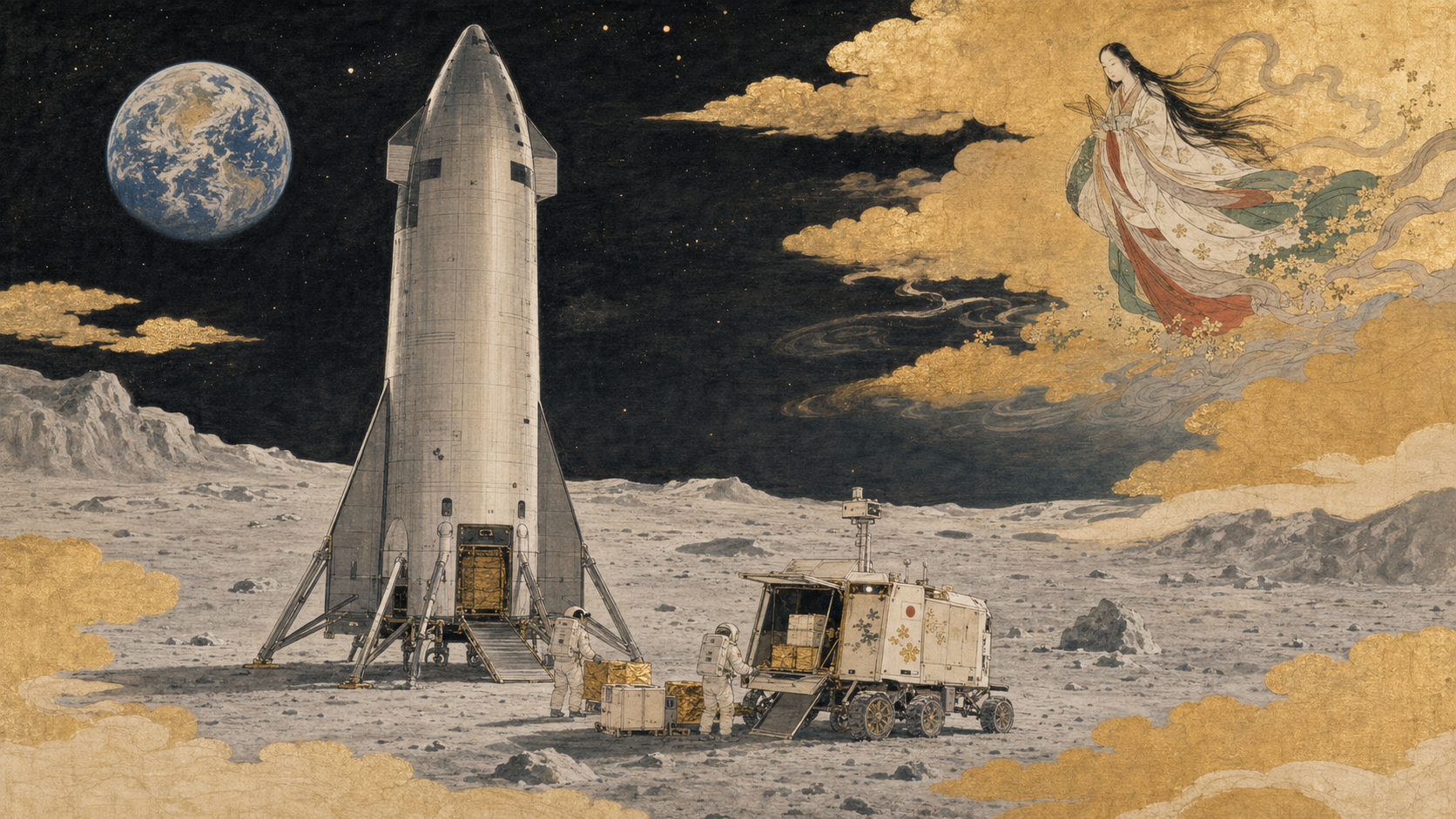
But the purchase is not merely a box on a rocket. Starship is designed to carry cargo all the way to the lunar surface. ispace plans to aggregate payloads from customers, integrate them into the mission and use a new Mobile Cargo System to transport them after landing. Executive Vice President Hideari Kamiya compared the service to a bus, complementing ispace’s smaller dedicated landers—the taxis.
The distinction matters. A launch broker usually arranges passage to orbit. ispace wants to become a lunar access integrator: part freight forwarder, part spacecraft integrator, part surface-delivery operator and, eventually, part infrastructure company.
Bus, taxi and the missing last mile
Dedicated lunar landers offer control. A customer can choose a destination, mission profile and schedule, but pays for most of the vehicle. Shared delivery spreads a large mission’s cost across many customers. The trade is familiar from terrestrial transport: a taxi goes where one passenger requests; a bus is cheaper because riders share capacity and accept a common route.
The Moon adds a complication: a common drop-off point may be kilometres from the place where an instrument is useful. A seismometer needs separation from vibration. A resource prospecting package may need a permanently shadowed region. Communications equipment needs line of sight. ispace’s proposed Mobile Cargo System is the last-mile layer, carrying hosted payloads away from Starship after touchdown.
That rover must survive launch loads, months of transit, lunar dust, radiation, extreme temperature swings and a landscape without roads. It must deploy safely beside an enormous lander and operate without fouling Starship systems. The business proposition therefore depends on much more than reserving mass.
From Google Lunar X Prize to a public lunar company
ispace traces its roots to Team HAKUTO, Japan’s entrant in the Google Lunar X Prize. The competition ended without a winner, but it helped create a generation of private lunar companies. Founder Takeshi Hakamada turned the team into a commercial enterprise built around transportation, data and eventual resource utilization.
The company expanded across Japan, Luxembourg and the United States and listed on the Tokyo Stock Exchange in 2023. Its vision—“Expand our planet. Expand our future.”—rests on a difficult premise: that regular, lower-cost transportation will create demand, and that growing demand will in turn justify more transportation. This is the classic infrastructure chicken-and-egg problem.
Two crashes, two different lessons
HAKUTO-R Mission 1 launched on a SpaceX Falcon 9 in December 2022 and attempted to land in April 2023. The lander ran out of propellant during final descent after its altitude-estimation system became confused by terrain. Contact was lost and the vehicle struck the Moon.
Mission 2, the RESILIENCE lander, launched in January 2025 and attempted touchdown in Mare Frigoris that June. It too made a hard landing. The company attributed the failure to delayed deceleration and insufficient altitude measurement performance during descent. Both missions demonstrated substantial capabilities—launch integration, deep-space navigation, lunar orbit and powered descent—but neither completed the defining commercial service: safe delivery to the surface.
Those failures are essential context, not a reason to dismiss the Starship agreement. Lunar landing remains hard because there is no atmosphere for parachutes, navigation landmarks can be ambiguous, sensor errors propagate quickly and every kilogram of fuel is rationed. The correct question is whether ispace converts flight data into a more reliable architecture and maintains the capital to keep learning.
Starship changes the unit of lunar planning
Most commercial lunar landers are designed around tens or hundreds of kilograms. Starship is conceived on a radically larger scale, with full reusability, orbital refilling and delivery measured in many tonnes. If it performs as intended, engineers could stop treating every gram as precious and begin designing heavier power systems, excavation equipment, communications towers, shelters and mobility platforms.
Large capacity is not automatically cheap capacity. Starship must complete orbital operations, demonstrate propellant transfer, survive extended missions, land safely on an unprepared dusty surface and—depending on the mission—depart again. Its test program has made dramatic progress, but the lunar version remains developmental. A 2030 booking is therefore an option on a future transportation system as much as a conventional freight contract.
| Layer | Provider | Job |
|---|---|---|
| Earth launch and lunar landing | SpaceX Starship | Move the shared cargo from Earth to one lunar landing zone. |
| Aggregation and integration | ispace | Sell portions of capacity, qualify payloads and coordinate interfaces. |
| Surface distribution | ispace Mobile Cargo System | Carry hosted payloads from the lander to useful nearby locations. |
| Payload operation | Customers and partners | Science, prospecting, communications, power or technology demonstration. |
Why $100,000 per kilogram is not the retail price
Dividing $50 million by 500 kilograms yields $100,000 per kilogram. That is a useful benchmark, not a customer quotation. ispace must design and build the rover, reserve volume as well as mass, provide mechanical and electrical interfaces, test payloads, insure or allocate risk, operate the surface vehicle and earn a margin. Some customers may require power, communications, thermal control or placement far from the landing site.
Nor does every kilogram have equal value. A rugged box that stays attached to the rover is easier than a delicate instrument that must be unloaded, levelled, powered and pointed. Mission assurance and schedule priority will affect price. The service may resemble air freight: the base rate is only the beginning.
The CLPS revolution—and its warning
NASA’s Commercial Lunar Payload Services program changed lunar exploration by buying delivery as a service rather than owning each lander. The agency accepts higher risk in exchange for lower prices, faster learning and multiple providers. Firefly Aerospace’s Blue Ghost achieved a successful commercial lunar landing in 2025; other missions failed or landed imperfectly.
CLPS demonstrated both sides of commercial exploration. Competition can produce new vehicles quickly, but fixed-price providers absorb technical and financial shocks that a traditional government program might carry. ispace’s U.S. business is tied to this ecosystem, although Reuters reported in March 2026 that its NASA-sponsored landing was delayed to 2030 as the company restructured after two failures.
The Starship agreement diversifies the architecture. ispace can continue developing dedicated ULTRA landers while also selling capacity on a much larger vehicle. Non-exclusivity is strategically important: the company is not betting that one bus replaces every taxi.
Why Japan cares
Japan’s lunar ambitions extend beyond one company. JAXA landed SLIM in 2024, demonstrating precision landing. Japan is contributing to the U.S.-led Artemis program and developing a pressurized lunar rover with Toyota. JAXA and India’s ISRO are pursuing LUPEX to investigate water and resources near the lunar south pole.
Commercial logistics could connect these national capabilities. Japanese manufacturers might supply sensors, batteries, robotics, construction equipment and communications systems. A domestic company that understands lunar interfaces and operations can become a gateway for firms that do not want to build an entire spacecraft.
There is also geopolitical context. The United States and partners are building an Artemis-centered lunar ecosystem while China advances its own exploration architecture. Reliable commercial delivery is both a market and a strategic capability. ispace’s value to Japan lies not only in landing its own hardware, but in learning how to orchestrate a multinational lunar supply chain.
What could customers send?
Early payloads are likely to be instruments and infrastructure precursors: cameras, radiation monitors, seismometers, navigation beacons, communications relays, regolith experiments, prospecting tools, solar arrays, batteries and small robots. Commercial customers may want brand demonstrations, memorial payloads or technology validation; governments may buy science and reconnaissance of landing zones.
A shared platform works best when payloads use standardized mechanical, power, data and thermal interfaces. Standardization turns a custom expedition into logistics. The history of container shipping is instructive: the container mattered because ports, cranes, ships, trucks and paperwork converged around an interface. Lunar commerce will need its own equivalents.
A market must exist at the other end
Transportation does not create a sustainable lunar economy by itself. Customers need reasons to return. Scientific research is real demand, but much of it is publicly funded. Communications and navigation can serve multiple missions. Resource prospecting may lead to water extraction, yet mining requires power, machinery, legal clarity and buyers. Tourism and settlement remain farther away.
ispace’s wager is that lower unit cost will unlock payloads now trapped in laboratories and business plans. If Starship flies rarely, if customers cannot tolerate its schedule or if the Mobile Cargo System cannot distribute payloads economically, the bus may leave with empty seats. If capacity becomes regular, however, ispace could occupy a valuable layer between a giant transporter and hundreds of specialized users.
How to read the 2030 date
“As early as 2030” is a target, not an appointment. Starship’s development, regulatory approvals, lunar-lander qualification, orbital refilling and the broader Artemis schedule can move. ispace must simultaneously finance and develop its Mobile Cargo System, sell payload slots and recover credibility through future missions.
The agreement is therefore best understood as strategic positioning. For $50 million, ispace has acquired capacity, a relationship and the right to design a business around a scale of lunar transport that does not yet operate. The risk is obvious. So is the logic: if a lunar freight network is coming, the most valuable company may not own the largest vehicle. It may be the company that knows what every passenger needs after the bus arrives.
Sources and further reading
- Reuters, July 8, 2026 — contract value, capacity, business model and ispace schedule.
- Space.com, July 9, 2026 — Starship booking and Mobile Cargo System.
- ispace — company mission architecture and corporate information.
- NASA Commercial Lunar Payload Services — the agency’s commercial lunar-delivery model.
- NASA Artemis — broader lunar exploration architecture.
- SpaceX Starship — vehicle design and intended capabilities.
- JAXA LUPEX — Japan–India lunar polar exploration context.