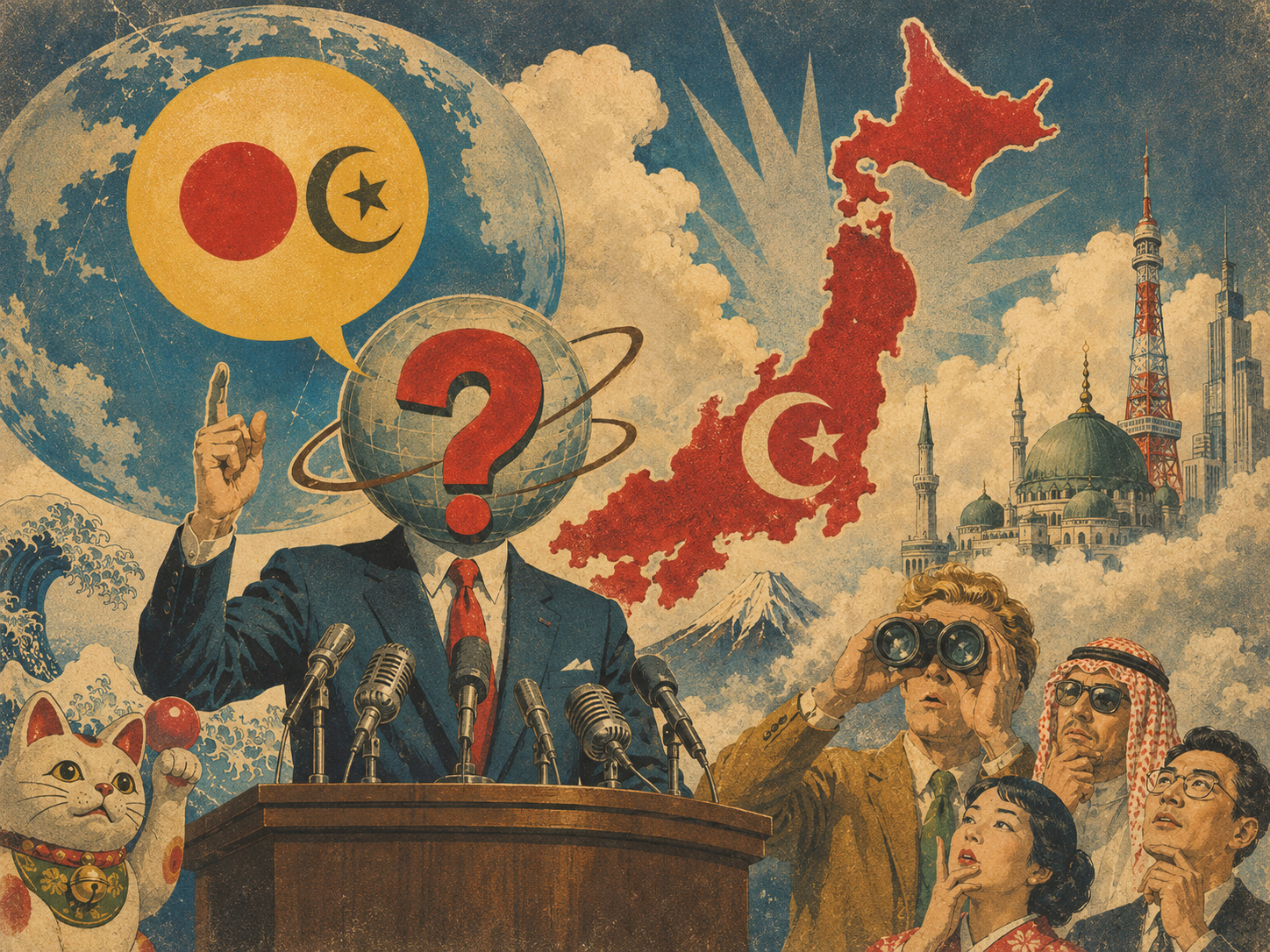
An impossible country appears for several seconds
“The Islamic Republic of Japan.” Four words are enough to construct a country that does not exist: Japan’s emperor, parliament, shrines, Buddhist temples, U.S. alliance and Tokyo skyline fused with the political title created by Iran’s 1979 revolution.
The phrase appeared on July 8, 2026, at the NATO summit in Ankara, Turkey. U.S. President Donald Trump was taking questions beside Ukrainian President Volodymyr Zelenskyy and discussing the defensive value of Patriot missile interceptors.
Trump referred to the aircraft carrier USS Abraham Lincoln and said that “111 missiles” had been fired by “the Islamic Republic of Japan.” The surrounding remarks made clear that he intended to say Iran. He subsequently spoke directly about the destruction of Iranian military power.
During the same appearance, Trump also referred to Zelenskyy, seated beside him, as “President Putin.” Laughter followed and he attempted a correction. Two major proper nouns had been displaced within a short period, turning a single wrong word into a broader story.
Correct the country name—and then check the rest
The sentence contained at least three basic errors. Japan is not an Islamic republic. It is not a republic at all. And it did not fire missiles at an American carrier.
The surrounding claim also cannot simply be accepted after replacing “Japan” with “Iran.” Trump appeared to be referring to an Iranian claim from March 2026 involving USS Abraham Lincoln. U.S. Central Command denied at the time that the carrier had been hit.
The result is important: correcting one noun does not make the full statement accurate. Wartime accounts mix propaganda, operational secrecy, misidentification and incomplete evidence. A precise number can sound authoritative without being verified.
What kind of country is Japan?
Japan’s formal English name is simply Japan; in Japanese, Nihon-koku or Nippon-koku. It is generally classified as a parliamentary constitutional monarchy, not a republic.
The Constitution defines the emperor as “the symbol of the State and of the unity of the People.” Sovereignty resides with the people. The prime minister is designated by the National Diet, and the emperor has no governing authority.
Japan also has no state religion. Article 20 guarantees freedom of religion and bars religious organizations from receiving state privilege or exercising political authority. Shinto and Buddhism remain culturally influential, but neither serves as the constitutional basis of the state.
What does “Islamic Republic” mean?
Iran’s official name is the Islamic Republic of Iran. The monarchy of the Pahlavi dynasty fell in the 1979 revolution, and a referendum established the new order.
“Republic” indicates the rejection of hereditary monarchy. “Islamic” indicates that the legitimacy and legal structure of the state are tied to Islam—specifically the Twelver Shiite tradition dominant in Iran.
Iran contains elected institutions, including a president and parliament, but also powerful religious institutions such as the supreme leader and Guardian Council. It is not merely a republic where most citizens happen to be Muslim; religious jurisprudence is built into the constitutional order.
| Category | Japan | Iran |
|---|---|---|
| Official name | Japan | Islamic Republic of Iran |
| System | Parliamentary democracy and constitutional monarchy | Islamic republic |
| Highest symbolic/political authority | Symbolic emperor; government led by cabinet and Diet | Supreme leader alongside elected institutions |
| Religion and state | Freedom of religion and institutional separation | Shiite Islamic jurisprudence central to state structure |
| Relationship with U.S. | Treaty ally | No diplomatic relations since 1979; adversarial relationship |
| Nuclear posture | Three Non-Nuclear Principles under U.S. extended deterrence | Nuclear program at center of international confrontation |
Japan and Iran do not sound alike
In English, Japan and Iran share little beyond similar length. Their pronunciations and etymologies are unrelated. “Japan” reached European languages through older Chinese-derived names for the archipelago. “Iran” derives from an ancient concept often rendered as the land of the Aryans.
This was therefore not an obvious phonetic substitution. One possibility is lexical interference: the fixed phrase “Islamic Republic of” activated the wrong country name from another heavily used diplomatic context.
Human speech errors can draw not only from similar sounds but from recently used words, emotionally charged topics and names repeatedly handled in public. A single incident, however, cannot establish a medical cause.
Does the slip prove cognitive decline?
Many Japanese online reactions raised age and cognitive ability. Trump was 80, and the confusion between Zelenskyy and Putin during the same exchange intensified concern.
It is not responsible to diagnose dementia from public clips. Fatigue, travel, improvisation, competing conflicts and name interference can produce errors.
But it is also legitimate to demand evidence of fitness from a leader handling nuclear weapons, war, alliances and markets. The appropriate response is not amateur diagnosis; it is transparent health information, immediate correction and institutional fact-checking.
- Review the full video and context, not only a clipped meme.
- Verify the entire claim, not merely the wrong noun.
- Do not diagnose a medical condition from afar.
- Do ask whether the officeholder meets the cognitive and communicative demands of office.
- Keep criticism focused on power and accuracy, not on insulting a religion or ethnicity.
Japan reacted with exhausted humor
Japanese online comments collected by SoraNews24 ranged from “Iran and Japan are completely different” to “red card” and nervous jokes asking the United States not to launch anything at Japan by mistake.
Some commenters suggested that Trump’s old image of Japan as an economic adversary remained in his mind. He has repeatedly invoked Pearl Harbor in discussions with Japanese prime ministers, allowing critics to connect the new slip with a much older mental image of Japan as an attacker.
Selected online remarks are not polling data. Platforms reward the sharpest and funniest comments, so they should not be mistaken for the view of the whole country.
Why “republic” is not a trivial error in Japan
Japan’s postwar constitutional order changed sovereignty from the emperor to the people while retaining the monarchy in symbolic form. Calling Japan a republic erases that compromise and the history of occupation, constitutional reform and democratic reconstruction.
Calling it an Islamic state also collides with the postwar separation of religion and government—a principle shaped partly by the experience of State Shinto before 1945.
One absurd phrase therefore managed to reverse two major outcomes of modern Japanese constitutional history.
Japan and Iran are not unrelated
Politically and geographically, the substitution was absurd. Historically, Japan and Iran have substantial ties.
Persian cultural objects and designs traveled across the Silk Road to ancient Japan, with West Asian influence visible among treasures preserved at Shōsōin.
In 1878, Japanese envoy Enomoto Takeaki met Qajar ruler Naser al-Din Shah in Russia. A Japanese mission led by Yoshida Masaharu visited Persia in 1880. Formal diplomatic relations began in the 1920s, giving the countries nearly a century of modern state relations.
Relations broke during World War II and resumed in 1953. That year also produced the Nisshō Maru incident, when an Idemitsu tanker carried Iranian oil to Japan in defiance of a British-led embargo. The episode remains part of favorable Japanese memory in Iran.
Oil bound the two countries together
Middle Eastern petroleum was crucial to Japan’s postwar growth, and Iran became a major supplier and investment destination.
After the 1979 revolution and the rupture between Washington and Tehran, Japan tried to preserve dialogue with Iran while remaining a U.S. treaty ally. Sanctions reduced crude imports, but Tokyo repeatedly sought diplomatic space between the two adversaries.
Prime Minister Shinzo Abe visited Tehran in 2019 and met Supreme Leader Ali Khamenei. The effort did not produce a dramatic breakthrough, but it demonstrated Japan’s unusual position as an American ally still capable of direct high-level contact with Iran.
In 2026, the distance was no joke
The 2026 Iran war directly affected daily life in Japan. Japan imports more than 85 percent of its energy consumption. In 2025, the Middle East supplied 94 percent of Japanese crude oil imports.
The effective closure of the Strait of Hormuz disrupted tankers, insurance, electricity costs, fuel, aviation, chemical production and food prices. CSIS estimated that about 93 percent of Japan’s oil imports normally passed through the strait.
Japan and Iran do belong in the same sentence—not because they are the same country, but because war around Iran can reshape the Japanese economy.
Why the number “111” spreads so easily
“One hundred and eleven” is a powerful media number. It sounds more observed than “about a hundred.” Precision creates an impression of measurement.
Yet wartime counting is exceptionally difficult. Attackers exaggerate success; defenders minimize damage. Drones, decoys, ballistic missiles, cruise missiles and interceptors can be counted under different definitions. “Launched,” “approached,” “intercepted” and “hit” are not interchangeable.
When a political leader uses an exact number, reporters and agencies should identify the evidence. Authority is not a substitute for sourcing.
Political leaders have always mixed up names
History is full of mistaken country names and leaders’ names. Speeches combine travel fatigue, rapid questions, translation, stress and age.
At the 2024 NATO summit, President Joe Biden introduced Zelenskyy as “President Putin” and immediately corrected himself. The same pair being confused again in Ankara two years later turned the incident into a bipartisan symbol of gerontocratic politics.
Slips do not automatically reveal policy. But partisan audiences often amplify the opponent’s error and excuse their own side’s. Even cognitive-fitness debates become tribal weapons.
Social media turns a slip into an alternate nation
In an earlier media era, the line might have appeared in a newspaper’s political column and disappeared. Now a few seconds become clipped video, subtitles, parody flags, maps, generated images and memes.
“Islamic Republic of Japan” was unusually generative. It combined regime type, religion and country name into a complete fictional world. People could instantly imagine its flag, capital, constitution and foreign policy.
Political satire is legitimate. But the joke becomes discriminatory if Islam itself is treated as the frightening or ridiculous element. The proper target is a powerful speaker who confused two states—and an information environment willing to transmit military claims without adequate verification.
Why correction matters
A correction is not an admission that government is weak. It is the mechanism by which a public authority returns to shared reality.
The White House, reporters and broadcasters should clarify the intended country, whether an attack occurred, the basis for the missile count and the actual interception systems involved. Video cannot be erased; annotation and transparent correction are the available remedies.
For Japan, not every verbal error requires a diplomatic protest. But when an ally’s president linguistically casts Japan as the attacker, officials have reason to ensure that no confusion survives in formal records.
The fictional country reveals real connections
The Islamic Republic of Japan does not exist. Japan is a constitutional monarchy, separates religion and state and is allied with the United States. Iran is an Islamic republic born from the 1979 revolution and remains an American adversary.
Yet the collision unexpectedly placed their real histories side by side: Silk Road exchange, Persian art, the Nisshō Maru, oil, sanctions, Abe’s mediation and the Strait of Hormuz. A calm Japanese morning is connected to war around Iran through ships and energy prices.
The world invented an impossible country for several seconds. After the laughter, a real question remained: Who verifies the language of leaders discussing war? When the country name is wrong, will the public also question the number? Democracy’s minimum defense is the ability to laugh—and then return to the facts.
Sources and further reading
- People, July 8, 2026: setting, wording, context and the disputed USS Abraham Lincoln incident.
- SoraNews24, July 9, 2026: Japanese online reactions and the three factual problems in the phrase.
- Embassy of Japan in Iran, “Iran & Japan: Long History of Friendship”: bilateral diplomacy and cultural ties.
- Japan Ministry of Foreign Affairs, Iran basic data: official name, political system and relations.
- CSIS, March 20, 2026: implications of the Iran war for Japanese energy, shipping and security.
- Constitution of Japan: status of the emperor, freedom of religion and separation of religion and state.
- Encyclopaedia Britannica: the 1979 revolution and establishment of the Islamic Republic.