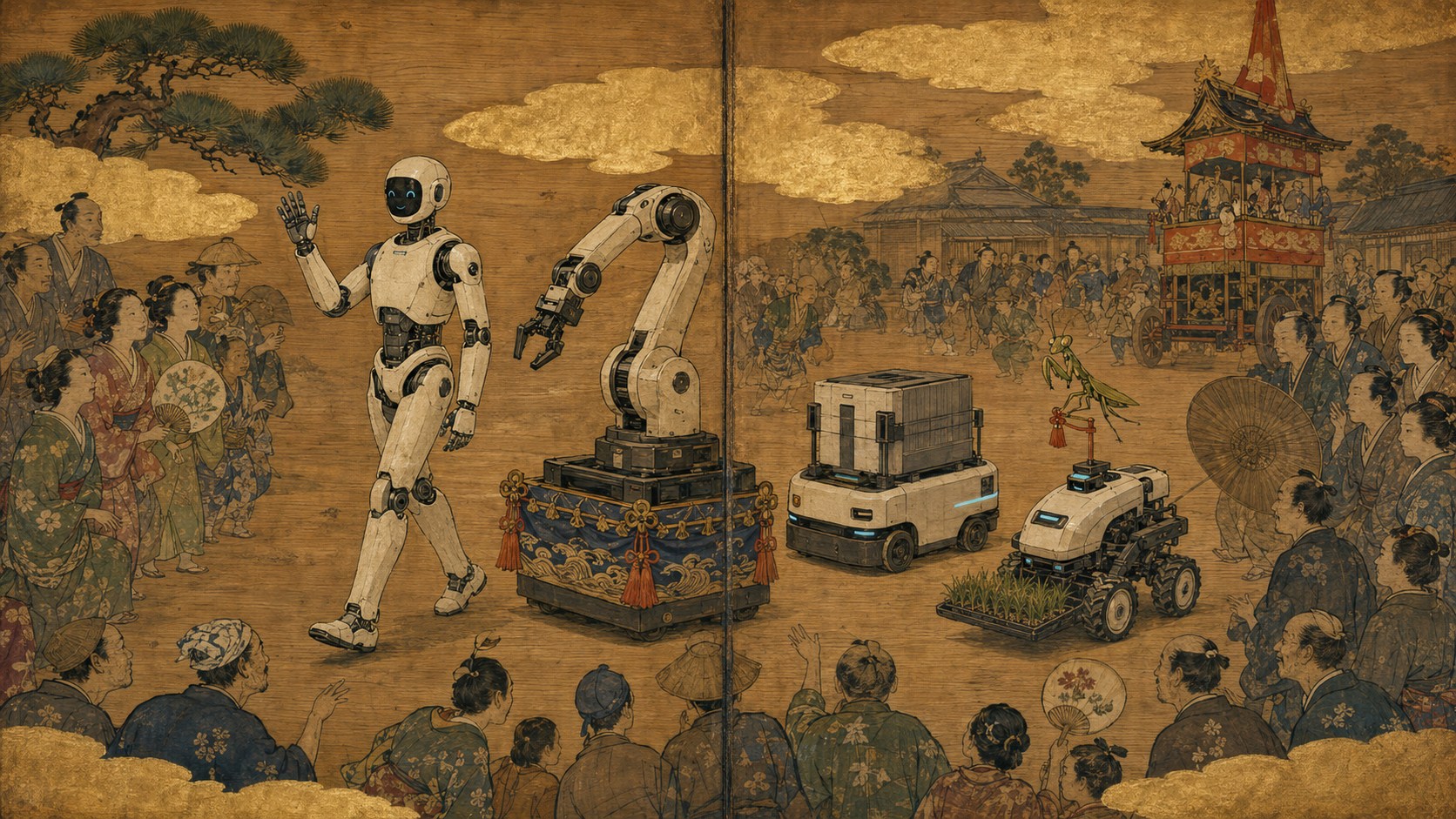
What Opens in Kamata Tomorrow
The event is HuRoC EXPO 2026. HuRoC stands for Human-Robot Commons, a community in which developers, companies, universities, government and local residents test how people and humanoid robots might coexist. The exhibition runs from 10 a.m. to 5 p.m. on Friday, July 17, in the Main Exhibition Hall of Ota City Industrial Plaza PiO. Admission is free with advance registration. The venue is two minutes on foot from Keikyu Kamata Station.
The official idea is to “see, touch and talk.” This is not simply a showroom for finished machines. Humanoid mass production, precision machining, AI, simulation, teleoperation, additive manufacturing, agriculture and social acceptance share one floor. That combination matters: an elegant demonstration does not become a product until robot-body builders meet people who understand the work.
How to Read the Exhibition Floor
The official exhibitor list reveals both spectacular bodies and the less glamorous layers that move robotics into production. Do not judge only top speed or whether a robot walks. Watch the entire loop: identifying an object, approaching it, grasping it, detecting failure, stopping safely and changing to the next task.
| Exhibitor or machine | What is promised | Why it matters |
|---|---|---|
| Sigmaxyz | Unitree R1 humanoid, Go2 quadruped and a Japanese semi-humanoid under development. | Compare not leg shapes but the jobs each body can perform at a defensible cost. |
| KAINA workshop | A dual-arm, five-finger humanoid; camera hand-tracking and VR teleoperation. | Human demonstrations can become training data and enable work at hazardous sites. |
| Yamaha Motor | A seven-axis collaborative robot with 1,300 mm reach and 10 kg payload. | It illustrates the trade between slower human-proximate collaboration and faster separated operation. |
| AMX / Trust Mecha | Farm-industry projects, wildlife deterrence and packaging for irregular leaves, fruit and prepared foods. | Agricultural objects do not arrive with the uniform shape and rigidity of factory parts. |
| Piezo Sonic | Mighty-D4 indoor-outdoor autonomous mobile robot. | For a defined transport job, wheels are often cheaper, steadier and more efficient than legs. |
| FIT / Formlabs; Sumitomo Rubber | Fuse 1+ 30W and Form 4 printers; functional printed rubber for fingers and fall protection. | Rapid parts and fixtures shorten the build-test-rebuild cycle. |
| Tokoshie / Shinkawa Electric | AI CAD turning words or sketches into 3D geometry; Inverse3 force-feedback hardware. | Interfaces connect “thinking AI” to design, touch and real machines. |
ICOMA’s communicative compact mobility called tatamo! and KARURA, a Mars rover project involving 104 students in Japan and the United States, widen the view. HuRoC is better understood as an ecosystem of movement, manipulation, sensing, manufacturing and learning than as a humanoid show.
Physical AI, Explained
A generative language model predicts a useful next token. Physical AI senses the world, chooses an action and changes the world through motors and actuators. Its loop is perception, reasoning and planning, action, observation of the result, and learning. Because it combines images, distance, force, joint angles, sound and temperature, multimodal models are central.
An error on a screen is not equivalent to an error by an 80-kilogram machine. Reality supplies friction, glare, soft objects, cluttered floors, network latency and people who move unpredictably. Developers therefore train in simulated environments and transfer policies to hardware—the process known as sim-to-real. Yet the gap never vanishes. Hardware trials, failure recovery, supervision and emergency stops remain essential.
In June 2026, Japan’s Ministry of Economy, Trade and Industry launched a multimodal foundation-model development program for AI robots and physical AI. The strategic prize is not a model alone. Manufacturing data, sensors, components and the ability to integrate them can become industrial infrastructure.
An Arm in 1969, a Body in 1973
Japan’s robot history has two important streams. The first is the factory arm. Kawasaki Heavy Industries partnered with the American company Unimation and in 1969 produced the Kawasaki-Unimate 2000, Japan’s first domestically made industrial robot. It removed people from hot, smoky and heavy handling. Toyota and Nissan adopted robots for automotive spot welding in 1973. Behind fences, robots repeatedly met identical parts placed in precisely controlled positions.
The second stream is the attempt to reproduce a human body. Waseda University completed WABOT-1 in 1973. Widely regarded as the first full-scale humanoid, it walked on two legs, grasped objects and communicated in simple Japanese. From the 1990s, Honda’s P2, P3 and ASIMO and Japan’s HRP research machines advanced walking, balance and whole-body control.
| Generation | What worked | What remained hard |
|---|---|---|
| 1960s–80s: industrial arms | Fast repetition in welding, painting and transfer. | Fences, fixtures and a highly ordered environment. |
| 1970s–2000s: humanoid research | Walking, balance and whole-body motion. | Cost, battery life and narrowly bounded autonomy. |
| 2010s: cobots and AMRs | Work nearer people and flexible indoor logistics. | Speed-payload limits, integration and application safety. |
| 2020s: foundation models plus bodies | Language instructions, multiple tasks and learning from demonstration. | Reliability, data, explainability, safety and economics. |
Why Humanoids, Again?
Factories and homes are organized around human height, reach, stairs, doors and tools. A humanoid might use that installed world without an expensive redesign. Two arms help hold and assemble simultaneously; dexterous hands can use varied tools; legs cross steps. Motors, reducers, batteries, sensors and mass-production expertise can also draw on the automotive supply chain.
But “human-shaped” does not mean universal. On a flat factory floor, wheels are cheaper, more stable and energy-efficient. A fixed arm is faster at a stationary task. A crop-specific end effector may harvest better than a five-finger hand. A humanoid creates value only when its flexibility across changing, human-designed spaces outweighs its purchase, integration, energy and maintenance costs.
Agriculture Is a Severe Classroom
A field looks open and automatable, but it is less controlled than a factory. There is mud, rain, glare, overlapping leaves, delicate fruit, slopes, seasons and weak connectivity. Every cucumber has a different curve; every tomato has a different ripeness. A harvester that identifies 95 percent may still impose a costly second pass or leave produce to spoil.
Utilization is just as difficult. An expensive machine used only during a short harvest can have a terrible effective hourly cost. Large equipment may not fit Japan’s small and fragmented plots. Shared ownership, contract services and robotics-as-a-service therefore matter. Japan’s agriculture ministry has promoted autonomous tractors, drones, fruit sorting, asparagus harvesters and “Aigamo” paddy-weeding robots, while emphasizing machines suitable for narrow or steep fields and regional sharing.
The demographic pressure is real. Japan’s core agricultural workforce fell from roughly 2.4 million in 2000 to 1.16 million in 2023; the age distribution peaks at 70 and older. At HuRoC, a session on Aomori agriculture is followed by Square Roots Japan on SAGE, an AI copilot for indoor farming. Its careful question is not “When do humans disappear?” It is: after AI improves cultivation decisions, at which points do harvesting and transport robots become economically rational?
Why Ota’s Small Factories Belong Here
Ota is known for having Tokyo’s largest concentration of factories, with specialist firms in cutting, grinding, sheet metal, molds and surface treatment located close together. For a robotics startup, a designer and machinist resolving a problem in person and testing a revision next week can be more valuable than waiting months for a distant supplier.
Physical-AI development does not run at software speed alone. Finger pads slip, enclosures resonate, cables chafe, reducers heat up and sensor windows fog. These are materials and manufacturing problems. 3D printing rapidly produces fixtures and low-volume parts; machine shops refine precision metal components and manufacturability. AI CAD can propose geometry, but it does not automatically guarantee tolerance, fatigue life, assembly or repairability.
The keynote describes a shift from finishing a design before mass production toward a distributed, co-created model of rapid prototyping, testing and improvement. It is also an attempt to redefine Ota’s workshops—from downstream subcontractors to a development network that teaches robot bodies how to survive reality.
Is Japan Still a Robot Superpower?
The International Federation of Robotics recorded 542,000 industrial robots installed worldwide in 2024, with an operating stock of about 4.664 million. Japan remained the second-largest market after China. It installed 44,500 units during the year, and its operational stock rose three percent to 450,500.
“Robot superpower” nevertheless conceals an adoption gap. Automotive and electronics plants excel at controlled automation. Smaller high-mix factories, food processing, construction, care and agriculture confront changing objects and processes. The real price includes not only the robot but grippers, sensors, guarding, system integration, programming, training, maintenance and lost production during failures. HuRoC is trying to bridge that implementation valley.
Translating “Working Together” into Safety Engineering
A collaborative robot is not automatically a safe robot. Risk belongs to the whole application: robot, tool, workpiece, speed, force, worker and layout. ISO 10218-1:2025 addresses industrial robot design; ISO 10218-2:2025 covers integration, commissioning, operation and maintenance. Collaborative applications combine measures such as speed-and-separation monitoring, hand guidance and power-and-force limitation.
Learning systems add new obligations. Operators need model-update control, sensor-data quality, cybersecurity, behavior under lost communications, event logs and a clean handoff to a remote supervisor. A language model’s strange answer may be amusing; an analogous physical action is not. Layered protection means slowing down, stopping at low confidence, asking a person, and physically limiting possible force.
Will Robots Remove Jobs—or Recompose Them?
Automation changes tasks as much as headcount. Moving loads, repetitive packaging, night patrol and pesticide spraying can shift to machines, reducing bodily strain. Integration design, data preparation, teaching, remote assistance, maintenance and safety management expand. The political and managerial question is who receives the productivity gains and the opportunity to acquire new skills.
“Labor shortage” is not a complete implementation plan. Veterans hear abnormal sounds and recognize bad texture before a machine does. Their tacit knowledge must be recorded and transferred. Bringing frontline workers into design early—and maintaining a procedure for continuing when the robot stops—turns coexistence from a slogan into an operating system.
The Numbers to Watch After the Expo
| Measure | What it reveals |
|---|---|
| Tasks completed without intervention | Whether autonomy extends beyond a curated demo. |
| Mean time to recovery | How often and how long a human troubleshooter is required. |
| Good units or harvested produce per hour | Real work output, not motion speed. |
| Uptime and charge or battery-swap time | The useful fraction of a working day. |
| Total cost per task | Robot, integration, maintenance and downtime economics. |
| Incidents, near misses and false stops | Both safety and excessive operational caution. |
| Time from prototype to repeatable production | Whether Ota’s co-creation model works. |
The Future Is Decided Offstage
The most memorable moment at HuRoC may be a biped taking a step. The industrially important sight is the network around it: reducers beneath the joints, non-slip fingers, impact-absorbing rubber, haptic controls, editable CAD, a local shop that can rebuild a part, an operator able to teach the task and a customer able to pay.
Success will not be measured by applause. Six months later, has a farmer’s workload fallen? Can a small factory afford flexible automation? Has dangerous work decreased? Can a failed machine be repaired locally? Japan has spent more than half a century building robot arms and bodies. The next challenge is building a system that keeps them useful amid the untidy variability of the real world.
Sources and Further Reading
- HuRoC EXPO 2026 Official Site — date, venue, registration and purpose.
- Official Exhibitor List — machines and exhibitor descriptions.
- Official Stage Program — physical AI, farming, humanoids and the 2050 panel.
- Human-Robot Commons: About — the co-creation and social-implementation model.
- METI: Multimodal Foundation Models for AI Robots and Physical AI.
- Kawasaki Heavy Industries: Dawn of Japan’s Industrial Robots.
- Waseda University: WABOT-1 and Humanoid History.
- IFR World Robotics 2025 — global and Japanese installations and operating stock.
- MAFF: FY2024 Annual Report on Food, Agriculture and Rural Areas.
- MAFF: Promotion of Smart Agriculture — technologies, services and field examples.
- Ota City: Tokyo’s Manufacturing Concentration.
- ISO 10218-1:2025 and ISO 10218-2:2025 — safety requirements for robots and applications.
- Japan’s AI Guidelines for Business, Version 1.2 — lifecycle governance.