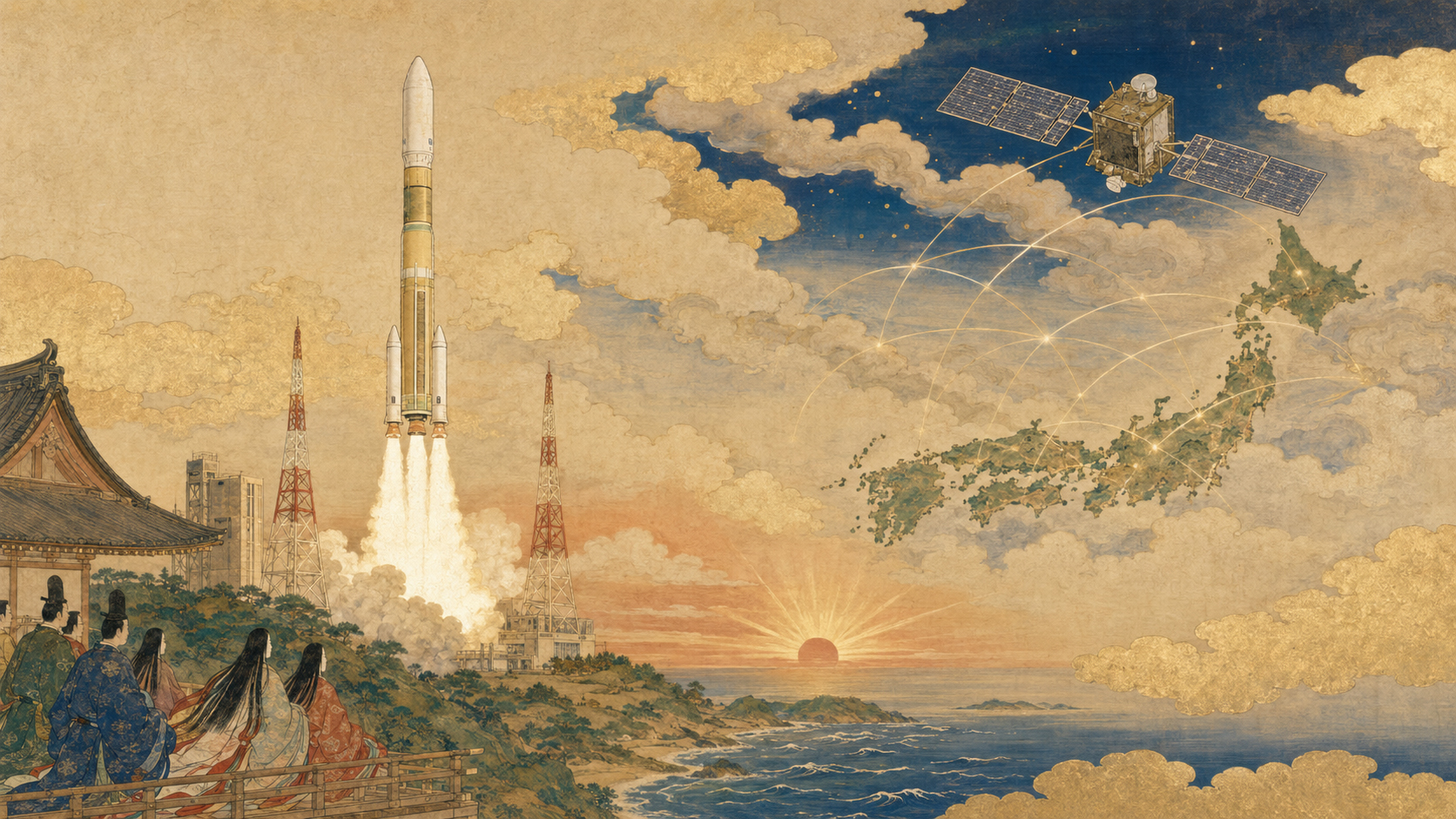
A ten-kilometre encounter in deep space
At approximately 6:30 p.m. Japan time on July 5, Hayabusa2 swept past asteroid (98943) Torifune. JAXA reported that a thermal-infrared image taken seconds before closest approach placed the spacecraft about 10 kilometres from the object. At 6:35 p.m., ground communications confirmed that the veteran probe was operating normally.
The July 6 release included an optical image from ONC-T and a thermal image from TIR, captured at about 18:29:59 and 18:29:58 respectively. Only part of the encounter data had reached Earth when JAXA announced success; additional observations were scheduled for later downlink.
This was the first asteroid exploration of Hayabusa2’s extended mission—and an extraordinary second career for a spacecraft whose original assignment ended when it delivered Ryugu material to Earth in 2020.
Not an arrival—a high-speed flyby
At Ryugu, Hayabusa2 matched the asteroid’s orbit and remained nearby for roughly 18 months. It mapped the surface, released small robots, fired an impactor, descended twice and collected material. Torifune was different. The spacecraft crossed the asteroid’s path and had only a compressed observing window.
A rendezvous cancels relative velocity so a spacecraft can hover in the target’s neighbourhood. A flyby preserves much of that relative speed. It consumes less propellant and can fit a surviving spacecraft’s trajectory, but the target grows from a point to a world and shrinks again within hours. There is no second orbit to repair a missed exposure.
JAXA said the scientific instruments observed until immediately before closest approach but could not observe after passage. Geometry, spacecraft pointing and communications forced the encounter to be planned like a one-take performance.
How a spacecraft finds a dark moving speck
Deep-space navigation begins with radio tracking from Earth, which measures range and velocity. But small asteroids have uncertain positions, and tiny trajectory errors become large miss distances. During approach, Hayabusa2’s telescopic optical navigation camera repeatedly imaged Torifune against background stars.
JAXA began ONC-T scientific observations in mid-June and directly detected the asteroid on June 20. Those images supported optical-radio hybrid navigation: radio data told controllers where the spacecraft was, while pictures refined where the asteroid appeared relative to the predicted path.
The final ion-engine operation for Torifune had ended in June. Later corrections and precise pointing brought the camera’s narrow field onto an object that reflected little light and occupied only a handful of pixels until late in approach.
Four instruments, four kinds of knowledge
| Instrument | What it measures | What scientists can learn |
|---|---|---|
| ONC-T | Visible-light images, 1024 × 1024 pixels | Shape, rotation, brightness, colour and navigation. |
| TIR | Thermal radiation at 8–12 micrometres | Surface temperature, roughness and thermal inertia. |
| NIRS3 | Near-infrared spectra at 1.8–3.2 micrometres | Mineralogy and signatures of water or hydroxyl. |
| LIDAR | Laser time-of-flight distance, 30 m–25 km range | Precise range and support for size and geometry. |
ONC-T makes the recognizable portrait, but a picture alone is not a complete asteroid. Thermal inertia reveals whether a surface behaves more like solid rock or insulating dust. Spectra search for chemical fingerprints. LIDAR supplies distance, turning angular size into physical scale.
Because the instruments observe different wavelengths and footprints, teams must reconstruct when each measurement crossed which part of a rotating body. The science begins after the dramatic image release.
Why Torifune has a name from Japanese myth
Discovered in 2001, the asteroid first carried the provisional designation 2001 CC21 and later the permanent number 98943. JAXA invited the public to propose a name. “Torifune” was selected and approved in 2024.
Ame-no-Torifune—often understood as a heavenly bird-boat or divine vessel—appears in Japanese mythology as a means of celestial travel. The name suits an object encountered by a Japanese explorer already associated with mythic destinations: Hayabusa visited Itokawa; Hayabusa2 went to Ryugu, the undersea dragon palace of the Urashima Taro tale.
A name does not change an orbit, but it changes public memory. “Torifune” turns a catalogue entry into a place, while its number preserves the precision required by astronomy.
The first Hayabusa: a damaged spacecraft that came home
Japan’s asteroid story begins with the original Hayabusa, launched in 2003 to near-Earth asteroid Itokawa. It demonstrated ion propulsion, autonomous proximity operations and sample return, but suffered fuel leaks, failed reaction wheels and communications loss. Engineers improvised ways to control it using remaining hardware and solar-radiation pressure.
Hayabusa returned to Earth in 2010 and burned up above Australia after releasing its capsule. Inside were microscopic grains from Itokawa—the first samples returned from an asteroid. The rescue became a national story and a technical inheritance.
Hayabusa2 was designed not as a repeat, but as a more capable answer to every failure: redundant systems, improved navigation, a better sampler, rovers and an impactor. Torifune now tests how long that improved architecture can continue producing science.
Ryugu: touching a rubble pile twice
Launched on December 3, 2014 aboard H-IIA Flight 26, Hayabusa2 reached carbon-rich asteroid Ryugu in June 2018. Ryugu surprised scientists with a spinning-top shape, boulder-covered surface and extremely low reflectivity.
In February 2019 the spacecraft made its first touchdown and fired a projectile into the surface to collect material. In April it released the Small Carry-on Impactor, creating an artificial crater and exposing less-weathered subsurface material. A second touchdown in July collected from near that site.
The mission also deployed the MINERVA-II rovers and the German-French MASCOT lander. Operating in milligravity required unfamiliar locomotion: hopping was safer than wheels because a wheel could push a rover away from the asteroid.
Five grams that rewrote the early Solar System
Hayabusa2 departed Ryugu in November 2019. On December 6, 2020, its return capsule landed in South Australia while the main spacecraft diverted past Earth and continued into space. JAXA recovered about 5.4 grams of sample—more than 50 times the original 0.1-gram goal.
Laboratories found water-bearing minerals, organic compounds including amino acids and material closely related to primitive carbonaceous meteorites. Because the grains were collected directly and protected from terrestrial contamination, scientists know their geological context far better than for a meteorite found on Earth.
Sample return lets future instruments ask questions not imagined when the spacecraft launched. Most material remains curated rather than consumed, a scientific library from a world 300 million kilometres away.
Why the spacecraft did not come home
Hayabusa2 carried the sample capsule but was never designed to land on Earth. Before capsule entry, the mother craft performed a trajectory correction and passed the planet, retaining functioning ion engines, instruments and communications.
Mission planners examined extended routes constrained by remaining xenon propellant, spacecraft health, thermal limits, communications and planetary encounters. They selected a path to fly by 2001 CC21—now Torifune—in 2026 and rendezvous with 1998 KY26 in 2031.
Extended missions are economical but not free. Aging electronics face radiation. Reaction wheels, heaters and transmitters accumulate operating time. Teams and ground antennas must be funded. Yet a proven spacecraft already beyond Earth can obtain unique science for a fraction of building and launching another probe.
Torifune as rehearsal and science target
The flyby has scientific value in its own right: shape, rotation, thermal behaviour and composition help researchers compare near-Earth asteroids. But it also exercises high-speed optical navigation, instrument sequencing and autonomous operation needed for later encounters.
Unlike Ryugu, Torifune could not be extensively surveyed before close approach. The team had to design commands around uncertain properties. If the object rotated rapidly or presented an unexpected shape, exposure and pointing plans still had to produce usable data.
Planetary defence benefits indirectly. The more scientists understand the diversity of small asteroids—their density, cohesion, surface and spin—the better they can interpret telescopic observations of objects that may someday pass close to Earth.
The stranger destination: 1998 KY26
Hayabusa2’s final planned target is the tiny near-Earth asteroid 1998 KY26, with arrival planned for 2031. Estimates place it at only a few tens of metres across, and observations indicate a rotation period of roughly 10 minutes—far faster than Ryugu.
Rapid spin challenges the familiar “rubble pile” picture. A loosely bound aggregate might shed material unless cohesion helps hold it together. Rendezvousing with such a small, fast object will test navigation and operations at a scale relevant to the numerous asteroids too small for detailed study from Earth.
Torifune was a fleeting pass. KY26 is intended as a sustained encounter. The two targets turn the extended mission into a progression rather than an encore.
A camera repurposed as an observatory
Hayabusa2’s Optical Navigation Camera was built to guide the spacecraft around asteroids. During cruise, the team has also used it for astronomy, including observations of zodiacal light and exoplanet transits. In 2026, JAXA highlighted a space-based exoplanet detection using the unusually small aperture.
This is a lesson in mission design. Instruments are built for requirements, but skilled teams can discover new observing modes after launch. Calibration knowledge accumulated at Ryugu made the old camera more valuable, not less.
Japan’s particular genius: return, reuse, continue
Many planetary missions end when a lander falls silent or a spacecraft reaches its target. The Hayabusa program emphasizes closed loops: go to a small world, touch it, bring material home, preserve the spacecraft when possible and use the experience to reach farther.
The engineering culture is visible in the narrative from Hayabusa’s rescue to Hayabusa2’s redundancy and extended mission. Failure is not romanticized; it is converted into design changes, operating procedures and institutional memory.
Torifune’s first close images are modest compared with Ryugu’s global maps. Their significance lies elsewhere. A spacecraft launched in 2014, after completing one of the most complex sample-return missions ever attempted, still found a dark moving world ten kilometres away and looked at it with four instruments.
What scientists will do next
JAXA cautioned that only part of the data had been downlinked with the initial release. Teams will calibrate the images, reconstruct exact spacecraft and asteroid geometry, derive the body’s shape and spin, map temperature and compare spectral measurements with meteorites and other asteroids.
Independent groups will test models and publish peer-reviewed results. The public image is the beginning, not the conclusion. Meanwhile, navigators will use the encounter’s performance to refine the long road to KY26.
Hayabusa2 has already delivered a world to Earth in a capsule. At Torifune, it delivered something different: a few pixels becoming a place, and proof that Japan’s asteroid explorer still has another world ahead.
Sources and further reading
- JAXA, July 6, 2026 — flyby time, images, distance and instruments.
- JAXA Hayabusa2 mission — Ryugu operations, samples and extended mission.
- Hayabusa2 Project: Naming Torifune — naming history.
- Hayabusa2 Extended Mission — operations and mission archive.
- NASA OSIRIS-REx — comparative asteroid sample-return science.