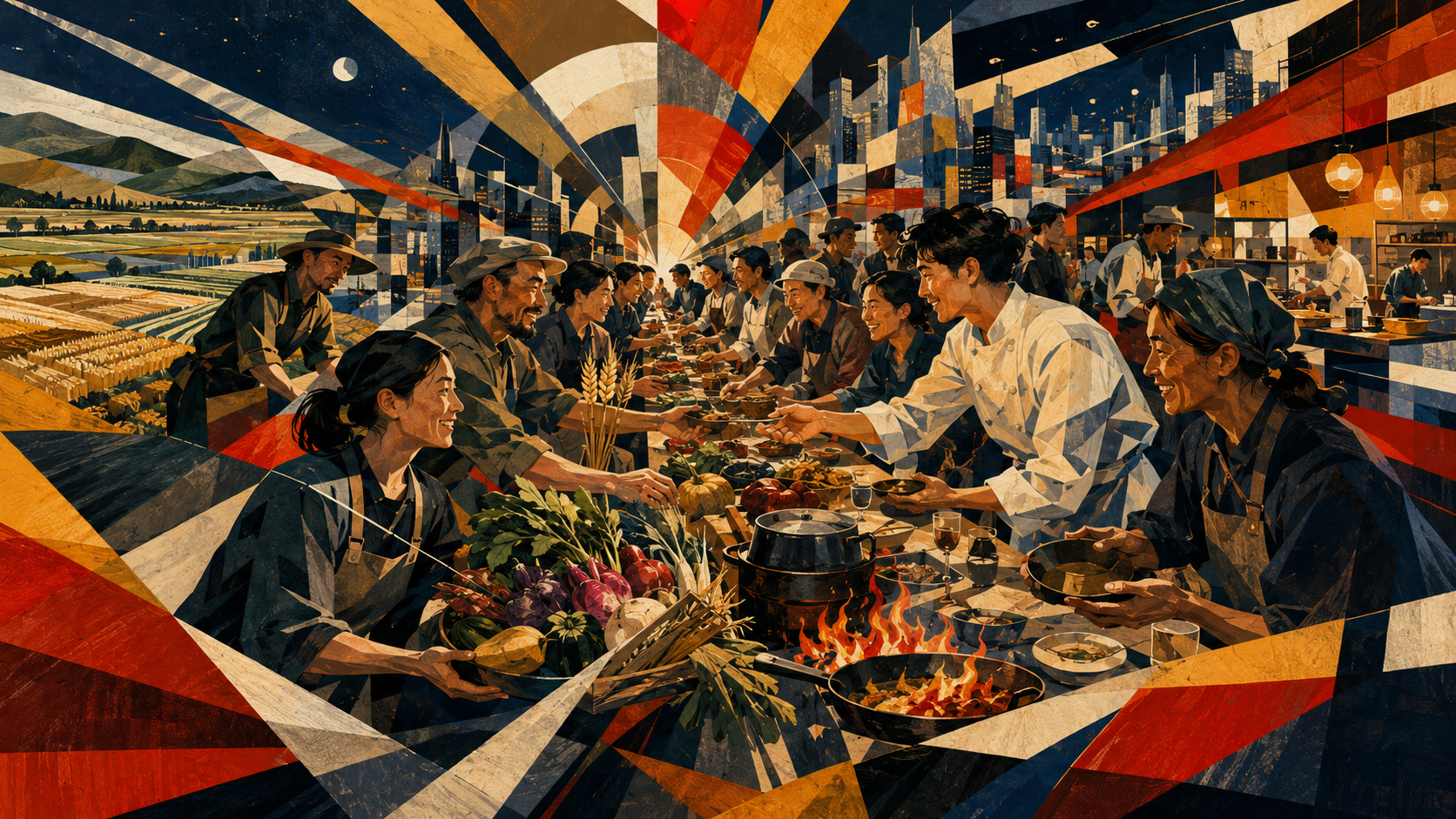
A night meeting, not merely a night market
Harayoru is best understood as connective infrastructure. Its announced premise links farmers, chefs and creators after dark, when a shared table can replace the segmented routines of field, kitchen and studio. Publicly indexed information does not yet establish a final organizer, venue, timetable or participant roster; those practical details should be confirmed through the project’s own announcement before attending.
That distinction matters. A market primarily moves goods. A dinner serves guests. A networking event exchanges contacts. Harayoru’s promise is to make all three activities reinforce one another: ingredients become dishes, dishes become stories, stories become relationships, and relationships ideally become recurring orders or new public projects.
Project school: what each participant brings
| Participant | Knowledge contributed | What the others can return |
|---|---|---|
| Farmer or fisher | Season, soil, weather, varieties, harvest timing, loss and cost. | Stable demand, usable feedback, recognition and a fair price. |
| Chef or food maker | Flavor, preservation, menu design, service, safety and customer behavior. | Distinct ingredients, provenance and direct production knowledge. |
| Designer, artist, writer or maker | Naming, images, space, packaging, documentation and public interpretation. | Real materials, social purpose and paid commissions. |
| Resident or eater | Memory, preference, household constraints and civic legitimacy. | Access, literacy and a voice in the local food system. |
“Creator” must not become a decorative job title. Design can clarify seasonality, reduce confusing labels, document methods, make a gathering accessible or turn waste material into useful objects. It can also obscure labor with a beautiful brand. The ethical test is whether creative work reveals value and distributes it, not merely whether it raises attention.
One municipality from mountains to ocean
Modern Hamamatsu covers about 1,558 square kilometers. The 2005 municipal merger joined the old industrial and commercial city with Hamakita, Tenryu and communities around Lake Hamana and the northern mountains; it became a government-designated city in 2007. Since 2024, its administration has been organized into three wards: Chuo, Hamana and Tenryu.
The map explains the richness of its table. The Tenryu mountains supply forest and upland landscapes. The Mikatahara plateau supports field agriculture. Mikkabi is identified with citrus. Lake Hamana’s brackish water supports fisheries and aquaculture, while the Enshu coast opens to the Pacific. Urban restaurants, factories and neighborhoods sit within the same municipal border as orchards, tea fields and remote settlements.
Yet a common city hall does not automatically create a common economy. Distance, aging, weak transport and different working hours keep producers and urban consumers apart. Harayoru treats the municipal map as unfinished social work: people must still be introduced across it.
| Landscape | Food-world association | Connection problem |
|---|---|---|
| Tenryu uplands | Tea, shiitake, game, forest products and small settlements. | Distance, labor shortages and costly collection. |
| Mikatahara plateau | Potatoes and diverse field crops. | Weather risk, grading standards and volatile prices. |
| Mikkabi and Lake Hamana | Mandarins, eel, oysters, seaweed and lagoon fisheries. | Ecology, seasonality, stock pressure and tourism branding. |
| Central Hamamatsu | Restaurants, retail, manufacturing workers and cultural venues. | Translating demand into durable rural income. |
Before “farm to table”: road, post town and market
Hamamatsu was a castle town and a station on the Tokaido, the early-modern highway connecting Edo and Kyoto. Nearby Maisaka was the eastern departure for crossing the water toward Arai. Travelers needed rice, tea, preserved foods, lodging, animals and porters. Food moved because roads, inns, rules and human labor made movement possible.
This history corrects a modern myth. Local food was never purely isolated or self-sufficient. Farmers grew for households and markets; fishers sold through intermediaries; merchants assembled volume; cooks adapted ingredients for travelers. “Local” has always depended on networks.
Harayoru shortens one part of that chain by creating direct knowledge, but intermediaries are not automatically enemies. Wholesalers, cooperatives and distributors aggregate small lots, carry credit, maintain cold chains and deliver when chefs are busy. The goal is not the shortest possible chain. It is a chain whose work, price and risk are visible.
Hamamatsu after dark has a long memory
Nighttime gathering is not a lifestyle idea imported from a global “night economy.” Hamamatsu’s civic traditions already use darkness as a social medium. During Hamamatsu Festival, ornate palace-style floats move through downtown at night while neighborhood groups carry lanterns and make music. Enshu Dainenbutsu processions use lanterns, drums, flutes and cymbals in memorial observance. The Akiha fire tradition turns flame into ritual, danger and protection.
On Lake Hamana, takiya fishing is practiced after dark with lamps that reveal fish and crabs in shallow water. Night changes what can be seen and how people cooperate. It concentrates attention, marks a temporary community and gives ordinary space a ceremonial quality.
Harayoru belongs to this longer grammar without claiming to be the same thing. Its light is not sacred and its table is not a festival float. The historical continuity is functional: after daylight labor ends, illumination creates another kind of public time.
The scheduling paradox
Farmers often begin before sunrise. Chefs work through lunch and dinner. Designers may have irregular project hours. An “after dark” meeting sounds inclusive because it sits outside the standard office day, but it may be hardest for precisely the people it wants to connect.
Good social design therefore needs more than a poetic hour. Meetings can rotate between early evening and daytime field visits; farmers can be compensated for time and travel; children can be welcomed; outcomes can be documented for those absent; small-group introductions can occur before a loud public program. Accessibility includes schedules.
The night also changes transport and safety. Rural buses may stop early, alcohol complicates driving, and poorly lit routes can exclude older participants or women traveling alone. A successful food event publishes the last-train and last-bus reality, arranges sober mobility and does not assume every participant lives near Hamamatsu Station.
From ingredient to relationship: the value chain lesson
Consider an irregular potato that a standard buyer rejects. A farmer knows it is sound but cannot recover the full cost. A chef may turn it into soup, croquette or fermented base. A designer can explain why shape differs, create a returnable container or document the field. The group has not “rescued waste” until the farmer is paid and the process is repeatable.
One-off collaboration is easy to photograph. Repeat purchasing is harder. Restaurants need reliable quantities and delivery times; farms face weather and biological variation. A durable agreement specifies a price range, acceptable variation, forecast window, cancellation rule, transport responsibility and what happens to surplus.
| Stage | Weak version | Durable version |
|---|---|---|
| Introduction | Business cards and praise. | A named problem and a next meeting. |
| Prototype | One photogenic special dish. | Costed recipe using realistic supply. |
| Story | “Made with love” and pastoral imagery. | Variety, place, method, labor and uncertainty explained. |
| Transaction | Free samples or exposure. | Written price, volume, payment and cancellation terms. |
| Legacy | Social-media impressions. | Repeat orders, new income and shared records. |
The chef as translator
A chef translates biological time into menu time. The field produces abundance unevenly; a restaurant promises consistency every service. Cooking techniques—drying, pickling, fermenting, freezing, stock-making and whole-crop menu design—mediate between those clocks.
The translation also runs toward the farm. Chefs can report what guests understand, which sizes work, how flavor changes through a harvest and which by-products have culinary use. But feedback becomes extraction if the chef demands custom production without sharing risk. Trial crops, special harvests and menu exclusivity should carry commitments.
Local cuisine is not simply a list of famous dishes. Hamamatsu gyoza, Lake Hamana eel, Mikkabi mandarins and Mikatahara potatoes are entry points into systems of migration, marketing, aquaculture, land and household work. A thoughtful menu teaches those systems without turning every plate into a lecture.
The creator as translator—and possible gatekeeper
Hamamatsu knows creative engineering. Textile machinery helped generate skills and firms that moved into musical instruments, motorcycles and automobiles. The local expression yaramaika—roughly, “shall we give it a try?”—is often used to describe this experimental civic identity.
Food collaboration can borrow the prototype habit: test a recipe, package, route or event at small scale; measure; revise. It should not pretend that a crop behaves like a manufactured component. Soil is variable, weather cannot be debugged and living systems do not owe a designer consistency.
Creators also control representation. Who is named on a menu? Whose face appears in publicity? Is a Brazilian, Filipino or other migrant food tradition treated as part of Hamamatsu or as an exotic guest? The person who frames the story can redistribute dignity—or centralize attention.
A multicultural table must be designed, not assumed
Hamamatsu’s manufacturing economy drew workers from overseas, especially a large Brazilian community shaped by Japan’s post-1990 migration regime. Portuguese-language institutions, shops, churches, schools and food businesses became part of the city. Other communities widened that landscape further.
Food can make encounter easier, but eating together does not erase unequal language, wages or status. Inclusion requires translated invitations, interpretation, allergy and religious-diet information, varied price points and paid roles for people whose cultural knowledge is used. “Community” should describe power shared, not merely diverse faces in a photograph.
A strong Harayoru network would treat migrant grocers, cooks, farmers, factory workers and young bilingual residents as co-authors. Hamamatsu’s local food is whatever its residents have made local through repeated life.
The economics of conviviality
A warm atmosphere is economically useful: trust lowers the cost of finding partners and makes candid knowledge possible. Yet conviviality can hide unpaid work. Farmers bring samples, chefs cook, designers make signs, organizers clean and participants post promotion. If everyone contributes “for community,” those with the least spare time subsidize the event.
Budgets teach values. Pay ingredients at a real price. Distinguish volunteer hospitality from professional labor. Publish who covers venue, insurance, transport and waste. If sponsorship is present, explain what the sponsor receives. A community project becomes credible when generosity is voluntary rather than structurally required.
Climate, ecology and the dangerous romance of abundance
Western Shizuoka agriculture faces hotter summers, intense rain, typhoons, changing pests and rising input costs. Mountain settlements face depopulation and abandoned land. Lake Hamana’s food economy depends on the health of a brackish ecosystem. Japanese eel is a threatened species whose aquaculture still depends largely on wild-caught glass eels.
Local sourcing does not automatically mean sustainable. A nearby greenhouse may use considerable energy; a distant consolidated delivery may emit less than many small car trips. Small farms can protect variety and landscape, but they also need income and labor. Sustainability must be measured crop by crop and route by route.
Creators can help make limits desirable: menus that change with supply, smaller portions of scarce foods, preservation of seasonal peaks and visible substitutions. The most honest local cuisine does not promise everything all year.
Third place—or temporary stage?
Sociologists use “third place” for informal social settings outside home and work where repeated, low-pressure encounters build familiarity. A single special event is not yet a third place. Regularity, affordability and the ability to attend without insider status matter more than decoration.
Harayoru can become an itinerant third place if it rotates among farms, kitchens, vacant shops, community halls and studios while maintaining a recognizable welcome. Rotation distributes travel and visibility. Continuity—a shared calendar, contact steward, small fund and public archive—keeps each night from starting at zero.
How to attend as a learner
| Before | At the table | After |
|---|---|---|
| Confirm the official venue, time, booking and access details. | Ask a producer what uncertainty costs most. | Buy again when the special event is over. |
| Learn which foods are actually in season. | Ask who set the price and who performed unpaid work. | Share the maker’s own link and correct name. |
| Bring a specific skill or problem, not “networking” alone. | Listen before proposing a brand or product. | Record one action, owner and date. |
| Check language, allergy, mobility and transport needs. | Welcome someone outside your professional circle. | Report barriers privately and constructively. |
What success should look like one year later
Count repeat orders, not only visitors. Track whether producers gained net income after delivery and preparation costs. Ask whether chefs diversified suppliers, whether creators received paid commissions and whether collaborations survived a failed crop or staff change. Record the share of first-time participants who returned.
Public outcomes matter too: multilingual participation, accessible venues, reduced waste, safe transport and learning materials that schools or residents can reuse. Publish failures. A canceled dish, impossible delivery route or poorly timed meeting is valuable evidence if the next design changes.
Harayoru should resist becoming a private circle of the already connected. Open invitations, rotating hosts, transparent selection and a small number of reserved newcomer places preserve permeability.
The historical meaning: night as regional infrastructure
Hamamatsu has repeatedly turned connection into productive capacity. The Tokaido linked castle town, traveler and market. Textile machinery generated techniques that migrated into instruments and vehicles. The 2005 merger placed mountains, plateau, lagoon and city center inside one political boundary. None of those connections guaranteed equality, but each changed what could be made.
Harayoru proposes a modest version of the same historical act. It reorganizes time so people separated by occupation can see one another’s constraints. Darkness is not absence; it is a second civic shift, long familiar in lantern processions, festival streets and Lake Hamana fishing.
The meal matters because it makes a system tangible. A diner can taste soil, craft, transport, heat, language and design at once. But the project’s lasting meaning will be found off the plate: in a farmer who can plan against a real order, a chef who shares risk, a creator who makes labor visible, and a resident who understands that “local” is something people continually build together.
One evening can introduce a region to itself. Only repetition, fair payment and shared memory can turn that introduction into community.
Sources and further reading
- Hamamatsu City agriculture portal — municipal farming policy, producers and agricultural information.
- Hamamatsu City profile — geography, administration and city overview.
- Hamamatsu City: history of the 2005 merger — formation of the present mountain-to-sea municipality.
- Hamamatsu City History Museum — archaeology, Tokaido, castle town and regional life.
- Hamamatsu and Lake Hamana Tourism Bureau — regional food, landscapes and cultural traditions.
- Hamamatsu Festival official guide — daytime kite battles, nighttime floats and neighborhood participation.
- Lake Hamana Takiya Fishing — nighttime fishing practice and visitor program.
- Ministry of Agriculture: 2020 Census of Agriculture and Forestry — farm structure, labor and land context.
- Ministry of Agriculture: rural innovation — value-added rural business and cross-sector collaboration policy.
- Ministry of Agriculture: food-culture portal — regional cuisine, preservation and transmission.
- Ministry of the Environment: Japanese Red List — conservation context for Japanese eel and other species.
- Hamamatsu City international and multicultural affairs — multilingual services and intercultural community policy.