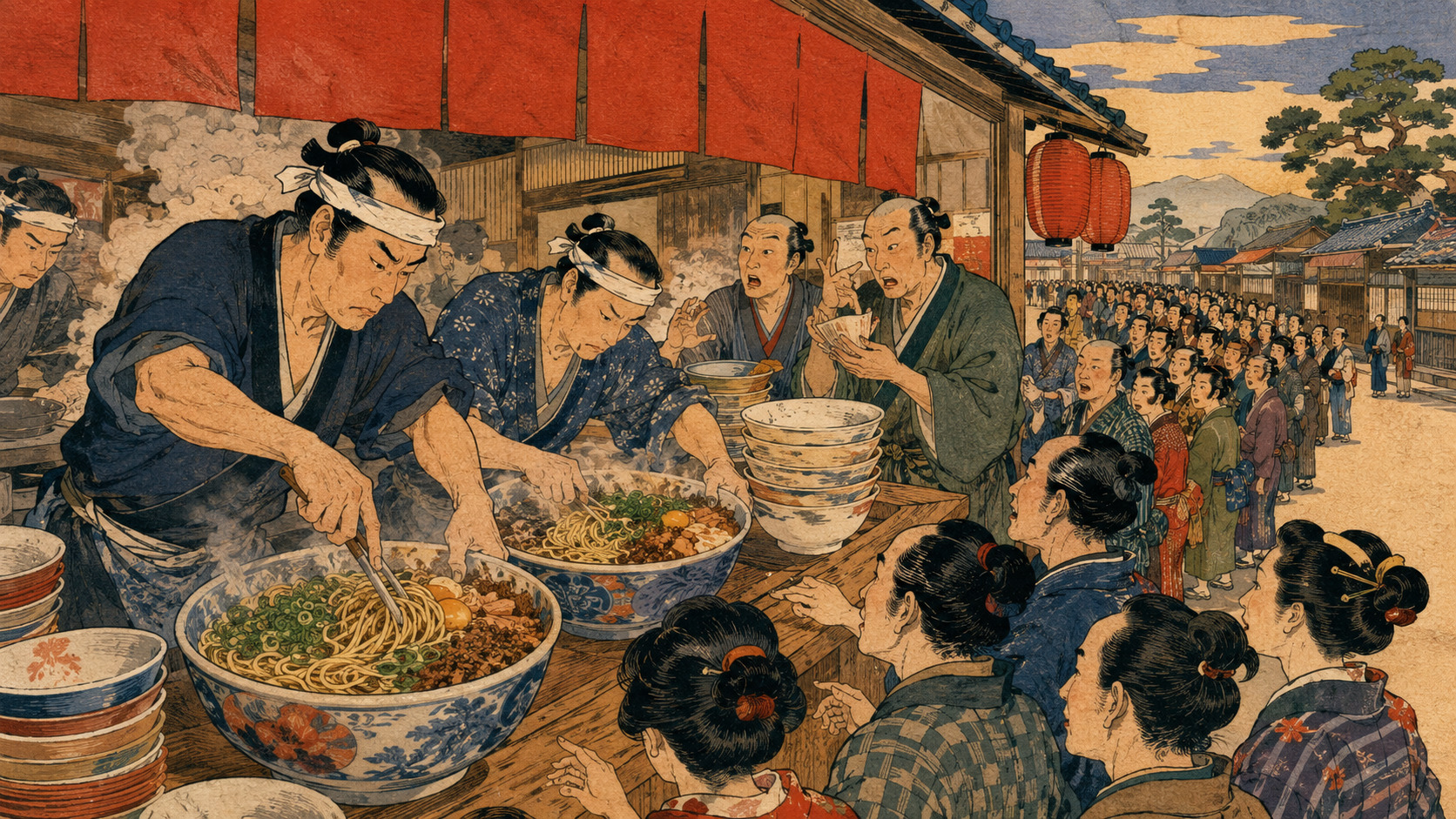
The dish costs ¥900, or ¥1,000 with a small serving of rice for the remaining sauce. It combines a house aromatic oil concentrating seafood and vegetable flavors, 200 grams of chewy medium-thick noodles, menma, nori, scallions, chopped onion and chashu. The customer mixes from the bottom; rice turns the last coating of sauce into a second course.
Born abroad, retested in Japan
Operator WIN'S Japan Holdings says the dish originated at its Phrom Phong branch in Bangkok in 2024 and became a daily sellout. Moving it to a Kurashiki mall food court is not a simple homecoming. The customer mix changes from an overseas urban district to Japanese families, students, older shoppers and mall visitors. So does the eating occasion.
Kouchan Ramen, produced by Hakata Ikkousha, reported 21 domestic and two overseas branches in July 2026; its parent group claims more than 90 restaurants across ten countries. That network makes national distribution imaginable, not automatically profitable. The new dish uses a medium-thick 200-gram noodle instead of the brand's signature thin Hakata noodle, creating supply and kitchen questions at every branch.
The longer history of noodles without broth
Modern Japanese brothless ramen is commonly traced to abura soba in the Tokyo suburbs during the 1950s. Competing origin accounts point to Sankou near Hitotsubashi University in Kunitachi and Chinchintei near Asia University in Musashino. Cheap, filling and noodle-heavy, the style found a natural audience in student districts and spread more widely through specialist shops and franchises in the 1990s.
Mazesoba began partly as another name for abura soba. Around 2008, Nagoya's Taiwan mazesoba gave the term a more distinct identity: spicy minced meat, chives, scallions, fish powder and egg mixed vigorously, often followed by rice. Despite the name, it is not a direct import from Taiwan; it is a Japanese regional dish descended from Nagoya's “Taiwan ramen” culture.
Remove the soup, redesign the product
Conventional ramen suspends noodles in a large volume combining stock, seasoning tare and fat. Mazesoba concentrates tare and aromatic oil at the bottom; the diner distributes and emulsifies them across noodles and toppings. Thick noodles contribute chew and enough surface to carry the intense coating. Onion supplies bite and water, nori aroma, menma texture and chashu fat and savoriness.
Using less soup can reduce dependence on a stock simmered for hours, but brothless does not necessarily mean cheap. Dedicated noodles, several garnishes, aromatic oil, assembly labor and unsold inventory all cost money. A 200-gram portion makes ¥900 feel substantial, while potentially diverting orders from the core tonkotsu menu.
A limited menu is a small laboratory
| Question | Useful measure | What a sellout hides |
|---|---|---|
| Demand | Hourly units and order share | Whether supply was set too low |
| Repeat use | Second purchases and rice attachment | Launch curiosity versus habit |
| Economics | Food cost, labor minutes, waste, ticket | Whether revenue produced profit |
| Operations | Service time, errors, peak throughput | Whether other kitchens can reproduce it |
| Brand | New-customer mix and core-fan reaction | Whether it strengthens “Hakata ramen” |
A limited run caps the cost of failure, uses scarcity to create a reason to visit, and produces revealed preference: what people buy rather than what they tell a survey they might buy. Kurashiki can therefore supply more valuable evidence than online enthusiasm alone.
Why test in Kurashiki?
A mall food court is not a destination reserved for ramen enthusiasts. Families can split up and order different cuisines; shoppers compare price, speed and appearance at a glance. It is a demanding but informative setting for testing broad appeal. A summer launch also tests the proposition that a diner may prefer noodles without a bowl of hot broth.
One branch cannot separate geography from format. Okayama tastes, mall traffic, school holidays, weather and promotion all enter the result. A serious next stage would compare the same recipe in a station shop, roadside branch and Hakata location, using identical measures.
Scarcity creates demand—and distorts the evidence
“Limited quantity” and “sold out” increase the cost of waiting. A photo of the sellout notice circulates as social proof and attracts the next day's queue. This is ordinary restaurant marketing, but deliberately low supply can make demand appear larger than it is.
Honest evaluation needs planned quantity, sellout time, stockout days and comparison with the ordinary menu. Zero leftovers can be achieved by preparing too little. A national launch instead needs “serviceable demand”: the volume a chain can satisfy while holding quality and margin.
Five barriers to a national rollout
- Noodles: supply the 200-gram medium-thick specification and manage its longer cooking time.
- Sauce: centralize seafood-vegetable aromatic oil without losing freshness.
- Labor: portion five garnishes consistently during the rush.
- Kitchen: protect the fast throughput of thin-noodle tonkotsu while sharing boilers and refrigeration.
- Meaning: explain why a Hakata tonkotsu brand sells a brothless dish born in Bangkok.
The chain would also need dependable allergen communication for wheat, fish and pork, nutrition data, regional pricing and waste controls. Add-on rice can lift spending and satisfaction, while also increasing carbohydrates and possible leftovers.
Permanent is not the only form of success
Even strong results need not lead to a permanent nationwide menu. The best form could be summer-only, mall-only, weekends, a traveling city special, a chilled retail product or a signature retained by overseas stores. If scarcity is part of the appeal, ubiquity can destroy value.
Weak sales do not necessarily condemn the recipe either. If the test identifies a problem in spice, portion, price, explanation or service time, it has purchased useful knowledge. Product testing is not only about passing; it narrows the conditions under which an idea works.
How one bowl earns the right to scale
Bangkok's sellout is a promising signal from one market. Kurashiki asks a second question in a Japanese family-oriented mall. National claims require repeated results across stores, seasons and sufficiently generous supply.
Mazesoba itself traveled from inexpensive student-district abura soba to Nagoya's Taiwan mazesoba and global “mazemen,” changing at each stop. Regional food is not merely preserved; restaurants and cities continually edit it. A national product will not be decided by the sign saying sold out. It will be decided when scarcity disappears and customers still choose to pay ¥900 again.
Reporting and sources
- WIN'S Japan Holdings: Kurashiki mazesoba announcement, July 9, 2026
- Myojo USA: history and terminology of abura soba, mazesoba and mazemen
- Japan Taiwan Mazesoba Association
- Noodle Summit 2026 and the group's limited-menu strategy
The “daily sellout” description comes from the operator. Its public announcement does not disclose Bangkok production quantities, unit sales or sellout times, so this article does not treat the claim as proof of nationwide demand.