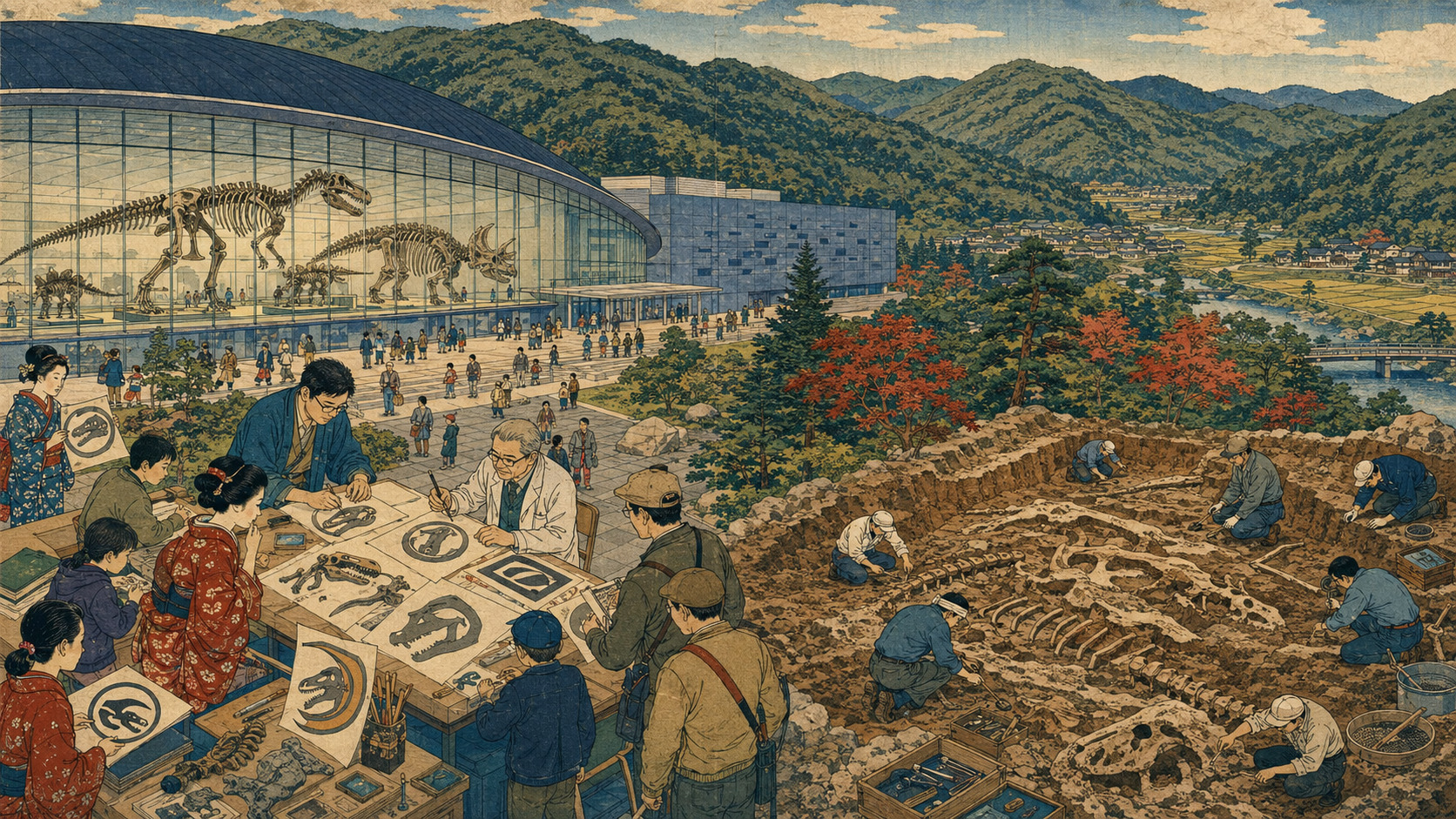
Entries are open from June 30 until the September 10 deadline. Individuals and groups of any age, occupation, residence and professional status may submit up to two designs. The top award is ¥50,000; about two runners-up receive ¥10,000 in museum goods. Results are expected around January or February 2027.
Rules to understand before entering
| Area | Requirement | Design implication |
|---|---|---|
| Name | Use one or more of the Japanese name, “Fukui Prefectural Dinosaur Museum,” or “FPDM” | Typography is integral, not an afterthought |
| Reproduction | Legible in monochrome and at small size | Must survive stamps, icons, signage and embroidery |
| Media | Posters, web, video and merchandise | Needs horizontal, vertical and motion-ready extensions |
| Submission | JPEG/GIF/PNG, under 7MB, 300dpi recommended; hand drawing accepted | Vector production and standards come later |
| Creation | Original and unpublished; AI-tool work excluded | Avoid generated images, stock dinosaurs and unlicensed fonts |
Winners transfer copyright and all other rights to Fukui Prefecture without additional payment and may not assert moral rights. The museum may edit a winning design for scholarly reasons and use symbol and lettering separately. Entrants should understand this broad permission—not merely the prize—before submitting.
Why redesign now?
The museum opened in Katsuyama in July 2000. A major 2023 renewal added an egg-shaped wing, special exhibitions, fossil-research experiences and visible storage. According to the competition rules, attendance reached about 1.3 million last fiscal year. A 25th-anniversary identity can acknowledge that the institution's scale and role no longer match its opening moment.
A logo is not confined to the building sign. It appears on reservation screens, papers, specimen labels, school materials, international conferences, buses, souvenirs and video titles. Repetition teaches three promises: this is a credible research institution, an inviting family destination and a place rooted in Fukui.
How Fukui became a “Dinosaur Kingdom”
A carnivorous dinosaur tooth found in neighboring Ishikawa helped focus paleontological attention on Hokuriku. Full-scale excavation began in Katsuyama in 1989, where the Tetori Group exposes rock from the Early Cretaceous, roughly 120 million years ago. Fukui accounts for a large share of dinosaur fossils discovered in Japan.
Fukuiraptor, Fukuisaurus, Fukuititan, Koshisaurus and Tyrannomimus carry the prefecture or local geography in scientific names. “Dinosaur Kingdom” was therefore not invented by advertising alone. Excavation, preparation, comparative anatomy, publication and naming accumulated into a regional brand.
A museum is also a laboratory
The museum describes 4,500 square meters of permanent galleries, 51 dinosaur skeletons and more than a thousand specimens. Animatronics and giant screens create an entrance to wonder; collection, preservation, research and education form the institutional core. Field tours take visitors to the quarry and let them split rock.
A strong logo should not sell only teeth, claws and a frightening dinosaur. Dinosaurs stand for reconstructing vanished life from evidence. Fossils, strata, excavation tools, the silver dome, the new egg and the letters FPDM offer materials that connect science to place.
The dinosaur-silhouette trap
The easiest museum logo is a side-view theropod. It is also the most dangerous. A Tyrannosaurus-like outline is used by museums, toys and films worldwide and erases Fukui's specificity. A pose or feather treatment can become scientifically dated as reconstructions change.
One species is memorable but narrows the whole museum. A Fukui species adds place but may be unrecognizable to general visitors. Too much abstraction removes science. Good design treats these conflicts as the brief, not as inconveniences.
The silver dome as a second fossil
Kisho Kurokawa's main building resembles a giant silver egg emerging from the ground; the 2023 wing answers with another egg-like form. Its silhouette distinguishes the institution from other dinosaur museums while suggesting fossil, egg, geology and future technology.
Architecture alone does not immediately say dinosaur. Rather than pile up three symbols, a designer can use negative space or letterforms to overlap bone, stratum and dome. A detail requiring explanation should reward a second look, not carry basic recognition.
A whole ecosystem of regional marks
Life-size dinosaurs move outside Fukui Station; dinosaurs spread across trains, buses, walls, roads and souvenirs. After the Hokuriku Shinkansen extension, they became a gateway to the prefecture. Yet the museum logo must not perform the same job as a prefectural tourism campaign or the museum's Dr. Dinosaur mascot.
A mascot speaks, changes costume and meets children. A campaign drives short-term visits. An official logo stays stable and certifies institutional origin from specimen case to international meeting. Too much resemblance confuses roles; too little fragments the brand. The new mark needs a family relationship with surrounding identities.
Authority and adventure need different layers
A heavy black mark may convey authority but repel children; a cartoon may invite families but weaken research credibility. The answer is not a bland compromise. Keep the core mark simple and exact, then let color, photography, diagrams, mascots and exhibition identities expand emotion.
Fossil earth, forest green, architectural silver, Sea of Japan blue and snow are all plausible colors. Too many official colors damage reproduction and accessibility. The mark should work first in black and white, then add a small palette tested for color-vision diversity and contrast.
Eight tests the jury should run
- Can it be recognized at approximately 16 pixels?
- Does it survive photocopy, embossing, embroidery and one-color printing?
- Do Japanese, English and FPDM combinations feel related?
- Is it readable on a distant road sign and a nearby specimen label?
- Could it be confused with another museum, film or sports mark?
- Does it freeze an obsolete paleontological reconstruction?
- How do children, scientists, overseas visitors and visually impaired users respond?
- Can it represent the institution after another decade of discoveries?
The promise and tension of an open contest
An open call lets outsiders and children ask what the museum means, creating participation around an anniversary. Accepting hand drawings widens entry. Yet ¥50,000 plus full rights cannot be compared with the normal cost of research, type design, multilingual testing and a complete identity manual.
The selected drawing should be a beginning, not an untouched final asset. With the winner's intent respected, specialists need to build vectors, exclusion zones, minimum sizes, palettes, bilingual lockups, motion rules and accessibility standards. The terms permit scholarly editing; explaining that refinement openly can reconcile participation with professional quality.
What the AI prohibition reveals
AI-made entries are excluded, plausibly to clarify authorship, rights and resemblance to existing work. But “AI tool” can be ambiguous: does it mean image generation only, or also automatic tracing, cleanup and layout assistance? Entrants should avoid doubtful processes and preserve sketches and work history.
Paleontological reconstruction itself infers an unknown animal from incomplete evidence and comparison. The logo should likewise show human judgment grounded in Fukui's fossils, geology and architecture—not merely recycle cinematic dinosaur imagery.
What success looks like
A successful mark will not explain everything at once. First it reads as dinosaur and science; next as Fukui and Katsuyama; over time, as a guarantee that information bearing it comes from a trusted institution. It should stay in a child's memory without looking unserious on a research publication.
Fukui's dinosaur identity did not arise from fossils alone. Decades of excavation, scholarship, education and transport investment made a regional image. The logo's task is not to invent Dinosaur Kingdom Fukui. It is to compress that accumulated work into a small form capable of surviving future discoveries.
Reporting and sources
- Fukui Prefectural Dinosaur Museum: official logo competition page
- Official rules: eligibility, rights, judging and prizes
- Museum: research, exhibition and visitor information
- Nippon.com: excavation history and the 2023 renewal
- Fukui Prefecture: dinosaur tourism and regional branding
Anyone entering should rely on the official rules, not this article. The deadline, file specifications, rights transfer, AI exclusion and parental consent for minors are material conditions.