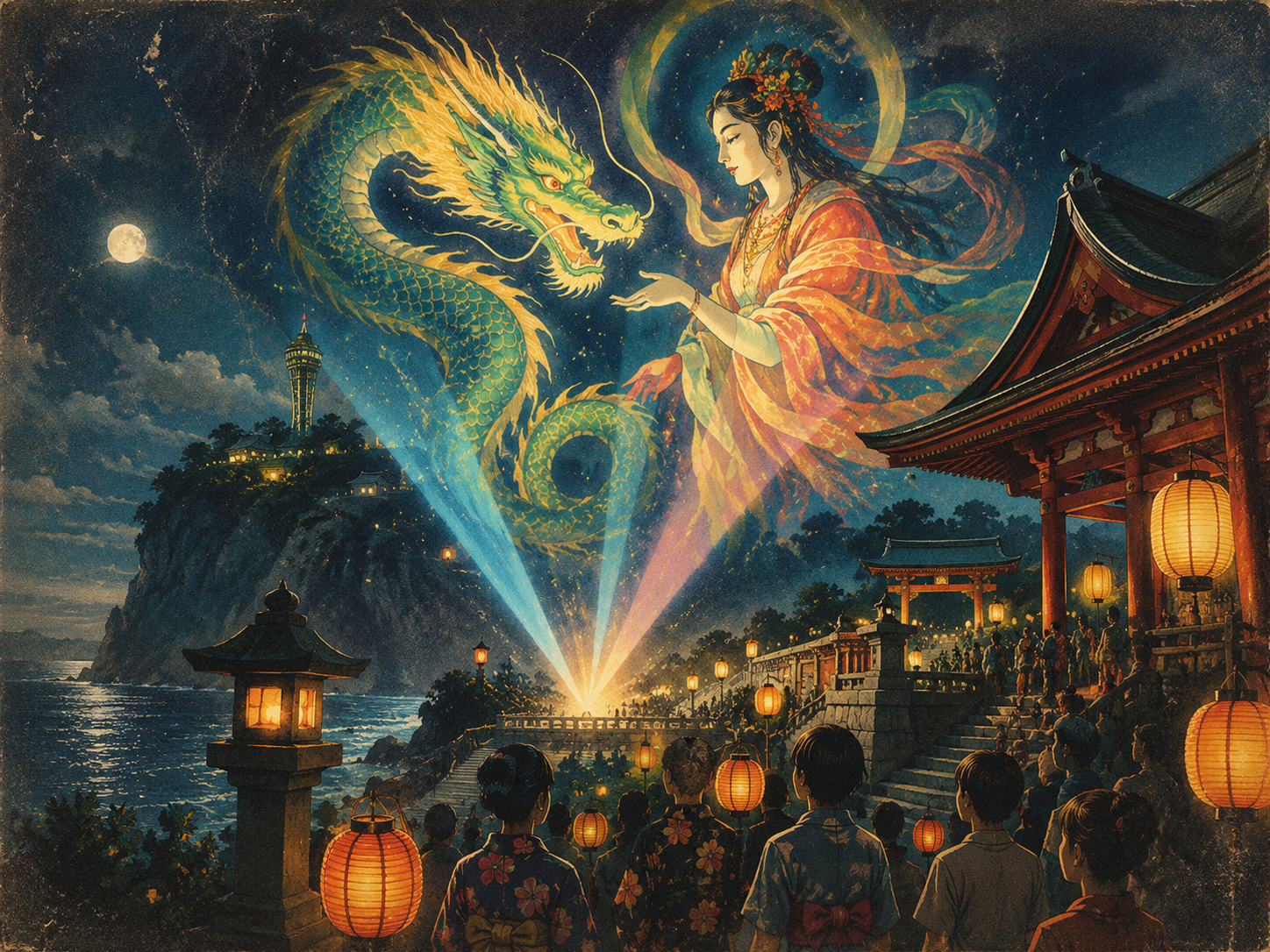
An island becomes a moving picture scroll
As the sun drops behind Sagami Bay, Enoshima’s white Zuishinmon gate begins to change. Sea blue, sunset orange and gold move across the entrance. Lanterns appear along the stairs. The deeper visitors walk, the less the island resembles an ordinary sightseeing district and the more it feels like an illuminated medieval scroll.
Enoshima Lanterns 2026 is scheduled from August 1 through September 23. Roughly 1,000 lanterns will spread across Enoshima Shrine’s Zuishinmon, Hetsunomiya, Nakatsunomiya and Okutsunomiya precincts, Samuel Cocking Garden, Enoshima Sea Candle, Oiwayamichi Street and the Enoshima Iwaya caves.
Standard illumination runs from 6:00 p.m. to 8:30 p.m., extending to 9:00 p.m. on weekends, holidays and August 10–14. The 2026 production follows the Enoshima Engi, the island’s sacred origin story. At Zuishinmon, light and sound evoke a summer sea at sunset. The route leads toward the goddess’s shrine. In the first Enoshima Escar section, moving imagery presents the heavenly maiden and five-headed dragon. At Samuel Cocking Garden, a giant lantern approximately five meters high rises toward the sky.
The romance begins as a horror story
Modern tourism presents the goddess and Gozuryu—the five-headed dragon—as Enoshima’s mythic lovers. The older narrative is far darker.
Long ago, a lake in the Fukasawa area of Kamakura was inhabited by a dragon with five heads on one body. It shattered mountains, caused floods and storms and ruined fields. Some versions say it abducted children and drove villagers to sacrifice human lives. The dragon personified uncontrolled disaster.
Then, in the 13th year of Emperor Kinmei—traditionally equated with 552—clouds covered the sea and the earth convulsed. A heavenly maiden descended in golden light. The seabed rose and an island appeared where none had existed. That island was Enoshima.
The dragon fell instantly in love and proposed. The goddess refused him because of the suffering he had caused. Unable to win her through desire alone, he vowed to change. He brought rain during drought, pushed back typhoons and protected the people. Only after his reform did the goddess accept him, and they became husband and wife.
The heavenly maiden is Benzaiten—and also three sea goddesses
Enoshima’s heavenly woman is commonly identified with Benzaiten. Her distant ancestor is Saraswati, the Indian river goddess of knowledge, speech and the arts. Through Buddhism and China, she entered Japan and became a patron of music, eloquence, learning, performance, fortune and wealth.
Enoshima Shrine today formally enshrines the three Munakata goddesses—Tagirihime, Ichikishimahime and Tagitsuhime—across three principal sanctuaries. The climbing route through Hetsunomiya, Nakatsunomiya and Okutsunomiya creates a layered pilgrimage up the island.
Over centuries of shinbutsu shūgō, the blending of kami and Buddhist divinities, the sea goddesses and Benzaiten overlapped. The Meiji government later separated shrines from Buddhist institutions, but popular memory did not cleanly divide them. Enoshima remains celebrated as one of Japan’s great Benzaiten centers.
When was the Enoshima Engi written?
Fujisawa’s official tourism history says the original Enoshima Engi was traditionally composed in 1047 by Kōkei, a Tendai Buddhist monk. The original is lost. Two copied textual traditions survive. The work consists of five volumes, with the goddess-and-dragon narrative in the first two.
An engi is not a modern factual chronicle. It explains the origin and sacred efficacy of a shrine, temple, deity or landscape. Geography, disaster memory, religious doctrine, political authority and oral tradition are braided into a story that tells people why a place deserves reverence.
Scholar Ami Tanaka’s study of the text argues that the dragon’s crimes and conversion appear to draw on several literary and religious traditions, including Buddhist conversion tales, narratives related to the Yamata-no-Orochi serpent and expressions found in medieval literature. The legend was probably not frozen folklore copied from a single ancient source. It was crafted by writers familiar with a much wider story world.
The religious pattern: converting an evil dragon
The core of the legend is not romance but conversion. Buddhist narratives often transform violent local gods, poisonous dragons and demons into guardians after they encounter Buddhist teaching. Dangerous power is not always destroyed; it is redirected.
Gozuryu follows that pattern. The being that once caused floods becomes a controller of beneficial rain. The force behind typhoons becomes a shield against them. The monster becomes a protector of land and people.
For coastal communities, water is necessarily double-faced. It sustains fishing and agriculture but also brings floods, storm surge and tsunami. The dragon gives that contradiction a body.
At the end, the dragon becomes a mountain
As the dragon grew old, the legend says he asked to become a mountain so he could continue watching over Enoshima and the goddess. That mountain became Ryūkōzan, the Dragon-Mouth Mountain.
Ryukō Myōjin Shrine enshrines Gozuryu Ōkami. Its foundation is traditionally dated to 552, making it one of the oldest shrine traditions in the Kamakura area and a rare sanctuary centered on the five-headed dragon. The shrine once stood near Ryūkōji but moved to its present Nishi-Kamakura site in 1978.
Visitors today sometimes worship at both Ryukō Myōjin Shrine and Enoshima Shrine as a divine married pair, seeking good fortune in relationships. A medieval calamity myth has become a modern route for romantic tourism.
| Place | Meaning in the legend | 2026 illumination |
|---|---|---|
| Zuishinmon | Entrance into Enoshima’s sacred world | “Summer Sea at Sunset” in moving light and sound |
| Hetsunomiya | First of the three principal goddess sanctuaries | Shell wind chimes and cooling evening light |
| Escar Section 1 | A modern transit device recast as a mythic passage | Special goddess-and-dragon video |
| Nakatsunomiya and Okutsunomiya | Progress deeper and higher into the sacred island | Lanterns and shrine illumination |
| Samuel Cocking Garden | Meiji-era garden and modern viewpoint culture | Approximately five-meter “Light of the Sky” lantern |
| Ryūkōzan | The dragon’s transformed body watching Enoshima | The mainland counterpart to the island story |
Why Enoshima became sacred
Enoshima is a small island at the mouth of the Katase River in Sagami Bay, linked to the mainland by bridge. Its circumference is roughly four kilometers. Steep slopes, wave-cut caves and exposed rock make the island feel naturally separated from ordinary land.
The Iwaya caves became places of religious practice, accumulating traditions involving mountain ascetics and famous monks. Crossing water to enter the island was itself a movement from everyday space into a sacred realm.
During the Edo period, Enoshima pilgrimage became mass travel combining devotion and entertainment. Visitors prayed to Benzaiten, admired Fuji and the sea, ate local food, stayed at inns and purchased souvenirs. Ukiyo-e artists repeatedly depicted the island. Modern tourism did not replace religion here; it inherited a long-established mixture.
A modern garden and lighthouse layered over myth
Samuel Cocking Garden derives from a late-19th-century botanical garden created by British merchant Samuel Cocking. Greenhouse ruins, exotic plants and views added a modern, cosmopolitan layer to the sacred island.
Enoshima Sea Candle is not a religious structure, yet during the lantern event it becomes the island’s highest emblem of light. An ancient heavenly maiden, a Meiji garden and a modern observation lighthouse occupy the same visual field. Enoshima’s power comes from that accumulation rather than historical purity.
What 1,000 lanterns do to an island
Lanterns do more than increase brightness. A chain of small lights changes walking speed and direction. Visitors who might hurry between shops during the day begin following each glow, noticing trees, stone, gates and shadows.
The official 2026 concept strengthens this as a “scroll of light” flowing from the entrance toward Hetsunomiya. The projection is not confined to a screen. It attaches the story to the actual pilgrimage route. The audience does not sit; it walks through the narrative.
On August 29 and 30, Samuel Cocking Garden is also scheduled to host a shadow-play performance of “The Heavenly Maiden and the Five-Headed Dragon.” Digital projection will meet one of humanity’s oldest storytelling technologies: light, hands and silhouettes.
Projection mapping or religious interpretation?
Illuminated heritage events are often criticized as scenery engineered for social media. Some visitors will photograph the shrine without learning the legend. Yet the event can also return an obscure medieval text to public attention.
Lighting a religious site requires restraint. A shrine is not merely a theatrical set. Worshippers, residents, businesses and tourists share a small island. Sound, brightness, crowding, night safety and environmental effects must be managed.
Still, Enoshima has never been exclusively sacred or exclusively commercial. Edo pilgrims prayed, ate, enjoyed scenery and bought souvenirs. The 2026 lanterns belong to that hybrid history.
A caution when reading it as romance
Modern versions emphasize the dragon’s sincerity and the couple’s happy union. That makes a compelling love story, but reducing the legend to “persistence wins the woman” weakens its ethics.
The goddess refuses the original proposal. The dragon’s transformation is proved through sustained action, not persuasive words. Marriage remains her decision, not an automatic payment for his desire. Preserving that structure makes the old story surprisingly modern.
What Enoshima’s illuminated night reveals
The lanterns will go dark each morning. The projected dragon and goddess will disappear from walls and gates. Yet the story remains because the lights did not invent it. They briefly made visible what was already embedded in the island’s caves, stairs, shrines, sea and opposing mountain ridge.
Gozuryu expresses the possibility that destructive force can become protection. The goddess is not merely beautiful; she rejects evil and demands change. Enoshima transforms earthquake, uplift and coastal danger into a story of conversion, marriage and guardianship.
Visitors following 1,000 lanterns in the summer of 2026 will unknowingly walk the route of a nearly thousand-year-old engi. The event’s real magic is not decorating an old myth with new technology. It is placing modern feet back inside the path of the story.
Sources and further reading
- Official Enoshima Lanterns 2026 site: dates, hours, venues, installations and pricing.
- Enoshima-Kamakura Navi: 2026 highlights and the Enoshima Engi legend.
- Fujisawa official tourism site: the 1047 attribution, five-volume structure and surviving copies.
- Enoshima Shrine official history: the goddess and five-headed dragon.
- Ryukō Myōjin Shrine: founding tradition, Gozuryu deity and 1978 relocation.
- Ami Tanaka, “Source Expressions in the Evil-Dragon Conversion Tale of the Enoshima Engi”: Buddhist and literary structures behind the legend.
- Japan National Tourism Organization: Enoshima’s geography and visitor history.