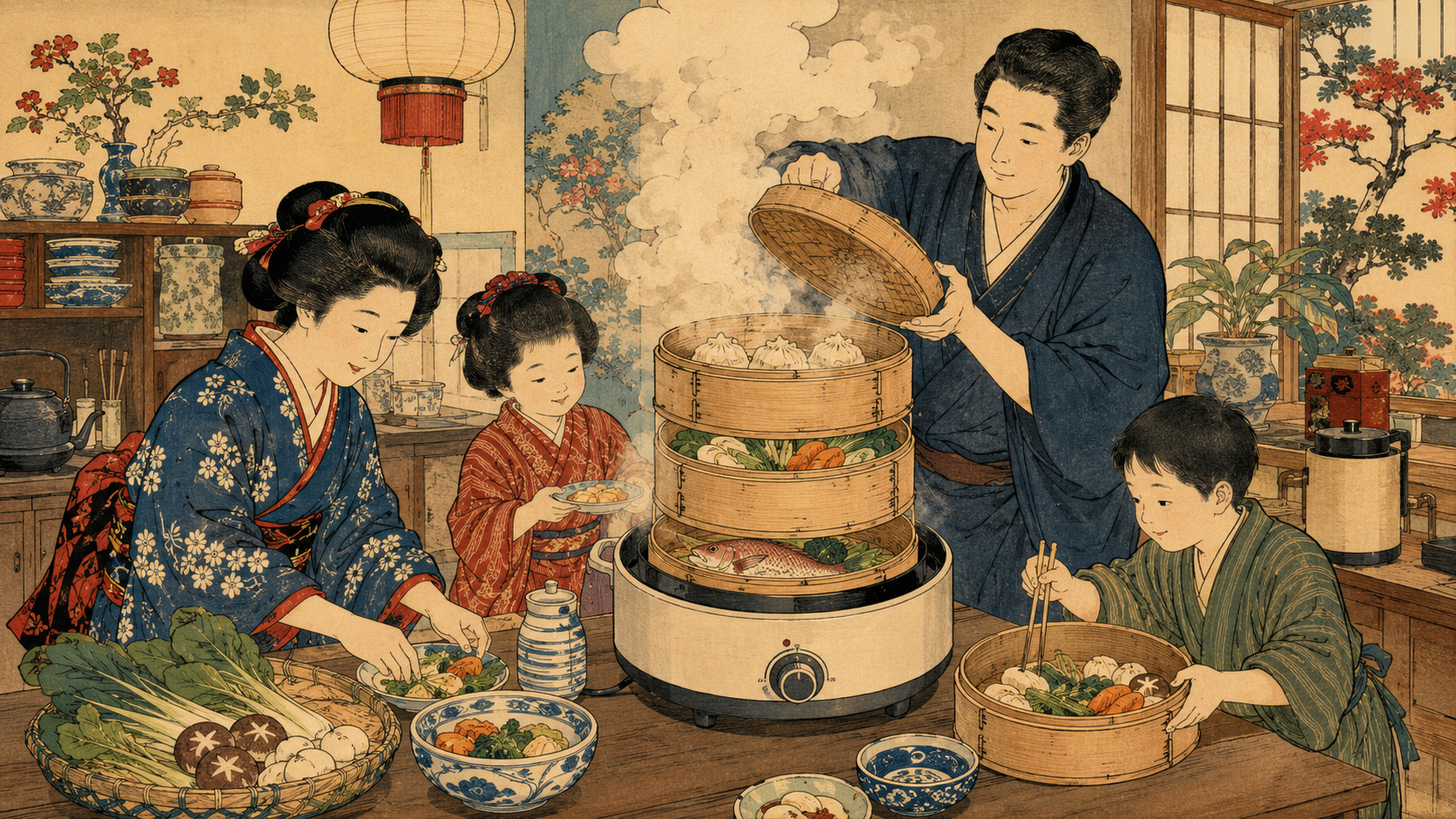
The white steam rising through rings of bamboo looks old-fashioned. The object beneath them is not. LITHON, a home-appliance and novelty company based in Higashiosaka, launched the Tenshin Ranman 21 electric bamboo steamer on July 10, 2026. Add water, set a bamboo basket on the powered base and turn a timer: the proposition is to return steaming to everyday cooking by removing the pot, open flame and constant adjustment.
What exactly has been launched?
The KDSC-005B has a suggested tax-inclusive price of ¥8,800. It draws 400 watts from a 100-volt outlet and has a timer of up to 30 minutes. Its base measures 180 by 190 by 95 millimeters; the included bamboo steamer is 21 centimeters in diameter, and the power cord is about 1.4 meters long. The plate also accepts commercially available steamers from 15 to 21 centimeters, reducing dependence on a proprietary replacement basket.
| Feature | Tenshin Ranman 21 | Why it matters |
|---|---|---|
| Power | 400W / AC100V | A maximum 30-minute cycle equals 0.2 kWh by a simple nameplate calculation |
| Timer | Up to 30 minutes | Reduces stove-watching, but does not make the appliance safe to leave unattended |
| Basket | 21 cm included; supports 15–21 cm | Fits buns, vegetables, fish, rice and stacked meal combinations |
| Care | Basket and plate are washable | Bamboo must still be dried completely before storage |
LITHON says the moist heat can rewarm frozen buns and leftover rice more evenly and softly than a microwave, and includes a guide with five recipes. The important boundary is easy to miss: this is not an autonomous cooking robot. It is a bamboo steamer whose heat source and shutoff timer have been electrified.
An old technology inside a new appliance
Steaming is among humanity's oldest ways of joining water, a vessel and fire. In China, bamboo steamers became inseparable from the culture of dim sum. In Japan, bamboo and wooden seiro have long been used for rice, beans, root vegetables, mochi and celebratory sekihan. Stack the baskets and several foods can share one heat source. This vertical kitchen was a rational design when fuel and work surfaces were limited.
Rice cookers, microwave ovens and frying pans later absorbed many of those jobs. A seiro also brings friction: finding a matching pot, monitoring the water, adjusting the flame and drying the bamboo after washing. The tool did not become useless. The number of small steps between cupboard and dinner grew. An electric base removes two of those steps—the compatible pot and flame control—while preserving most of the method.
Why steam transfers heat so effectively
At ordinary atmospheric pressure, water boils at roughly 100°C. When vapor touches cooler food and condenses back into liquid, it releases the substantial energy stored during vaporization. This latent heat of condensation transfers energy to the food's surface more effectively than hot air alone. Because the surrounding air is humid, moisture is less likely to race out of the surface of bread or rice.
Bamboo contributes too. The natural material absorbs some condensation and reduces the large droplets that can fall from a metal lid. Gaps allow vapor to circulate, creating a gentle heating chamber. But there is no magic. Overpacking blocks the vapor paths, stacked levels may cook at different rates, and the approximately 100°C environment is poorly suited to the high surface temperatures needed for browned, crisp Maillard flavors.
It is not a replacement for the microwave
A microwave makes polar molecules in food move and generate heat. For one bowl of rice or a drink, it is exceptionally fast and often energy-efficient. Its weaknesses can include uneven heating and dry edges. A steamer needs warm-up time, measured water and cleanup, but its humid, moderate heat is well matched to buns, dumplings, leftover rice and leafy vegetables.
The sensible contest is therefore not “which machine wins?” A weekday bowl may belong in the microwave; weekend dim sum or fish and vegetables cooked together may belong in the seiro. The return of an old tool does not require the defeat of a newer one.
Why hands-off cooking, and why now?
Urban Japanese homes often have limited counter and storage space. In dual-income and single-person households, an appliance that frees attention for another task can be worth more than one that merely saves a few minutes. A tabletop unit that removes pan compatibility, stabilizes the heat and stops on a timer saves attention. Carrying the bamboo basket to the table can also reduce dishes while keeping food warm and visually appealing.
There is an emotional dimension. Among plastic shells and displays, bamboo offers texture, aroma and visible vapor—the sensation that cooking is taking place. Rather than sealing tradition in a display case, the product puts it on an electric foundation. That combination fits health-minded menus, short cooking videos and complete “one-steamer” meals.
Less oil does not automatically mean healthy
Steaming can reduce the need for added oil. Because food is not submerged, some compounds that might enter boiling water can remain with the food. Yet nutrition still depends on the ingredient, cut size, time and temperature. Fatty processed meat or salty dumplings do not become health food because they are steamed. Vegetables, beans, fish and whole grains—and the sodium in dipping sauces—matter more than the appliance label.
Raw meat and seafood require food-safety judgment. Do not rely on appearance alone; use a food thermometer and reach the appropriate safe internal temperature. Follow package instructions for frozen foods. In stacked baskets, arrange raw ingredients so their juices cannot contaminate ready-to-eat food below.
No open flame does not mean no hazard
Removing a flame lowers the chance of ignition and forgotten gas. A timer can help reduce boil-dry risk. Yet steam can burn skin even where the plume is difficult to see. Lift the lid from the far side first, keeping face and hands out of the escaping vapor, and use heat-resistant gloves. Place the unit on a stable, heat-resistant surface; keep the cord away from walkways and children; use the specified quantity of water; and do not leave home while it operates.
“Hands-off” is a marketing shorthand for not adjusting a burner every few minutes. It is not permission to sleep, leave the building or run the machine in a room occupied only by children. Nor is electric automatically ideal for every older user. Avoiding flame may help, but opening a hot lid safely still requires vision, grip and coordinated movement.
Seven habits that help bamboo last
- Before first use, clean the basket as directed by the manual and dry it thoroughly.
- For meat, fish and sauces, use a heatproof plate, leaves or perforated cooking paper.
- Leave vapor pathways instead of packing ingredients into a solid wall.
- After use, let it cool and clean it promptly; avoid prolonged soaking.
- Follow the maker's instructions on detergent, since fragrance can remain in bamboo.
- Dry every side completely in moving air before putting it away.
- Inspect for dark spots, odor, cracks and splinters; replace deeply moldy or structurally damaged baskets.
The appliance test that matters
Running a 400-watt appliance for 30 minutes gives a simple upper nameplate calculation of 0.2 kWh, though actual consumption varies with control cycles and cooking time. The stronger purchasing question is not the electricity bill alone. How many times a week will it be used? Will it add vegetables or fish that the household otherwise would not cook? Is there permanent counter or cupboard space? Compatibility with ordinary baskets is a modest but meaningful advantage for repairability and waste.
Higashiosaka is famous for its dense community of small manufacturers. Founded in 1991 and capitalized at ¥20.5 million, LITHON is not proposing a gigantic frontier technology. It is reconnecting a familiar electric heater to a vessel refined over centuries. The product's success will not be measured by launch-week attention, but by whether steam is still rising six months later.
Can convenience remove the nuisance without erasing the method?
The Tenshin Ranman 21 is betting less on tradition itself than on a modern compromise: people want to preserve flavor and tactile pleasure while surrendering some of the watching. The electric base does not remove bamboo's aroma, the physics of condensation or the responsibility to wash and dry the basket. It removes part of the pan selection and flame management.
That is also the test of thoughtful redesign. It should not paste heritage onto a gadget as decoration. It should explain what the old tool does well and reduce, one by one, the points where it clashes with contemporary schedules. If bamboo steamers become daily equipment again, nostalgia will be only part of the reason. The deeper cause will be that the physics of vapor and the timetable of modern life have found a workable fit.
Reporting and sources
- LITHON product announcement: Electric Seiro Steamer Tenshin Ranman 21, July 10, 2026
- Kikkoman Food Forum: Seiro Steamer
- University of Hong Kong: Bamboo Steam—From Kitchenware to Cultural Icon
- LITHON: earlier electric steamer product information
- The Japan Store: bamboo steamer usage and care guide
Specifications come from the manufacturer's announcement. The 0.2 kWh figure is a nameplate calculation—400 watts multiplied by 0.5 hours—not a measured consumption claim. Health and safety passages are general guidance; the product manual and food packaging take priority.