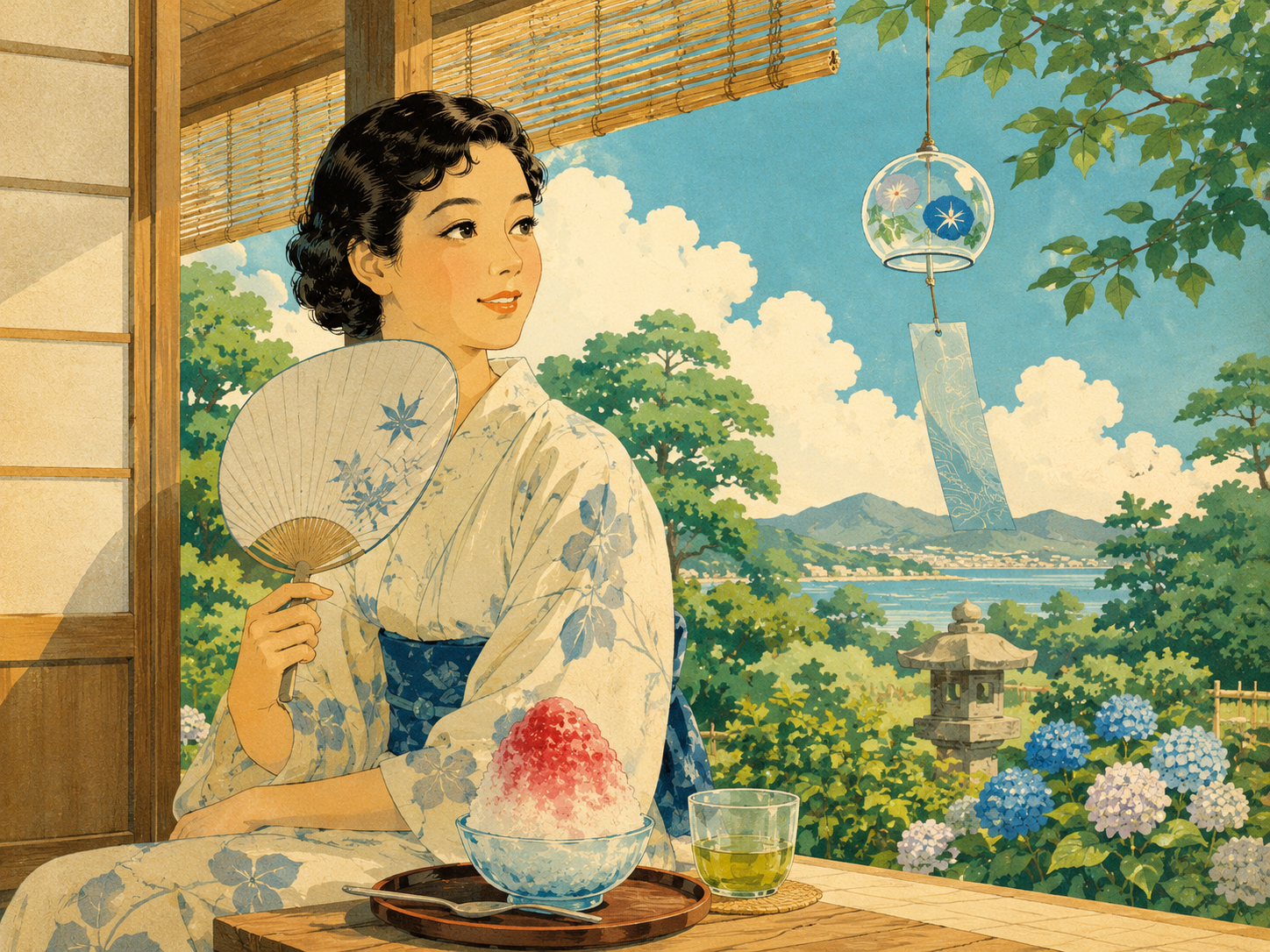
Japan’s summer is not just hot. It is humid, bright, fragrant, noisy, edible, frightening, festive and, at its best, deeply designed. A bamboo blind softens the light. A wind chime makes the invisible breeze audible. A bowl of shaved ice brings winter into the mouth for a few seconds. A ghost story cools the back of the neck. A museum offers air-conditioning, but also snow, deep sea, stone, shadow and imagination.
The July 2026 issue of Discover Japan, published by Discover Japan Inc., is titled Nōryō, shimasho — roughly, “Let’s keep cool.” Released on June 5, the issue frames summer cooling not merely as weather advice, but as culture. Its official preview points readers toward Edo-period cooling wisdom, Kanazawa’s inherited ice-house culture, Unzen in Nagasaki as a highland retreat, Shimane through the ghost-story world of Lafcadio Hearn, summer sweets, festivals and museums where curiosity and cool air meet.
That makes the issue more than a seasonal magazine package. In 2026, Japan’s summer is becoming a serious question for households, travelers, schools, cities and employers. Heat is no longer just a background condition; it is a policy problem, a tourism problem and a cultural problem. What makes the Discover Japan issue compelling is that it asks an older and more interesting question: how did Japan learn to make coolness before modern cooling?
Why “nōryō” matters again
The Japan Weather Association’s warm-season outlook says temperatures from June through August 2026 are expected to be higher than normal across a wide area of Japan. The World Economic Forum has also noted Japan’s preparations for extreme summer heat, including the social arrival of a new term, kokushobi, for days above 40°C.
In that context, “keeping cool” is not nostalgia. It is a practical theme. Air-conditioning, heat alerts, shade, hydration, urban greenery and labor rules are essential. But if summer becomes only a season to endure, something is lost. Japan’s older cooling culture does not replace modern heat safety. It gives summer a vocabulary beyond emergency.
The Japanese word nōryō means more than lowering the temperature. It can mean seeking, enjoying or creating coolness. It includes the body, but also the senses. The sound of glass in a breeze does not change the thermometer, yet it changes the room. A reed screen does not remove heat, yet it changes the quality of light. Water sprinkled on a street cools the surface, but it also changes the smell of the town. Coolness, in Japan, has often been environmental, social and poetic at the same time.
Edo cooled the city through the senses
Before modern air-conditioning, Edo had to survive as one of the world’s great dense cities in a humid summer climate. Its answers were layered: architecture, clothing, water, food, nightlife, river culture, shade, sound and timing. People used sudare and yoshizu screens to filter sunlight and encourage airflow. They sprinkled water outside homes and shops. They gathered near rivers. They dressed for movement and ventilation. They made summer into an evening culture.
Uchimizu, the sprinkling of water, is a good example. It was practical, because evaporation helped cool the ground. It was also social, because it cleaned and prepared the threshold. It signaled hospitality. It made the street feel human. Likewise, the wind chime was not a machine for cooling air. It was a machine for noticing air.
Edo’s cooling culture did not eliminate discomfort. It managed it. It taught people when to move, where to gather, what to eat, what to hear and how to share the season. In a time when modern cities are rediscovering shade, ventilation, water and walkable evening life, that older knowledge suddenly feels less quaint.
Kanazawa’s ice-house memory
The issue’s attention to Kanazawa’s himuro culture opens a deeper history. Before refrigeration, ice was not ordinary. It was harvested, stored, protected and sometimes offered as a precious seasonal gift. To carry winter into summer required labor, architecture and authority. Ice was coolness made political and sacred.
The Japanese fascination with summer ice reaches back to the courtly world. The Pillow Book by Sei Shōnagon famously includes an aristocratic summer pleasure involving shaved ice and sweet syrup. Ice was rare, and therefore magical: a small piece of winter preserved against time.
Modern kakigōri is democratic by comparison. It appears at festivals, cafés, convenience stores and specialty shops. Yet the act is still beautiful: a hard block becomes snow, syrup becomes color, and heat disappears on the tongue. The best kakigōri shops today use natural ice, careful tempering, local fruit, matcha, milk, bean paste or pastry techniques. What was once elite has become popular, then artisanal, then global.
Kakigōri: from court luxury to global dessert
Kakigōri is one of Japan’s simplest summer symbols, but its history is long. It is generally traced to the Heian period, when stored ice was shaved and served to court elites. In the 19th century, as ice and urban commerce became more accessible, kakigōri became a public summer pleasure. Early shops in Yokohama helped make shaved ice part of the modern city.
By the 20th century, the blue-and-white “ice” flag had become a seasonal sign. It told passersby that relief was available. A child at a festival, an office worker in a shopping street, a family by the sea — all could find a bowl of colored ice. The dessert became both food and weather response.
In the 21st century, kakigōri has become a refined dessert category. Chefs use seasonal fruit, tea, condensed milk, sake lees, brown sugar, regional syrups and natural ice. In that sense, it captures the full movement of Japanese cooling culture: courtly, popular, local, technical and exportable.
Unzen and the geography of retreat
Unzen, in Nagasaki, represents another form of cooling: altitude. Japan’s modern resort history is partly a history of people escaping lowland heat. Karuizawa, Nikkō, Hakone, Rokko and Unzen all became places where climate, scenery and social life combined. A retreat was not just a cooler place. It was a different rhythm.
Unzen is especially rich because it blends highland air, volcanic landscape, hot springs and Nagasaki’s international history. The irony is lovely: a hot-spring landscape can also be a place of cool retreat. Mist, forest, altitude and slower time make the body recalibrate.
In the 2026 tourism context, this matters. Japan is crowded in its famous corridors, and summer travel can be physically punishing. A good summer itinerary should not simply ask “what is famous?” It should ask “where can the body recover?” Unzen’s value lies in that answer.
Shimane, Lafcadio Hearn and the chill of fear
One of the most Japanese forms of cooling is psychological. Summer ghost stories work because fear creates a bodily chill. That is why the issue’s Shimane and Lafcadio Hearn thread is so effective. It treats coolness not only as weather, but as imagination.
Lafcadio Hearn, known in Japan as Koizumi Yakumo, arrived in Meiji-era Japan and became one of the great interpreters of Japanese ghost stories and folk memory to the English-speaking world. Through tales such as “Yuki-Onna” and “Mimi-nashi Hōichi,” he preserved stories that connect landscape, death, sound, snow, water and the uncanny.
Ghost stories cool what air-conditioning cannot: the mind. On a hot night, a low voice, a darkened room and a tale of the unseen can change the temperature of experience. Japanese summer culture has always understood that the body is not the only place where heat gathers.
The museum as a modern cooling device
The issue also points readers to museums as places to keep cool while staying curious. This is a very modern form of nōryō. A museum is air-conditioned, but its cooling power can also come from subject matter: snow, ice, deep sea, underground space, stone, water, shadow, science and memory.
The magazine’s table of contents includes a wide range of museums and cultural facilities, from science and national museums to ice, snow, aquarium, art, geology and infrastructure spaces. That diversity matters. It suggests that summer cooling can be educational, not merely passive.
As heat intensifies, museums, libraries, shopping arcades, stations and public halls increasingly function as heat refuge infrastructure. But the best version of that future is not only a “cooling center.” It is a civic place where people rest, learn and feel part of a shared culture.
Festivals turn heat into rhythm
Summer festivals do not avoid heat. They transform it. Nebuta, Tanabata, Gion Matsuri, Tenjin Matsuri, Awa Odori, Gujō Odori, fireworks and local shrine rites all take heat and convert it into night, movement, music and community. The body still sweats, but the meaning of the sweat changes.
That is why summer festivals belong in a cooling issue. Their cooling is temporal and social. They move people from afternoon glare into evening light. They put bodies in yukata. They gather people near rivers, shrines and streets. They create a reason to be outside after sunset. The festival does not deny summer; it choreographs it.
For visitors, this is one of the great lessons of Japan in July and August. The day may be difficult. But the night can become luminous.
Coolness as soft power
Japan’s soft power is usually discussed through anime, manga, food, design, fashion and technology. But in a warming world, cooling culture could also become part of Japan’s global appeal. Sudare, furin, uchimizu, yukata, kakigōri, shaded verandas, river terraces, highland retreats, ghost stories and summer festivals are not merely “traditional.” They are cultural responses to heat.
They should not be romanticized as substitutes for public-health policy. A wind chime will not prevent heatstroke. A ghost story will not lower urban heat islands. But technology alone does not make summer livable. A good society needs cooling systems and cooling culture.
For international travelers, this is especially useful. Japan in summer can be punishing if approached as a checklist. But if the itinerary is built around early mornings, shaded spaces, museums, evening festivals, regional sweets, water, highland retreats and slower movement, summer becomes legible. The heat remains. The experience changes.
Japan.co.jp’s view
Discover Japan’s July 2026 issue works because it identifies a serious theme inside a beautiful one. Japan is hot, and likely getting hotter. The question is not only how to cool buildings, but how to keep summer human.
Nōryō is a cultural verb. It means adjusting time, light, water, food, sound, imagination and travel. It means accepting that coolness can be physical, emotional and social. It means that summer is not only a climate problem, but also a design problem.
The issue’s mix of Edo wisdom, Kanazawa ice culture, Unzen, Shimane ghost stories, sweets, festivals and museums shows how much Japan already knows. The task now is to recover that knowledge without pretending that the past is enough. The best summer Japan will be old and new at once: heat alerts and wind chimes, cooling centers and museums, air-conditioning and shaded streets, kakigōri and climate adaptation.
Coolness, in Japan, is not only something to buy. It is something to notice.
Reader guide
| Item | How to read it |
|---|---|
| What happened | Discover Japan released its July 2026 issue, “Nōryō, shimasho,” on June 5. |
| What the issue covers | Edo cooling wisdom, Kanazawa ice-house culture, Unzen, Shimane ghost stories, summer sweets, festivals and museums. |
| Why it matters | Japan is facing a hotter summer, making cooling a cultural, tourism and public-life question. |
| Historical background | Japanese cooling culture includes uchimizu, furin, sudare, kakigōri, himuro, ghost stories, festivals and mountain retreats. |
| Japan.co.jp’s view | This is not nostalgia. It is a useful cultural framework for a hotter age. |
Sources and references
This article draws on Discover Japan’s official issue preview, the PR TIMES release, the Japan Weather Association’s summer 2026 forecast, JMA seasonal information, World Economic Forum coverage of Japan’s extreme-heat preparations, and public background material on kakigōri, Edo cooling customs and ice-house culture.
- PR TIMES: Discover Japan July 2026 issue announcement.
- Discover Japan: official preview of “Nōryō, shimasho.”
- Japan Weather Association: Summer 2026 weather forecast for Japan.
- Japan Meteorological Agency: seasonal temperature outlook.
- World Economic Forum: Japan’s preparations for extreme summer heat.
- Food & Wine: history of kakigōri and The Pillow Book.