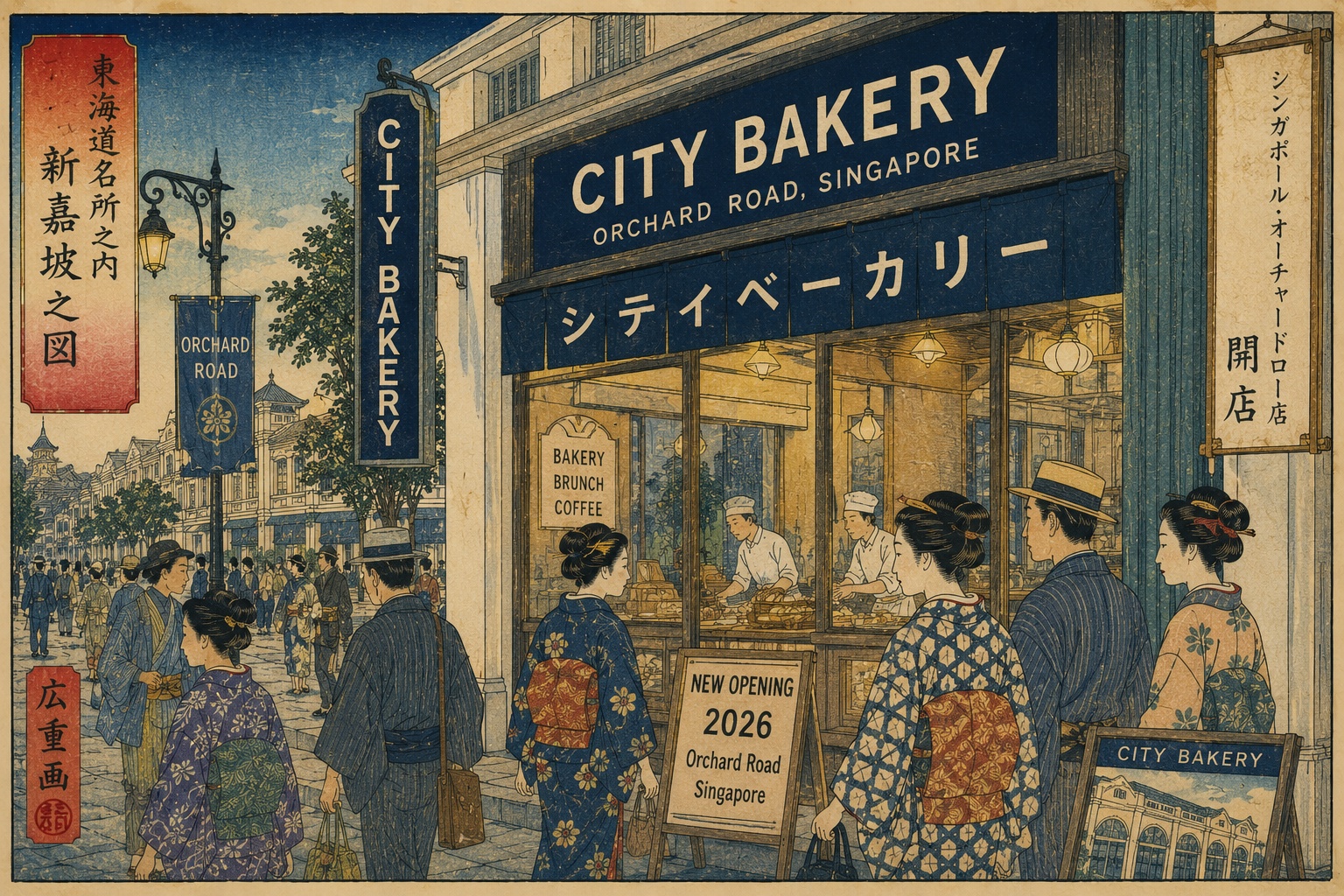
Japan-based operator FONZ has announced that Singapore’s first THE CITY BAKERY ORCHARD will open at Mandarin Gallery in August 2026, combining a bakery and café with a restaurant. The published address covers five second-floor units at 333A Orchard Road, about a five-minute walk from Somerset MRT. The restaurant will introduce “PAN NOMI,” pairing bread and food with wine, beer and other alcohol, in an interior with Japanese elements and an open terrace. As of the research cutoff—6:00 a.m. Japan time on August 1—the exact opening date, hours, seat count, prices, full menu, sourcing plan and training structure had not been announced. Signature products are discussed as brand history, not presented as confirmed Singapore launch items.
The smell of breakfast crosses three cities
On an Orchard Road afternoon, tropical humidity stays beyond the glass while another climate holds inside the mall. Shoppers, hotel guests, office workers and visitors cross paths through Mandarin Gallery. On its second floor, bread is due to be baked under a name born in New York, developed abroad in Osaka and now carried toward Singapore: The City Bakery.
It would be easy to describe the project as the Singapore arrival of a famous American bakery. That is true, but incomplete. The company opening the 2026 store is FONZ, founded in Karuizawa in 2000 and responsible for The City Bakery’s Japanese operations. FONZ also opened Japanese Restaurant Suju Masayuki in this same Mandarin Gallery in December 2009. The bakery is therefore not a simple first landing in an unknown market. It is a New York concept reconstructed in Japan and brought by an operator with nearly seventeen years of experience in this Singapore address.
The journey complicates the brand’s nationality. The pretzel croissant and dense hot chocolate carry New York memory. Production systems, regional products, restaurant formats and much of the current store network were developed in Japan. Orchard Road will add a Japanese phrase—“pan nomi,” drinking with bread—rendered in Roman letters inside an American-named brand in a Southeast Asian city. Three cultural layers meet before the ovens even start.
What has been announced—and what has not
| Item | Published by August 1, 2026 | How this article treats it |
|---|---|---|
| Opening | August 2026 | No exact date had been announced. The article does not claim the store is already trading on August 3. |
| Location | Mandarin Gallery, 333A Orchard Road, #02-05, #02-06, #02-07, #02-24 and #02-25 | About five minutes from Somerset MRT. Official unit numbers take priority over conflicting secondary listings. |
| Format | Bakery and café plus restaurant | A combined retail, café and dining operation; hours and seats remained undisclosed. |
| PAN NOMI | Bread and food paired with wine, beer and other alcohol | An official concept; labels, prices and specific pairings were not yet published. |
| Space | Japanese elements and an open terrace | A stated design direction, not a review of an unfinished or unopened room. |
| Menu | No complete Singapore menu | Pretzel croissant and hot chocolate appear as brand history, not guaranteed launch products. |
The easiest mistake in pre-opening coverage is to confuse a brand’s famous products with a new store’s confirmed menu. FONZ’s announcement names the pretzel croissant and hot chocolate while recounting The City Bakery’s history. It does not yet publish every item, price, local special, breakfast, lunch or dinner dish for Orchard Road.
That gap leaves the most interesting question open: what travels, and what changes? How does a drink built around New York winter find a role near the equator? Can a sweet-salty, sesame-topped laminated pastry become an everyday purchase in a breakfast culture already fluent in kaya toast, kopi and traditional buns? A press release can create curiosity. Only repeated local use can answer those questions.
In 1990, Union Square gained a bakery built for an entire day
The City Bakery opened near Manhattan’s Union Square in 1990. Founder Maury Rubin did not emerge from a baking dynasty. He worked in television, including producing and directing at ABC Sports, before a pastry course in France in 1986 redirected his attention from cameras and audiences to flour, butter, chocolate and physical space.
Rubin did not build only a counter where bread left the room as quickly as possible. The operation combined a bakery, coffee bar, cafeteria-style lunch and chocolate shop in a large modern environment. It used regional farm products, organic ingredients, seasonal cooking and unusually deliberate design before “local,” “sustainable” and “all-day” became routine restaurant language.
The pretzel croissant became one emblem: sweet laminated dough given sesame, rock salt and the savory memory of a pretzel. The other was dense hot chocolate topped with a large house-made marshmallow. The Japanese brand history says the drink reached as many as 1,000 cups a day. A Hot Chocolate Festival that began in 1991 turned a beverage into a month-long sequence of reasons to return.
The phrase “city bakery” did not describe a modest scale. It described a place able to absorb the city’s morning, lunch and afternoon, serving neighbors while also becoming a destination. The deeper invention was to expand the bakery from single-product retail into an editor of urban time.
Japan became a workshop of inheritance, not a copy machine
After the New York bakery marked its twentieth anniversary in 2010, Japan was selected for the brand’s first overseas store. The City Bakery and Brasserie Rubin opened at Grand Front Osaka in April 2013. Before launch, Japanese bakers and café employees went to New York to learn bread and beverage production from the original team.
The learning did not stop at replication. The official Japanese story describes using regional flour and vegetables, creating location-specific products, and placing production workshops near important urban stores so bakers can hear customers and adjust. Rather than duplicate one interior nationwide, the company designs every store from the beginning, changing the balance between New York atmosphere and local daily life.
That method is different from preserving a licensed brand as a museum object. It keeps central recipes, manufacturing discipline and visual language while allowing place to alter the store. Osaka energy, Kyoto’s meeting of Japanese and Western design, Hakuba’s mountain setting and Fukuoka’s urban rhythm are expressed under the same name without producing identical rooms.
Then the story took a difficult turn. The original Union Square City Bakery closed in October 2019 under heavy debt after nearly thirty years. A busy and beloved store proved that customer affection alone does not repair a balance sheet. Japanese locations continued operating. The physical birthplace disappeared while the inherited techniques and memory remained active abroad. Orchard Road makes that unusual cultural reversal visible.
Why FONZ was positioned to play that role
FONZ was established in February 2000 and opened Kawakami-an in Karuizawa that July. The company says its name evokes a fountain or source and its aim of creating beginnings through food. It started with Japanese formats centered on soba, miso, soy sauce and rice, then opened its first major Western bakery-and-restaurant concept, Sawamura, in Karuizawa in July 2009.
Sawamura trained the company not to confine bread to a morning retail purchase. Coffee and breakfast, sandwiches and lunch, wine and dinner could share one location. Bakers, cooks, service and design had to operate together. FONZ says that work led it to The City Bakery.
In December 2009, FONZ opened Japanese Restaurant Suju Masayuki at Mandarin Gallery. The restaurant emphasizes rice and miso from Nagano while combining them with locally selected ingredients, and uses tableware, art, lighting and service to express a Japanese home-like atmosphere. It still lists the Mandarin Gallery restaurant, and a second Singapore branch opened nearby at Ngee Ann City in 2023.
The Orchard bakery’s operator therefore does not have to learn Singapore hiring, imports, service expectations and landlord relationships from zero. It has worked at the address for more than a decade. Yet a Japanese restaurant’s endurance does not guarantee a bakery’s success. Early production, pastry humidity, takeaway peaks, café turnover and evening alcohol require a different choreography.
From nutmeg orchards to an Asian shop window
The name Orchard Road gives this opening more than accidental poetry. The route appeared unnamed on maps in the late 1820s and was shown with nutmeg orchards on both sides by the 1840s. Chinese gambier plots, European-owned nutmeg estates, pepper and fruit trees occupied the area. Disease devastated nutmeg in 1857, and much of the land shifted toward residential use.
Homes, schools, religious institutions and motor showrooms followed. Department stores, hotels and shopping centers accelerated from the 1950s through the 1970s, and coordinated tourism campaigns helped make Orchard Road a regional leisure destination in the 1980s. A country lane associated with cultivation became one of Asia’s most recognizable consumption corridors.
The orchards disappeared, but the name remained. Now the road gathers food brands whose ingredients arrive through global supply networks. A bakery that calls itself “City” opens on a street named for agriculture. Orchard Road’s own history—from plantation to suburb to retail theater—mirrors the changing distance between food production and urban appetite.
Mandarin Gallery has watched Singapore reinvent tourism
The new store’s building descends from the Mandarin Hotel complex, opened in 1971 during Singapore’s hotel boom. The project anticipated tourism growth, and its rooftop revolving restaurant embodied a city determined to look modern from above. The hotel and retail podium were later transformed; Mandarin Gallery underwent a S$200 million repositioning and formally opened as a high-end shopping and lifestyle destination in January 2010.
The mall now occupies four lower levels of Hilton Singapore Orchard and presents a 152-meter frontage to Orchard Road. Its glass face, deep canopy, pedestrian promenade and direct second-floor access were designed to connect the street with the interior rather than hide retail behind a hotel lobby.
Suju Masayuki arrived in December 2009, during the transformed mall’s opening period. The City Bakery will add a second FONZ operation on another level. This is not merely a new lease. One Japanese group will operate two different translations of food culture—home-style Japanese dining and a New York-born bakery—inside the same Singapore tourism landmark.
Singapore is not a blank space waiting to discover bread
International expansion stories often treat the destination as an empty market waiting for novelty. Singapore has a deep, hybrid bread culture shaped by colonialism, migration and local invention. Hainanese cooks carried experience from British and Peranakan households into the kopitiam. A Western-looking breakfast of toast, eggs and coffee was rebuilt with kaya—coconut milk, egg, sugar and pandan—and dark soy sauce.
Traditional bakeries baked soft loaves with dark outer crusts that were cut away before the bread went to coffee shops, where it met butter, kaya or peanut spread. Heritage accounts recall hundreds of such bakeries in earlier decades; a small number still run old machinery and ovens around the clock. Hainanese bakers also localized British pies, buttercream cakes and custard-style tarts.
French pastry, Japanese shokupan, Korean cafés, European sourdough and specialty coffee later joined that base. Singapore customers are not learning “foreign bread” for the first time. They compare multiple traditions and use them differently for breakfast, takeaway, gifts, café meetings and dinner.
The City Bakery therefore competes with far more than international cafés at a similar price. It competes with inexpensive kaya toast, traditional neighborhood bread, hotel breakfast, independent bakeries and dessert shops inside the same malls. “Born in New York” can earn a first visit. Aroma, temperature, value, convenience and human recognition earn the tenth.
PAN NOMI: exporting a Japanese habit in Roman letters
The most revealing new phrase in the Singapore announcement is PAN NOMI. It means drinking with bread. FONZ describes wine, beer and other alcohol served with bread and dishes, including pairings, in the restaurant. A Japanese expression is left in Roman letters inside an American-named brand. The name itself reveals the project’s cultural mixture.
Bread and alcohol are hardly new companions in Europe. In contemporary Japanese cities, however, “pan nomi” works as language that extends the bakery beyond breakfast and lunch. Bread becomes an appetizer, a carrier of sauce, a partner to cheese or meat and a reason to remain after dark. Alcohol changes not only average spending but the pace and social character of the table.
Combining bakery-café and restaurant in prime Orchard Road space also has an apparent operational logic. Morning bread, afternoon coffee, evening takeaway, dinner and drinks can address different demand across one day. That is an inference; FONZ has not released the store’s area, revenue targets or daypart model.
For PAN NOMI to matter, bread cannot be a free afterthought beside the main course. The restaurant has to explain which bake belongs with which drink, preserve texture on a humid terrace and offer equal imagination to guests who do not consume alcohol. The romance of the phrase will be tested by service and production.
What becomes of winter hot chocolate in the tropics?
The City Bakery mythology is tied to New York cold: heavy coats, dense chocolate and an oversized marshmallow floating at the surface. That sensation cannot simply be transported into a city with high heat and humidity throughout the year.
Climate difference does not automatically make the signature irrelevant. Air-conditioned malls, rainy evenings, dessert occasions and traveler nostalgia create other contexts. Iced forms, portion size, sweetness and time of day may matter—but the Orchard menu had not been published by the reporting cutoff, so adaptation should be evaluated after announcement rather than invented beforehand.
The pretzel croissant faces a related material test. Salt, sesame, butter and laminated layers provide a strong identity, but tropical humidity is unforgiving to crisp pastry during display and takeaway. Baking frequency, cooling, packaging and demand forecasting may matter more than the beauty of the case. A city bakery is not a shelf of icons; it is a production system adjusted to the weather every day.
Baking in a city that imports more than 90 percent of its food
The Singapore Food Agency says the country imports more than 90 percent of its food and sourced from more than 180 countries and regions in 2025. A bakery-restaurant using flour, butter, chocolate, dairy, meat and wine is directly exposed to world prices, exchange rates, logistics, food-safety requirements and cold-chain reliability.
In Japan, The City Bakery says it uses regional flour and vegetables, places workshops close to important stores and works to reduce waste. How that philosophy will be executed in Singapore was not disclosed. Importing everything may improve recipe consistency while increasing cost and transport exposure. Greater local sourcing can deepen the relationship with place but requires recipes and standards to be recalibrated.
If “the same as New York” becomes the only definition of quality, Singapore remains merely a consuming endpoint. If local produce, seafood, fruit, fermented flavors, drinks and coffee culture can enter the structure of the food rather than appear as gimmicky limited editions, the restaurant can begin to acquire local knowledge. But pre-opening reporting should not invent kaya or pandan products simply because they sound plausible.
Baker, cook, barista, server: four clocks inside one store
A combined format runs on multiple clocks. Bakers manage fermentation and ovens before the doors open. The café absorbs short morning and afternoon orders. Cooks prepare for lunch and dinner peaks. Service moves between takeaway customers and guests who stay longer. PAN NOMI adds beverage knowledge and evening hospitality.
Singapore’s Food Services Progressive Wage Model increased the entry-level monthly gross wage requirement to S$2,220 from July 1, 2026, with further scheduled rises. The government also explains that licensed restaurants may hire foreign workers under the services quota of two local workers to one foreign worker. Better wages are necessary for workers; for employers they intensify the need to redesign productivity, pricing, training and retention.
An opening queue places the greatest strain on a new team. Overbaking, sellouts, uncertain explanations and delayed tables may look like separate failures, but often share a training and coordination cause. FONZ’s experience teaching careful service at Suju is an asset. The movement of bread, coffee and takeaway through the room is still a new system to learn.
Where does authenticity live after the original closes?
When overseas stores grow after the birthplace closes, authenticity becomes unavoidable. Is a recipe from New York sufficient? Does the absence of the founder change the answer? Are Japanese regional products deviations? Would Singapore adaptation move the brand farther from its source?
Culinary inheritance is never perfect duplication. Different flour, water, climate, equipment, workers and customers produce different results even from the same written formula. What matters is the ability to explain what is protected, what changes and why. The salt and layers of a pretzel croissant, the density of hot chocolate and the ambition to hold neighborhood life may be central; the expression around them can change.
The Japanese team’s direct training in New York before 2013 provides a technical lineage. Thirteen years of operating distinct stores across Japan provides a lineage of adaptation. Orchard Road will prove authenticity less through photographs of Manhattan on a wall than through consistent bread, honest service and repeated local relationships.
Success cannot be measured by the opening-day line
International debuts make easy photographs: queues, sellouts, limited bags and the first drink handed across a counter. A business calling itself a city bakery has to be judged after that moment.
- Do nearby customers return? The key is not only one-time tourism but office workers and residents using the store for breakfast, lunch and takeaway.
- Does bread connect the day? Bakery, café, restaurant and PAN NOMI should feel joined by one production idea rather than four unrelated businesses.
- Can the local team reproduce quality? Standards must remain after launch specialists leave.
- Does the store build Singapore relationships? Long-term links with local producers, coffee, beverages, designers and employees matter more than cosmetic localization.
- Can abundance avoid waste? A full display has to be balanced with batch size, demand and responsible handling of unsold bread.
- Does price have an explanation? Premium-mall costs should be translated into food quality, space, training and fair pay rather than image alone.
If the store enters local habit, nationality becomes less important. A New York name, Japanese operation and Singapore customers will create one place through repeated mornings. If only tourist symbolism and premium pricing remain, “city bakery” will be no more than positioning language.
The Orchard chapter begins only after the bread is baked
Orchard Road changed from plantation to suburb, then from suburb to a corridor of hotels and commerce. The Mandarin Hotel anticipated a tourism city; Mandarin Gallery was rebuilt for twenty-first-century retail. FONZ opened Suju during that transition and, nearly seventeen years later, is preparing to add another food culture to the same building.
The City Bakery also changed form: one New York store became Japanese workshops, cafés and restaurants. Even after the birthplace closed, technique, memory, design and working practice survived in other cities. Singapore is possible not because the brand was frozen, but because it kept changing.
Yet no historical narrative can replace the final object in a customer’s hand. The bread has to be fragrant, layered, served at the right temperature and worth its price. Staff have to recognize returning guests. Neighbors have to open the door again. When that repetition begins, the bakery will stop being an American icon exported by Japan or a new tenant in a tourism mall. It will finally become a bakery of Orchard Road.
Sources and verification
Japan.co.jp reviewed FONZ, The City Bakery, Suju Masayuki, Mandarin Gallery, OUE REIT, Singapore government and heritage materials, and New York reporting available by 6:00 a.m. Japan time on August 1, 2026. The exact opening date, hours, seats, complete menu, prices and sourcing were not public at the cutoff and have not been invented. The displayed exchange rate is the provided value of ¥157.57 per U.S. dollar; July 31 at 9:00 p.m. UTC equals August 1 at 6:00 a.m. JST.
- FONZ: The City Bakery Orchard, PAN NOMI, address and August 2026 plan
- The City Bakery: official Singapore announcement
- The City Bakery: 1990 origin, 2013 Osaka launch, training, regional products and store design
- FONZ: founding, Sawamura, Suju Singapore and The City Bakery Umeda timeline
- FONZ: company philosophy and bakery-café-restaurant model
- Suju Masayuki Singapore: Mandarin Gallery operation, ingredients, space and service
- Singapore National Heritage Board: Orchard Road’s plantation, residential and retail history
- Singapore National Heritage Board: the 1971 Mandarin Hotel and 2009 transformation
- OUE REIT: Mandarin Gallery’s S$200 million transformation and property details
- Singapore National Heritage Board: traditional bakeries and localized Western baking
- National Library Board Singapore: Hainanese kopitiams, kaya toast and culinary adaptation
- Singapore Food Agency: more than 90% of food imported from over 180 sources
- Singapore Ministry of Manpower: 2026–2028 food-services wage schedule
- Singapore Ministry of Manpower: restaurant foreign-worker quota and productivity support
- Eater New York: closure of the Union Square original in 2019
