Zero is not a small number
One line in a customs table went blank. In June, China recorded no exports to Japan of gallium, dysprosium, terbium or yttrium. Gallium, which had briefly returned in a large May shipment, fell back to zero. Yttrium shipments to the United States were also zero for a second month. At the same time, China’s worldwide exports of rare-earth magnets rose from 4,730 metric tons in May to 5,649 tons in June.
That contrast is the heart of the story. The magnet trade did not stop everywhere. Finished magnets were moving while particular raw materials needed by Japanese companies to make their own high-performance magnets, thermal coatings and compound semiconductors were not. This is not only about scarcity. It is about who performs the processing, owns the production knowledge and captures the manufacturing value.
Four materials, four industrial pressure points
Precision matters. Dysprosium, terbium and yttrium are rare-earth elements. Gallium is not. It is a separate metal, usually recovered as a by-product of alumina or zinc production. The four belong in the same economic-security story because they are used in small amounts, can be hard to substitute and come through exceptionally concentrated supply chains.
| Material | What it does | What becomes harder without it |
|---|---|---|
| Dysprosium (Dy) | Raises the coercivity of neodymium-iron-boron magnets, helping them retain magnetism under heat. | High-temperature magnets for EV and hybrid traction motors, industrial robots, machine tools, aerospace and defence. |
| Terbium (Tb) | Used in small quantities, including grain-boundary diffusion, to improve high-temperature magnet performance; also used in phosphors. | Producing compact, precise motors and sensors with less material but demanding thermal specifications. |
| Yttrium (Y) | Used in advanced ceramics, phosphors, lasers, superalloys and thermal-barrier coatings. | Protecting blades in aircraft engines and power turbines and maintaining the life and quality of electronic ceramics. |
| Gallium (Ga) | Forms compound semiconductors such as GaN and GaAs for high-frequency, high-power and light-emitting applications. | Telecom base stations, radar, satellites, LEDs, power conversion and parts of the advanced chip supply chain. |
These are not bulk commodities carried in oil-tanker volumes. Their importance can therefore be easy to miss. The value of a high-performance magnet is not proportional to its weight. The International Energy Agency says permanent magnets account for about 95% of rare-earth consumption by value. Magnets made chiefly with neodymium and praseodymium, and often enhanced with small amounts of dysprosium and terbium, enable EVs, wind turbines, industrial motors, AI data centres, medical devices, aircraft and defence systems. Demand for the four magnet rare earths has doubled since 2015 and, under today’s policies, is projected to grow by another third by 2030.
The difficult part is often not the mine
Rare earths are not called rare simply because almost none exist. The family of 17 elements is chemically similar; commercially viable concentrations are uncommon, and separating a mixed feed into individual elements is technically demanding. Ore must be crushed and concentrated, chemically upgraded, separated into oxides, refined into metals, alloyed into powder, pressed in a magnetic field, sintered, machined and coated. Owning one stage does not make a complete supply chain.
In 2024, according to the IEA, China produced 60% of the world’s mined magnet rare earths, 91% of its refined output and 94% of its sintered permanent magnets. Its share of sintered-magnet production had been about 50% in 2005. The rise was not geology alone. China assembled large domestic demand, separation plants, skilled workers, specialised equipment makers, lower-cost inputs and decades of production learning. A new mine elsewhere does not create a non-Chinese supply chain if the concentrate still has to be separated, metallised or made into a magnet in China.
2010: the first alarm
Japan learned this vulnerability in 2010. In September, a Chinese fishing trawler collided with Japan Coast Guard vessels near islands administered by Japan and claimed by China, known in Japan as the Senkaku Islands and in China as the Diaoyu Islands. Relations deteriorated rapidly after the captain’s arrest. Chinese rare-earth flows to Japan then slowed sharply. Beijing did not formally acknowledge a politically ordered embargo, but customs delays became an immediate industrial fact for Japanese buyers.
Japan then sourced about 90% of its rare-earth imports from China. Prices jumped. A later review by the U.S. Government Accountability Office recorded dysprosium rising from $250 a kilogram in April 2010 to $2,840 in July 2011. Manufacturers accelerated material thrift, substitute technologies and recycling; Tokyo expanded stockpiles and financial support for mines abroad.
In 2012, Japan joined the United States and European Union in challenging China’s export duties, quotas and restrictions on trading rights for rare earths, tungsten and molybdenum at the World Trade Organization. The 2014 ruling found the measures inconsistent with China’s obligations and not justified by the claimed conservation exception. China removed the quotas. The decision mattered, but it did not erase the power of a later licensing system grounded in national-security and dual-use law.
Japan’s answer: Lynas, thrift and inventories
The emblem of Japan’s response was Australia’s Lynas Rare Earths. In March 2011, trading house Sojitz and the government agency now known as JOGMEC provided $250 million in loans and equity. In exchange they secured roughly 8,500 tonnes a year for the Japanese market for ten years—about 30% of Japan’s market at the time. A chain linking the Mount Weld mine in Western Australia to separation in Malaysia grew into the most important commercial rare-earth alternative outside China.
The next challenge was heavy rare earths. In 2023, Sojitz and JOGMEC committed another A$200 million to Lynas and secured up to 65% of the dysprosium and terbium produced from Mount Weld feedstock for Japan. In 2025, Lynas became the first commercial producer outside China of separated dysprosium and terbium. A May 2026 Australia–Japan statement identified the Lynas expansion as a flagship and also highlighted an Alcoa project to recover gallium at an operating Western Australian alumina refinery with anticipated Japanese, Australian and U.S. public support.
Japan also worked on demand. Magnet makers reduced heavy-rare-earth content through techniques such as grain-boundary diffusion; firms redesigned motors and recovered material from production scrap and end-of-life products. The IEA estimates that post-2010 policies, coordinated closely with industry, left Japan’s total rare-earth demand 30% below its 2010 level. China’s share of Japan’s total rare-earth sourcing fell from about 90% to about 60%.
But an aggregate dependence ratio can mislead. Light rare earths can increasingly come from Australia while dependence on China remains almost total for particular heavy elements. A supply chain can be broadly diversified by weight and still have a single point of failure measured in kilograms.
From 2025, the tap became a licence
The present regime is not the export-quota system litigated after 2010. In August 2023, China placed gallium- and germanium-related items under export licensing, citing national security and non-proliferation. The Ministry of Commerce stressed that the measure did not automatically prohibit exports and that compliant applications could be approved.
On April 4, 2025, China’s commerce ministry and customs authority issued Announcement No. 18. It put seven elements—samarium, gadolinium, terbium, dysprosium, lutetium, scandium and yttrium—and specified metals, oxides, alloys, compounds and magnets under export control. Exporters had to identify products, end users and end uses and obtain licences. Volumes fell sharply in April and May, and some automakers outside China reduced utilisation or temporarily stopped production for lack of magnets.
China announced far more expansive controls in October 2025, including some extraterritorial requirements, then suspended those additions for one year in November. The April controls on seven elements remained. In January 2026, Beijing tightened dual-use controls for Japan. In February, it prohibited dual-use exports to 20 Japanese organisations it said supplied the military and placed another 20 on a watch list. Units of Mitsubishi Heavy Industries involved in shipbuilding and aircraft engines were among those affected. Japan called the action unacceptable and demanded its withdrawal.
This is why June’s figure must be described carefully. A licensing law and a customs record showing no shipments are not identical. Chinese exporters can in principle apply; exceptions may exist; Beijing can say ordinary trade is unaffected. Yet legal trade can still freeze through review time, end-use documentation, proximity to a listed company and policy discretion. For a procurement manager, unpredictability is itself a cost—and several months of zero can be operationally indistinguishable from an embargo.
June 2026 is not a simple replay of 2010
Flows began to thin after Prime Minister Sanae Takaichi’s November 2025 comments about Taiwan and the diplomatic rupture that followed. Chinese customs data show that exports to Japan of dysprosium, terbium, yttrium oxide and gallium largely stopped from December, apart from a few tiny exceptions. June’s zeros therefore confirm a sustained pattern, not merely an odd month.
Finished magnets, however, continued to move, and China’s total magnet exports strengthened in June. The present system is more granular than a uniform slowdown in “rare earths.” It can distinguish an element, product, end user or intended use. Chinese magnet producers retain access to local inputs and can sell finished goods abroad; a competing Japanese producer seeking raw material encounters the licence gate. If that asymmetry lasts, the consequence may be not only a price spike but also a migration of market share and know-how.
A quiet warning spreads through corporate Japan
The crisis has not yet produced a nationwide factory stoppage. Companies have different inventories, specifications and tiers of indirect exposure. The change is visible instead in disclosure. A Reuters review found nearly 200 Japanese corporate filings mentioning rare earths in May and June. More than two-thirds said export controls were hurting business or could do so. In the previous decade, fewer than 40 such mentions in a month was typical.
Citizen Watch warned that a prolonged restriction could affect production and financial results, while saying current production and earnings had not been hit. Omron said it did not procure rare earths directly but bought components containing materials that use them; the company included the issue in its geopolitical-risk assessment, while reporting no significant present impact. TDK said it was diversifying sources. Mitsubishi Motors had secured its requirements at least through mid-year. A Western customer told Reuters that Shin-Etsu Chemical had stopped taking new orders for magnets containing dysprosium; the company declined to comment.
The differences reveal the timeline of a supply shock. Prices and delivery terms move first, then new orders, and only later output. A large manufacturer may carry six months of stock while a second- or third-tier supplier cannot. Even a company that never buys a rare-earth oxide has embedded exposure through a motor, sensor, pump, servo or power module. Mapping a few hidden grams deep in a bill of materials is now a board-level task.
Alternative supply exists—but it is still narrow
Lynas’s heavy-rare-earth production is a historic advance, yet the scale gap is stark. It produced a combined eight tonnes of dysprosium and terbium in the first quarter of 2026. China had exported roughly 14 tonnes of the two materials to Japan each month in 2024. Not all Lynas output goes immediately to Japan, and new production still faces ramp-up, qualification, contract allocation and expansion time.
The IEA estimates that meeting non-Chinese demand in 2035 would require mining capacity to double, refining to quadruple and magnet manufacturing to increase sixfold beyond the existing project pipeline. About $60 billion of investment is needed over the next decade. That is substantial, but small next to the $6.5 trillion in annual downstream production outside China that the IEA says could be put at risk if the broad controls were implemented in full.
Money is only part of the answer. A diversified chain also needs permits, safe management of chemical waste and naturally occurring radioactive residue, specialised workers, separation cells, metallisation equipment, long-term offtake and credible price signals. The bottleneck has moved from “find another ore body” to “build an entire industrial ecosystem.”
Gallium jams a different chain
Gallium should not be reduced to a footnote in the rare-earth story. It is mostly recovered as a by-product when bauxite becomes alumina or when zinc is refined. Opening a stand-alone gallium mine is generally not the answer; recovery has to be integrated into a much larger host industry. The U.S. Geological Survey says China has produced more than 90% of primary gallium since 2014, with its estimated share reaching 98% in 2023.
Japan has high-purity refining and recycling capabilities, but those strengths need a low-purity feed at the entrance. Gallium nitride supports fast switching and high-frequency operation; gallium arsenide is important in wireless, optical and space applications. Silicon or silicon carbide can substitute in some designs, but not without trade-offs in performance, redesign, qualification or yield. The planned recovery of gallium from an Alcoa refinery in Australia is a direct response to the by-product problem, but future commercial output cannot instantly replace a June shipment that never arrived.
A stockpile is a bridge, not the other shore
Japan’s government and its companies accumulated rare-earth inventories after 2010. An industry-ministry official said in 2026 that stockpiled material was being released where necessary, but volumes, products and recipients are not disclosed. Secrecy can deter speculation; it also prevents the market from knowing how much time remains.
Inventory can buy months. It cannot redesign an industrial chain if licensing remains blocked for a year. Effective preparedness requires buffers at more than one stage—oxide, metal, alloy and magnet—rules for transferring material between firms, emergency qualification of new sources and coordinated release with partners. The IEA estimates the net operating cost of a one-year strategic stockpile covering exposed imports of magnet rare-earth oxides, metals, alloys and magnets outside China at about $200 million. That is modest beside the cost of disrupted production, but the hard decisions are what to hold, for whom and when to release it.
Minamitorishima: hope six kilometres down
In January 2026, the deep-sea research vessel Chikyu sailed for waters around Minamitorishima, about 1,900 kilometres southeast of Tokyo, to test the world’s first continuous lifting of rare-earth-rich mud from roughly 6,000 metres below the surface. The government has invested about ¥40 billion since 2018 and plans a larger mining trial in February 2027. The prospect of obtaining a domestic resource inside Japan’s exclusive economic zone has enormous symbolic force.
A resource on the seabed is not yet a stable feed at a magnet plant. A commercial system must lift mud through six kilometres of pipe, process it aboard ship, transport it, separate and refine its elements, handle waste, measure environmental effects and survive weather and equipment failure at a viable cost. The deep-sea project is a long-term option, not an emergency cargo that fills June’s zero.
What to watch next
The simplest signal will be China’s customs records for July and the months after. Tonnage alone is insufficient. Watch approval times for Japanese civilian users, the mix of oxides and metals, finished-magnet trade, the price gap between China and other markets, the reopening of new orders by magnet makers, and whether corporate disclosures move from “possible impact” to “production affected.”
| Indicator | Evidence of improvement | Evidence of deterioration |
|---|---|---|
| Chinese customs | Dy, Tb, Y and Ga shipments to Japan recover for several months. | Zero or trace volumes persist and spread to more products. |
| Licensing | Longer or general civilian-use licences; shorter review times. | End-use checks lengthen and firms outside formal lists pull back. |
| Japanese companies | New orders reopen; alternative materials qualify; inventories normalise. | Order limits, longer lead times, line stoppages or profit revisions. |
| Supply outside China | Lynas ramps up; Australian gallium and new separation plants start. | Permitting delays, project cancellations or a lack of long-term buyers. |
| Diplomacy | Transparent civilian licensing through China–Japan control talks. | Additional company designations tied to Taiwan or defence policy. |
The goal is not autarky. It is the freedom to choose
Complete self-sufficiency is a poor test of mineral security. Japan has industrial technology; Australia has ore; Malaysia has separation; the United States and Europe have demand and capital; China has unmatched scale and accumulated expertise. The practical aim is not to erase trade with China. It is to prevent a single political decision or licensing desk from becoming the only answer available to a Japanese factory.
The 2010 crisis did change Japan. It helped keep Lynas alive, reduced demand, built inventories and encouraged recycling. Those achievements are why the 2026 shock has not produced an immediate total shutdown. But the four June zeros demand a second chapter: extend diversification from light to heavy rare earths, from mines to separation and magnets, and from national stockpiles to the hidden dependencies inside smaller suppliers’ bills of materials.
Principal sources and methodology
- Reuters: June 2026 Chinese customs data and exports to Japan
- Reuters: the 2026 cutoff and Japanese government and company responses
- Reuters: corporate disclosures and supply-chain warnings
- IEA, Rare Earth Elements: Pathways to Secure and Diversified Supply Chains (2026)
- China MOFCOM and Customs, Announcement No. 18 of 2025; MOFCOM explanation of gallium controls
- WTO: China—Measures Related to the Exportation of Rare Earths, Tungsten and Molybdenum
- JOGMEC and Sojitz: 2011 Lynas investment and offtake; 2023 heavy-rare-earth investment
- Australia–Japan Joint Statement on Elevated Critical Minerals Cooperation, 2026
- USGS study of gallium and germanium export restrictions; U.S. GAO review of the post-2010 price shock
- Reuters: Japan’s Minamitorishima rare-earth-mud test
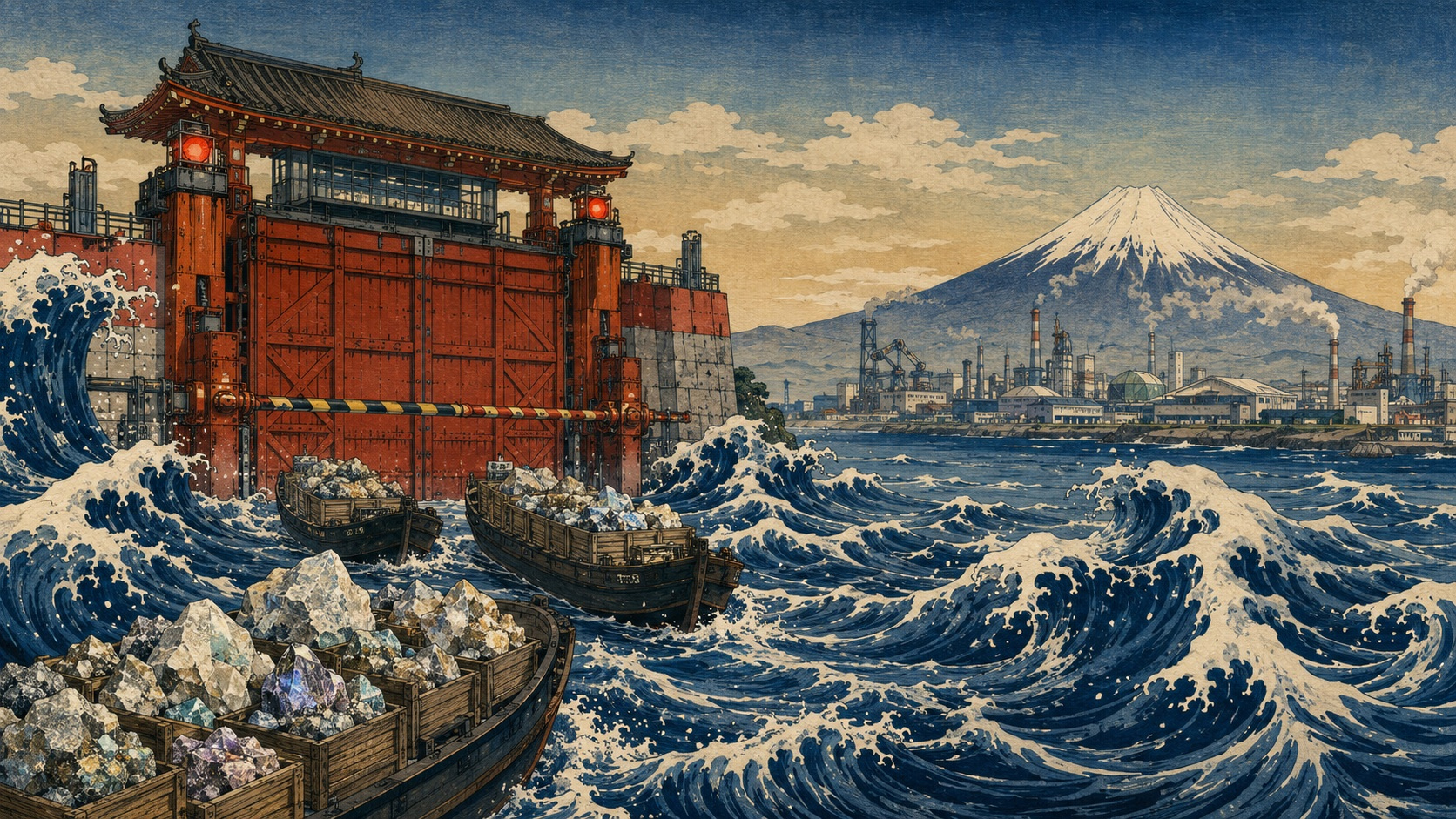
Editor’s note: This report cross-checked Chinese customs data, government announcements, international-agency research and company reporting available through July 21, 2026. “Zero exports” refers to recorded shipments in the stated month; it does not mean China has legally prohibited every gallium or rare-earth export to Japan. Gallium is not a rare-earth element. The currency strip uses the supplied rate, “1 US Dollar = 162.49 Japanese Yen.” The supplied update time of July 21 at 1:27 a.m. UTC converts to July 21 at 10:27 a.m. Japan Standard Time. The lead image is a contemporary editorial illustration, not a historical Hokusai work.