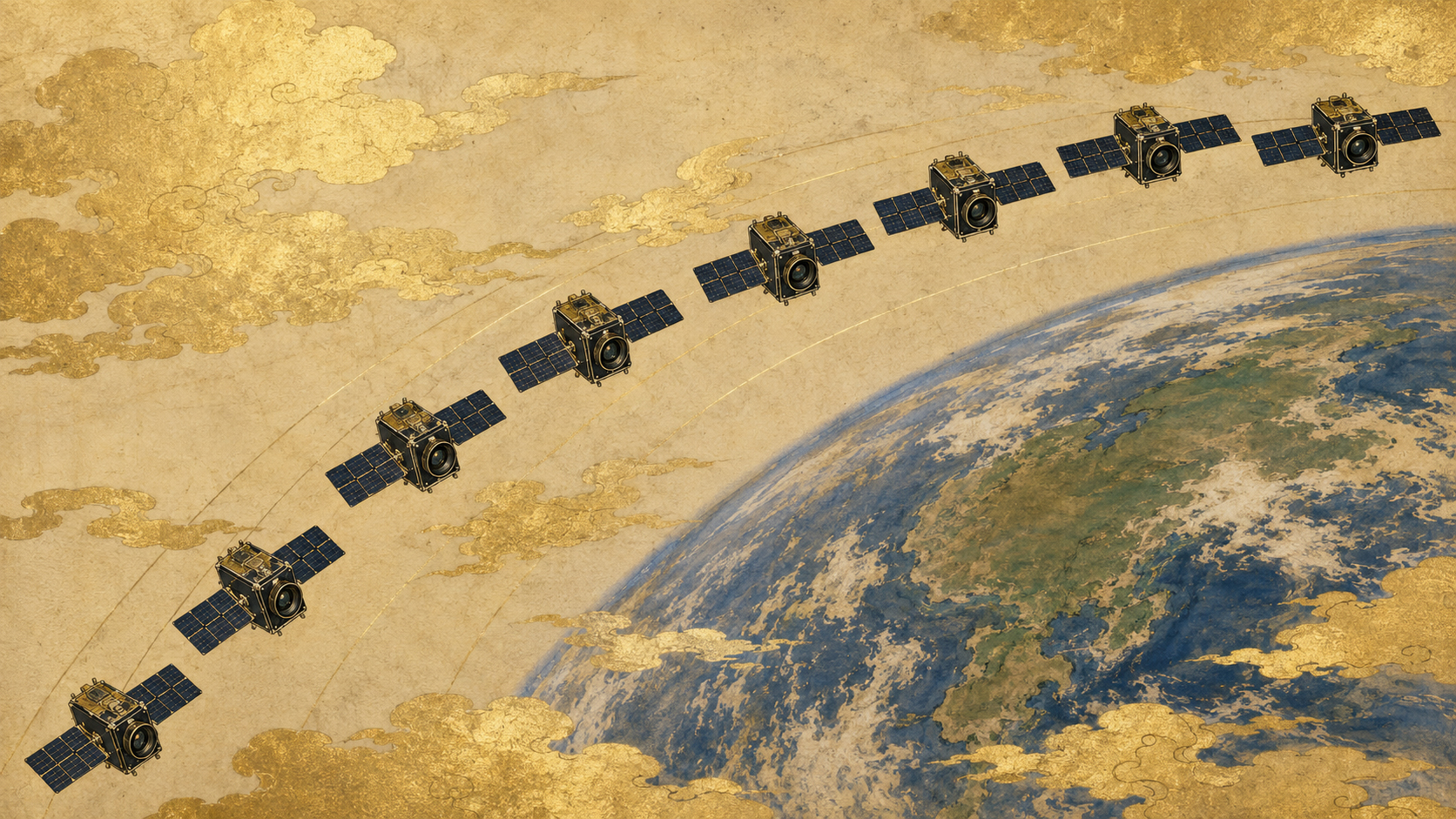
Seven separations, seven voices
A Falcon 9 lifted off from Vandenberg Space Force Base on July 7 carrying SpaceX’s Transporter-17 rideshare. Among the mission’s 81 satellites were seven nearly identical Japanese Earth-observation spacecraft: GRUS-3A through GRUS-3G. Exolaunch handled their mission management, integration and deployment.
By July 8, Axelspace said first signals had been received from all seven. On July 10, the Tokyo company announced that every spacecraft had completed its critical-operation phase, the period immediately after separation when controllers confirm that a satellite is alive, communicating and fundamentally healthy.
That sequence—launch, separation, first contact, health verification—sounds routine only because successful space operations hide their difficulty. Seven spacecraft create seven opportunities for a deployment problem, power anomaly, radio mismatch, attitude tumble or software fault. All seven answered.
What “first signal” actually means
After release from the launch vehicle, a small satellite may be rotating. It must wake its flight computer, establish power, deploy or orient solar arrays, determine its attitude and transmit a recognizable beacon. Ground stations search the expected sky region and frequency, often during brief passes lasting only minutes.
A first signal proves that the spacecraft’s radio, power system and onboard computer are functioning well enough to communicate. Telemetry may reveal battery voltage, temperature, rotation rate and fault flags. Controllers can then send commands and begin stabilizing the spacecraft.
It does not prove that the camera is focused, that imagery meets commercial standards or that the satellite can deliver data day after day. First contact is the newborn’s cry, not a graduation certificate.
The critical-operation phase
Mission teams divide early life into phases because the risks and priorities change rapidly. During the critical phase, survival comes first. Engineers confirm communications, electrical power, thermal conditions, attitude control and essential command paths. They compare telemetry with limits prepared before launch and investigate differences across the seven vehicles.
Once basic health is verified, commissioning begins. Axelspace must test the optical payloads, calibrate detectors, measure pointing error, validate image geometry and radiometry, exercise onboard storage and downlink large data files. Orbital positions must be adjusted or allowed to spread into the intended pattern.
| Phase | Main question | Evidence required |
|---|---|---|
| Launch and deployment | Did each satellite separate safely? | Launch-vehicle data, tracking and deployment confirmation. |
| First acquisition | Is it alive and talking? | Beacon and basic telemetry. |
| Critical operations | Can it survive and be controlled? | Power, thermal, attitude and command health. |
| Commissioning | Does the full system meet specification? | Calibrated images, pointing, downlink and repeatability. |
| Commercial operations | Can customers receive dependable products? | Tasking, delivery time, quality and service availability. |
Why seven change the product
An Earth-observation satellite sees only a narrow strip while moving around the planet at several kilometres per second. It may pass a target when clouds obscure it or when the customer does not yet know an event has happened. A constellation creates more opportunities.
Axelspace says the seven GRUS-3 spacecraft are intended to support once-daily imaging of the same location in areas north of 25 degrees latitude. Daily revisit does not mean continuous video, nor does it guarantee a cloud-free image. It means the orbital geometry can provide an observation opportunity roughly every day within the stated region.
That difference changes decisions. Crop stress can be followed before harvest. A construction project can be measured repeatedly. Flooding, wildfire damage, illegal logging, port congestion or military activity can be revisited while events are still unfolding. Value often comes not from the sharpest single picture but from consistent comparison.
Optical imaging and the tyranny of clouds
GRUS is an optical system: it records reflected sunlight, producing imagery that is intuitive to human eyes and useful for mapping, agriculture and change detection. Optical satellites generally need daylight and a clear view. Clouds are opaque at visible wavelengths.
This is why revisit frequency matters. More observation opportunities increase the chance of capturing a usable scene. It also explains why optical data and synthetic-aperture radar are complementary rather than interchangeable. Radar can observe through cloud and at night; optical systems offer natural spectral information and visually legible detail.
Customers rarely buy a beautiful photograph alone. They buy an answer derived from calibrated data: where vegetation changed, how many buildings appeared, whether a road reopened, how rapidly a shoreline moved. The analytics layer can be worth more than the pixels.
Nikon optics inside a Japanese constellation
Axelspace announced in May that the seven satellites use Nikon telescopes. This is an industrial story as much as a space story. Japan’s heritage in cameras, lenses, precision machining and metrology can be redirected toward small spacecraft.
A space telescope must remain aligned through launch vibration, vacuum and repeated heating and cooling. There is no technician in orbit to clean a surface or turn a focus ring. Image quality depends on optics, detector, structural stability, attitude control and ground processing working as one instrument.
The partnership also illustrates a broader shift. Small-satellite manufacturers do not need to vertically integrate every component. A constellation can combine specialist suppliers with a standardized bus, shortening development cycles while retaining industrial quality.
From university microsatellites to AxelGlobe
Axelspace was founded in 2008 by engineers shaped by Japan’s university microsatellite movement, particularly work associated with the University of Tokyo and the University of Tokyo–led Hodoyoshi approach. The philosophy was that smaller, lower-cost spacecraft could shorten development and open missions to customers excluded by traditional large satellites.
The company’s early work included WNISAT-class spacecraft and custom microsatellite missions. In 2018, its first GRUS Earth-observation satellite was launched. AxelGlobe became the commercial layer: satellites, ground operations and imagery offered as a continuing service rather than a one-off engineering project.
GRUS-3 represents a step from proving individual spacecraft to manufacturing and operating a fleet. Constellations reward standardization. The seventh unit should not require seven times the engineering invention, yet it must be tested with the same discipline as the first.
Rideshare changed who can build a constellation
Historically, a small satellite either waited for spare capacity on a government mission or paid for a dedicated rocket. SpaceX’s Transporter program offers regularly scheduled rideshare missions to sun-synchronous orbit, allowing many customers to divide launch cost.
Transporter-17 carried spacecraft from commercial, institutional and government operators. Exolaunch reported 19 microsatellites and 30 CubeSats among the 49 customer spacecraft it deployed, and 81 satellites on the mission overall. It procured capacity, handled logistics and customs, integrated hardware and used separation systems designed to release satellites with low unwanted rotation.
Rideshare reduces price and schedule barriers but limits choice. Customers accept a common orbit and launch date, then use propulsion or natural drift to reach their operating geometry. The satellite and constellation must be designed around those constraints.
The invisible ground constellation
Satellites are only half the system. A low-Earth-orbit spacecraft is visible to any one ground antenna for short periods. Seven satellites create more contacts, more commands and far more image data. Ground capacity can become a bottleneck even when the spacecraft work perfectly.
Axelspace expanded its partnership with Norway’s KSAT before launch. KSATlite provides automated ground-station services for small satellites and constellations. A distributed network allows earlier contact after an observation and reduces dependence on one antenna or geography.
The operating chain is long: a customer requests an image; software checks orbit, sunlight, cloud forecast and competing tasks; the plan is uploaded; the satellite points and exposes; data are stored, downlinked, processed, calibrated and delivered. “Daily observation” is a promise made by that entire chain.
Seven satellites, one fleet—or seven separate problems?
Fleet operations require automation. Controllers cannot manually plan every command for every pass as the constellation grows. Software must schedule tasks, detect anomalies, prioritize downlinks and prevent conflicting commands. At the same time, excessive automation can reproduce one software error across every spacecraft.
Common design creates economies and common-mode risk. If all seven share a vulnerable component, firmware defect or calibration error, scale multiplies the problem. Operators therefore compare telemetry across the fleet, stage software updates and preserve safe modes that can recover from bad commands.
The launch success was collective; future reliability will be statistical. Customers will care about the constellation’s available capacity even when one satellite is unavailable. Redundancy is one of the product’s advantages.
Competition in a crowded Earth-observation market
Axelspace operates among global fleets from Planet, Maxar, BlackSky, Satellogic, ICEYE, Synspective, QPS Institute and national agencies. Competitors differ in resolution, spectrum, revisit, latency, tasking responsiveness and price. No single number captures usefulness.
Axelspace’s opportunity is to combine Japanese manufacturing credibility, a growing optical constellation, regional partnerships and accessible data services. Its partnerships in Saudi Arabia, Africa and with national mapping users show that the market is global. Its challenge is turning capital-intensive spacecraft into recurring revenue before newer systems make them obsolete.
Sustainability belongs in the design
Launching seven spacecraft also creates seven future disposal responsibilities. Low Earth orbit is a shared environment. Satellites must avoid collisions during operation and leave protected regions at end of life rather than become long-lived debris.
Axelspace has worked on D-SAIL, a deployable membrane intended to increase atmospheric drag and shorten deorbit time. NASA’s small-spacecraft technology reporting has recognized this work. Sustainability is not separate from constellation economics: collision avoidance, licensing, insurance and end-of-life compliance affect whether customers and governments trust an operator.
What to watch before declaring victory
The next meaningful milestones are not more beacons. Watch for first-light images, radiometric and geometric calibration, successful high-volume downlinks, formation establishment and a declared start of commercial GRUS-3 service. Then watch delivery speed and consistency across seasons and cloud conditions.
Axelspace has completed the dangerous opening minutes and days. Seven spacecraft left California together and all seven called home. The harder achievement will unfold quietly over years: making those seven voices answer customer questions every day.
Sources and further reading
- Axelspace, July 10, 2026 — completion of critical operations.
- Axelspace News — launch, first signals, Nikon optics and program history.
- Exolaunch: Transporter-17 — mission manifest, deployment and integration.
- KSAT–Axelspace partnership — automated ground segment.
- NASA Small Spacecraft Technology — spacecraft buses and mission operations context.