This article is based on the operator’s announcement and official restaurant, Hyogo Prefecture, bridge-authority, dairy and regional-history sources available through July 31, 2026. The grand opening is scheduled for 11:00 a.m. on August 3, and several menu prices were described as planned prices at the time of announcement. Japan.co.jp has not independently reviewed the food before opening. The record dated 738 indicates that dairy products were procured from Awaji Island for the imperial court; it does not establish an unbroken line from ancient products to modern Italian-style cheese.
Cut the burrata, and the island’s time begins to flow
A knife enters a white pouch of burrata. Its thin skin opens, and cream and strands of curd spill into red tomato sauce. Beyond the window, the Seto Inland Sea fills the horizon; by evening, blue light turns gold. The technique came from Italy, but the story begins with an Awaji morning: milk delivered by local dairy farmers, transformed into fresh cheese while its flavor is still close to the farm, then joined with island pasta, beef, fruit, honey and sea air.
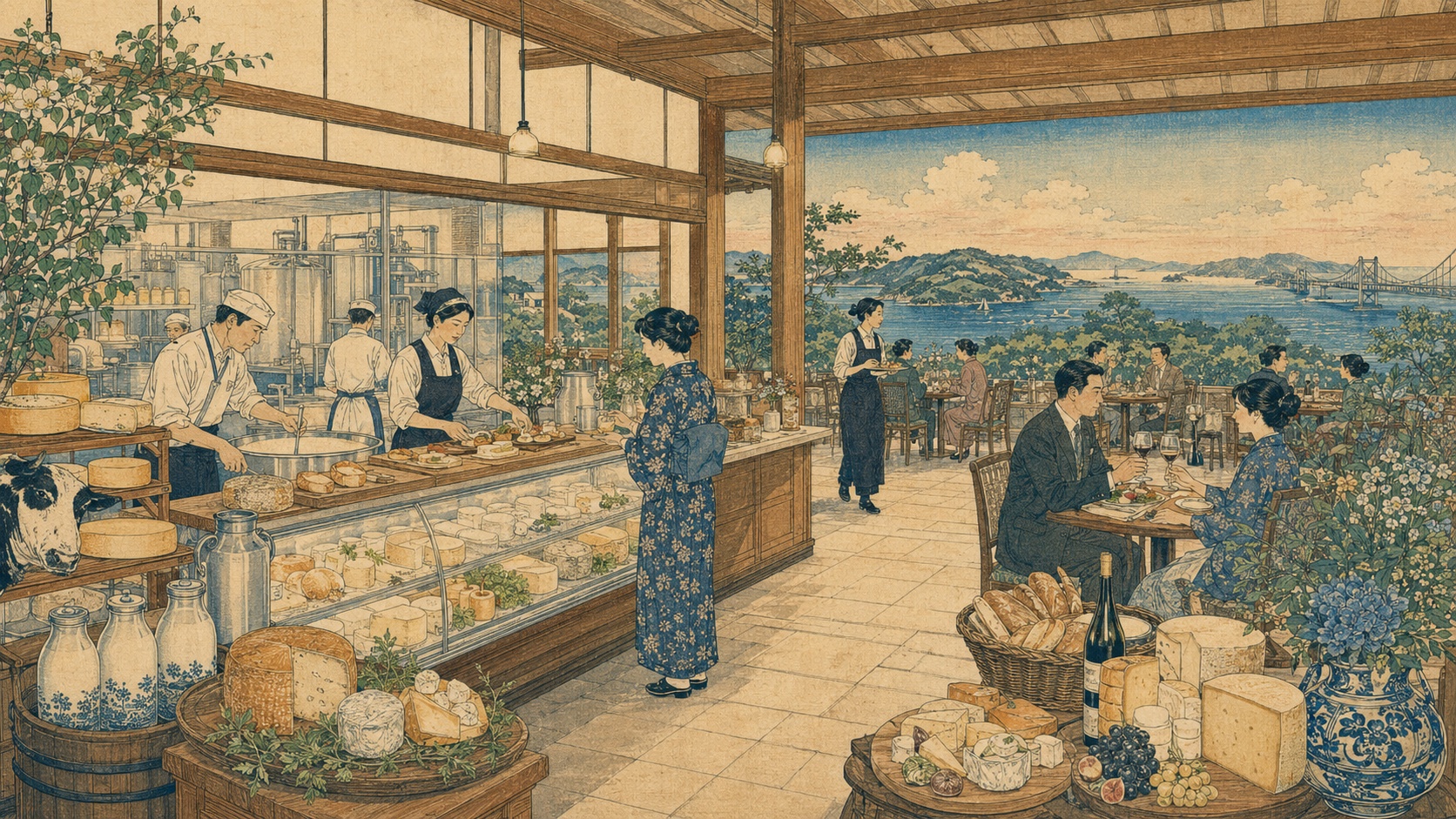
On August 3, 2026, Awaji Island Cheese Factory is scheduled to move its main operation from Ikuha in Awaji City into Aqua Ignis Awaji Island, a hot-spring resort on the island’s northern coast. The new format is neither simply a factory shop nor simply a café. It layers cheese making, retail, restaurant dining and destination tourism in one place. Every seat is designed to face the sea, and dinner service will begin for the first time. Daylight, sunset and the sound of the waves after dark become part of the meal.
Regional-development announcements often rely on familiar language: local production, spectacular views and revitalization. The underlying challenge here is more concrete. Milk does not wait. It must be collected, chilled, transported and sold every day. The new restaurant tries to move that time-sensitive commodity through three transformations: milk into cheese, cheese into a meal, and a meal into a memory valuable enough to bring visitors back to the island.
What is actually opening on August 3
The restaurant will occupy the former Pescheria Kazenami space, whose Italian operation ended on July 20. The factory’s regular service at its previous Ikuha shop ended July 12, the new site held a pre-opening on July 24, and full service is scheduled to begin at 11:00 a.m. on August 3. The former shop focused on lunch and café hours. The new restaurant extends into dinner, responding to customers who wanted to eat fresh cheese and Awaji ingredients after sunset.
The operator emphasizes three features: ocean views from every seat, an expansive terrace where dogs may accompany guests, and a pet menu built around additive-free island food, unsalted mozzarella, seasonal vegetables and a whey drink. That may sound like a hospitality detail, but it broadens the market from a quick lunch stop to multigenerational and pet-inclusive travel. It also signals that the restaurant wants to be used for time—an evening, a celebration, a slow meal—not merely as a retail counter.
Most important, this is not being presented as a conventional cheese restaurant that buys finished products from elsewhere. The business says it receives fresh milk from local farmers each morning and makes preservative-free fresh cheeses by hand. Mozzarella, ricotta and burrata are unusually sensitive to freshness and distance. Their short life, normally a distribution disadvantage, becomes a reason to travel to the place where they are made.
The menu is a map of an island supply chain
The announced signature dish is an Awaji beef cheeseburger made with a 100-percent Awaji beef patty and covered with enough house-made cheese to spill across the plate; its planned price is ¥2,800. A tomato-sauce fresh-pasta dish, planned at ¥2,400, combines the factory’s burrata with noodles from Awaji Mengyo. The restaurant also plans Basque cheesecake made with house ricotta, multiple flavors of that cake, a honey-cheese baumkuchen limited to ten servings a day, and whey-based drinks.
At first glance, this is a collection of indulgent, camera-ready cheese dishes. Follow the ingredients, however, and the menu becomes a map. Milk comes from island dairy farms; the meat is Awaji beef; the pasta comes from an island noodle company; fruit and vegetables can move through seasonal local networks. One plate can link several producers and keep a larger share of visitor spending circulating locally. That matters more than simply placing the words “locally sourced” beside a dish.
Whey offers an especially revealing example. Cheese making separates curd from liquid whey. Treat that liquid only as waste and the producer inherits disposal costs and environmental burdens. Turn it into honey-lemon drinks, smoothies or a marinade for Awaji chicken, and a byproduct becomes another product. The sums may appear small, but using the whole flow of milk can help determine whether local processing is merely picturesque or economically durable.
Cheese gives milk a place
Milk is among agriculture’s most unforgiving products. Cows must be milked every day. Raw milk has to enter a cold chain quickly and meet strict standards before it reaches consumers. Farmers pay for feed, power, veterinary care, equipment and labor, while the finished carton often hides the identity of the farm behind a standardized commodity.
Cheese can alter that structure. Removing water, concentrating flavor and applying craft can give the same milk a different price, use and story. Fresh cheese does not solve the storage problem in the way a long-aged cheese does. Its value is precisely its immediacy. That apparent weakness becomes an advantage when cheese is made near the farms and eaten near the factory.
The factory has framed its mission around increasing milk consumption, supporting dairy farmers and energizing the region. Moving into a restaurant expands that mission from the refrigerated shelf to the dining room. Guests do not buy only cheese. They buy an ocean view, dinner, family time and proof that they were on Awaji Island. If a meaningful share of that added value returns to milk and farmers, the restaurant becomes not only a tourism attraction but a sales system for dairy agriculture.
The dairy record of 738 and Awaji as a miketsukuni
The oldest frame for Awaji food culture is the word miketsukuni: a region that supplied food to the sovereign and the imperial court. Awaji is remembered alongside places such as Wakasa and Shima as a provisioning region. Strong currents in the Akashi and Naruto straits, a mild climate, and the unusual proximity of sea, fields and livestock made it possible for seafood, salt, vegetables, fruit and animal products to coexist on one compact island.
The Awaji Island Kuniumi Association cites a tax record dated 738 in which the imperial court procured dairy products from Awaji, products thought to have resembled butter or cheese. They were not modern mozzarella or burrata, and the evidence does not show that one technique survived continuously for thirteen centuries. Yet the record gives the new restaurant a remarkable historical depth: Awaji milk was connected to a distant elite table long before refrigerators, highways or resort dining.
Ancient Awaji loaded food onto boats and sent it toward the capital. Modern Awaji is asking consumers to cross the bridge and eat on the island. The direction of value has reversed. Instead of the ingredient leaving while most of its story remains behind, the customer travels to the place of production and pays for the story as part of the experience. The cheese factory is rebuilding the miketsukuni idea as destination dining rather than tribute shipment.
More than 120 years of modern dairy, and the rise of island cheese
There is a large historical break between the ancient record and modern dairying. Awaji Island Milk describes the island’s present dairy lineage as more than 120 years old. After the war, cattle improvement accelerated. A high-pedigree bull was imported from the United States in 1953, and another major Canadian breeding import followed in 1969. The Awaji Island Milk brand launched in 1978 and became a familiar regional product made with milk from island dairy farmers.
In recent years, that milk culture has expanded from drinking milk into jicheese—cheese identified with a place. Awaji Island Milk now produces mozzarella, caciocavallo and string cheese, and its caciocavallo won a category gold award at the 2024 Japan Cheese Awards. That producer is separate from Awaji Island Cheese Factory, but its success matters to the wider story. It shows that the island is developing an ecosystem in which cheese is made, judged, sampled, taught and discussed rather than treated as a novelty.
Hyogo Prefecture is also running an Awaji milk campaign from July 1 through August 31, 2026, encouraging photographs of milk products and milk-based dishes at island restaurants and lodging facilities. The factory’s opening falls directly in the middle of that campaign. The coincidence is revealing: the region is trying to move milk beyond the household refrigerator and connect it to menus, hospitality, travel and digital storytelling.
Southern Italy’s preservation logic meets an Awaji morning
Burrata, the symbolic cheese of the new restaurant, comes from the food culture of Apulia in southern Italy. Its outer shell is stretched cheese curd; inside is stracciatella, strands of curd mixed with cream. The decisive visual moment is not the finished ball but the cut, when its center flows onto the plate.
The history associated with Burrata di Andria says that in the early twentieth century, a dairy farmer unable to take milk into town during heavy snow used leftover stretched curd and cream instead of wasting them, enclosing the mixture in another sheet of cheese. One of the first written mentions dates to 1931. Some elements remain oral tradition, but the economic idea is clear: perishable milk and remnants of production were transformed into a premium fresh product.
The Awaji factory’s burrata is not the EU-protected Burrata di Andria PGI. It is a Japanese regional adaptation made from Awaji milk. The shared logic is nevertheless powerful: work while the milk is fresh, use curd, cream and whey intelligently, and turn the disadvantages of distance and short shelf life into a reason to eat the cheese where it is made.
In 1998, a bridge reversed the flow of food
The Akashi Kaikyo Bridge opened on April 5, 1998. At 3,911 meters, it joined Kobe to Awaji and completed the island’s direct expressway connection between the Kansai economy and Shikoku. It shortened freight time, but it also altered the imagination of the island. Awaji food no longer had to be understood only as something shipped to urban markets. Urban consumers could drive to the source.
The new restaurant is about five minutes from Awaji Interchange and close to an express-bus stop. The milk truck and the lunch traveler move through the same transport revolution. The island’s northern gateway has become a corridor of parks, architecture, flowers, hot springs, character attractions and restaurants.
Convenience creates a paradox: people can arrive quickly and leave quickly. That is why dinner matters. Keeping a visitor through sunset can lead to a bath, shopping, lodging, another meal and travel the next morning. The cheese factory is trying to stretch the day-trip market created by the bridge into an evening and overnight economy.
From the 2022 Park-PFI experiment to a local factory
Aqua Ignis Awaji Island opened on July 13, 2022, with a “food and health” theme. It was described as Japan’s first approved Park-PFI project in a national government park, combining public land and private operation. Hot springs, an infinity bathing pool, restaurants, bakery service and cycling were assembled into a resort intended to become a northern gateway to the island.
The replacement of an Italian restaurant by a local cheese maker is more than a tenant change. It moves the resort’s identity one step closer to a visible production system: morning milk, island farmers and an on-site factory. A resort can consume scenery while remaining economically detached from its surroundings. A restaurant that consistently buys local milk, pasta, meat, fruit and other inputs can instead become part of the island’s economic circuitry.
The meaningful measures will therefore extend beyond customer counts. How much milk is purchased locally? How stable are contracts with farmers? How many jobs are created? How much spending reaches island suppliers? Does whey use reduce waste? Those questions will determine whether the ocean view is simply a backdrop or the front window of a functioning regional food economy.
What a “food destination” must protect
Views and novelty will not be enough. The operation must receive morning milk reliably, maintain consistent quality, survive the gap between summer peaks and winter demand, and price its food sustainably. A ¥2,800 burger and ¥2,400 pasta communicate the cost of local ingredients, hand production and resort real estate, but they may also create distance from everyday island customers. The restaurant will have to balance tourism pricing with the familiarity expected of a local establishment.
Awaji must also avoid becoming only a food theme park. Behind every attractive plate are feed prices, heat stress, labor shortages, capital costs and the unrelenting routine of milking. The point of the restaurant should not be to hide that reality. It should help guests understand why local milk has value and return enough income to make continued production possible.
Even with those tests ahead, the new factory contains a persuasive model for regional food business. Do not send a low-value raw material farther away than necessary. Bring people to the source. Add value through processing, meaning through cooking and memory through landscape. Milk becomes cheese; cheese becomes a reason to travel.
Visitor guide
| Item | Information announced before opening |
|---|---|
| Restaurant | Awaji Island Cheese Factory, Aqua Ignis Awaji Island location |
| Opening | Scheduled for Monday, August 3, 2026, from 11:00 a.m. |
| Address | 2-28 Yumebutai, Awaji City, Hyogo, inside Aqua Ignis Awaji Island |
| Access | About five minutes by car from Awaji Interchange; near the Seirei Awaji Hospital-mae express-bus stop. |
| Format | Cheese-specialty restaurant, café and factory shop; dinner service added. |
| Seating | Ocean views from every seat; dogs permitted on the terrace. |
| Planned signatures | ¥2,800 Awaji beef cheeseburger, ¥2,400 burrata tomato fresh pasta, ricotta Basque cheesecake, whey drinks and other fresh-cheese dishes. |
| Before visiting | Prices, hours and daily quantities may change. Check the official website for current information. |
When morning milk becomes an evening landscape
The best description of the new Awaji Island Cheese Factory may not be restaurant or factory. It may be conversion system. Morning milking becomes cheese. Cheese becomes cooking. Cooking becomes an island story. The story is then asked to return as revenue that can help sustain farming.
In 738, dairy products from Awaji are said to have traveled toward the imperial court. In 1998, a bridge changed the movement of people and goods. In 2022, a food-and-wellness resort opened beside the sea. On August 3, 2026, a knife will cut into a burrata there. What flows out is not only cream. It is the accumulated time of an ancient provisioning island, modern dairy farming, the bridge era and the search for a tourism economy rooted in production.
Sources and verification
Japan.co.jp reviewed primary announcements and official regional, dairy and infrastructure sources available through July 31, 2026. This is a food-culture and regional-economy analysis based on the opening plan, not an independent restaurant review. The displayed exchange rate is ¥157.57 per U.S. dollar. The supplied update time of July 31 at 9:00 p.m. UTC converts to August 1 at 6:00 a.m. Japan Standard Time.
- Aqua Ignis: August 3 relocation and grand-opening announcement
- Awaji Island Cheese Factory: official website
- Awaji Island Cheese Factory: menu, cheese and whey information
- Aqua Ignis Awaji Island: official concept and access information
- Aqua Ignis Awaji Island: 2022 opening and National Government Park Park-PFI project
- Awaji Island Kuniumi Association: the 738 dairy record and island food history
- Awaji Island Milk: more than 120 years of modern dairy history
- Awaji Island Milk: brand and product history
- Hyogo Prefecture: 2026 Awaji milk campaign
- Honshu-Shikoku Bridge Expressway: Akashi Kaikyo Bridge opening date and dimensions
- Awaji Island Tourism Association: miketsukuni history and island ingredients
- Qualigeo: Burrata di Andria PGI method and history
